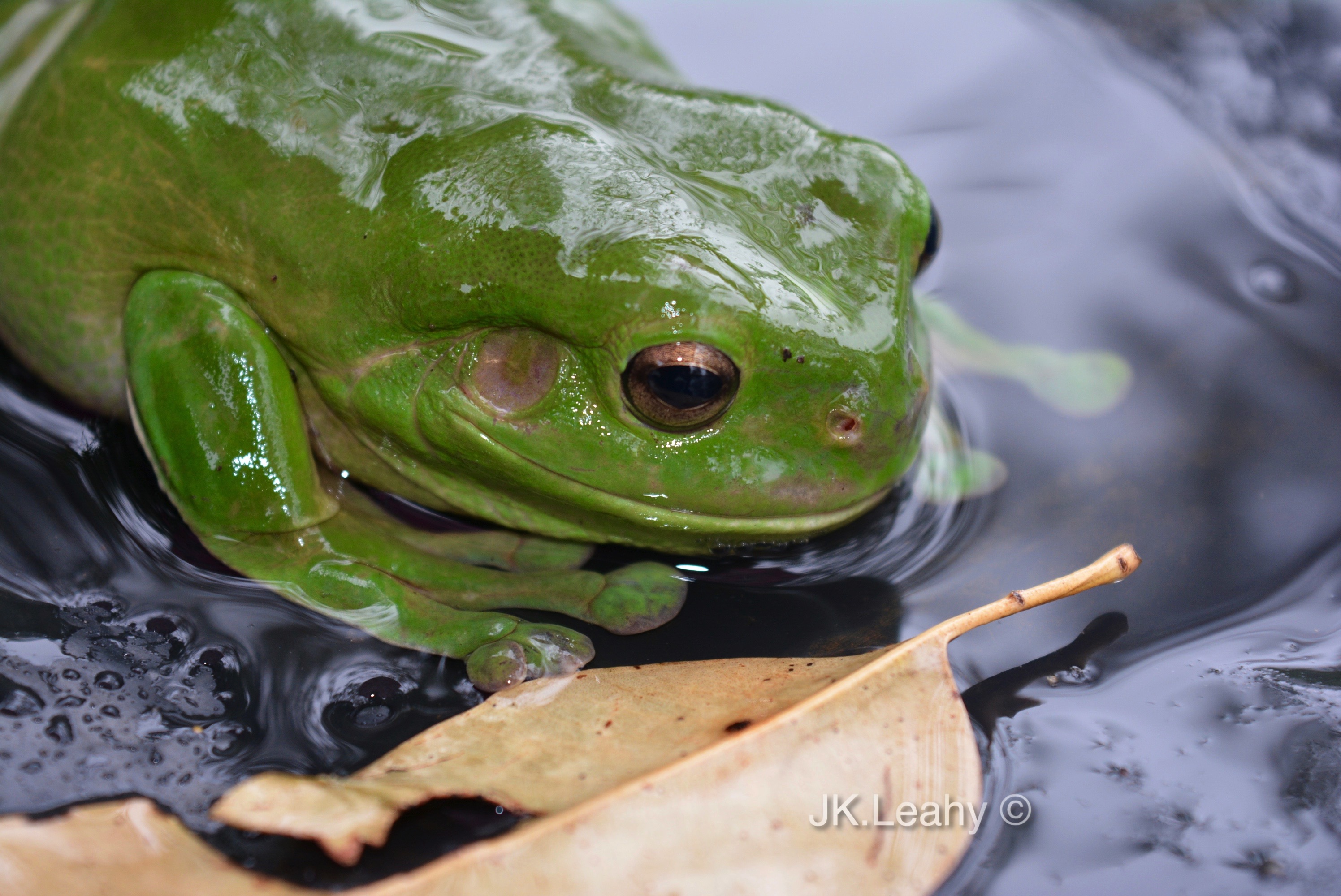
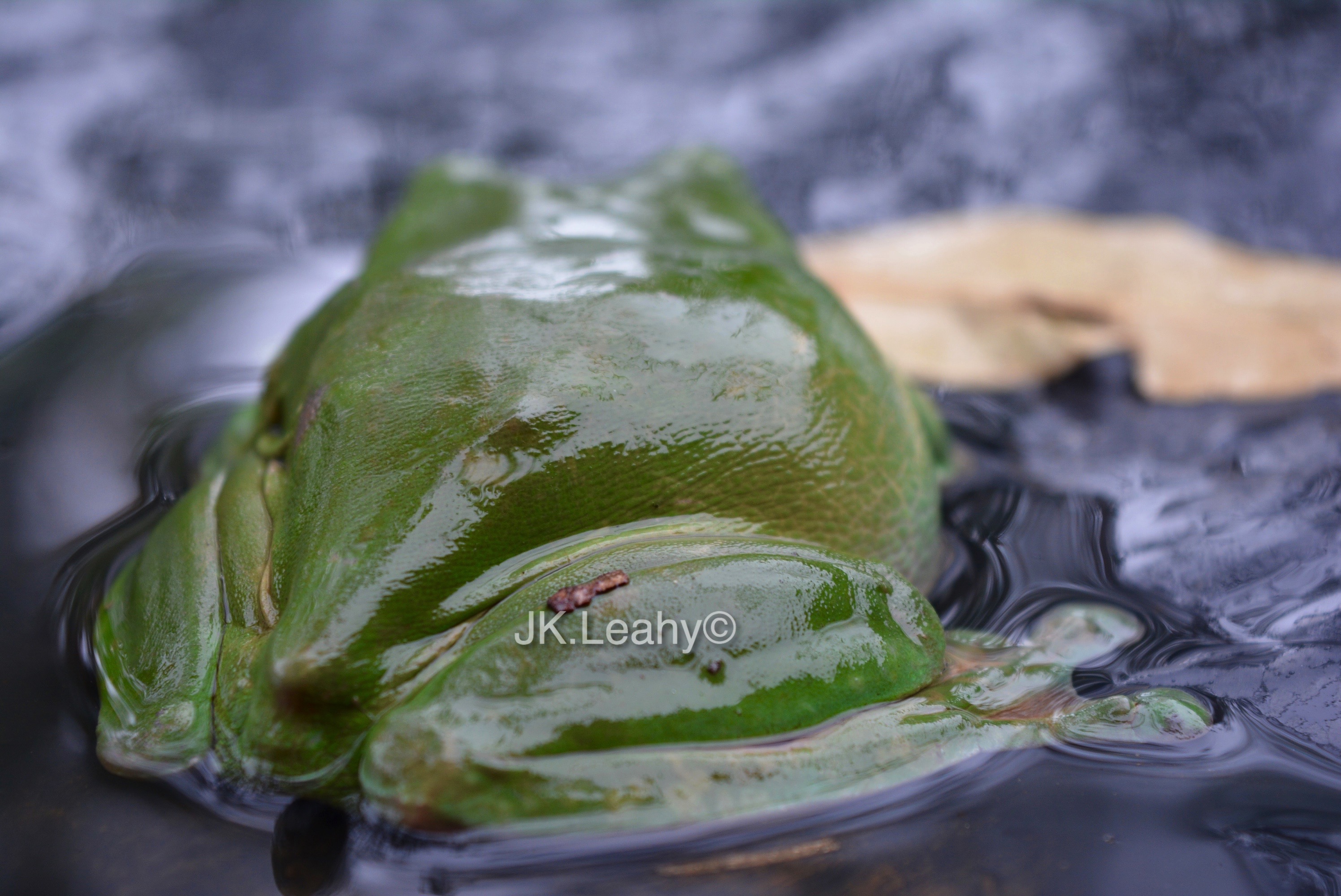
It rained yesterday. Guess what was on the chicken house? Not a spider this time. The rain catcher, the first Green Tree Frog (I have seen) for 2016. Sitting strategically where all the rainwater ran to it, it had its eyes shut until I approached with the camera.
This frog, the Litoria caerulea or the Green Tree Frog lives in Queensland. It is also found in northern and eastern Australia. It is generally a large frog, and grows to 110mm. The frog is green to light brown or even blue, short snout and rounded face. It has a smooth, thick skin on head and shoulders. Some have white spots or irregular stripe from mouth to forearm. Its abdomen is white and the back of its thighs is sometimes maroon or yellow. More information can be found on Save Our Waterways.
Although they are called the tree frog, they love to live in building drain pipes and water tanks. In summertime of course, they love wide open spaces with waterways…I guess that’s why this frog found this spot and stayed. I wish I could have told the frog this was not a waterway, but as soon as the rain stopped, it disappeared.
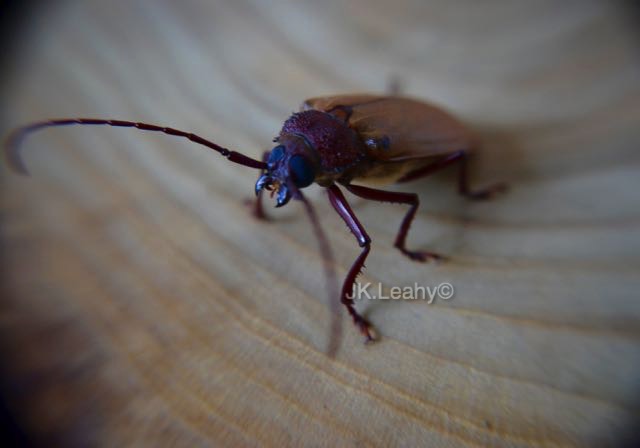
Our night visitor never left. The long-horned beetle entered our house on Sunday night and was flying around crashing into everything and everyone. My son took it outside, but yesterday I found it alive and under a floor mat.
The brown/reddish native beetle from the Cerambycidae family (according to Queensland Museum) was supposed to live in open forests and woodlands throughout Australia. It has been accidentally introduced to many overseas countries where it is a serious pest in eucalypt plantations. The white, legless larvae of this beetle bore under the bark of recently dead or sick eucalypts lives for several months.
The beetle is 15–30 mm long. This one in our house was at least 45 mm long. This species has a dark-brown, elongated body with a pale band and spots at tips of wing-covers. The reddish antennae is much longer than the body. When I photographed the beetle yesterday, it was very aggressive. I returned it to the woods.
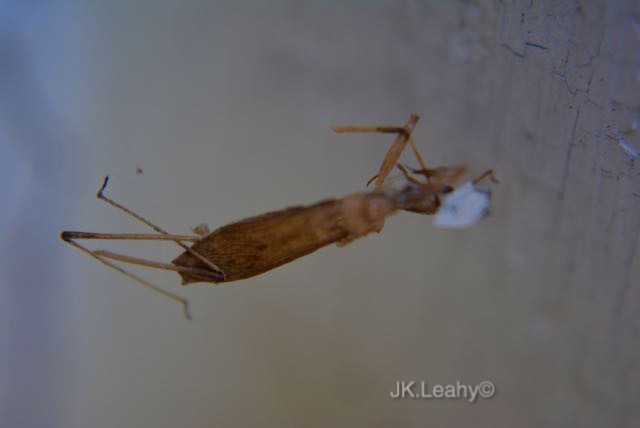
I enjoy this time of the year in Queensland because the bush is full of interesting creatures, both live dead and ones. The garden transforms into a photography playground for me. Not everyone likes insects, I know. Here are some interesting shapes, colours and types of things I found through the lens. My son Chris took the grasshopper shot.
A fly caught in a spider web. See a similar fly, alive, on the golden orchid picture below.
I love these mustard mushrooms – they are creeping out of the dead gum leaves.
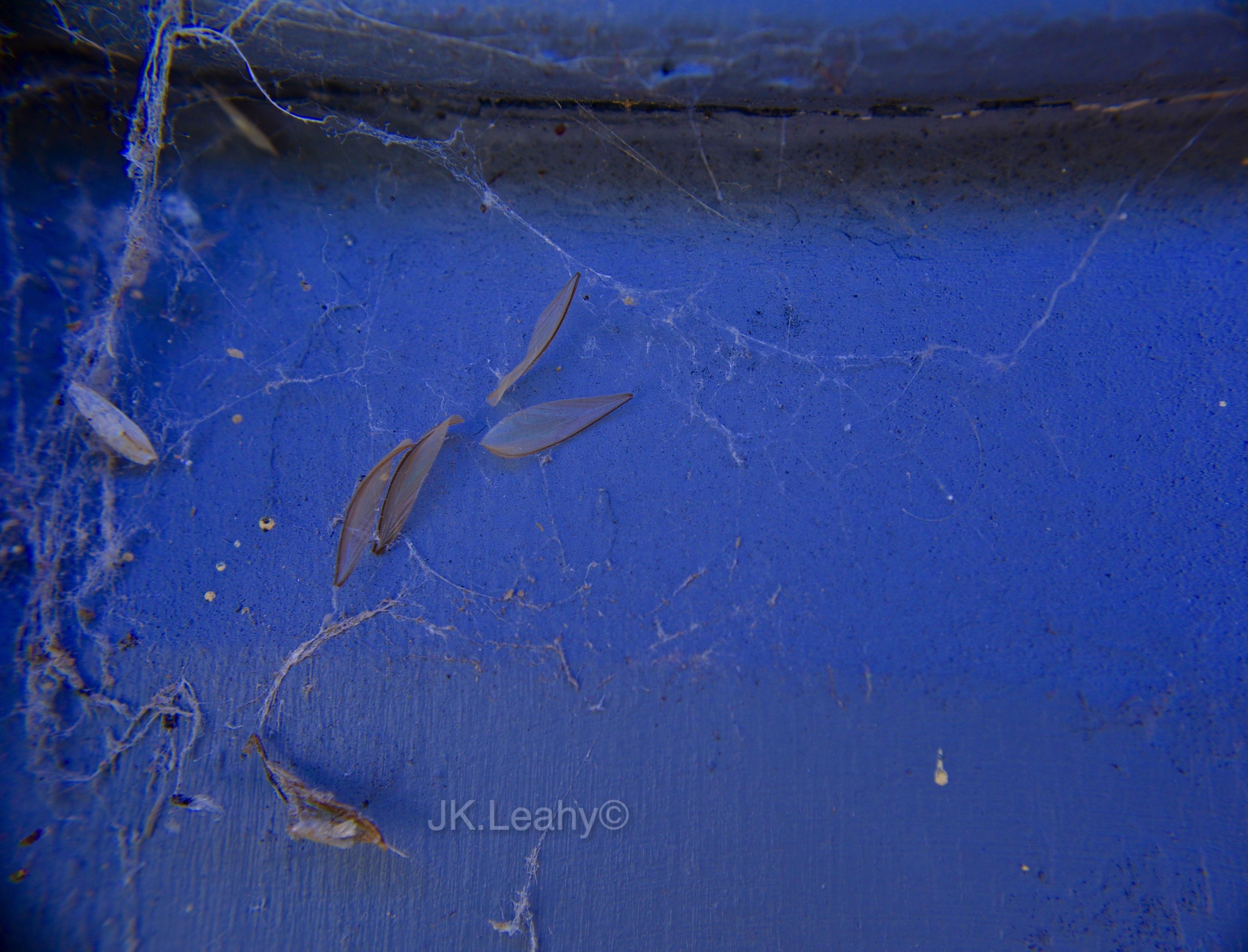
Fly wings on my gallery wall.
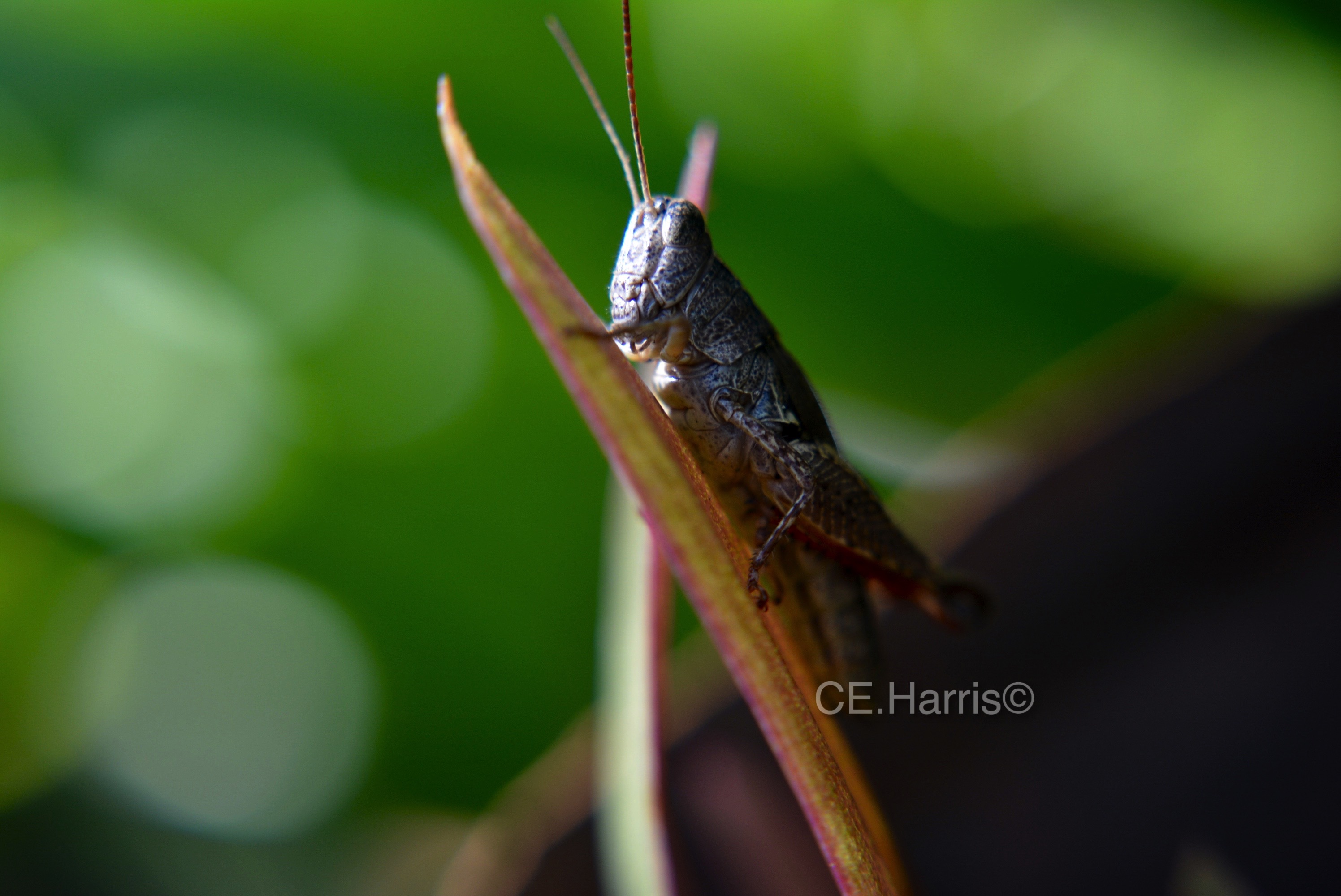
A small grasshopper photo by Chris Harris.
A large huntsman skeleton swinging off a bromeliad leaf.
Queensland orchid – notice the small insect on top left.
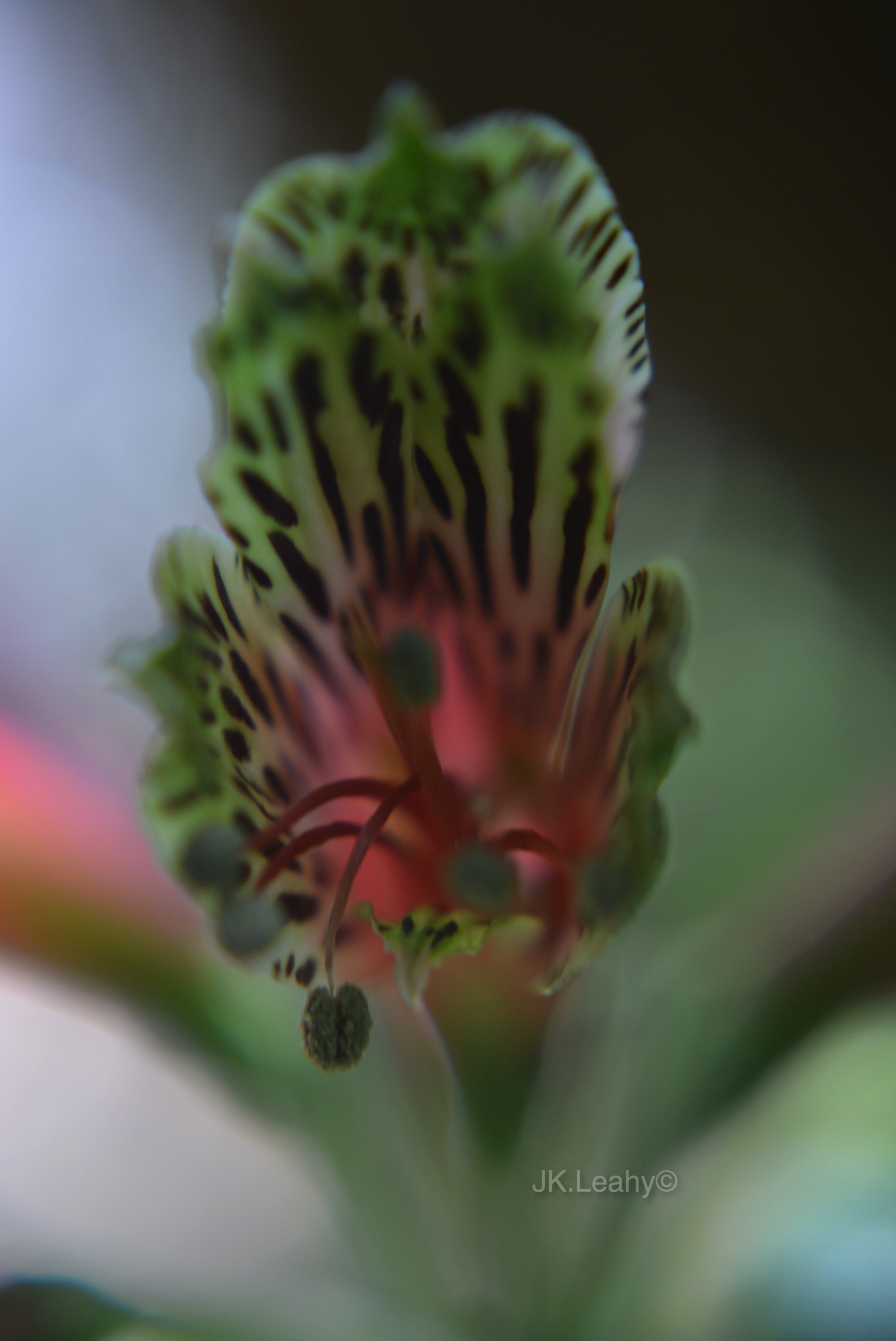
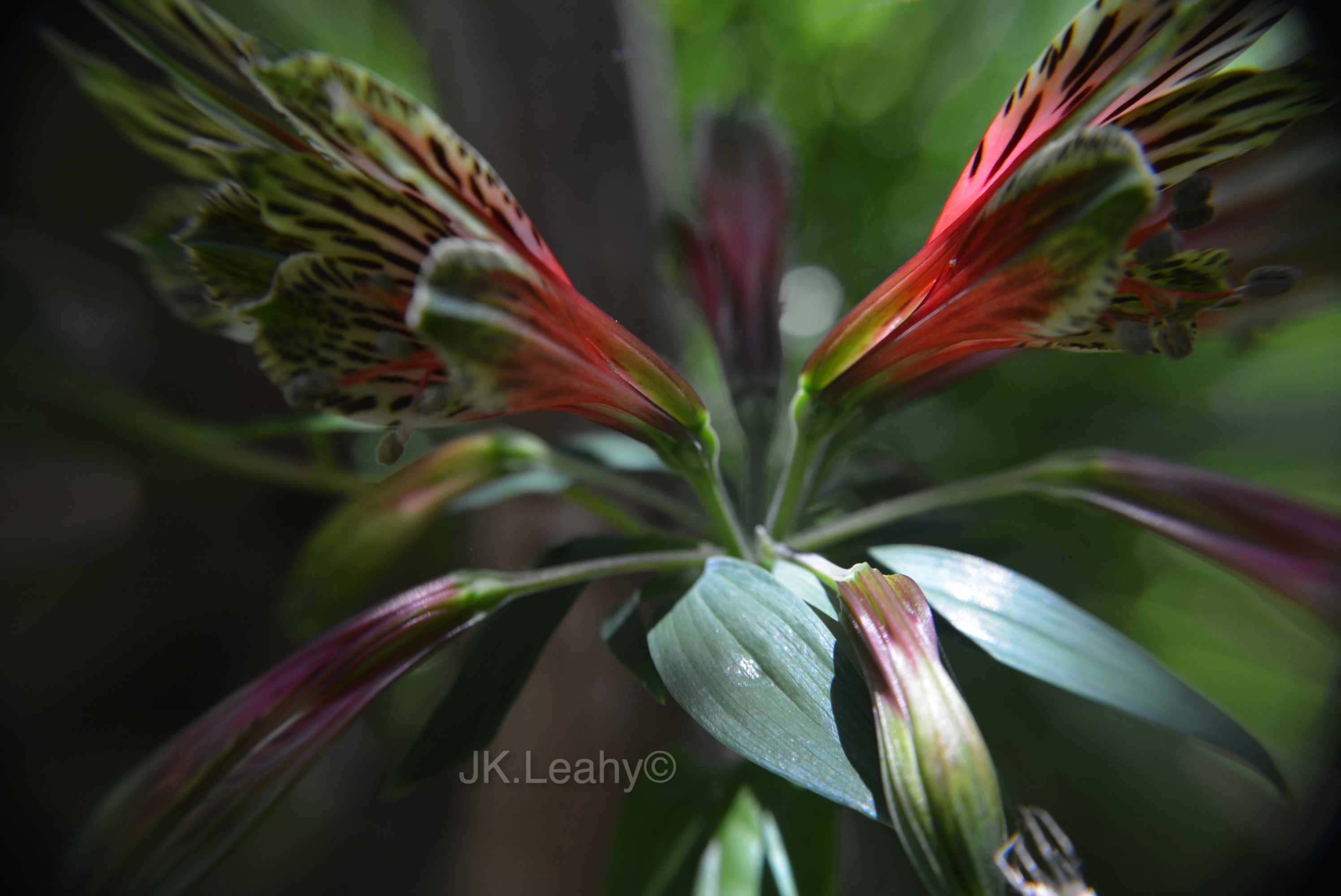
This mysterious and gorgeous flower appeared in one of my pots. I did not plant it, and do not claim any ownership for its cultivation. I guess I own it now, since it is in a pot that I have paid for. And, this pot sits in my garden. Perhaps the birds brought me the seed.
I was surprised to see its glorious bloom a few days ago. I am taking a guess that it is a Peruvian lily, but I could be wrong. I am happy for anyone that knows this flower to identify it.
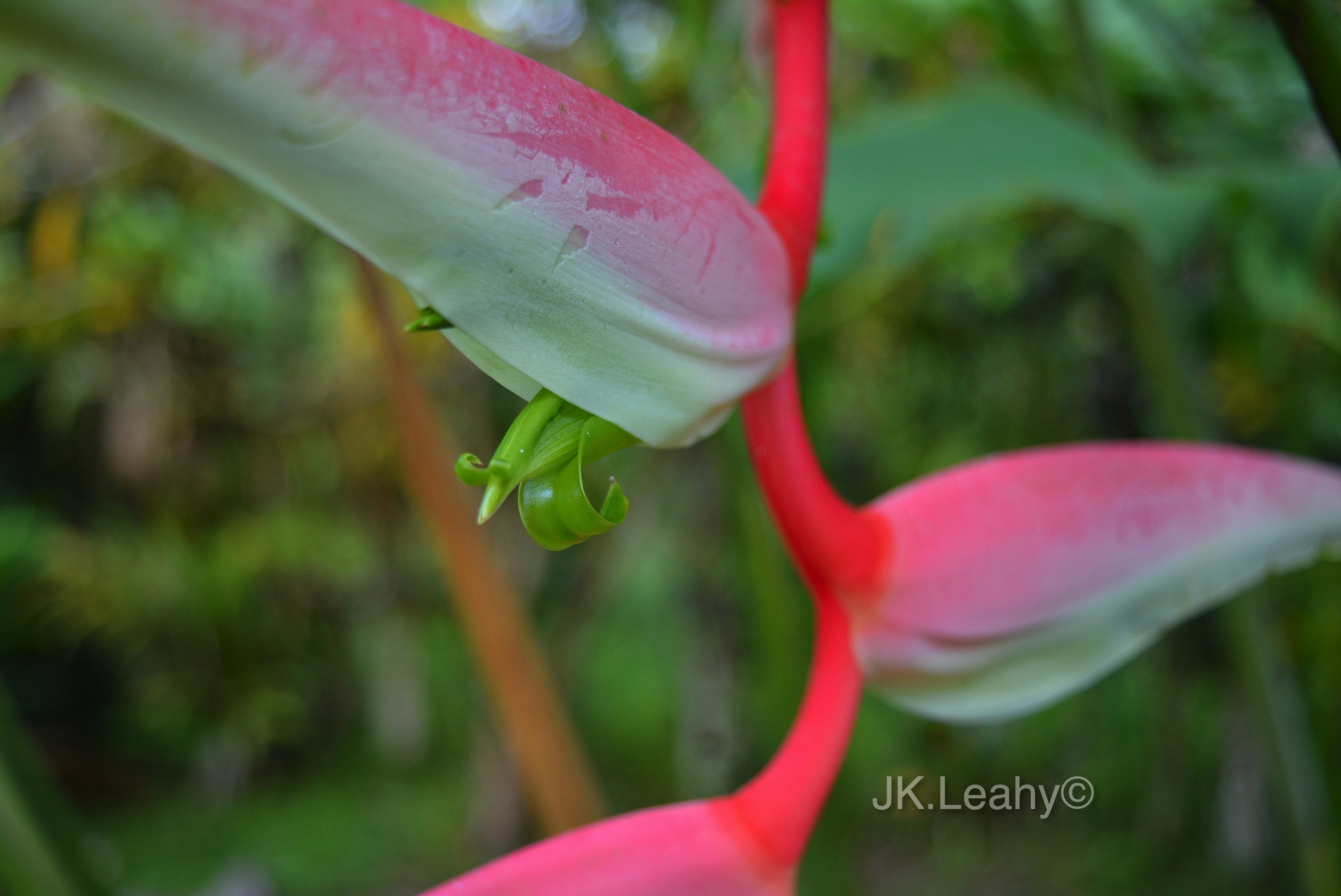
Nature’s beauty is its simple mystery. How can a Heliconia Sexy Pink as they call it, get from the colours in the picture above to the colours in the image below when it is aging? I don’t know, but I really like the contrast. I took these pictures in my mother’s garden in Lae, Papua New Guinea. They were taken from the same bush before my mother pruned the ginger plant. The kurakum (pidgin word for red ants) really appreciate the aging flower. That is another mystery.
The cicadas are one of my favourite insects. I have listened to them on many occasions through out my life without knowing what a complex and intricate life-cycle they have. They remind me of the low-sounds made by Jews Harp, a small musical instrument which is held against the teeth or lips. When there are thousands of cicadas calling at once, it is like an orchestra of the Jews Harp.
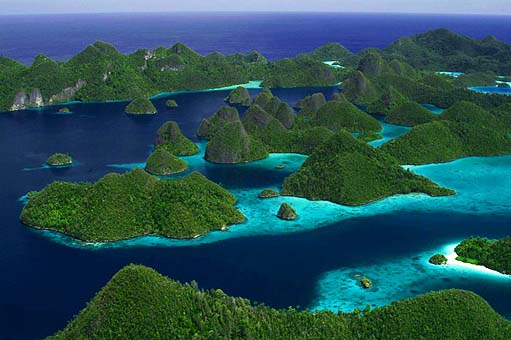
Wayag Island is one of the islands within the Raja Ampat district in the province of West Papua. The island is known for its beautiful atolls and amazing underwater life covering a total area of 155,000 hectares (about 383,013.3 acres).
I heard this interesting news yesterday that West Papua is declared as the first province anywhere in the world; and the entire province is now a world conservation site. West Papua remains part of Indonesia. One is hopeful that the political status and the livelihood of West Papua people will be recognised as well.
If coral reefs are the rainforests of the seas, then the Coral Triangle is the underwater equivalent of the Amazon. This is a bioregion that’s half the size of the United States, passes through six countries (the Philippines, Indonesia, Malaysia, Papua New Guinea Solomon Islands and East Timor), and harbours more marine species than anywhere else on the planet. There are single reefs in the Coral Triangle that contain more species than the entire Caribbean. When it comes to abundance and sheer scale, nowhere else comes close to the Coral Triangle.
The Indonesian province of West Papua has just been declared a Conservation Province, a first for both Indonesia and the rest of the world. The new designation is important both symbolically and in ensuring the future health of the province’s astonishing ecosystems. Besides its rainforests, West Papua is the world’s epicentre of marine biodiversity, boasting more species than anywhere else on the planet.
One of the women in Kapatcol hamlet in Misool shows her harvest. (Courtesy of The Nature Conservancy, Nugroho Arif Prabowo) – See more at: Jakarta Post
As forest fires rage in Sumatra in the midst of the worst El Nino weather event on record, this example of local government taking action in partnership with local communities and international NGOs shows that real, inclusive action is possible and that it can reach the legislative level.
The declaration was signed on Monday by West Papua governor Abraham Ataruri in Manokwari, the provincial capital, with Indonesia’s minister for Home Affairs, Tjahjo Kumolo in attendance. “This declaration will help us maintain and manage our natural resources wisely and continuously so that future generations can enjoy them,” said Ataruro. The new bylaw designating West Papua a Conservation Province falls under the jurisdiction of Indonesia’s Ministry for Forestry & the Environment.
Supported by Conservation International (CI), Worldwide Fund for Nature (WWF) and The Nature Conservancy (TNC), the local government in West Papua has set up a working group representing a range of civil and political bodies to ensure that the new legislation translates into meaningful action on the ground. They are now drawing up regional bills known as Ranperdasus.
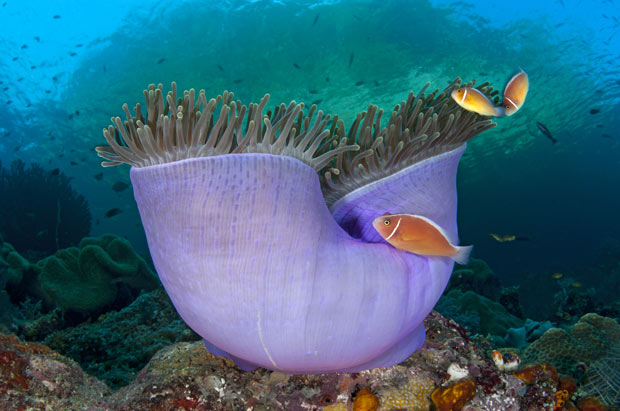
Pink anemonefish (Amphiprion perideraion) in a purple magnificent sea anemone (Heteractis magnifica), Misool, Raja Ampat, West Papua. Picture: Alex Mustard/Steve Bloom Images / Rex Features
Background Information
Papua (both Papua and West Papua provinces) is a complex piece of the planet, partly because of its convoluted tectonic history that forms mountainous areas, prominent lakes, swamps and mangroves where Indonesia’s largest mangrove ecosystem is nestled at the head of Bintuni Bay.
The north-western part of Papua is also part of the Coral Triangle Marine Protected Area, containing the world’s greatest diversity of coral-reef fish, with more than 1,650 species in eastern Indonesia alone. Papua’s abundant coastline is magnificent, placed together with more than 1,000 fringing islands like Raja Ampat, Biak, Supiori, Yapen and the satellite islands of Cenderawasih Bay, which also contribute significantly to Papua’s astonishing features.
It is currently considered an area of global priority for biodiversity conservation because, in part, of the species-rich forest environment of Australopapuan fauna, as well as of many uniquely New Guinean species.
Papua has huge reserves of natural resources in the mining and oil and gas sectors and continues to retain some 80 percent forest cover, including large reserves of commercially valuable lowland rainforest.
These all significantly contributed to the gross domestic product (GDP) of the provinces.
Despite its socially rich environment, Papua and West Papua are among the provinces with the highest level of poverty in the country. A report by the Central Statistics Agency (BPS) said that until March 2013, West Papua was among the eight provinces with the highest poverty rate (26.67 percent) — second after neighbouring Papua (31.13 percent). Jakarta Post
A note from the author of this blog – so finally the world is going to conserve the land, place and environment of the West Papua people is this the sign that times are changing for West Papua people? Could we apply the same kind of protection for the Melanesian PEOPLE in West Papua too?
Those who love orchids know their exotic blooms and unusual colours. Some have certain places and conditions they like to grow in. But did you know of the weird sex life of orchids?
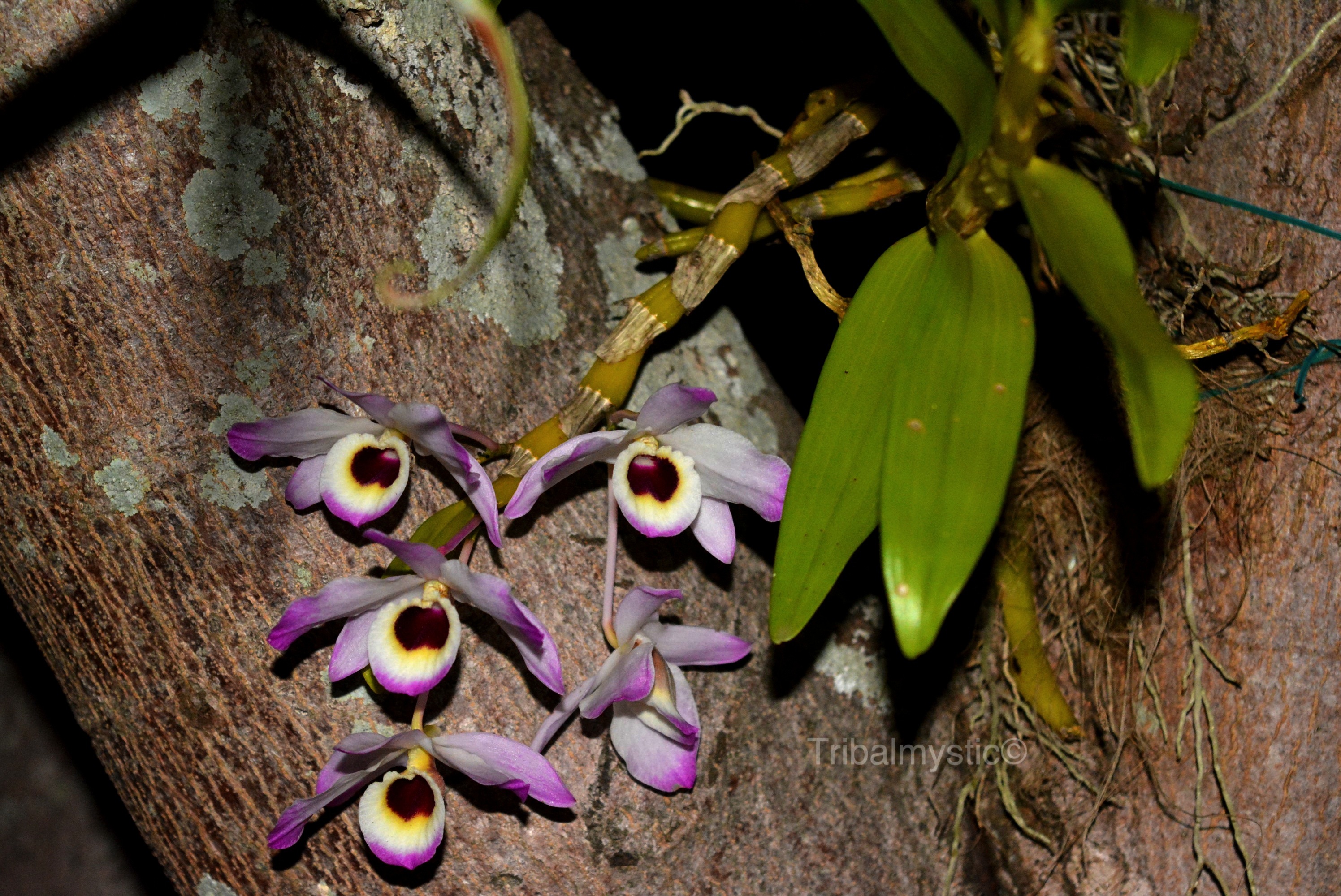
While I was away, one of my orchids bloomed for the first time. I had been wondering when she would flower. Perhaps her deception to attract pollination or her ‘voodoo’ did not work for the 12 months I grew her. This orchid (pictured above) is one of several I received from my sister-in-law Ufi Leahy’s garden in Kenmore, before she returned to PNG. I was ecstatic to find each clump – wherever I had planted them, bloomed.
The great majority of animal pollinated plants secure the services of their animal pollinators by providing food rewards such as nectar or pollen. However, orchids are exceptional in that perhaps as many as one-third of the 30,000 or so species achieve pollination by deception. That is, they lure animal pollinators to the flower by false promises of food, but do not provide any. They are all show – just for the sex and no rewards for their visitors. Most of orchid species are ‘food deceptive’ – falsely advertising the presence of food by bright colors and sweet scents.
We animals don’t give plants nearly enough credit. “A vegetable” is how we refer to a person who has been reduced to a condition of utter helplessness, having lost most of the essential tools for getting along in life. Yet plants get along in life just fine, thank you, and had done so for millions of years before we came along. True, they lack such abilities as locomotion, the command of tools and fire, the miracles of consciousness and language. But the next time you’re tempted to celebrate human consciousness as the pinnacle of evolution, stop for a moment to consider exactly where you got that idea. Human consciousness. Not exactly an objective source.
Ophrys eleonorae and Ophrys lupercalis, a wild hybrid orchid, whose pollinator, a male solitary bee, is engaged here in pseudocopulation. Photograph: Christian Ziegler/Minden Pictures
So let us celebrate some other pinnacles of evolution, the kind that would get a lot more press if natural history were written by plants rather than animals. I’m thinking specifically of one of the largest, most diverse families of flowering plants: the 25,000 species of orchids that, over the past 80 million years, have managed to colonise six continents and almost every conceivable terrestrial habitat, from remote Mediterranean mountaintops to living rooms the world over. The secret of their success? In a word, sex. But not exactly normal sex. Really weird sex, in fact. Click here to read more.
Series 1 of 2 Open. Forest Mantis Orchid (Caladenia attingens) Margaret River area, Western Australia
National Geographic: The genus name of the forest mantis orchid (Caladenia attingens) is derived from the Greek words calos (meaning beautiful) and aden (meaning glands), referring to the colourful labellum and the glistening glands that adorn the middle of flower. Their shape and colour mimicking female insects, attracting male insect pollinators. I like this wasp orchid because it also looks like the Bird of Paradise.


















 Tribalmystic Stories