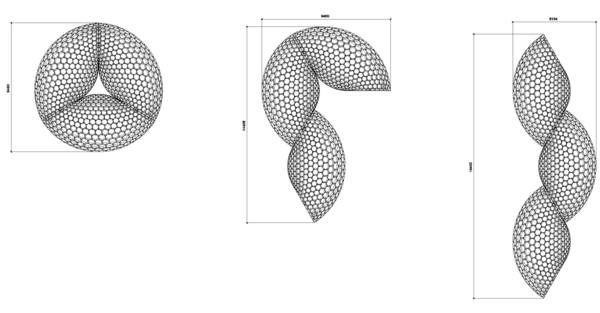
The Cool Stuff this week is a multi-functional exhibition space called Kreod Pavilion. Inspired by nature and organicin its form, this beautiful space was designed by London Architect Chun Qing Li.
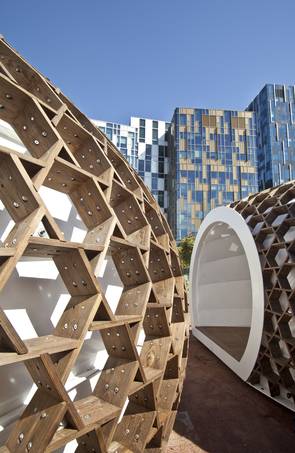
Environmentally friendly the Kreod pavilion combines three 20 m² capsules in a variety of spatial configurations. The hexagonal structure is based on a simple recurrent joint connection detail as seen in Chun Qing Li’s sketches below.
Architect: Chun Qing Li & Pavilion Architecture
Location: Greenwich Peninsula, GB-London SE10 0PE (until early 2013)
Kreod is a multi-functional pavilion – its three pods can be combined in a variety of configurations or installed as free-standing forms. It is portable and easily demountable. The wooden structure of KREOD is made of Kebony, a certified sustainable alternative to tropical hardwood. The product is dark, acquiring a silver-grey patina over time if left untreated.
The wood was impregnated with a liquid produced from crop biowaste. The treatment with furfuryl alcohol forms stable furan polymers, which are locked in the wood cell walls and increase the dimensional stability as well as durability and hardness of the wood, giving exceptionally good decay resistance and long life span was obtained after kebonization. This durability was achieved without the disadvantages of traditional impregnation methods using toxic chemicals.
“New Portraits” is primarily made up of Instagram pictures of women, many in sexually charged poses
I found this story quite disturbing and in my opinion, it has a huge impact on intellectual property laws and what we own (or not own) as artists or people in general, once the property becomes virtual. In this story by Jessica Contrera, Washington Post – your Instagram photos aren’t yours: Someone can sell them as art for $90,000, which raises the questions once more about what is truly yours once it goes virtual. The Internet is the place where nothing goes to die. Those embarrassing photos of your high school dance you marked “private” on Facebook? The drunk Instagram posts? The NSFW snapchats? If you use social media, you’ve probably heard a warning akin to “don’t post anything you wouldn’t want your employer (or future employer) to see.” We agree, and are adding this caveat: Don’t post anything you wouldn’t want hanging in an art gallery. (What about what other people post of you, without you knowing?) This month, painter and photographer Richard Prince reminded us that what you post is public, and given the flexibility of copyright laws, can be shared — and sold — for anyone to see. As a part of the Frieze Art Fair in New York, Prince displayed giant screenshots of other people’s Instagram photos without warning or permission. The collection, “New Portraits,” is primarily made up of pictures of women, many in sexually charged poses. They are not paintings, but screenshots that have been enlarged to 6-foot-tall inkjet prints. According to Vulture, nearly every piece sold for $90,000 each. Read more here
Together We Can, a music video from Papua New Guinea.
I had a request by fellow blogger Annette from Beauty Along the Road for some singsing (dancing) when I posted a story last Saturday about the South Pacific Games opening in Port Moresby, Papua New Guinea. I could not find any material on the web, You Tube and other avenues, however I found this video, released on July 3rd, 2015 which is about the 2015 SP Games. The video was released to celebrate the opening of the 2015 South Pacific Games. I am proud to share this video not only for its content, but it was created by two of PNG’s amazing talents, Jamie Lee and Jagarizzar. The video features a collection of traditional singsing from across PNG and some of PNG’s pop and contemporary singers. I hope you enjoy the video.
Artist: Jamie-Lee
Featured Artists: Jagarizzar, Briena Micah, Tinzy Mau, Henry & Santanya Gewang
Choir: Emirau Praise
Directed by Karl Bouro & Andrew Bouro of Torn Parachute
Written & Composed by Jagarizzar & Jamie-Lee
Produced, Mix & Mastered by Bryan B of Tune Studios, Malaysia
Aerial/Drone Footage: Robert Weber & MASALAI
Video Producers: Motsy David & Kamuna Consultancy
Production Assistants: Floyd Manata, Roan Paul, Graham Robinson
Cultural Groups: Aroma, Morobe, Huli Duna, Asoro Mudman, Paluai SookSook, Kiwai Dancers, Buka Bamboo Band
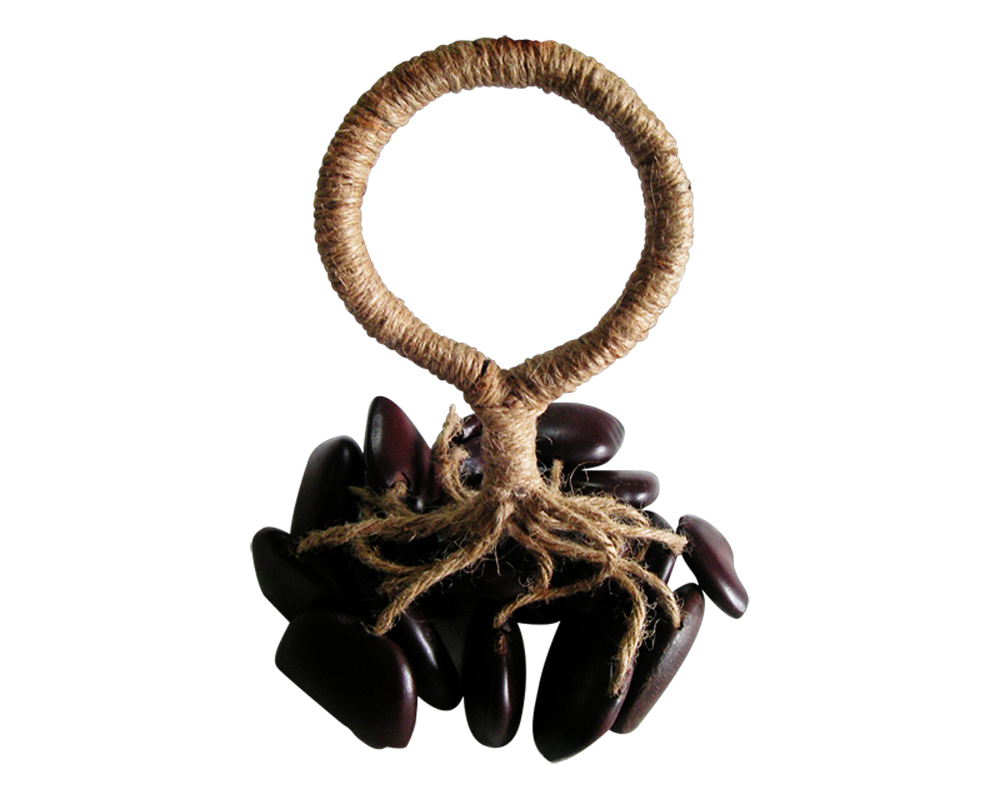
Similar seed pod rattle found on the public domain images.
Standing in the warm Brisbane sun outside the Queensland Museum this morning, listening to Rhianna Patrick recall her story about her heritage, which reminded me of my own. My grandmother and I collected the same seeds and went through almost the same process to produce seed pod rattles for my aunts to dance with. This musical instrument is quite common in Melanesia and other cultures such as the Indigenous Australian culture.
While Rhianna and her father drilled holes in the hard seed shells, grandma and I used metal rods from broken umbrellas by burning the rod on the fire until it was red, which then easily burnt a hole into the seed.
Rhianna’s story was about making the Kulap, the dance rattle (as pictured above) from the Torres Strait. The rattle was an object found in the Queensland Museum collection. Rhianna’s is one of twelve stories told in a photographic exhibition to highlight the significance of Australian indigenous cultural heritage in association with the collection. The exhibition also acknowledged young keepers of traditional knowledge and promoted the importance of skills in making these cultural objects. Young keepers of traditional knowledge and skills were encouraged to sustain the knowledge and skills for future generations.
Curated by Michael Aird and Mandana Mapar, twelve outstanding indigenous Australian story-tellers were invited to speak about their personal recollections of their cultural heritage – the Kulap, an object in the Queensland Museum, was the one thing that stirred many memories for Rhianna.
In her early childhood, at eight, Rhianna recalled that she had run out of things to ‘show and tell’ at school, and finally, she was forced to make something up. That was when her father suggested the two of them make the Kulap. In the process of collecting seeds on the beach to sawing the seeds in half and incising holes to threading the half seed pods together, the Kulap-making became one tradition she learnt from her father, and also one cultural heritage that has left a lasting impression on her.
Rhianna’s story about the Kulap with 12 other storytellers and their personal recollections on objects of cultural significance went on show in Queensland Museum today. The event was timed to mark the beginning of the National Aborigines and Islanders Day Observance Committee (NAIDOC) week.
In the curatorial statement, curators Aird and Mapar wrote, “In our own way, each of us gathers mementos and keepsakes around us as we remember our past and look towards the future. Our collective stories and memories guide us to tell our own personal narratives with strength and conviction.”
According to Aird and Mapar, the stories told in this exhibition reflect on the tangible core themes of connection to family and country of the indigenous people. The stories also acknowledge the unique techniques used to craft some of the artefacts and signpost historical and political milestones in Queensland indigenous history.
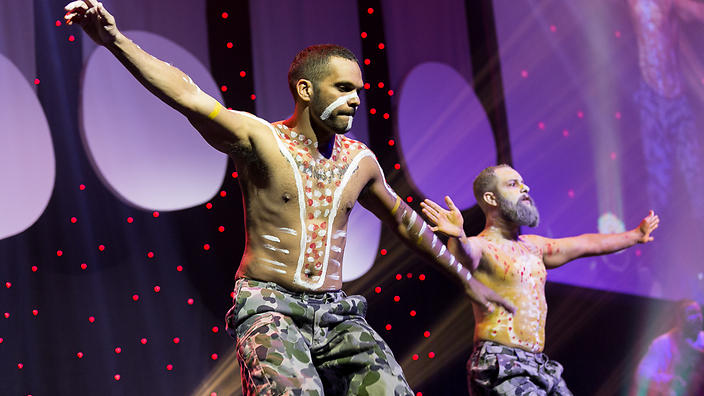
National NAIDOC Awards Ceremony 2014. Event Photos Australia Pty Ltd
This is my heritage opened today to coincide with the Statewide launch of NAIDOC, a week-long event celebrating the history, culture and achievements of Aboriginal and Torres Strait Islander peoples.
Treasurer and Minister for Aboriginal and Torres Strait Islander Partnerships Curtis Pitt said the This is my heritage exhibition was a stimulating way to recognise Queensland’s indigenous people as the primary guardians and knowledge holders of their cultural heritage.
Photograph: Winsome Bonham – Macquarie lighthouse in Sydney was the first Australian Lighthouse.
Monday 6 July 2015 8:28AM
I have always been fascinated by lighthouses.As a child I’ve often wondered what happens inside these small but very tall, peculiar houses, even though I understood their purpose (to prevent accidents and save lives). I have been in a few lighthouses over the years and I think my curiosity is somewhat satisfied that not much goes on in them. I know it could not be a very comfortable place to live, but lighthouses do have amazing views. The other thing that always holds my interest in lighthouses are their architectural designs.
In this ABC story by Ann Jones writes about the anniversary of the Australian lighthouses and I have added a few more pictures of the historical architects I have found on the public domain.
This week marks the 100th anniversary of the formation of the Commonwealth Lighthouse Service. With its enormous coastline, Australia plays host to more than 300 lighthouses, and as Ann Jones learns, many of them are architecturally and technologically unique.
The first lighthouse in Australia was the Macquarie Lighthouse at the entrance to Port Jackson (otherwise known as Sydney Harbour), first lit in 1818, well before federation.
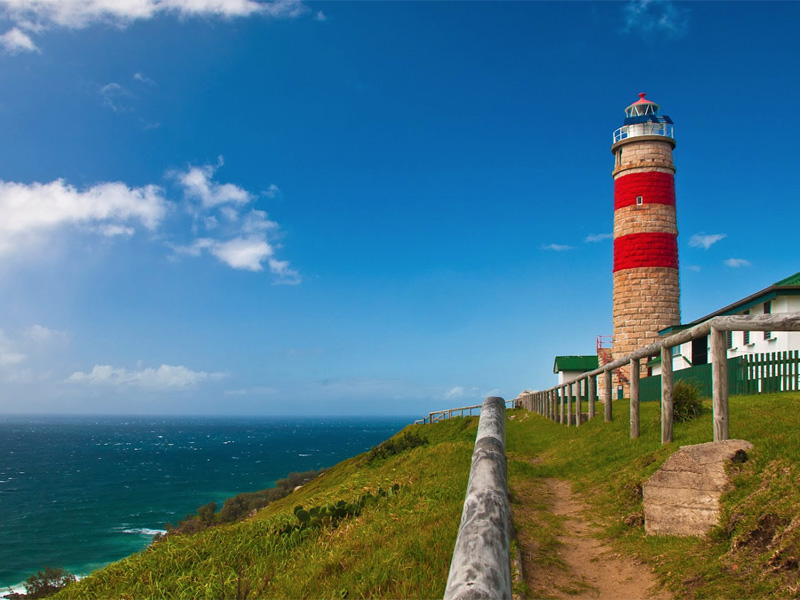
Cape Moreton, Queensland lighthouse (1857) designed by Edmund Blacket. Public Domain
It’s not the one you see there today, though it was very much like it. Apparently the stone they built it on was a bit soft and the lighthouse had some structural issues, so they rebuilt it later in the 1800s.
Cleveland Point. Another Queensland light house. The original lighthouse was established in 1864 -1865 as a wooden hexagonal tower. Wikipedia
It’s charming. A tower plonked on a rectangle, a quintessential lighthouse perhaps; it’s easy to imagine a lighthouse keeper wandering out of the downstairs accommodation with a storm light and winding his way to the top of the tower to light a whale oil lamp.
Photograph by Annette Flotwell of the Hornby lighthouse in South Head, NSW.
My friend Paco D. Taylor enjoys researching and writing articles. I have not met many people who are so fascinated and interested in a culture outside of their own. Paco is from Chicago, U.S.A, but he is intrigued by Melanesia. After a year of exchanging stories, history, art, music, etc, I can understand why Paco feels strongly about the Melanesian people and culture. His study of the black people in Asia has produced some very interesting connections to Melanesians.
In my culture, as you make friends with someone and whether they are from your tribe, a relative or a friend, they become your “wantok”. Some time ago, my wantok Paco published his article, Black East which discusses the ancestry of the black people in the East. I have read and found this story very interesting and Paco has kindly let me share the article on this blog. I hope you enjoy it. If you have any questions, I’m sure Paco would be very happy to answer them.
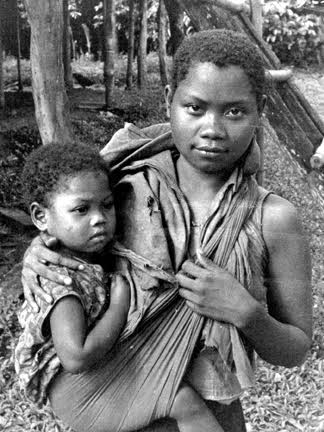
Ban Doan Woman (Wa) and child (Samoi). Saturn Province, Southern Thailand, 1963. Photo by John H. Brandt
BLACK EAST
By Paco D. Taylor
As a kid growing up on the far South Side of Chicago, whenever I would envision the physical features of Asian peoples—since those I saw most were in martial arts movies and Ultraman reruns on television—a fairly narrow set of characteristics always came to mind. Perhaps not surprisingly, brown skin and curly black hair were never among them. But one fateful day my father told me of an eye-opening experience he’d had as a young man serving in the United States Marines. While stationed in the Philippines between 1961 and 1963, “Pops” learned of Asians whose physical features were significantly different from what most Americans have been conditioned to expect.
There in the Philippines, Pops saw native Filipinos who, albeit small in stature, looked a lot like him, with dark brown skin, curly black hair and—stranger still—African facial features. To say the very least, the sight of such people living in the heart of Southeast Asia was completely unexpected.
It was also unsettling.
Perhaps equally as unsettling, my father learned that these puzzling pint-sized people were referred to locally by a Spanish term, one that translates literally into English as the “little blacks.”
Facts of Life
As the Earth’s largest and most populous land-mass, Asia is home to 60 percent of the planet’s human population. Included in this sum are the continent’s lesser-known groups called the Negritos—indigenous Asians who look a lot more like the relatives of Gary Coleman than Jackie Chan.
Whatchoo talkin’ ’bout, Paco?
The term Negrito was first applied by Spanish explorers in the 16th century, after encounters with such people during early forays into the region. And though wholly unscientific, the term is still used today to refer to distinct ethnic groups living in parts of Southeast Asia and the Asian Pacific island of Papua New Guinea.
According to James J.Y. Liu, author of the book The Art of Chinese Poetry, the term kunlun is the equivalent of Negrito in the Chinese language, and there are several mentions of kunlun people in the early literature of China. The most well-known of these can be found in the classic adventure romance entitled The Kunlun Slave.
In the language of their Malay-speaking neighbors, Negritos are known as the orang asli, meaning, “first people” or “original people.” This term would come into general use in the 1930s, in response to efforts by the Malaysian government to officially recognize them as the region’s earliest human inhabitants.
Prior to the adoption of a more respectful designation, such people were commonly called by the pejorative term semang (“debt slave”), a word bonded to times when, like other blacks, Negritos too were abducted from their homelands and sold into slavery, but in Asia.
Family Tree
The defining physical features of Negrito people include dark brown to black skin, curly black hair and diminutive stature. The average height among men is 5 feet, 5 inches, and the average height among women is 4 feet, 8 inches.
And though they are seemingly orphaned from humanity’s family tree, Maury Povich won’t be needed to pop for a DNA test to figure out “Who is the father?” According to geneticists, these peculiar Peoples are actually the modern descendants of the first migrant populations to venture into Asia more than 50,000 years ago.
That there is a strong resemblance between Negritos and African groups like the Pygmies of Uganda and Congo is obvious What is impossible to see, however, is that on DL (DNA level), these people share closer genetic bonds to other Asians than they do to now-distant cousins back in the Motherland.
Stunted Growth
Fossil finds from across the continent suggest that these nomadic hunter-gatherers once lived across Asia from India to southernmost Japan. The southern islands of the Pacific Ocean (Oceania) were also once part of their domain, as well as the southern continent of Australia and the island of Tasmania.
Their stomping grounds today, however, are but mere traces of what they once were.
Challenged by the continuous spread of larger, more organized and more technologically advanced human groups, their once wide-open range has been limited only to isolated parts of the Philippines, Southern Thailand, Malaysia, Indonesia, the Andaman Islands (off the coast of Burma), and Papua New Guinea.
What’s more, populations that were documented as recently as the late 19th century to have numbered in the tens of thousands now number only in the thousands. But the numbers for some groups have become even smaller.
Drastically smaller.
Today, the tribal population of the Onge people in the Andaman Islands numbers less than one hundred. It is conceivable that in the proverbial blink of an eye, this ancient tribe of humankind will simply cease to exist.
Please visit Paco Taylor’s blog link below to read the rest of the article and view images.
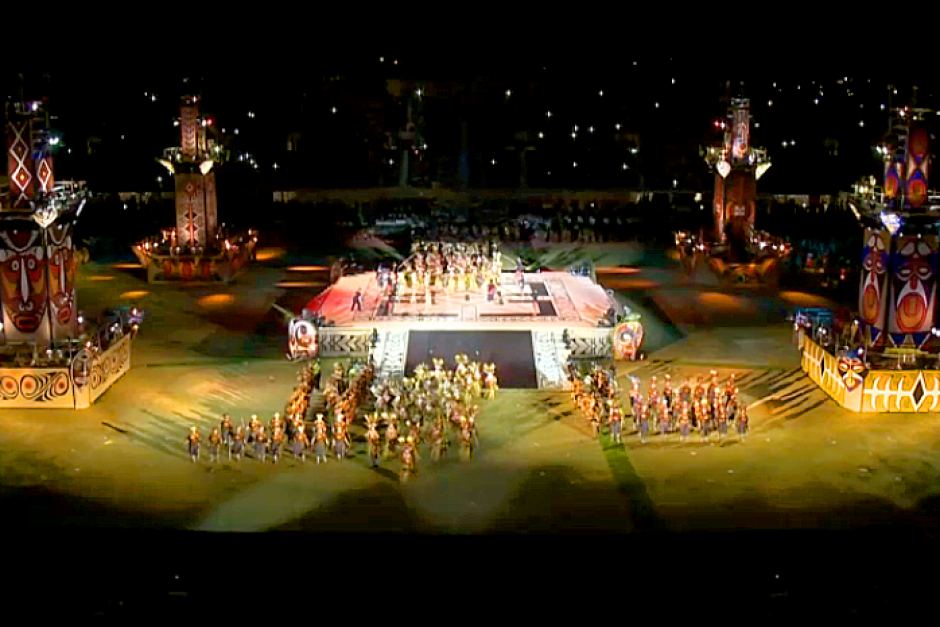
The South Pacific Games opens tonight in Port Moresby. After years of preparation by Papua New Guinea (PNG) and hundreds of regional athletes, the 15th South Pacific Games opening ceremony has begun in the nation’s capital. Australia and New Zealand participate for the first time ever. It is expected 24 South Pacific island countries will compete in the next two weeks. Citizens, visitors, and sportsmen and women at tonight’s opening will also witness the largest group of traditional dancers from across PNG. Up to 900 singsing groups will perform, according to organisers. Artistic director of tonight’s opening ceremony, Airleke Ingram, said it is a celebration of Papua New Guinea’s rich cultural history, while pointing to the country’s future direction. The ceremony’s theme is tied to the local region’s hiri trade, an important cultural influence. “It’s a really key part of our culture. There are a lot of songs, dances and tattoos,” said Mr Ingram, a music producer, traditional drummer and famed percussionist from Central Province. The ceremony pays homage to the trade relationship between the Motuan and Gulf Province people, and the role this played in shaping PNG. ABC News
Potato prints using acrylic and plant dyes from the gardenPlant dyes from my garden on watercolour paper and digital graphic outlines (black). Below – work in progress and starting to look like birds.
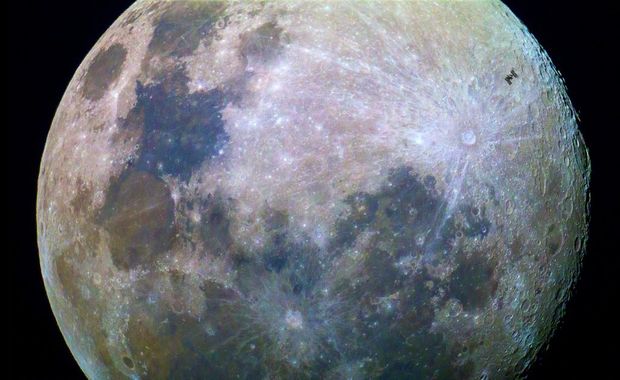
Byron Bay photographer Dylan O’Donnell took this stunning photo of the International Space Station passing the moon on Tuesday. Photo Contributed
The media has called it the holy grail of astro-photography. The Cool Stuff of the week is Dylan O’ Donnell’s fantastic photograph of the full moon with the incredible capture of the space station on the top right.
The BYRON Bay (Australia) photographer who captured the shot on Tuesday with International Space Station passing over the moon said this was his second attempt to take the stunning shot.
“I’ve only tried once before and I completely botched it, it looked like a blur,” he said.
“The International Space Station ISS passes through the sky semi regularly, but for it to line up like it did with an almost full moon is quite rare.
“Some people go chasing around the world to try to line it up but I just waited from my home and it was about 12 months from the last time it lined up that way for me.”
Written, Directed & Animated by Nicolas Ménard
Sound & Music by Rich Vreeland
The mundane story of a heartbroken man,
an online gambling addict, an alcoholic kleptomaniac
and an anxious loner living in the same apartment building. Additional animation by Iris Abols, Anne-Louise Erambert, Nicole Kozak & Robert Loebel









 Tribalmystic Stories