Mondays Finish the Story is a flash fiction challenge by Barbara W. Beacham. Here is my story for this week’s prompt in the first sentence below and in reference to the above picture.
Zeus was not having a good day and he made sure everyone knew it. Mack was a mess as soon as Zeus got going.
“Get me a cleaver…”
“Nooooo! Pleease! Oh god – I’m sorry!” Mack sobbed and gurgled as I ran to boss’s collection for a blade. I almost dropped it; my legs could barely keep up.
As Zeus’ knuckles tightened to white around the knife handle, I desperately avoided his predatory gaze, leering at me through the lightning bolt tattoo across his right eye.
“Now, get out” he growled. I didn’t linger.
Mack had hidden Zeus’s package as well as the money. He lied. I warned him that Zeus would not buy it. The kid messed up.
I wondered why you’d risk losing some fingers for a few bucks, and then I heard a chop. Mack’s screams battered the walls of the warehouse, and the echoes shook my bones. I guess you never quite get used to working for a psychopath.
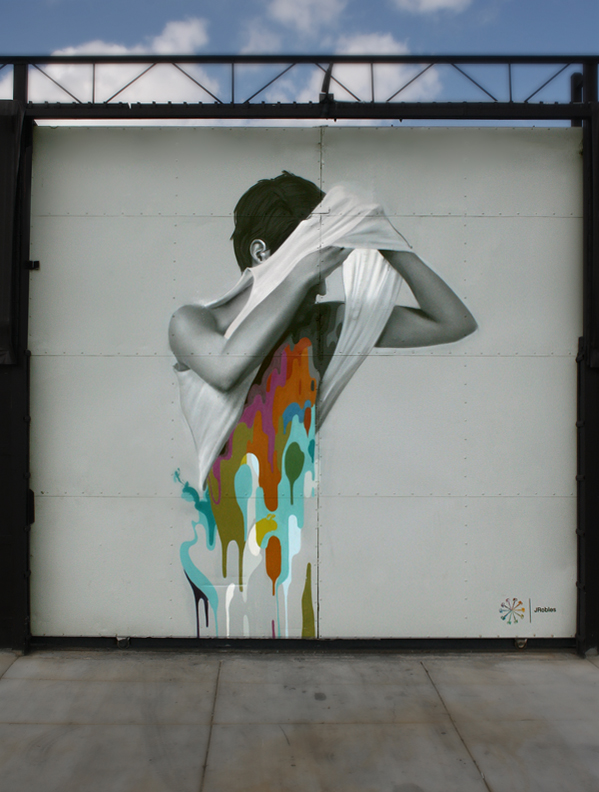
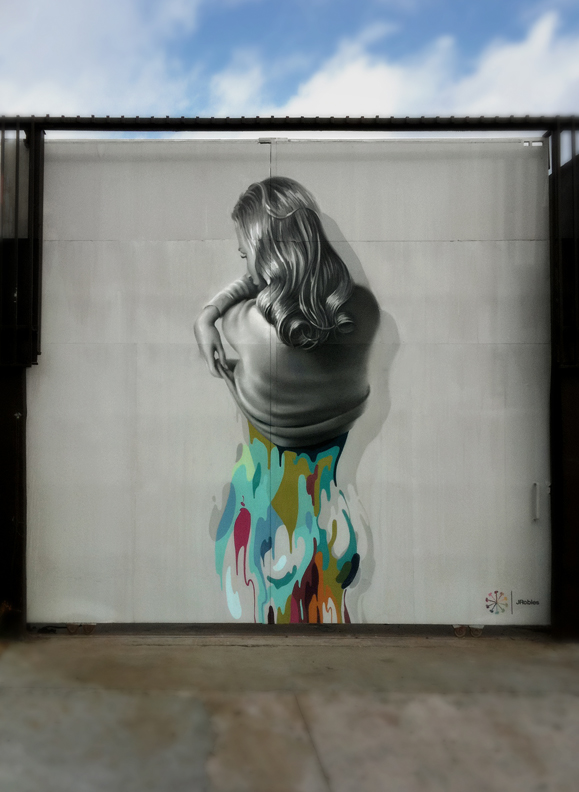
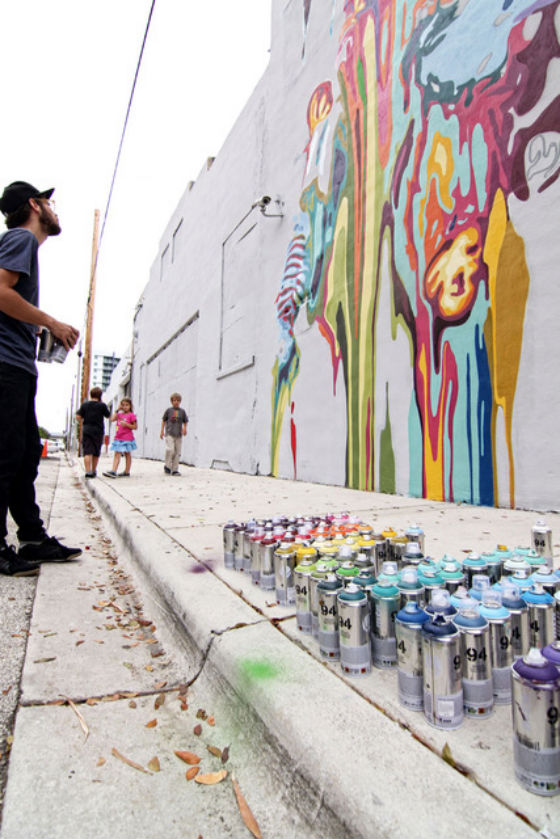
Johnny Robles an artist, creates cool street art in the streets of Miami. With a mixture of cartoon and pop style drawings and graffiti techniques, he gives color to the streets. Residents say they love it..and so do I.
Featured here at work where some of his cool stuff happens.
“The only residents remaining in the small town of Miners Hill are spirits.” Uncle Joseph said.
A tear rolled down his wrinkled tired face. The Eastern Belt explosion left several hundred dead last week. The town was evacuated. I watched another tear form and my eyes salted.
“My first thoughts were Josepha, Maria, and Antonia”.
“Where were you?”
“We sat for dinner. I went down to get a bottle of wine from the cellar – only minutes away”, he covered his face with bloody bandaged hands and wept.
My 50-year-old uncle cried as I rubbed his shoulders.
“I…I heard a single explosion, it sounded so far away. I thought it was the daily blasting at mine site. I should have come up. Antonio wanted a Carménère to celebrate Maria’s first communion. I couldn’t read the labels…suddenly I heard the crumbling, screams upstairs and everything went black”.
“Don’t cry, please uncle. They are with God now”, I whispered, as I cried with him.
This is a flash fiction challenge where Barbara W. Beacham offers a picture and the first sentence of the story. Based on the photograph and the first sentence, one must come up with a 100-150 word short story.
The crew of the Angel Flame received orders to head out. When Yakov and Marishka reach the secluded Russian base, most men had already boarded.
Marishka wiped her tired eyes as her husband walked to the submarine, leaving her, their newborn Polinka and their sick two-year-old, Boris. It was a dreary Friday at 5am; three lost seagulls skirted past Yakov, fleeing the brooding storm.
After Yakov’s head vanished into the submarine, Marishka left – four hours later the snowstorm hit. The radio announced that nobody was hurt. Marishka medicated and monitored Boris’s temperature.
The next day at 7am she heard a knock. It was persistent. Unwrapping herself from Polinka, she reached for her gown.
Marishka caught a glimpse of a man in uniform through the winter-frosted glass and threw open the door with a grin. Expecting to fall into Yakov’s arms, her stomach sank when instead she met the gaze of a stone-faced man carrying Yakov’s personal effects.
Through my son Nathan and his friend Hamish, I got hooked on this audible storytelling a few days ago. After my day job and house-work, I found myself listening until I fell asleep with the episodes still running. The falling asleep part was not because of boredom, but early hours of the next day, which my human body could not stay awake until. The story was captivating. The way journalist Sarah Koenig told the story took me through several emotional states – fear, anger, frustrations and sadness. These emotions also wore me out, but I wanted more.
The Alibi
It’s Baltimore, 1999. Hae Min Lee, a popular high-school senior, disappears after school one day. Six weeks later detectives arrest her classmate and ex-boyfriend, Adnan Syed, for her murder. He says he’s innocent – though he can’t exactly remember what he was doing on that January afternoon. But someone can. A classmate at Woodlawn High School says she knows where Adnan was. The trouble is, she’s nowhere to be found.
Brought to you by Serial, a podcast from the creators of This American Life, and is hosted by Koenig. Serial tells one story – a true story – over the course of an entire season. Each season, they follow a plot and characters wherever it takes them. And they don’t know what happens at the end until they get there, not long before you get there with Serial. Each week the plot brings you the next chapter in the story, so it’s important to listen to the episodes in order, starting with Episode 1. Lucky The Alibi started at the end of 2014 and was completed early this year so that’s what I did for the last two days, between my day job and house-hold chores – listening. I was completely absorbed in the 12 episodes up to yesterday afternoon. I cannot say what happens in episode 12, but do start from episode 1 to fully enjoy the effect of case-solving.
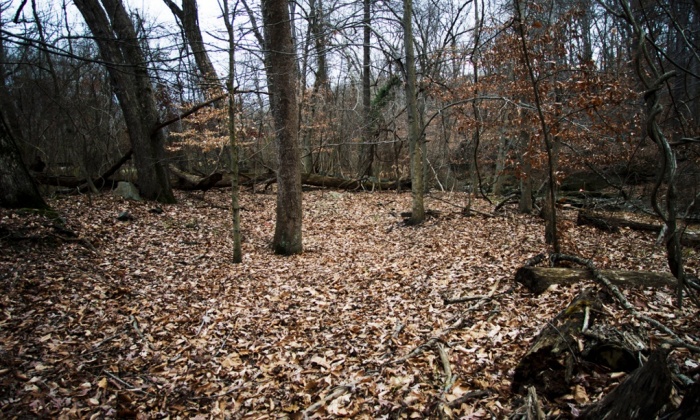
Leakin Park where, on February 9, a man known as “Mr S” came across Hae’s body, 127 feet back from the road, buried in a shallow grave behind a log.
Episode 1
On January 13, 1999, a girl named Hae Min Lee, a senior at Woodlawn High School in Baltimore County, Maryland, disappeared. A month later, her body turned up in a city park. She’d been strangled. Her 17-year-old ex-boyfriend, Adnan Syed, was arrested for the crime, and within a year, he was convicted and sentenced to spend the rest of his life in prison. The case against him was largely based on the story of one witness, Adnan’s friend Jay, who testified that he helped Adnan bury Hae’s body. But Adnan has always maintained he had nothing to do with Hae’s death. Some people believe he’s telling the truth. Many others don’t.
Koenig, who hosts Serial, first learned about this case more than a year ago. In the months since, she’s been sorting through box after box (after box) of legal documents and investigators’ notes, listening to trial testimony and police interrogations, and talking to everyone she can find who remembers what happened between Adnan Syed and Hae Min Lee fifteen years ago. What she realized is that the trial covered up a far more complicated story, which neither the jury nor the public got to hear. The high school scene, the shifting statements to police, the prejudices, the sketchy alibis, the scant forensic evidence – all of it leads back to the most basic questions: How can you know a person’s character? How can you tell what they’re capable of? In Season One of Serial, she looks for answers.
On October 3, 2014, a podcast unraveling the tale of the teenage girl’s murder in Baltimore aired. Barely a month into its release, the podcast broke download records and changed how audio journalism was perceived all over the world.
Podcasts are becoming the latest non-linear way of delivering the news, and some are applying the narrative format to explore—and expose—stories that have never been touched on before. The Alibi reached thousands over-night as Koenig took listeners through the scenes of what happened to Hae Min Lee and details of where her ex-boyfriend Adnan Syed was – on that fateful day.
I personally feel that this (podcast of a crime or any story) could be an interesting exercise for writers to learn how to describe scenes and structure different chapters in word imagery for their readers. It teaches you ways to keep your reader hooked in each chapter until the end. Where you pause to ask questions in your story as Koenig did in Serial, your readers will be asking these questions too as you take them with you through your plot.
I really enjoyed listening to The Alibi.
To listen to the story in all 12 episodes, click here.
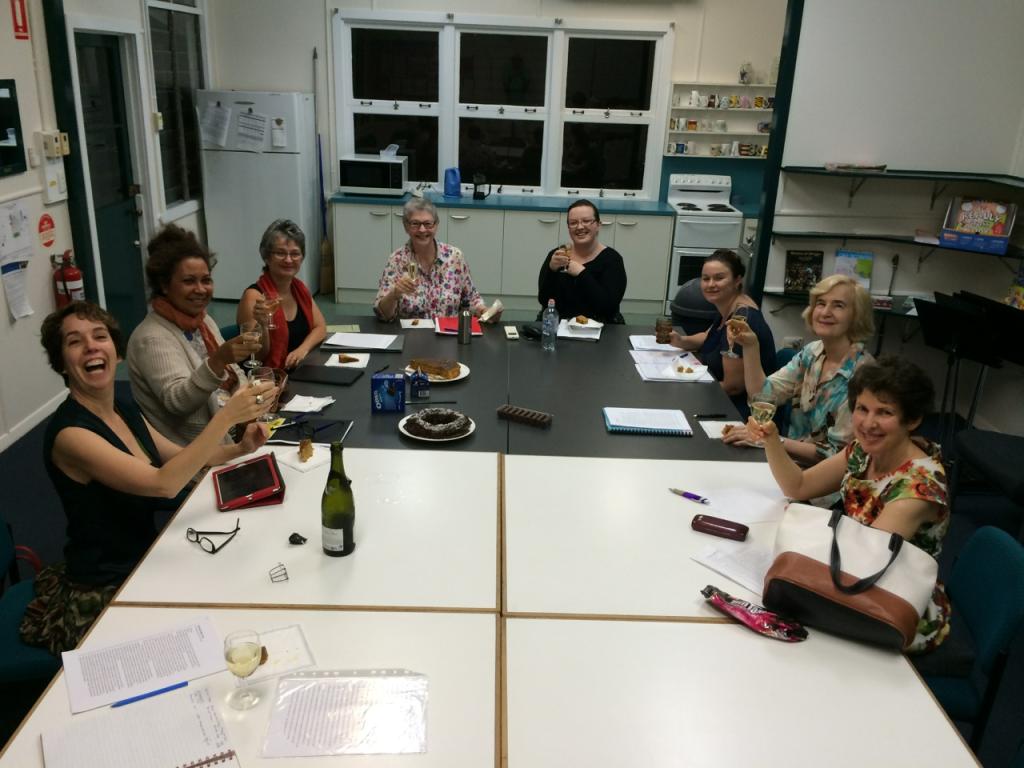
This was how we ended our creative writing workshop this week.
My creative writing group surprised me with champagne and birthday cake last week. Thank you Judy Ward for baking the delicious coffee-chocolate and Orange cakes and thank you Isabel and fellow writers for the champagne and all the snacks. We also celebrated the end of another great term of work-shopping our stories. The eight-week long workshop ended on Tuesday. Many writers in the group have been attending this workshop at Kenmore, Queensland (Australia) for as long as five years. I have been part of the group for two years. Author Isabel D’Avila Winter is a beautifully crazy and an inspiring teacher. Below was the note I got in email before we had our last workshop.
“No reading for next week, because we’ll be too busy eating the leftover TimTams and madly workshopping our work. We’ll also be discussing the upcoming local writing competition, and brainstorming what kind of stories might be suitable to enter,” Isabel D’ Avila Winter.
Isabel is seated in front (left). Other participants included writers of memoir, rural romance, fantasy, sci-fi and crime fiction. We are not all females, we do have two male writers. Tom was not well this night and the other male writer, Bill, took this lovely picture. The group members have planned to enter the local writing competition in August.
I find that being part of this group was a major contributing factor in my story-telling; both in finding constant inspiration to write and sharing my work for an honest feedback. I also enjoy listening to each writer’s story.
This is a draft opening of a short story I am working on. I have not decided where the plot is going. I have a few options and will post more later.
Betty picked up contents of their mailbox. It was only 4pm and she was extremely tired having entered her third trimester last week. Her mother was overseas, and still unhappy at Betty’s choice to keep the baby.
In her Mother’s eyes, Betty was the faltered child, not pursuing the right career or man, having wasted her mother’s precious money and now having a baby at 23 before she had her own income. Her choice to follow arts while keeping her casual job as a Cole’s cashier was beneath her mother’s expectations. Her mother wanted a Law, Business or Accounting Degree – not Arts!
“She thinks just because she herself married a rich man, that I have to do the same, Betty complained to her aunt.
On the other hand, Betty mentioned to her aunt, her younger sister Mina, 22 was exceeding their mother’s expectation with a University degree in business and now engaged to a young engineer from a wealthy family.
Betty has been out of work for three months and already she feared her mother was right – that she needed to find some money quickly. Her mother refused to spare a cent from her own millions.
“Betty must earn it herself, she must work for it”, her mother told her aunt. The house they lived in on the hills in Brookfield belonged to her mother’s multi-millionaire lover. He gifted it to her, after his second divorce was final.
As Betty shuffled white envelopes, bills and junk mail, the young mother-to be wondered how she would pay her bills this month. Amongst the pile she noticed a small yellow aged envelope, stamped and posted in Brisbane. The envelope was addressed to her. Betty examined the back but there was no return address. She looked at the stamp again. She could not think of anyone in Brisbane that would send her a letter, most of her friends contacted her on Facebook or emailed her. The enveloped was marked Monday, January 15, 2013, just two days ago.
That was the question of our discussion in creative writing workshop tonight. My friend Bill Heather is an architect. He is also a writer in my creative writing workshop group. The group is tutored by Isabel D’Avila Winter, a published author. Pamela Jeffs, another writer-friend suggested that I should blog this discussion and my own response, to help writers who are planning to write autobiographies and memoirs or fiction based on real life stories. I begin with Bill’s email to me and others in our group.
Bill Heather: Hello all you aspiring and proven writers,
Is there a limit to what you can mine from your own life experiences for a story?
Are authors of autobiographical fiction or memoir at risk of alienating their family and friends in their search for that elusive storyline?
Is ruthlessness in search of your best fiction a necessary attribute of a writer?
Would you publish a story if it could destroy the marriage of your closest friend?
There are good questions to ponder as we head towards the end of another year, and ones which are addressed in the attached article from the November 2014 issue of the Monthly. Link at the end of my response to Bill.
Omar Momani: Ferguson’s pen mightier than the sword
My Response to Bill: Dear Bill and friends,
Thank you Bill. I found the article very interesting and very true. The most safe writing would be fiction.
In my Memoir writing, I question everything I write. I know there will be a lot of ‘hurt’ of others as well as my own. I have created pain in many stories I read in our evening workshop. For example, if I had told my mother the old uncle rubbed my sore leg the ‘wrong way’ I think there would have been some serious charges or bloodshed in my family. The man is dead now but if I spoke about it now – what could happen? I don’t know. I also spoke to my mother and step brother about some stories I have written so far, and we discussed them. These stories were all painful…my stepbrother is my late step father’s son. But my step brother is my best friend – we are very close.
So my point is, as often as I do, I ask, should I just change my memoir to fiction and pretend it is not me or get my ‘freedom to express’ in fiction? Perhaps some stories could be written differently, safely..? Those and others are questions I ask myself all the time. 75% of what I have written, I don’t bring it to our workshop, I am scared to. Sometimes, I write the whole thing and then delete it.
Every now and then, I write fiction for the class exercises, because, this gives me the freedom to write freely without guilt, pain, horror and more. I totally lose myself in the ‘fake’ when I write fiction.
I deal with my writing the truth ‘problem’ this way; I write about me, the events, people and places and things that affect me. I write it all, then I decide what I can manage to live with, and I keep that story. I tell myself, ‘stop thinking about everyone else’. I just write ‘my’ story. I can always pull out what I think is too much at the end of the day. The final choice is mine, and I have to live with it.
I love most art forms. To show and tell a story, I have often wondered if film and photography are the art form that truly capture the essence of a story. As a story-teller, I often ‘cheat’ by throwing in an image to complete the imagery ‘in’ my story. I see many bloggers use images this way, and it is great. As you are reading my stories, I want you to see and visualise the events, emotions, and actions with me. We are in the story together. Now, imagine if we did not have pictures; how could we, story-tellers, tell a story? I know how hard it is to describe a scene, simply. How many words and sentences do we need to describe every picture, and every scene we wish to create in our readers’ minds?
Between 1980-2000, in my news print days, I carried a Nikon FE2 with me in PNG. I must admit, I was in-love with this camera. It took two decades of pictures with me. These pictures hit front newspaper pages and glossed magazines. I entered and won competitions. I could not have been a true journalist without it. Being a photojournalist, assisted by FE2, we took stories to another level.
Sadly, I do not use this camera anymore. Apart from losing the mirrors inside the FE2’s body to some hungry mould, I paid over $AUD600 for repair, and never got the mould completely removed. The mould began feeding and grew again. I still have the FE2 with me because we have too many memories together. I cannot use it, and I cannot bare the thought of losing it.
These days, everything has moved to digital. Over the years, trying to save money for a new ‘real’ camera has not been successful. Family, mortgage and many other urgencies always top the priority list. Without a good camera, I often wonder how many great shots I have missed in so many years. I stare for hours at photographs and pin them on Pinterest and the net. I wonder how I could have taken these pictures differently; using light, better angle or simply, showing the object better. Fellow blogger/photographers, you know I am checking your pictures out, and I am looking at your pictures in awe and with some jealousy. This is envy that is not evil but respectful. A somewhat sad feeling about how much I have missed in my photography. I have long resigned to the fact that –that’s life!
Going Digital
In-coming tide on Tami Island, Lae, Morobe Province, PNG. Picture JLeahy. 2008
I still take pictures with the phone, and small digital cameras. A few years ago, I had a digital pocket sized Nikon I bought from a Cash Converters store. It accompanied me conveniently for its size. The FE2, and its lenses was sometimes hard to lug about. After doing some solid photographic work, the little camera’s bottom broke. There is a pin inside the battery cage which broke and the camera batteries would protrude out and lose power. So, I taped the bottom and kept using the camera. When a moment presented itself, the photographer would need to press harder on the tape to keep the batteries in and take the shot. Only I used it expertly. It was hard work instructing others to handle the little camera in her special needs. If less pressure was applied, the camera did not work. Sounds like a joke right? The camera worked most times and I was proud of it.
The Right Equipment
Anyway, the point I am making is that, when and if you have a great equipment for your work or even artwork – everything flows beautifully. Just imagine when you don’t and the moment presents itself. In 2008, I was on Tami Island, Papua New Guinea doing my field research into how climate change affected intangible cultures.
I travelled with my mother and my broken-bottom pocket Nikon. The bottom was taped and, we went to a place at least a few hours in up the coast, in a boat, so there was no such thing as batteries nor camera shops.
I took several photos with the bad-bottom camera, and one picture has become a favourite. I had to mention this picture because, it is not only I that thinks it a wonderful picture, but strangers have complimented the photo, hundreds of times. I posted this picture on About Me, on my Page and each day, I can get numerous compliments and comments about this picture.
The Story of This Picture
Morning light on Awaho flowers, Tami Island, Lae, PNG. Picture, JLeahy. 2008
In the days my mother and I stayed on Wanem Island, we would wake in the morning to crisp breezes, beautiful skies and chatters of seagulls and other birds flying by, searching for food. The village was a separated by trees and coconuts. The only sound was the soft waves, gently slapping the sandy beach. At least three metres in, from the water’s edge, the beach was lined with various soft and hardwood natives, and one we call the Awaho. This tree has many uses. Its timber is used for building, the leaves for cooking food in, and the bark for making clothing, as well as ropes. At the end of its life, the Awaho wood is a very good firewood.
Each morning, before we woke, the Awaho trees would start dropping their flowers on the hardened, cleaned sand, left by the receding low-tide. The flowers would be placed randomly but precisely, so it did not clutter. These droppings ravished the beach with these delicate burnt orange flowers with deep carmine centres. From each of the rich red-wine centre protruded a pale feathery, sticky pale stem with a red tip. Seeing the flowers on that beach for the first time, I thought someone had laid the flowers out. By the end of the day, before the flowers have completely wilted, the tide would come in, and sweep the flowers away before the shadows melted into darkness. If you swam at night, you would see the flower floating amongst the flotsam. In the morning, the white beach would be cleaned and ready. Once again, the Awaho’s bouquets would arrive, and scattered across the white sandy beach. The cycle began all over, a picture and a moment of Mother Nature’s artwork. I would have never captured this images without the broken-bottom pocket Nikon.
Ryan Lobo has traveled the world, taking photographs that tell stories of unusual human lives. In this haunting talk, he reframes controversial subjects with empathy, so that we see the pain of a Liberian war criminal, the quiet strength of UN women peacekeepers and the perseverance of Delhi’s underappreciated firefighters.






 Tribalmystic Stories