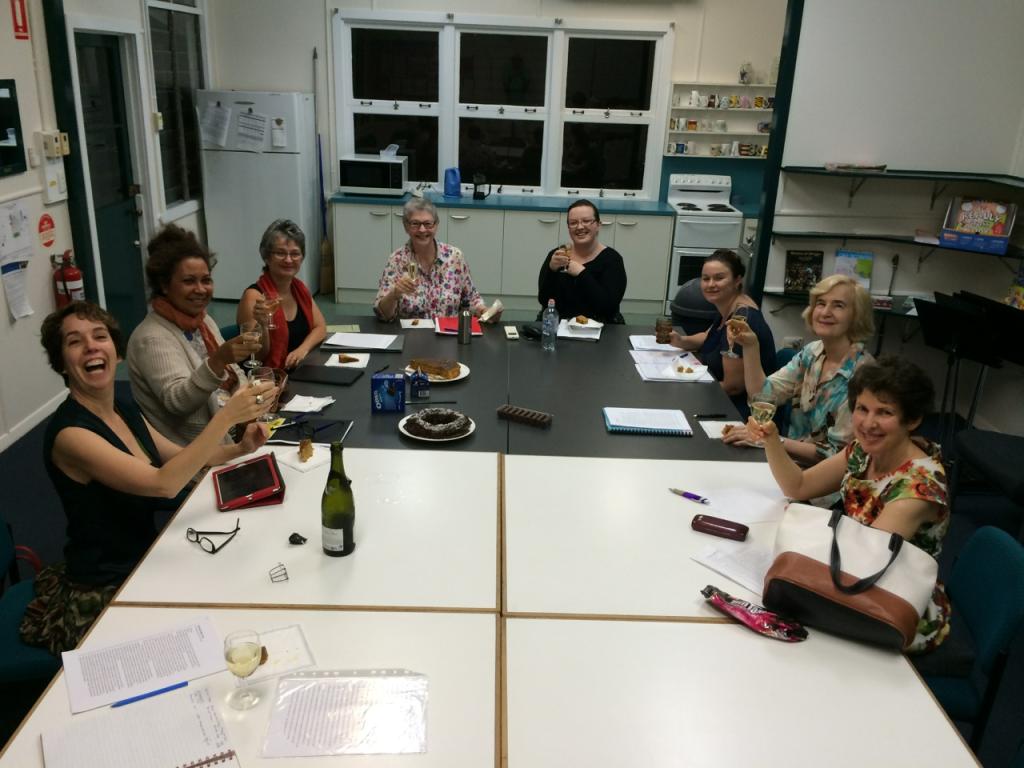
This was how we ended our creative writing workshop this week.
My creative writing group surprised me with champagne and birthday cake last week. Thank you Judy Ward for baking the delicious coffee-chocolate and Orange cakes and thank you Isabel and fellow writers for the champagne and all the snacks. We also celebrated the end of another great term of work-shopping our stories. The eight-week long workshop ended on Tuesday. Many writers in the group have been attending this workshop at Kenmore, Queensland (Australia) for as long as five years. I have been part of the group for two years. Author Isabel D’Avila Winter is a beautifully crazy and an inspiring teacher. Below was the note I got in email before we had our last workshop.
“No reading for next week, because we’ll be too busy eating the leftover TimTams and madly workshopping our work. We’ll also be discussing the upcoming local writing competition, and brainstorming what kind of stories might be suitable to enter,” Isabel D’ Avila Winter.
Isabel is seated in front (left). Other participants included writers of memoir, rural romance, fantasy, sci-fi and crime fiction. We are not all females, we do have two male writers. Tom was not well this night and the other male writer, Bill, took this lovely picture. The group members have planned to enter the local writing competition in August.
I find that being part of this group was a major contributing factor in my story-telling; both in finding constant inspiration to write and sharing my work for an honest feedback. I also enjoy listening to each writer’s story.
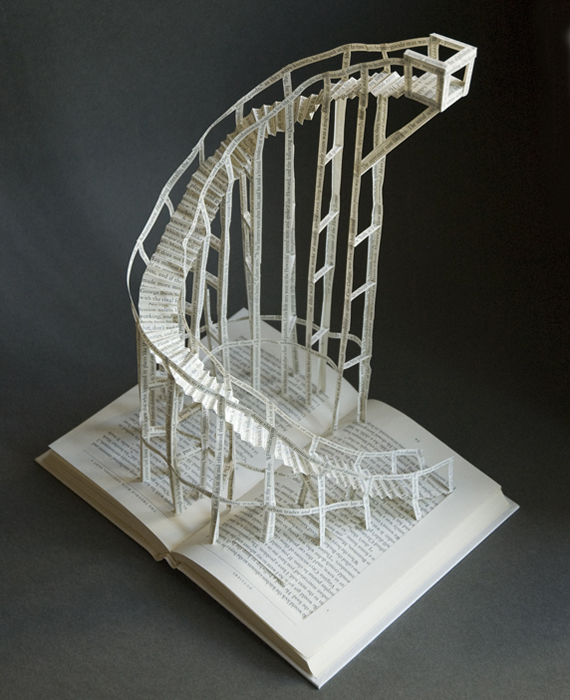
“I make these things as an escape from the world of problem-solving.” Stephen Doyle said. His paper sculptures are exquisite.
I make things from paper myself and I am obsessed with paper. I was fascinated when recently I found this article about Stephen Doyle’s work. I wanted to share it in Cool Stuff.
The Trial
Stephen Doyle’s vision unites words and images in unforgettable ways. The design firm of which he is a principal, Doyle Partners in New York, creates acclaimed identities and all means of conveying them (and he always gets the colors right). He’s also recognized for his visual contributions to the Op-Ed page of The New York Times. Here he talks about another artistic pursuit: creating astonishing paper sculptures. Read More on Impressions from the paper-obsessed
The Llareta is a flowering plant as much as 2,000 years old.
I am about to celebrate one of my big birthdays and today was a mix bag of events. It started with a premature but a lovely morning tea birthday party from fellow staff. We ate ice-cream cake. Weird, but ok. The morning tea was followed by a reprimand from my ordinary boss, he was throwing a tantrum that is not worth mentioning. Then, I caught up with special friends from PNG during the course of X-rays and scans and medical tests leading to my doctor at 2pm, telling me, I must have surgery. I decided to return to work after the doctor’s visit and take a deep breath and keep going until the end of the day.
I have left that day and I decided that I will forget everything ordinary that happened. I only want to remember the extraordinary things and prepare a huge party for my birthday next week. And speaking of ageing, you may know, I enjoy art, reading and writing when I am not outdoors. I have been working on some art projects and looking at art. I found an interesting story about an artist who documented old things from around the world in the last ten years. I am not posting this because I am getting old, it just happened to be something I unexpectedly discovered and somehow, it made sense to link it to age. Aged things always interest me and it was part of my purpose in completing a Masters programme in Museum Studies. Rachel Sussman is a contemporary artist based in Brooklyn. Her photographs and writing have been featured in Smithsonian in The New York Times, Wall Street Journal, The Guardian, and NPR’s Picture Show. Her book The Oldest Living Things In The World sells for $1500 per copy.
From ABC Environment
8 things in nature so old you’ll feel young
THERE IS SOMETHING about extreme age that fills us with awe.
It’s hard not to feel it, when standing in the presence of a huge eucalypt that has raised its branches to the sun since long before European settlement. Or when watching the silent majestic form of an immense whale, which has outlived several generations of humans, glide through the dark blue.
Sometimes it takes a little more intellectual investment to find that awe, like when staring at a grey-green patch of lichen that grows just one centimetre every century and which has weathered the harsh climate of Southern Greenland for more than 3,000 years.
“In thinking about the natural sublime and awe and that sort of thing, a lot of it is tied to scale and to time,” says Rachel Sussman, a New York-based contemporary artist who has spent 10 years researching and photographing some of our planet’s oldest living entities.
Sussman has taken an extraordinary series of photographic portraits, published in her book The Oldest Living Things In The World.
3D facial reconstruction of a young male dated -2500 years from “iberic” period (Spain). The skull was pierced with an iron nail as part of a ceremonial practice. The views were done working on a 2mm cut CTscan, Zbrush, Cinema4D and VrayforC4D. Due to the amount of hair strands each frame had a 45mn render time on a Mac Pro 12 cores with 24GB Ram in HD 1080p format. (This Vimeo video is only in 720p).
Reconstruction done for the MAC Ullastret/Catalonia/Spain (Archeological Museum of Catalonia).
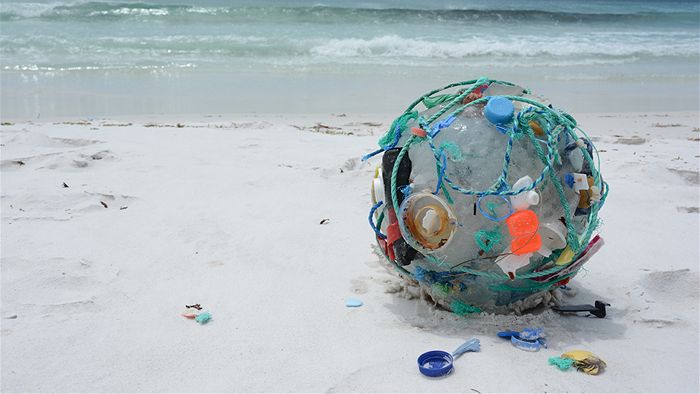
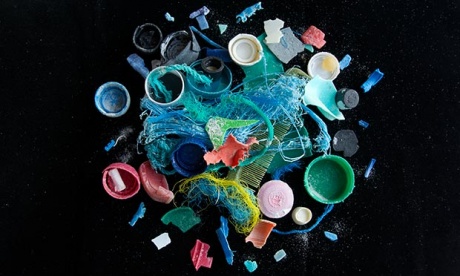
On an isolated stretch of Western Australian beach, artist Tim Pearn creates works from washed-up plastic waste collected over the course of a year on Albany’s Goode beach. The resulting artworks, both beautiful and disturbing, are on show during the Great Southern festival, part of the 2015 Perth festival.
The Great Southern conjures images of pristine coastline and unspoilt beaches. The Western Australian artist is challenging this picture by sculpting with artificial materials found on an Albany beach.40 beach walks. 40 bags of plastic rubbish. That’s all it took for Pearn to collect enough material for his exhibition, On the Beach.
Tim Pearn art
Featuring sculpture, photography and video work, the display uses plastics collected from Goode Beach to create eerily beautiful images of artificial materials in the natural environment.
“I lived on Goode Beach for over a year and started to notice little, tiny specs of plastic and started collecting it. I was amazed how every time I walked down the beach I could pick up a small bag,” says Mr Pearn.
Speaking to the ABC Great Southern Morning show, the artist was struck by the sheer volume of waste he encountered on his regular walks.
“I started picking up stuff to throw away and it just kept coming and kept coming. I started to think ‘What could I do with this?’ and I was amazed that it never stopped really”.
Mr Pearn hopes that his exhibition will draw attention the problem of plastic pollutants.
“It really is a provocative exhibition. I think we’re being very irresponsible in how we use plastic. It’s very useful material if it’s used properly, but we’re really having an awful impact on the environment,” he said.
“The impact of plastic waste is affecting us severely in the Great Southern like everywhere else.” No place left untouched
Dr Jennifer Lavers knows more about ocean plastics than the average beach goer. A marine biologist at the Institute for Marine and Antarctic Studies, Hobart, she has spent considerable time researching the impact of plastic pollutants on marine birds in the Great Southern.
Dr Lavers says the problem cannot be understated.
“It’s absolutely everywhere. Nowhere is immune. From the top of the world to the bottom, from the Antarctic to the Arctic, plastic is absolutely everywhere.”
Dr Lavers studies the health of marine birds, including local mutton birds, to paint a picture of the health of the ocean.
“Seabirds are really reliable indicators to gather the data that we need of what’s happening,” she said.
Ocean plastics feature heavily in her research.
“It’s the main component of what I work on,” said Dr Lavers, who considers the pollutants one of the biggest threats to the environment.
Her research has demonstrated the biological impact of plastic pollutants ingested by ocean birds.
“Once ingested, more toxins such as mercury and arsenic can be found in the bird tissues.”
“The ability of plastic to act as a vector for pollutants is accepted.”
Ocean plastics in humans?
If plastic pollutants are being ingested by marine life, could this be impacting humans higher up on the food chain?
“That’s the million dollar question. That has not yet been proven, but there are various lines of evidence that are moving in that direction,” said Dr Lavers.
“Whilst no one has made a direct link, other independent lines of evidence are quite strong and suggest that we should be worried,” she said.
On the Beach is showing the Western Australian Museum, Albany until March 7, as a part of the Great Southern Festival 2015.
An artist transforms written words on paper into work of art you can touch.
Jennifer’s practice focuses on creating work from paper; by bonding, waxing, trapping and stitching she produces unusual paper ‘fabrics’, which are used to explore the ‘remaking’ of household objects. The papers are treated as if cloth, with the main technique employed being stitch; a contemporary twist on traditional textiles. The papers themselves serve as both the inspiration and the media for my work, with the narrative of the books and papers suggesting the forms. Jennifer tends to find items then investigate a way in which they can be reused and transformed; giving new life to things that would otherwise go unloved or be thrown away.
I found this short documentary made by Planet Doc and presented in Spanish. I tried to watch it and work out what the narrator is saying (without the sub-titles). Don’t worry, for you, there are English sub-titles. There is a sequel to this film which I can post later. I believe a cultural heritage of a person can influence what they value is important and how they present that value in a story. There were certain practices of intangible cultures from Papua New Guinea island tribes presented in this film. It stretched from the Trobriand Islands to the islands of New Britain. I don’t understand what the language (Spanish) the narrator is speaking, but watching the pictures, and knowing the culture, I can see what he is trying to show. Perhaps some Spanish speakers here can figure it out what the narrator is trying to say about the shell money he is showing , from both island traditions.
This is the magic of story-telling. Simply, what you can show your readers. As good writers, we need every possible word that can draw a picture well in our reader’s mind.
I have found these stories very fascinating. One story is about the Japanese monks and the other story is about ancient Chinese statues and an interesting discovery.
Scattered throughout Northern Japan around the Yamagata Prefecture are two dozen mummified Japanese monks known as Sokushinbutsu, who caused their own deaths in a way that resulted in their mummification. The practice was first pioneered by a priest named Kuukai over 1000 years ago at the temple complex of Mount Koya, in Wakayama prefecture. Kuukai was founder of the Shingon sect of Buddhism, which is the sect that came up with the idea of enlightenment through physical punishment. A successful mummification took upwards of ten years. It is believed that many hundreds of monks tried, but only between 16 and 24 such mummifications have been discovered to date.
The elaborate process started with 1,000 days of eating a special diet consisting only of nuts and seeds, while taking part in a regimen of rigorous physical activity that stripped them of their body fat. They then ate only bark and roots for another thousand days and began drinking a poisonous tea made from the sap of the Urushi tree, normally used to lacquer bowls. Read more
Here is another story relating to the same.
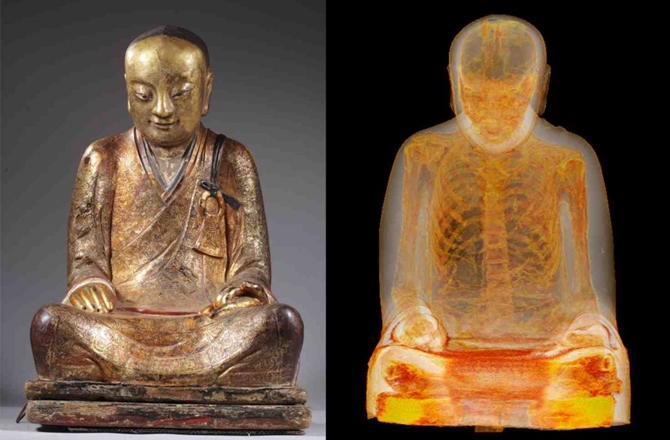
Researchers at the Drents Museum in the Netherlands made a shocking discovery when they imaged an ancient Chinese statue and found a nearly 1,000-year-old mummy inside.
Sitting in the lotus position, the mummy fits within the statue perfectly.
“On the outside, it looks like a large statue of Buddha,” the museum said in a release. “Scan research has shown that on the inside, it is the mummy of a Buddhist monk who lived around the year 1100.”



![Sokushinbutsu4[4]](https://tribalmystic.me/wp-content/uploads/2015/02/sokushinbutsu44.jpg)
 Tribalmystic Stories