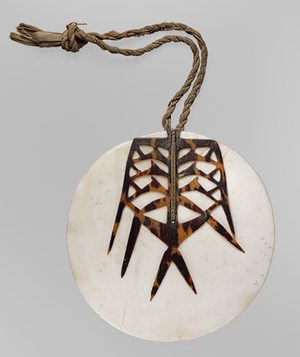
Breastplate (Tema, Tambe, or Tepatu), late 19th–early 20th century Santa Cruz Islands, Solomon Islands Tridacna shell, turtle shell, trade cloth, fiber; Diam. 7 3/8 in. (18.7 cm) The Michael C. Rockefeller Memorial Collection, Bequest of Nelson A. Rockefeller, 1979 (1979.206.1519)
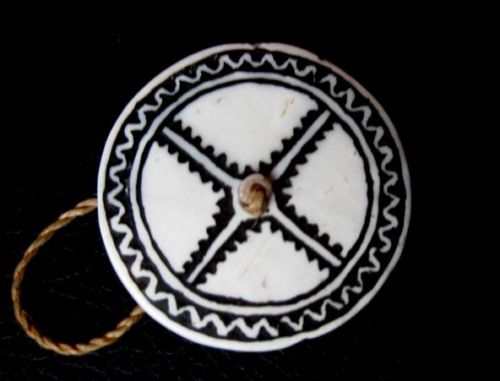
The tema or kapkap are flat, round breast plates or disks made and worn as men’s chest or forehead ornament in the Solomon Islands. Tema is one of my favourite ornaments from the Melanesian region.
Tema from Malaita. Public domain image.
I particularly like the tema because of its spiritual meaning, its stunning appearance and temas take a long time to make, by hand. A A tema in the Melanesian culture is regarded as a spiritual object. They are worn as a protective shield during tribal warfare and for general well-being. The white part of the tema represents the moon. It is made from the giant clam shell. In the Santa Crus Islands, the traditional symbol of the frigate bird, shark or dolphin is intricately carved out of the turtle shell and embedded or attached to the clam shell base. The brown necklace is made from bark and bush ropes.
The wild duck we saved twice, once from the drought (in December last year) and the second time from the python has hatched seven ducklings today in our backyard at Bellbowrie, Queensland. The python had taken one of the two ducks we saved (see story here) last February and the rest of its siblings died from the drought and the cold.
Today, my two sons already saved the seven ducklings from being eaten. As I write this story, I can hear the ducklings quacking in high baby pitches and I am torn between separating them for a safer enclosure or leaving them out in the bush with their mother and father. I have made a warm bed and tried to make their hiding place as safe as it can be but the babies could be eaten before day break. As babies do, they are making too much noise and soon, others will know their hiding place – the swimming pool skimmer box.
If you have missed the story opening published last week, click here
Although peeking through the pale mud with life and vibrancy, the young mangrove regrowth looked naked and vulnerable against the open swamp, and without the mother-tree nearby. In the distant, under the long shadows, piles of de-skinned fallen mangrove laid like stacked cadavers. This was part of an extensive wetland area used for fishing and gathering food like sugo, small snails and Kina, a fresh water mussel. There was some kind of an order in the distribution of the mangrove shoots along the random waterways. It was a peculiar, and neat arrangement. Amongst this orderly disarray, I stood out like the tallest cross in a dwarfed graveyard. The young mangrove shoots only came to my knees, just like the old stumps.
I must remove myself from here, I had thought although this had always been our favourite fishing spot. Today, the place felt strange, unlike before. Before, we would fish for hours and take our breaks on the logs. We ate with one hand and smacking of mosquitoes, then wiping their blood off and scratching the small bite mounds with the other hand. I had been to this place with my Grandma and Aunty Yellow. I also came here with my cousin Alison before she lost her mind to Malaria. I should not have been here alone today.
Once when Alison was eleven and I twelve we spotted a stranger here. On that day, we had brought with us Tinang’s (grandma) bush knife, which we were forbidden to use. The bush knife had cost a lot of money and one bush knife served many families in many ways. It turned out, the man we had seen was not a stranger, nor was he real. From his actions and the way the Sockwing (a type of wag-tail) birds were calling, my cousin and I became alarmed and we ran off, leaving grandma’s bush knife behind. I had to run back and get it. If we had left the knife there, we would have been punished for taking the bush knife. We were told that same evening, the man we had seen was a spirit of a dead great-uncle. This too was his favourite fishing spot.
I thought I saw a movement and my eyes tried to focus. Nothing seemed out-of-place, and everything around me looked like it had always been.
The Japanese bombing in the Second World War left a large gap in the wetlands. The bombs opened the place as wide as a soccer field, and made it lifeless; right in the middle of the thick mangrove that was relished by fish, birds, snakes, lizards and all kinds of insects. My Aunty Yellow said, in the open centre, mangrove regeneration since the bombing struggled for decades. The bomb explosions took both natural and human lives; our great-uncle was amongst those.
Apart from the war, this place was a landmark because the mouths of many small creeks gathered into the head of the largest one, which flowed into the main river, named Bu-dac. Budac meant Blood River, a name that reminded us of our history.
Our house was built along the river near its centre and at the entrance to our village. In pidgin, it is called, maus-rot which means mouth road.
I was standing at the head of Budac. There was a large T-junction, where the main creek met the river. The swamp clay was very soft and pale and covered with dead rotting leaves. In the dark river, life existed; a place where fresh-water fish feeding, spawning and nursery took place. Fish gathered daily to feast on other fishes and debris collected and deposited by the creek as well as the river at this meeting point. Not today, I had not seen fish movement breaking the water rhythm nor its surface. I could not understand nor remember why I was here today, and alone – only a few kilometres away from our village, just outside Lae, Papua New Guinea.
SWAMPED (Copyright JLeahy on Creative Writing Wk 3)
Mangrove stumps – Public Domain
The river emptied rapidly as the new day reluctantly begun. The sun had not yet arrived for warmth was lacking. I stood facing the river, able to see the creek. A war that was not ours took many of my family’s lives here, on this customary landmark. The small creek had reduced to a thin flow of a silver running snake. It slithered along a dark swampy path, often picking up flashes of light from the sun on its scales. The flashes only came when the mangrove trees allowed the sunlight trickle through its dense, green-yellow leaves. In contrast to the creek, the river was fuller, darker and moved in a quiet menacing meander. I was the tallest, standing amongst the mangrove stumps. Around me was hazy with un-condensed dew and I could not find my way, even though I had been here many times. I could almost smell the dank, which hung in a strange and familiar blanket.
This is the opening of a short-story (non-fiction) for our exercise in the Creative Writing Workshop – Kenmore. I wanted to share the opening with you. I may post more depending on how the story ends up. It may become a chapter in the JL memoir. I hope you like it.
The SBS News brings us the first carbon positive pre-fab home in Australia. This house and the news made my Cool Stuff list.
Carbon zero is the benchmark for best practise when building today, but in the future the federal government expects so-called “carbon positive” buildings to play an increasingly important role limiting global warming.
In a significant step forward in efforts to reduce emissions, Melbourne-based architects have designed what is being billed as Australia’s first carbon positive pre-fabricated home.
Here is a short video of the house and to read more click on the link below. SBS News clip or read more here
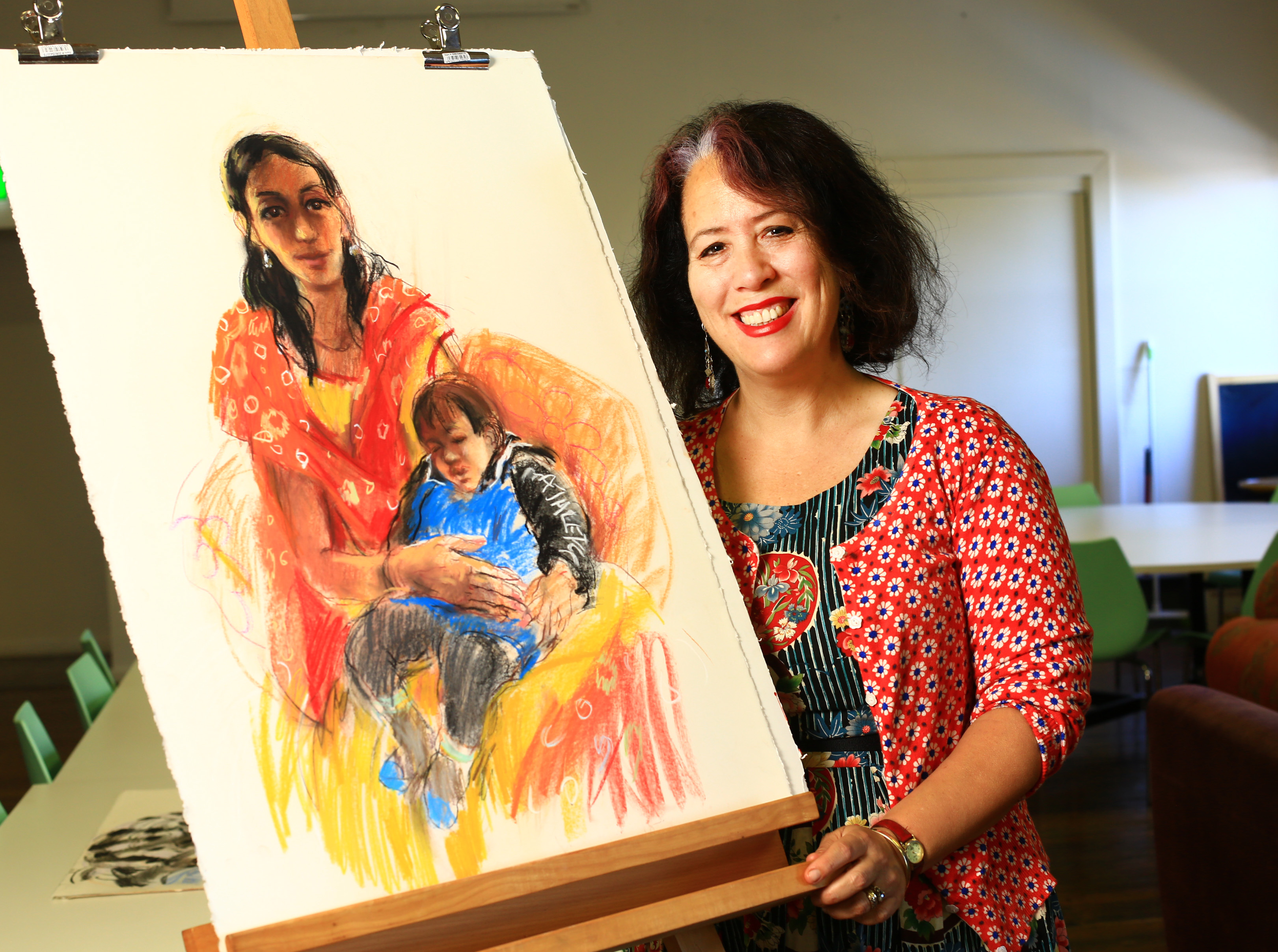
‘Seeking Humanity’ is an art exhibition by renowned Australian artist, Wendy Sharpe. It is not about politics, but puts a human face to those who have fled situations of great danger in their home country in search of safety and freedom in Australia.
A previous Archibald winner and 2014 finalist, Wendy has drawn portraits of 39 asylum seekers and refugees. Through her art, she shares their lives with us to show that underneath all the troubles and politics around the issue, we are all the same; we all have the same hopes and dreams. The show will start on February 17 and end on May 24 in Penrith, Sydney and Canberra.
‘Seeking Humanity’ is brought to you by the Asylum Seekers Centre. All portraits will be on sale with proceeds going to the Centre to help provide practical and personal support for asylum seekers.
Click on the link and press play to watch Wendy draw live.
Curled into a ball, our spiny visitor on the floor of the workshop in Bellbowrie – Picture by Flynn and Chris.
One of the luxuries of living in the Australian bush is the unusual ‘visitors’ we get. So, far in the three years we have lived in Bellbowrie, Queensland, we have had some interesting ‘visitors’. We have had the slithering kinds, the furry kinds, and scaly kinds, and two days ago, a spiny kind.
My younger son Chris and his friend Flynn were downstairs in Chris’s workshop and they heard a noise of something knocking thinks over. With their phone lights, they saw a dark mop run to the corner and wedge itself between a child’s chair legs. I kept these chairs for children’s art classes. Even when they had switched the lights on, they could not tell what it was. When they got closer, they were surprised and started yelling in excitement. We all rushed downstairs to see what it was.
Wedged between the small chair legs was a frightened little spiny ‘visitor’ – an echidna. The poor echidna was so frightened that it rolled up in a ball with its head between its front legs. The boys carefully removed the chair to take the picture above and then put it back. We never got to see its face and after half hour or so, with the lights off, it disappeared.
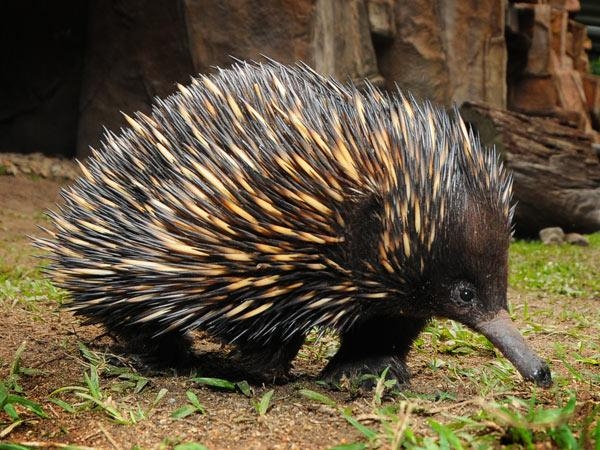
‘Dame’ here is a male short beak echidna that lives in Australia zoo and is much-loved by all the zoo keepers. Photo: Australia Zoo
Judging from what I saw and the image Chris and Flynn took, this spiny visitor was a short-beak echidna (Tachyglossus aculeatus). It is also known as the spiny anteater. There are five sub-species of this echidna in Australia. The Echidna generally is a highly adaptable creature and can be found in coastal forests, alpine meadows and interior deserts of Australia. They weigh up to 6 kilogrammes and can grow up to 45 centimetres. Read more here
After all this time, this spiny ‘visit’ finally solves the mystery of the half-moon shape hollows dug into the base of plants in my garden. The markings would have been made when it was looking for ants, baby roots and worms to eat. I have been blaming my chickens and the bush turkeys for these markings.
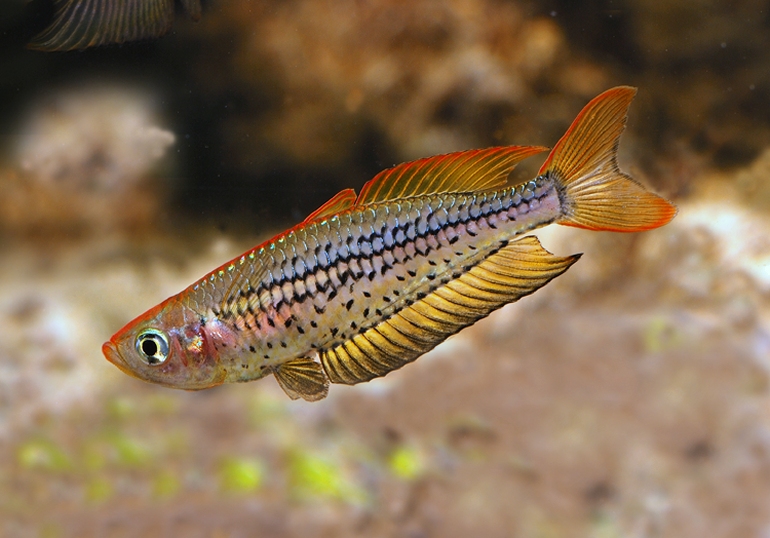
The ornate rainbow fish (Rhadinocentrus ornatus) is a small and beautifully coloured freshwater fish. You don’t often spot them straight away in dark creek ways because their colours show when the light catches their scales. Few populations of these fish are scattered in freshwater creeks in parts of Brisbane where I live, and some creek systems in Queensland’s Redlands, Moreton Bay and Byfield regions.
Ornate rainbowfish (R.ornatus) Castaways Creek Photo Leo O’Reilly/ANGFA
The ornate rainbow fish, also known as soft-spine sun-fish can also be found in Nambucca, New South Wales. Four distinct populations have been found in the areas between Queensland and New South Wales.
The numbers of the ornate rainbow fish have decreased rapidly due to human impact. Urban and rural development have caused experts to fear that certain species of the fish have already been lost forever. Every creek in the parts of Australia where the fish is found, has its own unique population which varies in colour and scientists believe they could also be genetically exclusive. The ornate rainbow fish on average grows five to six centimetres long. They can grow up to 8cm long.
“The sad tale is that every time we lose a population of ornate rainbow fish from a creek system we are effectively losing a very unique group of fish forever”, Wildlife Queensland.
Wildlife Queensland has issued a fact-sheet for voluntary information on spotting of the ornate rainbow fish. They hope this data collection would determine where the fish are still found and how many types are left. The information would also assist Wildlife Queensland to educate the public and minimise threats to the fish life.
I really liked the story about the missing shoes and I accidentally came across it while having a conversation with my son. I enjoy conversations with both my sons because I learn a lot from them. When they were younger I still learnt from them, but, it is nothing like the age now where they are growing into young adults and they have their own views and interests. Nathan, my eldest (19) is a storyteller so he often suggests some interesting topics for my readers. While I bring you some of these interesting topics, I have personally learnt a lot from reading these topics myself. In a way, life as a parent starts by being a teacher, and eventually your children become your teacher and you are their student.
Together, Nathan and I watched a show called the Drunk History this afternoon. It is a comedy about drunk actors re-telling history. The show was quite funny. One of the historical features in this show caught my attention, and in a more serious way. It was a story about the Native American super athlete, Jim Thorpe. Now some of you may know that Thorpe was celebrated for his legendary achievements in athletics and football. Thorpe’s life before he became an athlete was quite moving. What caught my attention and I found to be truly inspiring, was a story about Thorpe’s participation in the 1912 Olympics and what he did (as pictured) when his running shoes went missing.
And, yes, he’s wearing unmatched , different sized shoes he found in a garbage bin at the Olympics. This didn’t stop him from winning two gold medals.
As Wheeler details in Jim Thorpe’s biography, Thorpe’s sneakers went missing before the final event of the 1912 three-day Olympic competition.
Thorpe’s emergency plan led him to burrow through the trash for a shoe too small then borrow a shoe so oversized he had to stuff it for his foot to fit.
What the mismatched pair produced was his magnum opus in the finale, winning the 1,500 meters in 4 minutes, 40.1 seconds – a time that a gold medalist decathlete wouldn’t beat until Mykola Avilov ran a 4:22 at the 1972 Munich Olympic Games.
“That story always evokes the greatest response when I share it,” Wheeler said. “I think it can still inspire generations to come. I think in the case of Jim Thorpe, the true story is just as good, or better, than the mythology.”
When people make lists of the greatest athletes of the 20th century, they are populated with the usual suspects: Michael Jordan, Babe Ruth, Muhammad Ali, Serena Williams, Wayne Gretzky, Jim Brown, Pele… but there is one name that should always make the list even though many people, even the biggest sports fans, may not recognize it, or if they do, they know little about the man- Jim Thorpe.
The story of Jim Thorpe is one of determination, triumph, tragedy, racial prejudice, controversy, and extraordinary athletic achievement. Born approximately May 28, 1887 (the exact date has been disputed) in a small one-room cabin near the town of Prague, Oklahoma, Jim was the son of a farmer named Hiram and a Potawatomie Indian named Mary James, who was a descendant of the famed Native American warrior Black Hawk.
Jim, or by his Native American name Wa-Tho-Huk meaning “Bright Path,” grew up on Native American land fishing, hunting, playing sports, and learning from tribal elders. He was actually born a twin, having a built-in best friend and brother to play with. Unfortunately, when Jim was only nine, his twin brother died from pneumonia.
The stress of losing his brother caused Jim to act out and he was sent to an “Indian” boarding school in Lawrence, Kansas. A few years later, his mother would die while giving birth. Shortly thereafter, his father died as well.
Left an orphan, Jim fled his hometown and began attending Carlisle Indian Industrial School in Carlisle, Pennsylvania. The school was founded by United States General Richard Henry Pratt in 1879 with the purpose of integrating Native Americans into the American way of life by “eliminating their Indianness.”
It was there that a 17-year old, depressed Jim Thorpe walked by the school’s track & field practice on the way back to his dorm. He saw all the boys running and jumping and later said he thought to himself “I can do that better than they can.”





 Tribalmystic Stories