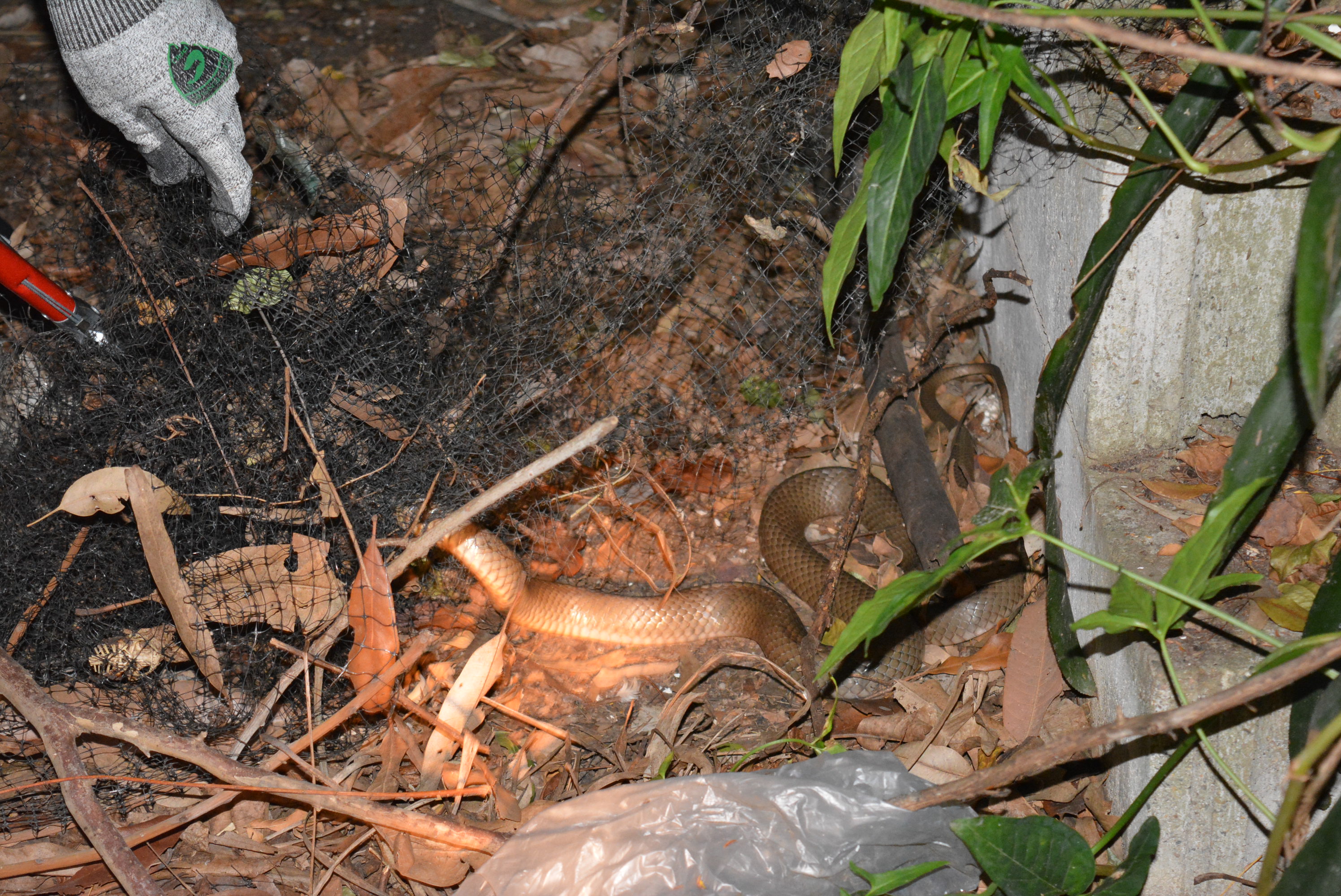
An Eastern Brown snake caught in the net – before it was set free. JK.Leahy picture.
This evening, when I called a Brisbane snake catcher to save an Eastern Brown’s life, I did not expect him to be married to one of Australia’s top romance authors, Ally Blake.
…………..
My younger son Chris had told me on Saturday night he had seen a large snake by the house, but it had gone. I wanted to check the surroundings but it was too dark when I returned from my recent trip to Papua New Guinea. After work today, I checked around the house to make sure no slithering kinds were lurking in the dark corners outside the house. This is the season for hibernators to emerge. Sure enough, at the back of the house, in the shady leafy spot among layers of fallen leaves and a stone wall, the fish net moved from side to side when I approached.
I knew it was alive, and I could see the beautiful long golden tail tuck away instinctively. The head was locked into the nylon knots in an awkward angle. It was an Eastern Brown, about a metre and a half long. We had caught a large male two years ago in the same spot and freed him into the Brisbane City Council wildlife reserve. This one was surprisingly alive and strong after several days in the net. The Eastern Brown snake accounts for more fatalities than any other Australian Snake. It is the second most poisonous land snake in the world and the most poisonous in South east Queensland.
The snake we caught looked exactly like this Eastern Brown. Picture courtesy of Queensland Museum.
I quickly ran back into the house to phone for help. From 5:30pm today, I called six snake catchers, one after the other – they were all busy. Finally, the fifth snake catcher who was heading three hours out-of-town told me to call Mark, the Bellbowrie snake catcher.
Mark told me he was away, but he would get to Bellbowrie in half hour, and if I had not found anyone else, he would set the snake free or take it away for a small fee. Mark also said he lived in Bellbowrie. I told Mark, I just wanted to make sure, the snake did not die.
After 45 minutes, Mark arrived. Armed with my torch, camera and his hoop, net and snake-catching equipment, we ventured into the back of the house where the snake was. Mark is an environment scientist and like me, he was more concerned about saving the snake’s life. I was relieved when he told me that.
As Mark tried to undo the feisty Eastern Brown, we had a conversation about other things and I mentioned casually that I had to leave soon to attend a creative writing workshop.
“Really! My wife writes romance novels. She has written 32 books”. Mark beamed.
“Who is your wife?”
“Ally Blake”.
“Wow!” – that was all I could say. Mark’s wife, Ally Blake is one of Australia’s top romance authors with over 4 million copies sold world-wide. She has published through Harlequin Mills and Boon, Entangled Publishing and Tule Publishing.
Mark catches snakes part-time, and only because he loves them, and he wants to protect them. He said most people he helps to catch snakes or removes snakes for – want the reptiles dead.
When Mark could not untangle the snake, he suggested it was safer to take the reptile with part of the net to his house. There, he was better equipped to relax the reptile and properly treat its injuries and rest it before releasing the snake into the local reserve.
Mark said the snake was a female of a few years and that females tended to stay at a favourite spot and the males come to visit.
“If you see two snakes wrestling, those will be two males fighting for her,” Mark said.
That was not really the news I wanted to hear – but a lot of changes will be happening this weekend to the snake’s favourite hiding place.
I have to also check out some of those romance novels by Ally Blake.
The Australian Government keeps track of endangered and extinct species through the Environment Protection and Biodiversity Conservation (EPBC) Act list. Australia is home to one million diverse species in the world.
The above slithering creature’s safety has caused a stop to a coal mine in Queensland.
ABC News reported a recent Federal Court decision setting aside approval of the Carmichael coal mine in Queensland has sparked debate about whether courts should have that kind of power.
The court was sidelined because the government had not properly considered environmental advice for two vulnerable species in the areas.
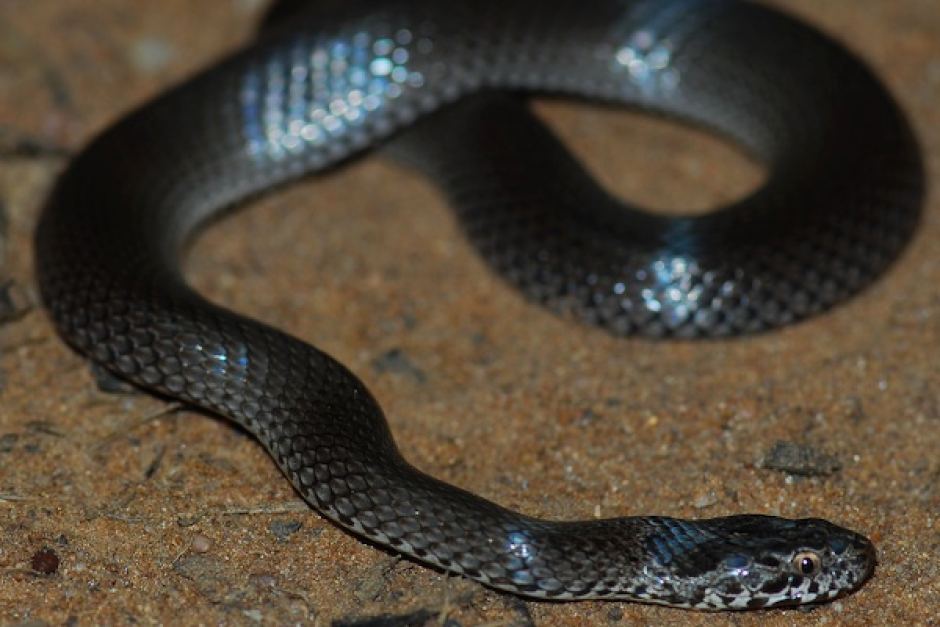
The pictured ornamental snake (Denisonia maculata) is on the EPBC list as vulnerable. It is one of two animals that were the cause of this court decision to overturn the mine approval in Queensland.
The fact check has confirmed of the 266 extinct species in the world, Australia lost 25. Pictured below, the Tasmanian Tiger is one of them.
From ABC News File: The Tasmanian tiger was declared extinct in the 1930s. Surveys to determine whether the Tasmanian tiger (Thylacine) was extinct or not began in the 1930s.
Extinct species
USA 266
French Polynesia 89
Mauritius 46
Saint Helena, Ascension and Tristan da Cunha 36
Australia 35
Source: IUCN Red List tables 6a & 6b
While described as one of the most dangerous birds in the world, cassowaries are beautiful large flightless birds. I have posted a story about threats to cassowaries in Northern Queensland due to their habitat destruction. Read Here. I had mentioned the value of cassowaries in Papua New Guinea (PNG) in that post and I wanted to show what this bird means to our people. This legend comes from Garaina, in Morobe Province. I also come from Morobe. The legend was contributed to a national high school collection of legends told Stephen Suij.
How the Cassowary became a Flightless Bird – A Legend from the Morobe Province, Papua New Guinea.
Long ago, the cassowary was a big bird with a long neck, large legs and big wings which enabled it to fly like all other birds of the forest.
At that time, the cassowary and the hornbill were best friends, and spent most of their time flying around together, feeding on the delicious fruits at the top of the trees.
They were very close friends, but as time passed, the hornbill became increasingly jealous of the cassowary, who with his long neck could stretch and reach the best of the fruit pickings. The poor hornbill had to be content with leftovers.
While the hornbill hid his jealousy, he began to plan a trick to punish the cassowary.
A Hornbill Picture by Waterdragon62 – Flickr Photo-sharing
One day the hornbill broke two dried sticks off a tree branch, placed them beneath each wing, under its feathers, and then flew off meet the cassowary.
“I have an idea”, the hornbill said to the cassowary.
“After we have fed on the fruit and are fully satisfied, let us do some stylish tricks in the air to see who is more brave and skilled.”
“Sure”, the cassowary said – liking the idea.
“But”, added the hornbill, “each of us must break his wings to see how far he can fly with broken wings.”
The cassowary had no objection to this ‘idea’, so when they had eaten enough fruit, they were ready for the game. The hornbill volunteered to go first.
Pretending to break his two wings, he snapped the two dry sticks beneath his wings and then flew away. He performed some stylish tricks in the air and then flew to a nearby tree to perch. The hornbill then called the cassowary to try to outwit his tricks.
The cassowary, ignoring the pain he had to suffer, broke his wings, one by one. Then he stretched the wings to fly away but he only crashed to the ground. He could not lift his weight with broken wings.
The hornbill broke into laughter at the top of his voice he said, “you have always had the most and the best of the fruit, but now you can stay on the ground and feed on my waste while I enjoy the best of the forest.”
From that day until today, the cassowary has been a bird of the ground, with wings that could not fly.
Flightless Feathered Family
The cassowaries are ratites, very large flightless birds in the genus Casuarius native to the tropical forests of Papua New Guinea, nearby islands and northeastern Australia. There are three extant species recognized today.
The most common of these, the Southern Cassowary, is the third tallest and second heaviest living bird, smaller only than the ostrich and emu.
Cassowaries (from the Malay name kesuari)[3] are part of the ratite group, which also includes the Emu, rheas, ostriches, and kiwis, and the extinct moas and elephant birds. The other two species are the Northern Cassowary, Casuarius unappendiculatus and Dwarf Cassowary, Casuarius bennetti. They are also found in Papua New Guinea.
A PNG warrior wearing a cassowary feather headdress. Picture by Brent Stirton
Cassowaries are very important to the native people of New Guinea both economically and ritually. Cassowaries have been traded for pigs and even as bride price for a wife and compensation payment especially in the highlands provinces .
Some tribes hunt them for their meat which is considered a delicacy. They use the feathers to decorate headdresses, and the feather quills for earrings. The sharp claws are often placed at the tips of arrows, while the strong leg bones are used as daggers.
For many native people, cassowaries are full of legends and mystical powers. Some tribes believe that cassowaries are reincarnations of female ancestors, while others believe that the cassowary is the primal mother. These tribes do not hunt or deal in trade with cassowaries.
Papua New Guinea (PNG) is home to the world’s largest butterfly – the “Ornithoptera alexandrae” or Queen Alexandra birdwing. Its wingspan can grow to 25cm. Queen Alexandra only breeds and lives in the Managalas Plateau in Eastern PNG or Oro Province. The butterfly numbers are unknown, and its habitat is increasingly disappearing. There are also concerns that the number of the large butterflies are depleting.
The Queen Alexandra’s Birdwing is on the red list of threatened species of the International Union for Conservation of Nature (IUCN), and its international trade is banned. From the perspective of species conservationists, the butterfly satisfies all of the criteria to make it a critically endangered species.
Walter Rothschild discovered the species in 1907 and named it after Alexandra of Denmark. The first European to discover the butterfly was one of Rothschild’s employee, Albert Stewart Meek during their expedition to Papua New Guinea.
Female Queen Alexandra image from Manchester Museum collection.
Unusual Reproductive Biology
The threatened butterfly is vulnerable because of its unusual reproductive biology. The female lays its eggs exclusively on a poisonous vine called Aristolochia. Once the caterpillars have hatched, they ingest the plant’s toxic leaves, making them unpalatable for potential predators.
The Aristolochia winds its way up into the crowns of jungle trees, which can grow to heights of up to 40 meters (131 feet). The butterfly would be lost without the vine, so propagating the Aristolochia is one of the main goals of conservationists.
Male Queen Alexandra image from Manchester Museum collection.
Australia’s iconic Cassowary is under threat of extinction.
I personally love the cassowary bird because of its unique beauty.
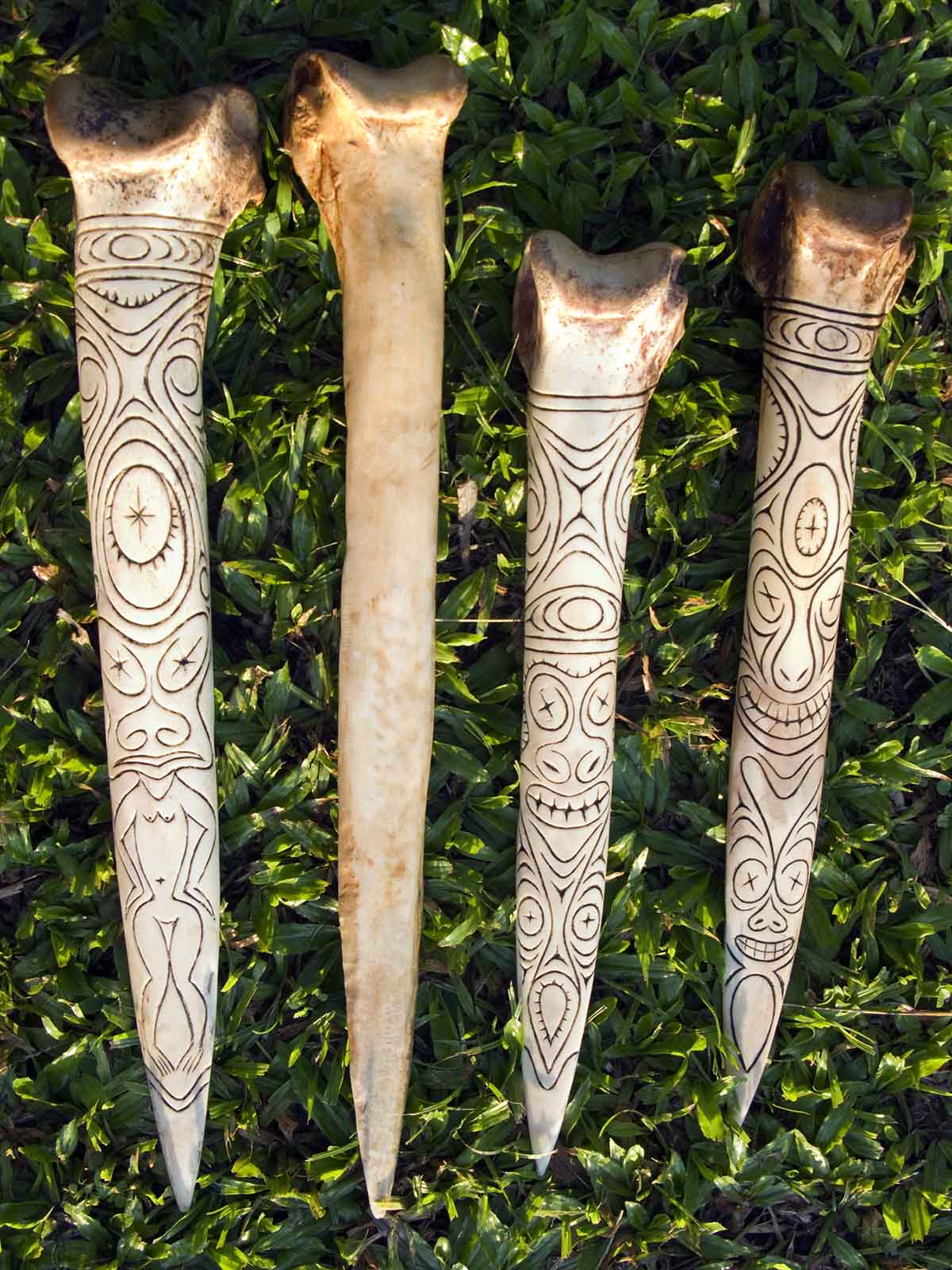
In Papua New Guinea(PNG), the cassowary is highly regarded in traditional myths as a source of life and spiritual energy. While cassowary is food in PNG cultures, it is also kept as a pet. Cassowary feathers are used for headdress and bones used for tools. I remember my grandfather (mother’s father) kept a cassowary wing bone he used to stitch sago leaves together for our roof. Some tribes, foe example the Abelam people in Sepik have used the femur of the cassowary birds to make weapons such as daggers (pictured below).
Cassowary daggers
The cassowary lives in north of Australia and PNG. I constantly read articles about the near-extinction of this giant bird and I wanted to share the awareness that if we in Australia (and PNG) are not careful, we will lose this species.
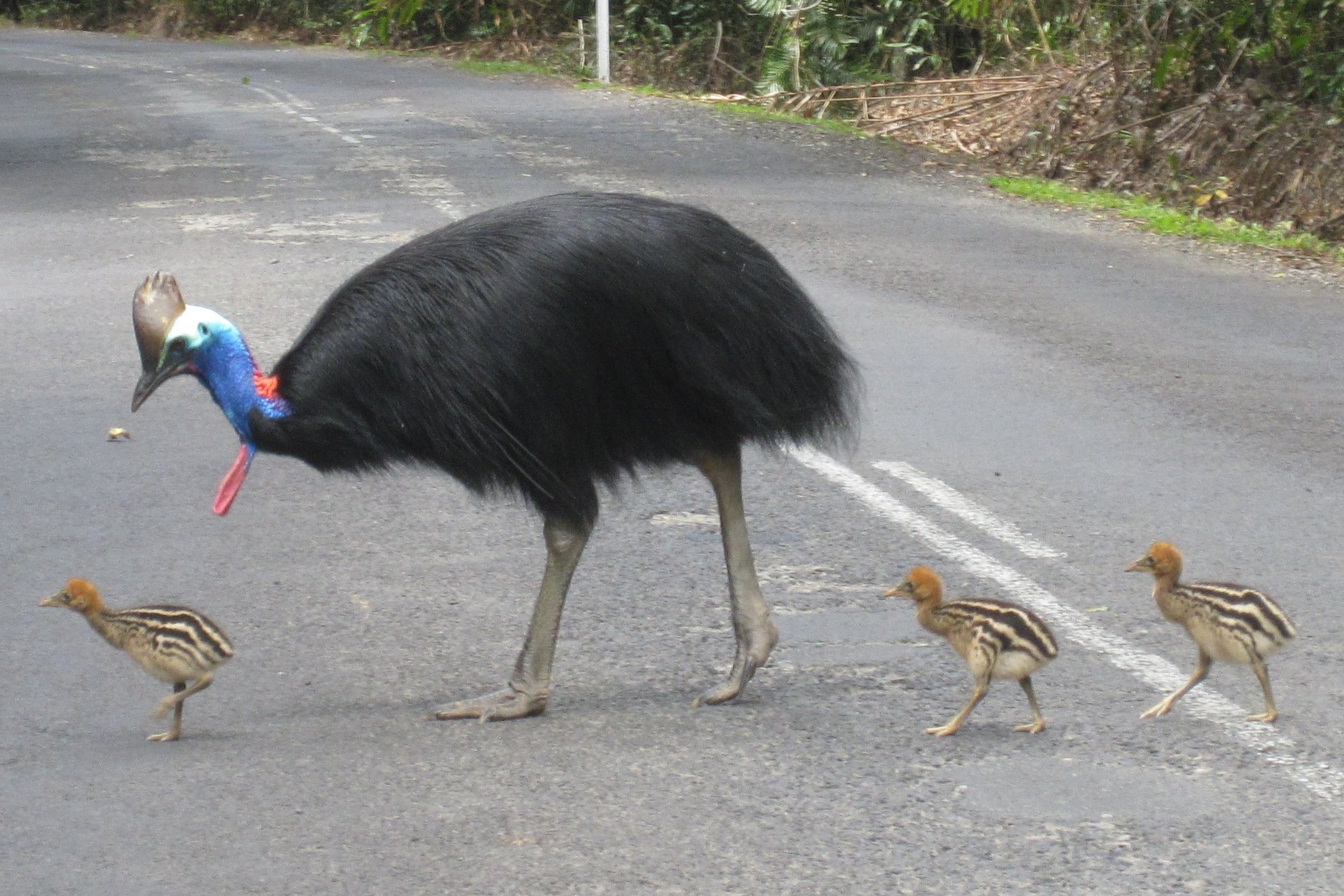
Southern Cassowary with three chicks crossing a road (photo courtesy of S. Hardy & D. Johnston) [Daintree to Port Douglas road, QLD, August 2013]Why did the cassowary cross the road?
This question is no longer a joke.
According to Megan Neal at Houston Zoo website:
“Unfortunately, there’s no punch line and the situation is no laughing matter. Habitat loss and fragmentation have left the Australian population of cassowaries on the brink of extinction. These huge birds need large amounts of land to roam in search of food and to breed”.
Like other species, cassowaries’ habitat have been repeatedly destroyed by the boom in residential and commercial construction. Everyone wants to live near the rainforests of Australia, but there’s simply not enough room for everyone.
The Australian Conservation Foundation (ACF) answer to the question gives another example of the problem. The cassowary crossed the road because its habitat has been chopped in half by a freeway. So far this year, more cassowaries have died from speeding cars, dog attacks and habitat loss than in all of 2014.
ACF report said the modern-day hazards are now increasing the extinction risk.
“While local groups are doing great work to protect these gorgeous creatures, governments need to catch up! We need to transform our national nature protection framework so local, state and national laws work in together to protect life in Australia”.
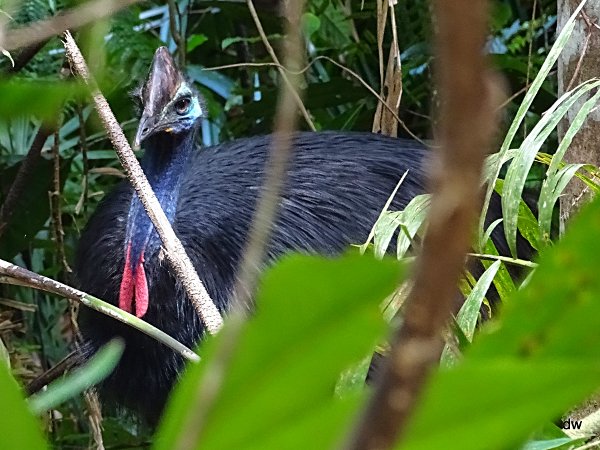
Near-frontal view of a female-Southern Cassowary (photo courtesy of D. Wilczynska) [Daintree NP, QLD, March 2015]The cassowary is far-north Queensland’s flagship species for both the tourism industry and the World Heritage rainforests.
It is an iconic and unique species that deserves better than the devastating carnage it faces on regional roads throughout the Wet Tropics.
Sadly, 2015 is off to a particularly bad start for the endangered – and rather large – flightless bird with reports of at least six cassowaries killed between Mission and Bramston Beach this year.
Another cassowary was killed recently by domestic dogs on the Atherton Tableland.
Until recently, the remaining wild population was thought to be at around 2000. However, new research by the CSIRO estimates that the cassowary population may be more than double that at around 4400.
But this number is spread over 730,000 hectares of potential habitat with strong populations known in some areas and few or no records from other areas.
BYRON BAY WRITERS FESTIVAL IS THRILLED TO ANNOUNCE THE FIRST ROUND OF WRITERS APPEARING AT THE 2015 FESTIVAL.
Julia Gillard
Five successful and talented Australian women have top-billing at the 2015 Byron Bay Writers Festival from August 7-9. In what is shaping up to be a Festival showcasing a line-up of strong, female Australian voices, the first five announced were former Australian Prime Minister Julia Gillard, Joan London, Helen Garner, Kate Grenville, and Jackie French. More writers will be announced soon.
EARLY BIRD TICKETS ON SALE FROM 17 APRIL!
Already the Festival is shaping up to deliver a diverse and eclectic program of stimulating and engaging conversations with some of Australia’s most celebrated writers and international guests in the Festival’s history.
Festival Director Edwina Johnson said she was delighted to be bringing the best writers and thinkers together to share stories, triumphs, challenges and ideas; to debate, laugh and cherish; to connect, nurture and celebrate literary talent and new friendships down by Byron Bay’s scenic ocean shore.
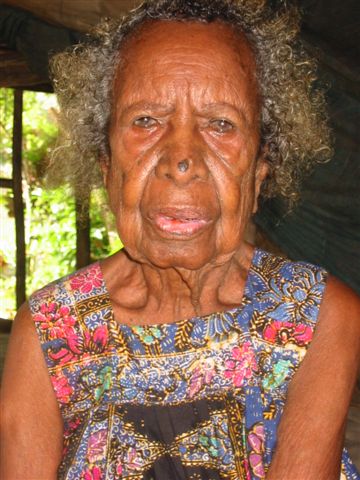
My grandmother Geyamlamuo Poaluawe Baim (Geyam) was born on 4/4/1919. She died in 2008 while I was away in Vietnam on a university field trip. Like many others she raised, I called her Tinang which means mother. I miss her so much even though I know, she is always with me.
Dew glistened on blades and seed pockets as we walked through the thick wet grass. My sun-tanned legs were studded in pale green grass seeds. I wore my brown shorts and an old white T-shirt, ripped on the shoulders with pin holes all over. It was cooler and easier to work in. I was turning eight and tall.
“Jesus loves me this I know, for the bible tells me so”, I sang quietly as grandma and I headed for our garden. Tinang sang with me and then stopped. The morning was cool and the humidity took its time to arrive. I tried pushing the grass apart with a stick before stepping into the track so I would not step on toads, snakes or get wet. My feet were covered in mud. If we did not go to the main market in Lae town, Papua New Guinea on Saturdays, I would be out fishing or gardening with Tinang. I was glad Tinang’s elephantiasis leg did not swell up today and I knew even if her foot bothered her, she would have never mentioned it.
We had left the main road to Wagang village and were crossing the wet over-grown track to our old garden. The old and new gardens were side by side. We needed to pick up some young banana shoots, tapioca sticks and kaukau (sweet potato) leaves for the new garden. It was almost 8am. I knew the time because the ambulance had come to pick up my uncle for work at 7am and we had walked an hour from the village. We stopped to visit my aunt; otherwise it would have taken us half hour to 45 minutes. Our garden was further away than other gardens.
“Ampom Mamang!” grandma whispered suddenly.
Tinang at her home in Lae 2006.
That was a very quiet order, telling me to stop singing.
Over the birds’ songs and the wind rustling the leaves, I could hear voices and wood chopping.
“They are close” grandma said.
“Who were they?” “What were they chopping on our land?” I needed clarity but grandma’s eyes indicated – now was not the time.
We both stood still and listened. We could not see anyone yet. I knew the noisemakers were not our villagers. They spoke a different language and sometimes in conversation, they would speak pidgin. This meant, “they” were outsiders, most likely the squatter settlers. We called them Kaii. This word means foreigners. Tinang and I had no idea how many they were.
Tinang signed that we would take a short cut through the trees and hide in the bushes near our coconut trees. The trees were planted as a landmark close to the boundary of the Martin Luther Seminary. This spot had some vines and thick undergrowth. Beyond the seminary, our tribal land was occupied by hundreds of illegal squatter settlers. They came from Morobe Province and the highlands of Papua New Guinea. Many settlers had lived there for up to three generations and claimed the land as theirs. Often, there were fights between villagers and the settlers.
As grandma and I got closer, the sound of chopping became distinct. People were talking and laughing. They joked and laughed as they went about their business.
Through the thick undergrowth and heavily entwined creepers, we counted seven adult male. Three had ‘weapons’ – two knives and one axe. Grandma and I only had one bush knife. I looked at her and then I watched the others break the dry firewood and stacked them on bush vines – prepared to be tied into a bundle.
Tinang made eyes to be quiet and move quickly. She was almost sixty, but she could move quickly even with her bad leg. She cut a long creeper and removed all the leaves. It was strong and several metres long. Then grandma cut the second one and did the same thing.
Two of the men started playing and chased each other and one jumped almost into our secret hiding place under the vines. I froze. The man fell two metres away, got up and ran and playfully pushed his friend over.
His friend tripped over some Hessian bags and fell. It was the first time I noticed the old brown bags were filled with food. We called these bags “copra bags” because our people sold their copra in the bags. I counted seven bags and four bundles of bananas. They could not get anymore bananas because I knew from last week, only four were ready to harvest. They did take a lot of sweet potatoes and tapioca. They also had taros that I could see from the open bags. They men harvested our gardens for themselves and now to top it off, they helped themselves to our firewood. They must have begun this thieving trip very early this morning I thought and I felt very angry.
I looked at grandma and she was very busy tying ropes in different parts of the bush – it was like, she was setting up a rope trap. I wondered how we would catch these grown men in our rope traps. I was afraid.
I lifted my chin in a question to grandma and made eyes at the ropes. She signalled me to wait and see. Once she tied the two creepers on all the small Aducbo trees, she brought their ends to one spot and told me to stand there and get ready to pull. I grabbed the robes and took my position. She worked under the vines and tied all the trunks of small trees in a semicircle.
Tinang cut two more strong thick vines and quietly under the cover of the vines, she creeped around to the opposite of the spot where I was. She winked at me and smiled. I knew she was up to something and although I was afraid of the men, I was confident she had a good plan.
After she tied the ropes at her side, grandma returned to me and asked.
“Are you afraid?”
“No Tinang” I said and smiled at her.
She hugged me. Then she whispered in my ear that she will give me a queue when she starts yelling abuses – I must, in my loudest and scariest voice scream and be very abusive as well and pull the two ropes at the same time.
The words I was to scream out were; ”What are you doing? What are you doing on my land?” “We will kill you, we will get you! We are coming for you!”
Grandma returned to her position and she stared hard at me and nodded, I nodded back and she started pulling the trees and screaming abuses. All the trees became alive in a semi-circle. I was surprised.
Caught off guard too, the men ran in my direction and I started doing the same thing. The ropes yanked the small trees – making noise and in an ambush, leaving only two escape routes. One gap led back to the garden and one led to the opening facing the Martin Luther seminary. Fleeing back in the direction to the garden, the men realised their mistake, turned and ran to the seminary. Tinang and I kept screaming and shaking pulling the trees and bushes until we were sure the thieves were gone. Then we hugged and laughed until we cried.
We inspected and confirmed the bags of food were harvested from our gardens. The thieves also left their two bush-knives and an axe. There were some dirty ripped smelly shirts, which we threw into the trees to hang as flags to celebrate our successful ambush.
Together, grandma and I carried the bags to new hiding places. Then we took the axe and bush knives and went to get my uncles to help carry our harvest home.
Last month, many butterflies hatched on my lime trees. I have been looking through some of the You Tube videos to see how Butterflies transform – well, I have seen hundreds but they are still very interesting. The ones that grew on my two lime trees are now flying about in the yard which is wonderful to see. In this YouTube video, the complete life-cycle of the Monarch butterfly is shown from a tiny caterpillar hatching from an egg on a Milkweed leaf through metamorphosis to become a glorious adult butterfly. Filmed utilizing high-powered microscopic cameras and time-lapse photography. Produced for the Chicago Nature Museum in Chicago, IL.









 Tribalmystic Stories