Category Archives: Stories

General stories, Other posts, Reblogs

Brooding Storm – Short Story


Mondays Finish the Story by Barbara Beacham

This is a flash fiction challenge where Barbara W. Beacham offers a picture and the first sentence of the story. Based on the photograph and the first sentence, one must come up with a 100-150 word short story.

2015-05-18-bw-beacham1
Picture by Barbara W. Beacham

BROODING STORM © JK. Leahy

The crew of the Angel Flame received orders to head out. When Yakov and Marishka reach the secluded Russian base, most men had already boarded.

Marishka wiped her tired eyes as her husband walked to the submarine, leaving her, their newborn Polinka and their sick two-year-old, Boris. It was a dreary Friday at 5am; three lost seagulls skirted past Yakov, fleeing the brooding storm.

After Yakov’s head vanished into the submarine, Marishka left – four hours later the snowstorm hit. The radio announced that nobody was hurt. Marishka medicated and monitored Boris’s temperature.

The next day at 7am she heard a knock. It was persistent. Unwrapping herself from Polinka, she reached for her gown.

Marishka caught a glimpse of a man in uniform through the winter-frosted glass and threw open the door with a grin. Expecting to fall into Yakov’s arms, her stomach sank when instead she met the gaze of a stone-faced man carrying Yakov’s personal effects.

“Mrs Vladimir?”

“…Yes?”


Antarctic Melting Giant Ice – Will Be Gone Sooner


antarctica-melting-ice-2ylxelxlyfixrlgety5bm2

The  earth will be re-shaped forever, once the Antarctic giant melting ice disappears. Does that not sound scary? It sounds very scary to me. And the water that is melting from the ice is enough to fill 1.3 million Olympic swimming pools.

Scientists say the antarctica’s once-massive Larsen B Ice Shelf is melting rapidly, and will likely be entirely gone by the end of this decade, according to a new report from NASA. A team led by Ala Khazendar of NASA’s Jet Propulsion Laboratory (JPL) found the shelf is developing large cracks while its tributary glaciers rapidly disintegrate.

Giant melting ice

Water is eating away at the Antarctic ice, melting it where it hits the oceans. As the ice sheets slowly thaw, water pours into the sea — 130 billion tons of ice (118 billion metric tons) per year for the past decade, according to NASA satellite calculations. That’s the weight of more than 356,000 Empire State Buildings, enough ice melt to fill more than 1.3 million Olympic swimming pools. And the melting is accelerating. See more 

An Iconic Beauty Under Threat – Cassowaries


Cassowary_head_frontal_news
Australia’s iconic Cassowary is under threat of extinction.

I personally love the cassowary bird because of its unique beauty.

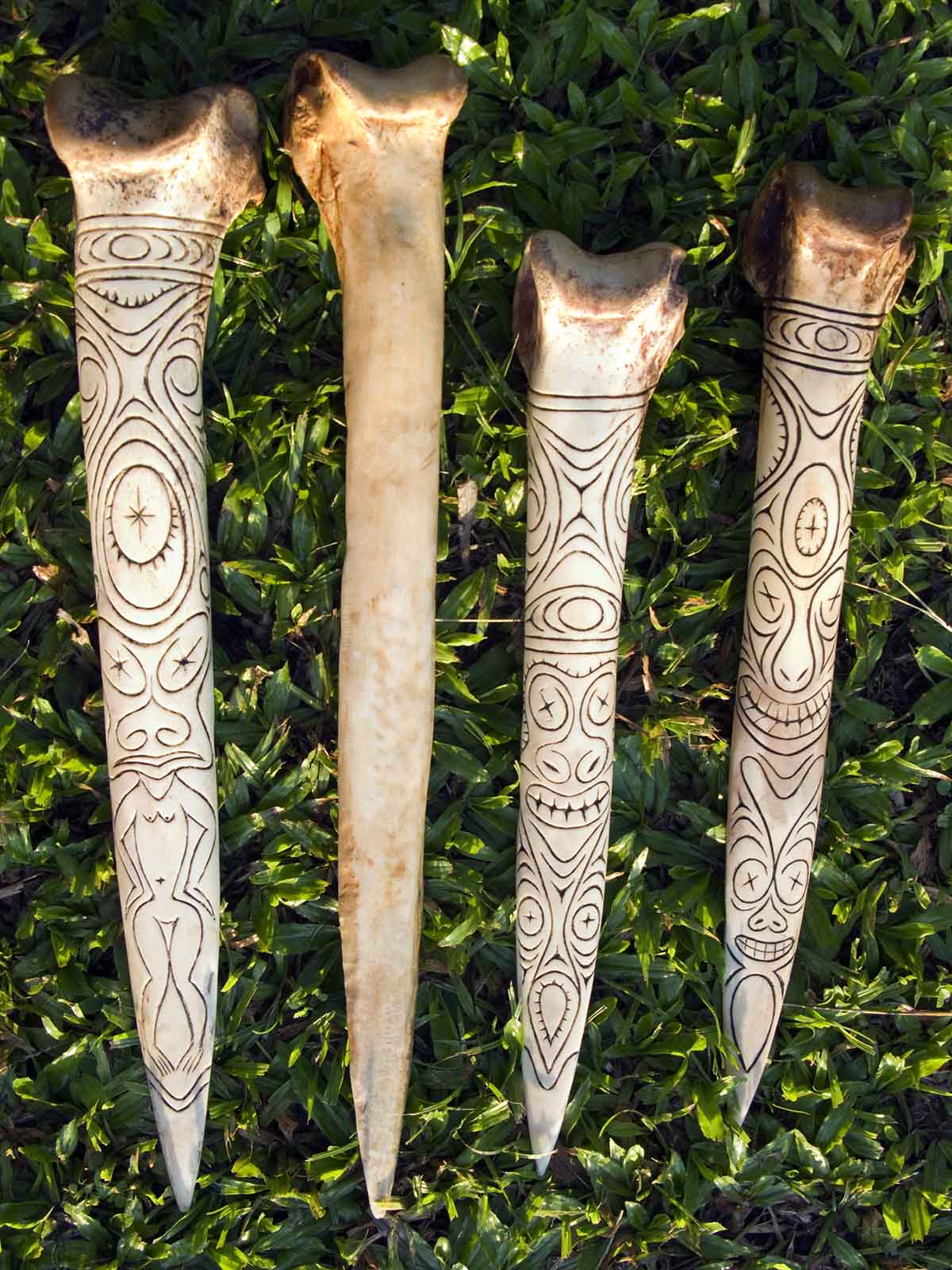
In Papua New Guinea(PNG), the cassowary is highly regarded in traditional myths as a source of life and spiritual energy. While cassowary is food in PNG cultures,  it is also kept as a pet. Cassowary feathers are used for headdress and bones used for tools. I remember my grandfather (mother’s father) kept a cassowary wing bone he used to stitch sago leaves together for our roof.  Some tribes, foe example the Abelam people in Sepik have used the femur of the cassowary birds to make weapons such as daggers (pictured below).

bones_img_2091
Cassowary daggers

The cassowary lives in north of Australia and PNG. I constantly read articles about the near-extinction of this giant bird and I wanted to share the awareness that if we in Australia (and PNG) are not careful, we will lose this species.

scassow_sh_2692_big
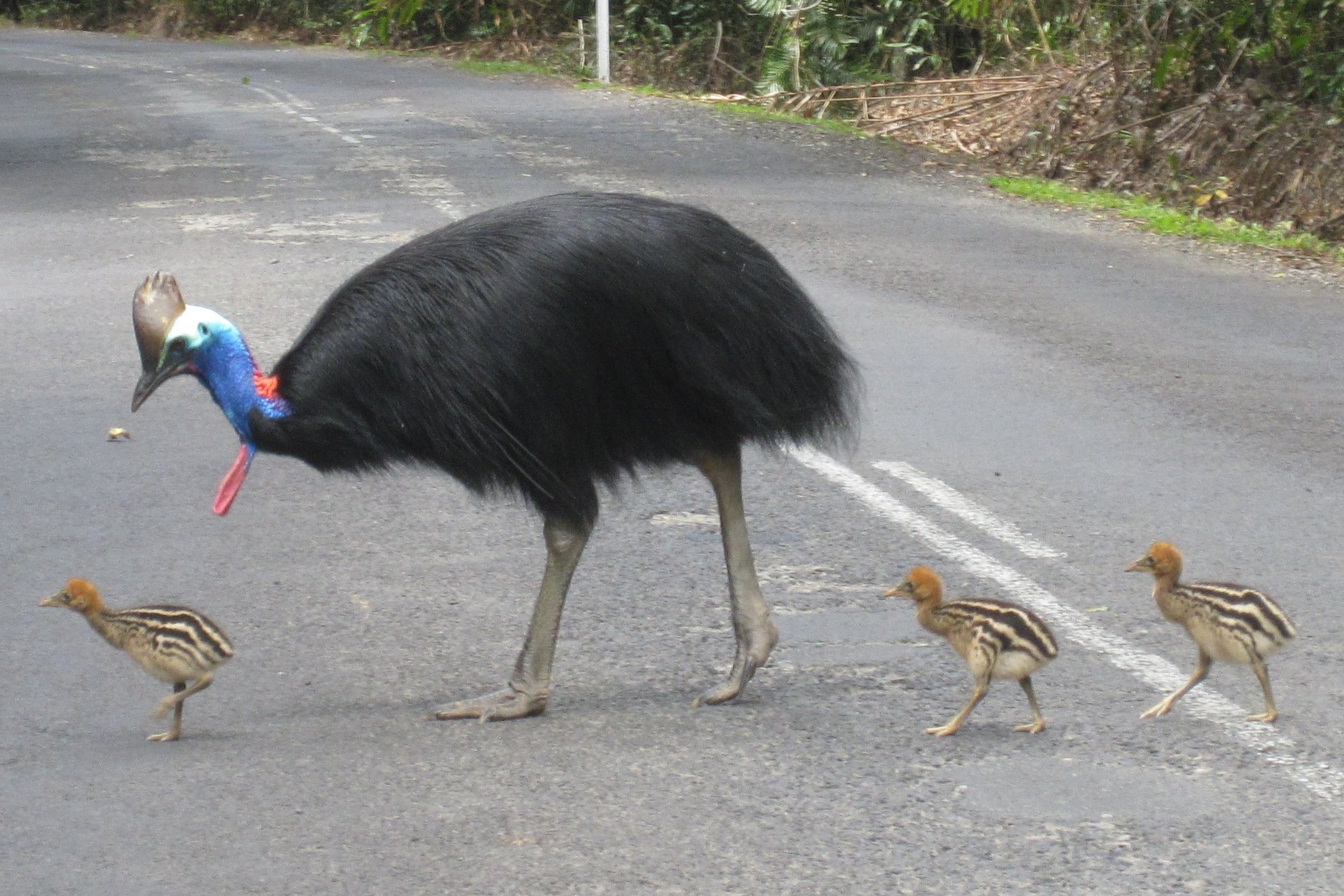
Southern Cassowary with three chicks crossing a road (photo courtesy of S. Hardy & D. Johnston) [Daintree to Port Douglas road, QLD, August 2013]
Why did the cassowary cross the road?

This question is no longer a joke.

According to Megan Neal at Houston Zoo website:

“Unfortunately, there’s no punch line and the situation is no laughing matter. Habitat loss and fragmentation have left the Australian population of cassowaries on the brink of extinction. These huge birds need large amounts of land to roam in search of food and to breed”.

Like other species, cassowaries’ habitat have been repeatedly destroyed by the boom in residential and commercial construction. Everyone wants to live near the rainforests of Australia, but there’s simply not enough room for everyone.

The Australian Conservation Foundation (ACF) answer to the question gives another example of the problem. The cassowary crossed the road because its habitat has been chopped in half by a freeway. So far this year, more cassowaries have died from speeding cars, dog attacks and habitat loss than in all of 2014.

ACF report said the modern-day hazards are now increasing the extinction risk.

“While local groups are doing great work to protect these gorgeous creatures, governments need to catch up! We need to transform our national nature protection framework so local, state and national laws work in together to protect life in Australia”.

scassow_dw_858
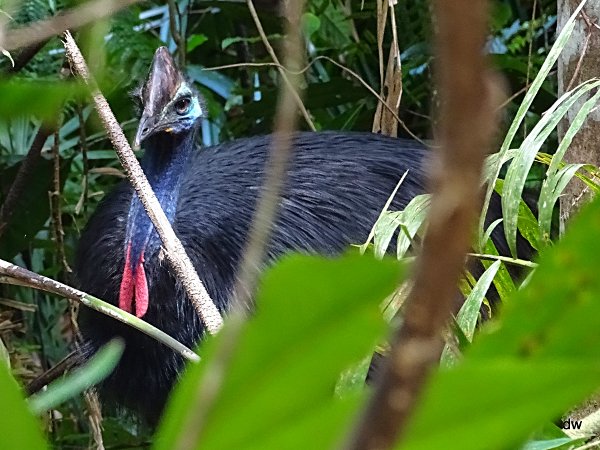
Near-frontal view of a female-Southern Cassowary (photo courtesy of D. Wilczynska) [Daintree NP, QLD, March 2015]
The cassowary is far-north Queensland’s flagship species for both the tourism industry and the World Heritage rainforests.

It is an iconic and unique species that deserves better than the devastating carnage it faces on regional roads throughout the Wet Tropics.

Sadly, 2015 is off to a particularly bad start for the endangered – and rather large – flightless bird with reports of at least six cassowaries killed between Mission and Bramston Beach this year.

Another cassowary was killed recently by domestic dogs on the Atherton Tableland.

Until recently, the remaining wild population was thought to be at around 2000. However, new research by the CSIRO estimates that the cassowary population may be more than double that at around 4400.

But this number is spread over 730,000 hectares of potential habitat with strong populations known in some areas and few or no records from other areas.

Read More on ACF Online News

Are We All Suspicious?


I took a walk yesterday in Bellbowrie, down our street on the edge of Brisbane River. I tend to walk on the grass because I like the soft- feel on my feet as I walk. Where we live, there is usually a piece of the city council land between the road and the various properties, enough for footpaths and walkers.

It was almost 5:45pm and with our winter, the place became dark quickly. I had a torch but I could still see so I did not use it.

“Are you right?” I heard a voice and saw a young man, about mid twenties, wearing white shorts and a polo coming towards me. I did not recognise him. He was walking on the road, going in the opposite direction.

Suddenly, I thought to myself, “why wouldn’t I be right?” And, “do I not look alright?” “Am I wrong?”

The tone of this young man’s voice did not seem friendly. I did not say any thing at first, just looked at him. I also wondered myself – if he was alright. I did not ask. My house was only four houses up the road.

Then, I calmly and with my best and warmest smile, I said, “I enjoy walking on the grass because it is soft and feet-friendly. I don’t like walking on hard surfaces”.

“Oh!” he responded with a puzzled look and then walked past me.

I don’t think it was the answer he expected. If that wasn’t the answer – what did he expect?

I re-told this random conversation to my younger son and he suggested, “may be the man thought you were ‘sus'”. (meaning suspicious).

“Do I look suspicious?”

To that question my son laughed and told me not to worry. How can I not?  It troubles me that given the world we live in today, you can never know what is well-meaning and what is not. Have we humans become allergic to each other?


Creating the Extraordinary – Cool Stuff


kristi-1-600x450-scaled1000
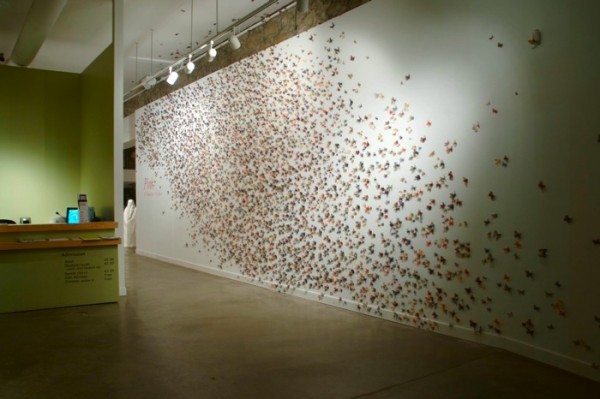
Swarm (detail) 2005/7 6000 color copies of butterflies on transparency material Dimensions variable

Making ordinary things become extra-ordinary is what artist Kristi Malakoff lives for.

Malakoff is a Canadian visual artist who has returned to Canada after time spent living abroad, most recently in Moscow, Russia, where she participated in a 2-month residency at Proekt Fabrika in the spring of 2010, and previously in Berlin, Germany, Reykjavík, Iceland and London, England where she attended the Chelsea College of Art and Design.

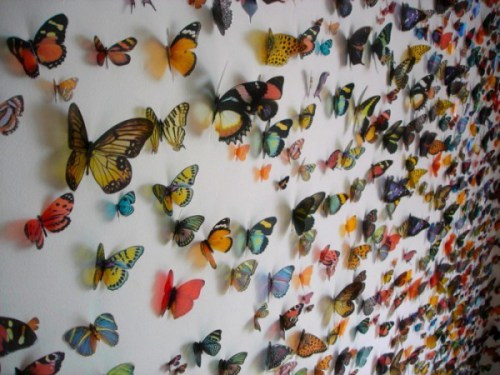
I particularly like her “swarmed” series. Visit her website to see more of her work. In the work displayed here, she used 6000 pictures of butterflies to create a vast swarm of butterflies.

kristi-2-600x399-scaled1000
Swarm 2005/7 6000 color copies of butterflies on transparency material Dimensions variable


The Missing – Short Story


2015-05-11-bw-beacham
Picture by Barbara W. Beacham

Mondays Finish the Story

Arriving at the beach, she reflected on her life. Mea searched the waves for two poles where the village bell hung. She had missed the bell sounds and the village gatherings. It has been 20 years since she left for Australia. The bell hung in the village centre; now, only seawater.

“I can’t see it,” she told her brother Tau.

“I don’t think it’s there anymore”.

“Right there” she pointed. “And what happened to Bubu Raga’s coconut trees?”

“The King tides, five years ago, took Moale’s family’s house, betel nut, breadfruit and the coconut trees. We dashed for the hill”.

“Oh My God! That would’ve been scary”.

“Yes, we lost everything. That was the day Chief Naka accepted the government’s offer to relocate us with other climate change refugees. It’s strange being on other people’s land. You are very restricted, but in the past 30 years, the water has raised so much. Our island will soon be completely submerged”.

Waiting to Catch the Bloom


Giant Apostle © JLeahy
Giant Apostle JLeahy

I had been keeping an eye out for my Giant Apostles to bloom in my garden. Two weeks ago, I thought the flower buds were showing in two of my beds, but when I got there, I realised the flowers had already bloomed and wilted. Today, three sets opened. You can imagine the joy of the anticipating gardener. Each flower opens only for one day. If I did not spot these beauties from my bedroom window today, I would have missed them completely.

Giant Apostle Pair © JLeahy

Extra large, richly colored, fragrant flowers distinguish the versatile walking iris ‘Regina.’ Native to Brazil, this tender perennial is very easy to grow and propagate. It grows and spreads from underground stems or rhizomes, and plantlets form at the end of the flower stems after blooming. As the plantlets grow in size and weight, the stems bend down to the ground and they root.

The Walking iris is clump-forming and its leaves are broad, sword-shaped and pointed at the ends. They grow in flat, fan-like arrangements, as do most members of the Iris  family. The brilliant purple-blue iris flowers are marked with white and burgundy-brown spots and borne in clusters on leafy stems held above the foliage. This species tends to bloom in succession from summer to spring, but ‘Regina’ may bloom for longer than average. My collection only bloomed this Autumn.

20150507_172720-2
Giant Apostle Pair © JLeahy

Mind Games – Short Story


2015-05-04-bw-beacham

Picture by Barbara W. Beacham

 Mondays Finish the Story by Barbara W. Beacham

This is a unique flash fiction challenge where Barbara provides a new photo each week, and the first sentence of a story. The challenge is to finish the story using 100-150 words, not including the sentence provided. The challenge runs from Monday to Sunday! 

Mind Games  ©JLeahy

“After losing her head, she realised that the rest of her body was falling apart”, Joe would mimic a psychiatrist.

I sat by the window. The sun warmed my scalp and shadows danced on my hands. In hiding, I watched police take Joe away last night. He would have calmed down, but only he and I knew that; not our new neighbours.

We could have lasted in this abandoned house. If only Joe stayed quiet. My thoughts hurt my head.

“Ava! Ava! Where is your doll?”

Over the low white fence were a lilac doll pantsuit and two doll hands.

I had watched Ava at work yesterday. The toddler first ripped the doll’s head and legs, which she threw towards me. Ava caught me watching her. She laid the doll arms and pantsuit down, and dropping the body, she ran to the house. My eyes salted, thinking how scary I must have looked to her. I must leave before the Johnson Mental Health party arrives.

(150 words excluding the opening quote)

The Important Places (short film)


A COLLABORATIVE FILM BY GNARLY BAY + FOREST WOODWARD + FRIENDS
Special thanks to Doug Woodward, Brendan Leonard, Skip Armstrong, David Marx, Jeff Scholl, Elliot Ross, Jess Lowe, Howl Collective, Story & Heart

Famished Eels – A Short Story Winner by Mary Rokonadravu


In partnership with Commonwealth Writers, Granta is publishing the 2015 winning stories for Africa and the Pacific: ‘Light’ by Lesley Nneka Arimah (Nigeria) and ‘Famished Eels’ by Mary Rokonadravu (Fiji). To listen to podcasts by all the regional winners and read the regional winning stories for Asia, Canada & Europe and the Caribbean, please visit the Commonwealth Writers website.

Podcast from the story-teller

I have read and wish to share the Pacific winner’s short-story. It is one of the most beautifully told short-story I have read. I would recommend you read the whole story from the link I have provided at the end of this passage.

Famished Eels
cropped-flying-eel-long

After one hundred years, this is what I have: a daguerreotype of her in bridal finery; a few stories told and retold in plantations, kitchens, hospitals, airport lounges. Scattered recollections argued over expensive telephone conversations across centuries and continents by half-asleep men and women in pyjamas. Arguments over mango pickle recipes on email and private messages on Facebook. A copper cooking pot at the Fiji Museum. Immigration passes at the National Archives of Fiji. It is 2011.

Fiji, with Guyana, Suriname and Trinidad and Tobago, had just registered the ‘Records of the Indian Indentured Labourers’ into the UNESCO Memory of the World Register, when my father, the keeper and teller of stories, suffered a stroke. Fate rendered his tongue silent. He cannot read or write – he first set foot in a classroom at fifteen, and was told by a nun he was too old. He ignores my journalist and doctor siblings to select me, the marine biologist, to finish his task. I am off the coast of Lifou in New Caledonia counting sea urchins when the call is relayed.

He hates me for not becoming a journalist, I say to myself.

I will be on the Thursday flight, I tell my older sister.

She meets me at the airport and drives me down to Suva. It is past midnight. We pass eleven trucks overloaded with mahogany logs between Nadi and Sigatoka. A DHL courier truck. A quiet ambulance. She smokes at the wheel, flicking ash into the cold highway wind. We pass a dim lamp-lit wooden shack before Navua. Someone is frying fish. We both know it is fresh cod. We remain silent as we are flung into the kitchen of our childhood at Brown Street in Toorak. We stop to sip sweet black tea from enamel pialas in Navua.

Come on tell me, she blurts. Who you seeing now? Is it a dark-skinned Kanak? Is that what’s keeping you in Lifou? Do you speak French now?

Screw you, I say from the back seat.

He wants you to do this because you won’t lie to him, she says. The rest of us may. Just to make him happy. Just give him what he wants to hear. But you won’t. You will find out and you will tell him.

Screw you, I say again, more to myself than her.

All his life, my father has sought one thing only – to know the woman in the photograph. To know the name of her city or town in India. To know that at some juncture in history, there was a piece of earth he could call his own. All he had had was a lifetime of being told he was boci. Baku. Taga vesu. Uncircumcised.

A hundred years was not enough. Another five hundred would not be either. In a land where its first peoples arrived a couple of thousand years before the first white man, the descendants of indenture would forever remain weeds on a forsaken landscape. A blight.

He had stubbornly remained in Fiji through three military coups and one civilian takeover. Everyone had left. He remained the one who rented out flats until his brothers’ houses were sold. He supervised brush-cutting boys on hot Saturday mornings. He was the one to call the plumber to change faucets in grimy, unscrubbed shower recesses. He was the one who kept receipts for oil-based butternut paint, bolts and drill bits; photocopied them faithfully at the municipal library and mailed them to Australia, Canada or New Zealand. Each envelope had a paper-clipped note: OK. It was the only word he learned to write. I received Christmas cards from him saying the same thing: OK. The handwriting on the envelope changed depending on who the postmaster was at the time.

His younger brothers send out family newsletters on email. There is only one photograph of my father they use, a blurred profile of him holding a beer. They use the same caption – ‘Still refuses to use email.’ I wish to click Reply All and say ‘fuck you’ but there is a distant niece in Saskatchewan on the list – she writes me regularly for shark postcards and she knows the scientific names of eleven types of nudibranch. She recorded herself reciting it like bad poetry and put it on YouTube. I am the only one who knows this. She insists I use real handwriting, real stamps. She hates pancakes, frogs, flatlands. Her handwriting yearns for water. Salt water. Sea. In her milk tooth grin I see the next storyteller – the one to replace the man who has gone silent. She is ten and wants three pet octopi.

I was born to be a bridge. All I see are connections. I bridge between time, people and places. I study migratory species. Tuna fish stocks. Whales. Sea urchins in between. Cephalopods. I was nine when I picked up my first cuttlefish bones on a tidal flat in Pacific Harbour. For years I thought it was a whistle. I wrote out the names of the world’s oceans, seas, currents and fish in longhand, unaware the lead scrawlings were placing miles between my father and me. He watched me from across the kitchen table. My mother had died bringing me into the world. He washed okra with patient fingers. Boiled rice. Warned me he was going to slice red onions.

Make sure you buy land, he whispers. When you grow up, buy a small piece of land. Build a house just for you. Promise me.

Promise. But my eyes were already on the Kuroshio Current. I was already reading the voyage of Captain James Cook and the transit of the planet Venus. Hearing the howl of winds at Tierra del Fuego. No one told me that as recently as one hundred years before, ships had cut through the rough straits with people carrying the makings of my teeth in their genes. They almost never happened. Almost.

Keep writing, he says in our old kitchen. As long as someone remembers, we live.

My sister drops me off at the Colonial War Memorial Hospital.

I won’t come in now, she says. I still smell of cigarettes.

My father is asleep when I reach out to hold his hand.

Famished Eels Continues here