I was doing some studies on stilt houses in Papua New Guinea and came across this very sweet story; an expatriate’s point of view of life in Papua New Guinea. I’m sure this ‘wantok’ (friend) does not mind me re-blogging his story about Karina. I have in the past posted historical images of Tubuserea Village, just outside the capital, Port Moresby.
I first met Karina Parina when I started my new job with Papua New Guinea’s National Library Service in Port Moresby in 1980. She was a shy, softly spoken 21-year old girl from the village of Tubusereia, about an hour’s drive eastwards along the coast from Port Moresby.
My job at the National Library was to arrange training programs for the Papua New Guinean library staff, to enable them to fill the positions that were occupied at the time by sixteen expatriate librarians. As my job involved working with staff across the organisation on an ongoing basis, my first challenge was to learn everyone’s names. I clearly remember my first introduction to Karina because her lovely rhyming name was impossible to forget.
Like most of the other Papua New Guinean staff members she went about the library barefoot. A few of the others wore rubber thongs. In the tropical heat…
Merry Christmas to all my readers, family and friends. Thank you for all your contributions in making this blog special. I wish you all a wonderful 2016. Here is one of my favourite short videos of singing Melanesian children.
Dear Readers of Mondays Finish the Story. I am very sad to re-post the news that Barbara who started and ran the Mondays Finish the Story fiction challenge has passed away last Sunday. I saw the message from the late Barbara’s husband when I visited her page this morning. I wanted to share the news with those of you that enjoy my contribution to this fun 100-150 story-telling exercise – created by Barbara W. Beacham. She also supplied all the pictures.
You have helped sharpened my story-telling skills. I will miss the challenge and your wonderful comments Barbara.
It is with the a sad heart and mind that I let all of the readers of Life In The Foothills know that Barbara who began this a few years back has succumbed to her illnesses and passed away last Sunday. Writing this blog as she dealt with her health issues gave her tremendous pleasure and as she told me many times a purpose to continue and fight the cancer that finally took her.
I shall miss her tremendously as she was my wife, my best friend, and my life’s love. Those that did correspond with her please know you helped her with her fight and added to the pleasure she received as she writing her stories.
To all of you thank you.
I myself do not have the same strength as Barb did at this time. I am in that emotional spot at this time that wants me to run from reality yet it wants me to confront it as well. I know many of you have experienced this as well.
As this will be the final post I ask that no-one reply to this as I will not be monitoring any reply to have it posted. So rather than reply please simply send out a thought or prayer on Barb’s behalf and that will serve a better purpose than a typed message.
There are some faces you cannot forget. I had been going through and editing pictures from Papua New Guinea and I found many faces with many untold stories. Some faces are hard to forget. Here is one of the unforgetful faces from the Irugl Mother Of Life Orphanage run by the Simbu Children’s Foundation (SCF). More on founder Jimmy Drekore’s work and the Irugl story on this blog in the future.
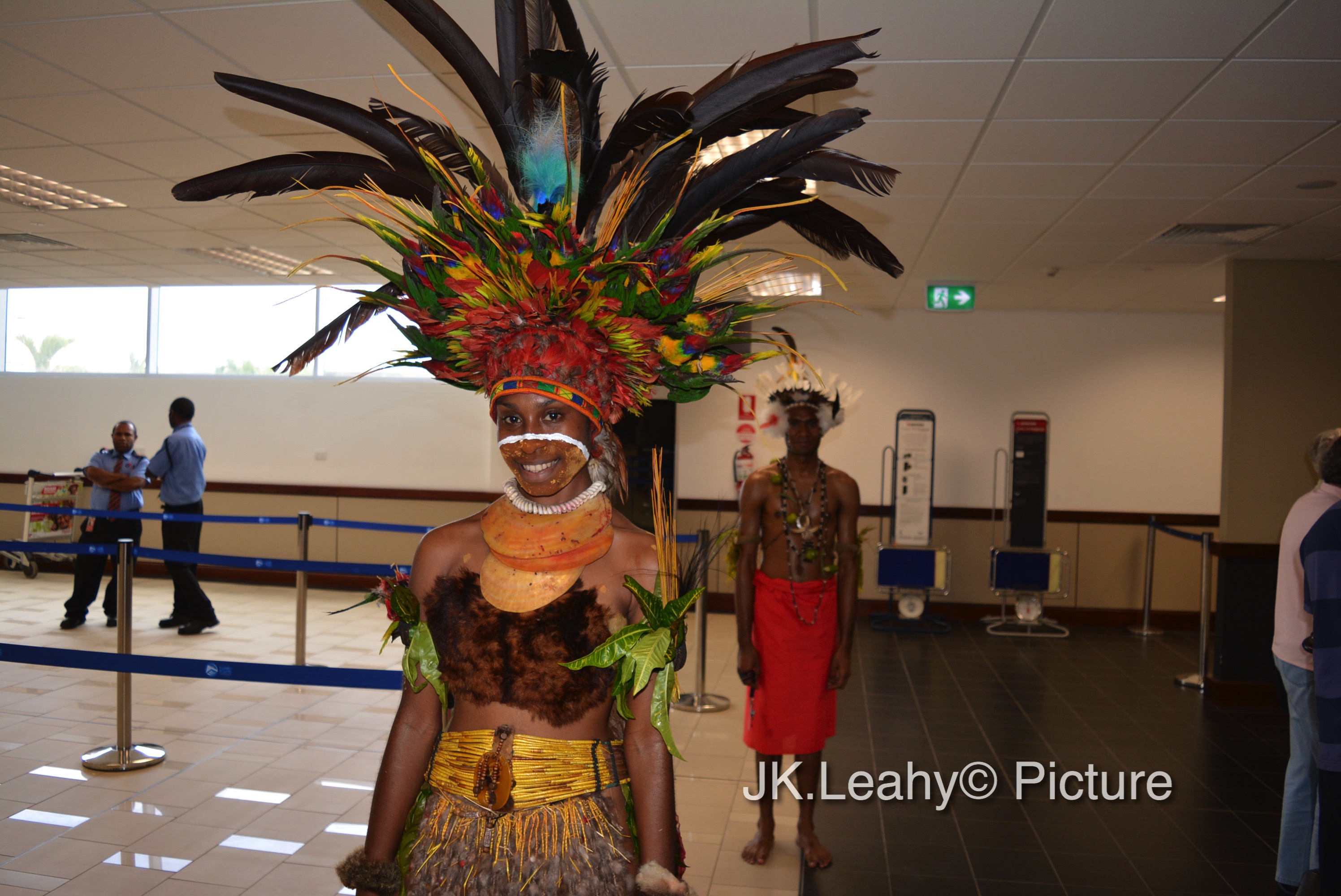
On my return home to Papua New Guinea on September 16th, it was the Independence Day. My son Chris and I were very lucky to see PNG people celebrating in their traditional costumes.
On arrival at the Jacksons International Airport, Port Moresby, our first meeting was with this stunning beauty. I wish I had taken more, but I only had time to take four photographs of this beautiful woman and rush to domestic terminal to transit to Lae. I will get her name later, that’s how PNG networking is, but she was dressed in Simbu traditional dress. I believe she was part of the Air Niugini staff and assisted the international departure passengers.
If you have any questions about her dress, ask me, but this post is purely to show the beauty of the image. When I come across moments like this, I am very proud to be a Papua New Guinean. My reasons being, we are unique people, we love our culture and we are always proud to show it.
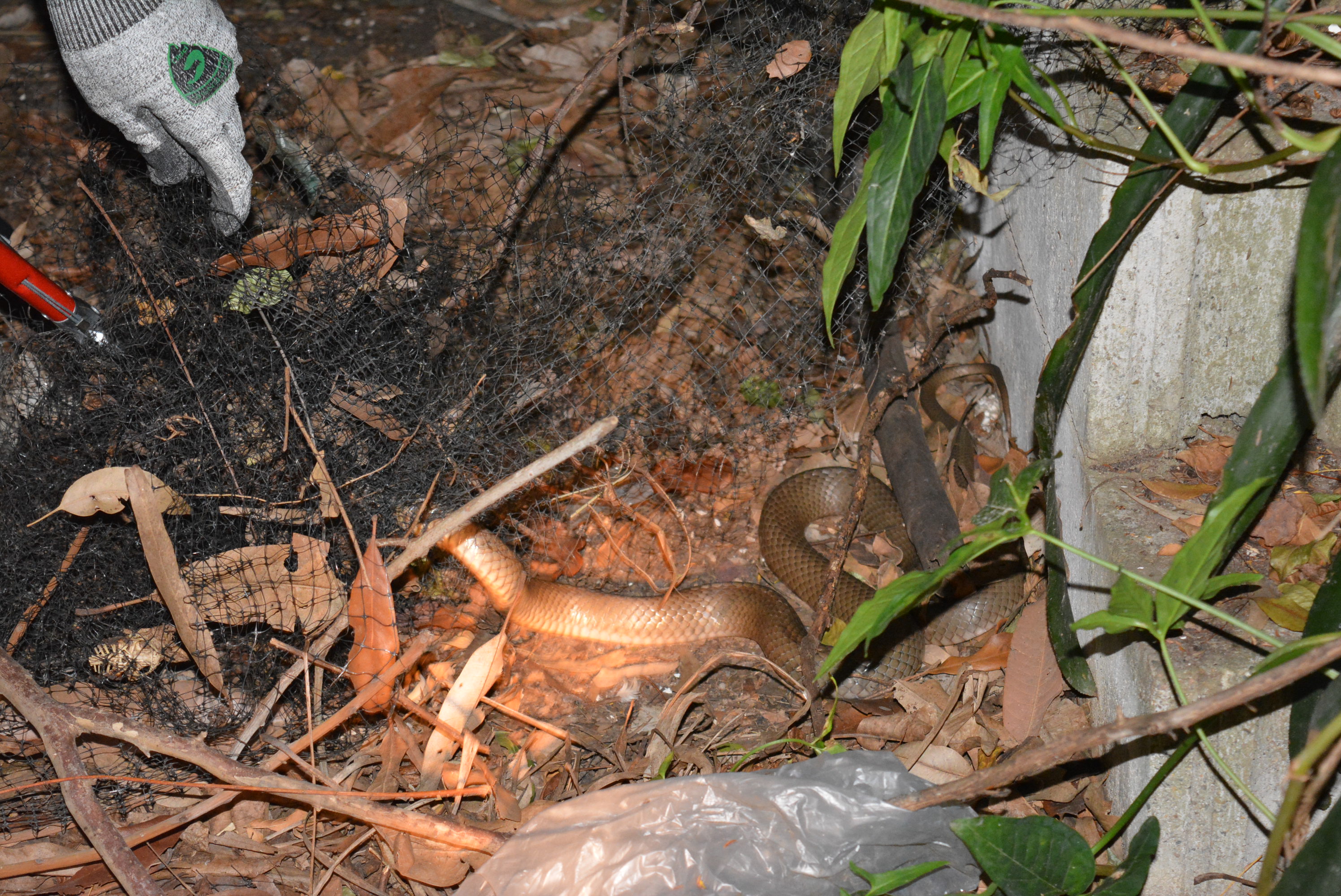
An Eastern Brown snake caught in the net – before it was set free. JK.Leahy picture.
This evening, when I called a Brisbane snake catcher to save an Eastern Brown’s life, I did not expect him to be married to one of Australia’s top romance authors, Ally Blake.
…………..
My younger son Chris had told me on Saturday night he had seen a large snake by the house, but it had gone. I wanted to check the surroundings but it was too dark when I returned from my recent trip to Papua New Guinea. After work today, I checked around the house to make sure no slithering kinds were lurking in the dark corners outside the house. This is the season for hibernators to emerge. Sure enough, at the back of the house, in the shady leafy spot among layers of fallen leaves and a stone wall, the fish net moved from side to side when I approached.
I knew it was alive, and I could see the beautiful long golden tail tuck away instinctively. The head was locked into the nylon knots in an awkward angle. It was an Eastern Brown, about a metre and a half long. We had caught a large male two years ago in the same spot and freed him into the Brisbane City Council wildlife reserve. This one was surprisingly alive and strong after several days in the net. The Eastern Brown snake accounts for more fatalities than any other Australian Snake. It is the second most poisonous land snake in the world and the most poisonous in South east Queensland.
The snake we caught looked exactly like this Eastern Brown. Picture courtesy of Queensland Museum.
I quickly ran back into the house to phone for help. From 5:30pm today, I called six snake catchers, one after the other – they were all busy. Finally, the fifth snake catcher who was heading three hours out-of-town told me to call Mark, the Bellbowrie snake catcher.
Mark told me he was away, but he would get to Bellbowrie in half hour, and if I had not found anyone else, he would set the snake free or take it away for a small fee. Mark also said he lived in Bellbowrie. I told Mark, I just wanted to make sure, the snake did not die.
After 45 minutes, Mark arrived. Armed with my torch, camera and his hoop, net and snake-catching equipment, we ventured into the back of the house where the snake was. Mark is an environment scientist and like me, he was more concerned about saving the snake’s life. I was relieved when he told me that.
As Mark tried to undo the feisty Eastern Brown, we had a conversation about other things and I mentioned casually that I had to leave soon to attend a creative writing workshop.
“Really! My wife writes romance novels. She has written 32 books”. Mark beamed.
“Who is your wife?”
“Ally Blake”.
“Wow!” – that was all I could say. Mark’s wife, Ally Blake is one of Australia’s top romance authors with over 4 million copies sold world-wide. She has published through Harlequin Mills and Boon, Entangled Publishing and Tule Publishing.
Mark catches snakes part-time, and only because he loves them, and he wants to protect them. He said most people he helps to catch snakes or removes snakes for – want the reptiles dead.
When Mark could not untangle the snake, he suggested it was safer to take the reptile with part of the net to his house. There, he was better equipped to relax the reptile and properly treat its injuries and rest it before releasing the snake into the local reserve.
Mark said the snake was a female of a few years and that females tended to stay at a favourite spot and the males come to visit.
“If you see two snakes wrestling, those will be two males fighting for her,” Mark said.
That was not really the news I wanted to hear – but a lot of changes will be happening this weekend to the snake’s favourite hiding place.
I have to also check out some of those romance novels by Ally Blake.
Flash Fiction Challenge for Mondays Finish the Story with Barbara Beacham.
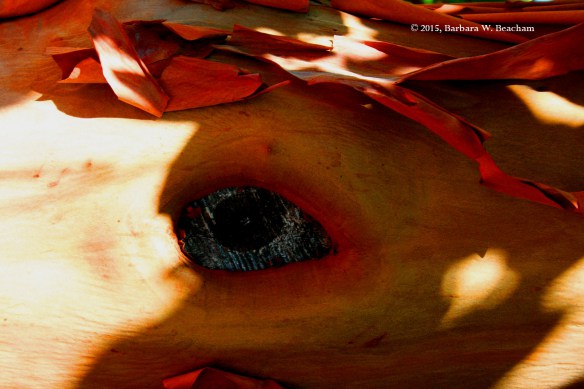
Picture by Barbara Beacham.
Mondays Finish the Story is a flash fiction challenge by Barbara W. Beacham. The story requires 100-150 words (excluding the first sentence). The challenge runs from Monday to Sunday. Here is my short story for this week’s prompt based on the first sentence below and the picture. (This story is set in Australia where we like to use the term ‘mate’ meaning friend).
“I see absolutely everything.” Oliver said and stopped. Drawn in by a large black shimmering eye, he placed two fat little fingers up his nose and tried to push them as far as he could.
“What are you doing mate?”
“Trying to find cheese”, the three-year-old replied, ignoring his mother.
“Cheese! Where are you going to put it?”
“On my sandwich.”
“Get your fingers out!”
Oliver pulled his fingers out of his nose and poked the large eye on the tree-trunk. The eye was soft. He pressed harder. Something gave and sucked him into the tree.
“Maaa ummmm!”
Then, minutes went by.
“Oliver! Oliver! Wake up!”
The little redhead stirred. He eyed his mother and sister Georgia.
“You fell and hit your head on the tree mate”, his mother said trying to hug him. Pushing her hands away, Oliver said, “my cheese sandwich?”
“Oh Oliver…” his mother said.
“Never a dull moment”, Georgia agreed.
……..
(Note: Oliver is my friend Celise’s three-year-old son. He has fiery hair and large blue eyes and is an inquisitive and mischievous little boy. Oliver also has something to say about everything).
The coconut is one of the most valuable trees in the islands across the Pacific, Asia, Latin America and Africa. The coconut tree has many uses. The nut, its husk and shells, the trunk, leaves, even the bone of a single leaf is used. Children use the leaf for toys and women weave and cook rice in the leaves. Hats, baskets, mats and many other useful items are also made from the coconut leaves.
The coconut juice, coconut oil and coconut cream have become a recent rage in nutrition and diets in the western world. Ask abungac (grandpa) Google about the many uses of the coconut.
What happens when you destroy the tree that gives life?
The Guardian Picture: In 2009, the crater of the extinct volcano Mount Bosavi, in the Eastern Highlands Province, PNG was found. The green beetle pictured was one amongst many species discovered, except that this specie is iridescent.
The green beetle is one of my favourites and the insect possesses a beautiful rainbow shine. The beetles come out in millions during fruit seasons. In Papua New Guinea beetles are eaten as food, but the green beetle is so beautiful that tribal dancers use the insect as part of their fashion. The fashion or their traditional dress, especially headbands and headdresses are worn in singsings. A singsing is a performance of song and dance by a group and it is one of many living rituals, handed down through generations.
An Eastern Highlander (PNG) spotting a row of green beetle in his headdress. The beetles are woven intricately into the golden orchid fibre in diamond patterns.
I have seen the beetles myself in Goroka, Eastern Highlands Province and found these ones on headdresses in Simbai, Madang Province, which prompted this post.
Simbai tribesmen (Madang, Papua New Guinea) wearing their fashionable head wigs made from the green beetle.
Like some of the more unusual legal tender in other cultures of the world, the stone money from Yap is quite unique, and grand.
This is not your typical gold coin or silver coin you could flip. You would need all your friends to help you flip it and I would not wait to catch it coming down.
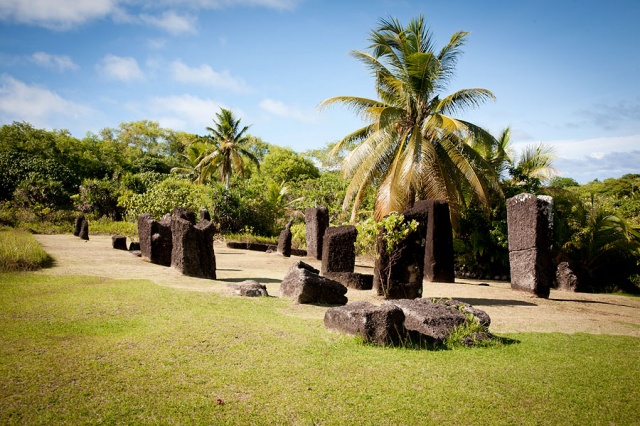
To continue from my post about the giant Easter Islands Monuments and this is my own theory; I’m speculating that the people who build the giant statues of the earlier post on this blog were part of the same (tribe of) people who manufactured the Rai or the giant stone coins of the Micronesian islands of Yap and Palau. My reason for thinking there may be a connection is because of what I have seen in Palau and Northern Marianas. There are giant statues all over the world and I am no archeologist. The Micronesians also have giant stone monoliths and statues. Yap became part of this ring of exchange and sharing giant objects when they brought the coins from Palau into Yap.
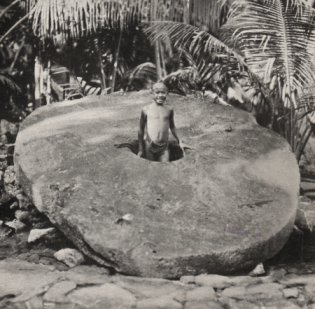
Yap is one of four states of the Micronesia. The large coins pictured above and below were made from limestone disks and each represent wealth in a family group. There is a lot of reading in the history of all these large objects and studies are still being carried out on the mystery that surrounds the objects.
Amusing Planet Picture
Why did the Yapese take to this new kind of money?
John Tharngan, historical preservation officer of Yap explained that the coins were invented during a period when the chiefs on Yap were struggling for power.
“In those days all sorts of commodities were being used as valuables, including shells and turmeric and so the concept of bringing something in from outside, that didn’t exist on Yap, was very attractive. So when they brought this piece home and called it money, it encouraged other people to make the journey and bring stones back. So they went and brought more, this time in the shape of a full moon with a hole in the middle, for ease of transportation, like the ones you can see here on Yap”, Tharngan said.
Jaime Hernandez – March 12, 2012 – Making the Rai.
The value of the stone coins is determined by the number of lives lost during the process of transportation and the workmanship on each stone. They are used for buying land and bride price.
I first saw the Rai at the National Museum of Palau in 2008. I asked many questions and got bemused looks from locals, to say that these coins were part of everyday trades, an undying culture passed through generations. I could not imagine a piece of coin carried by six adult male compared to a dollar you could pull out of your pocket and flick in the air, and in Papua New Guinea, we mostly used shells as our legal tender. Perhaps at one point, we also used stones.
What a wonderful life blog picture.
Yap is about 100 square kilometres and home to 12,000 people. The island of Yap has no precious material like gold or silver instead, they use these giant disks of limestone called Rai as currency for large trades and still use them as small as seven to eight centimetres in diameter to trade with. The larger ones stand as high as 3.65metres (12 feet tall) and weigh five tonne. Many of the Yapese coins were carved in Palau and shipped 400 metres to Yap. There was a story that once a large Rai was transported across the water between the Yapese and it tipped the canoe and sank. This coin was always remembered and its value (for the family that owned that coin) was continued to be used in the trades. Read more on the Yap’s coins on the links below.








 Tribalmystic Stories