Category Archives: blogging

Short Story: Swamped


Pneumatophore_overkill_-_grey_mangrove
From Wikimedia Commons, the free media repository

If you have missed the story opening published last week, click here

Although peeking through the pale mud with life and vibrancy, the young mangrove regrowth looked naked and vulnerable against the open swamp, and without the mother-tree nearby. In the distant, under the long shadows, piles of de-skinned fallen mangrove laid like stacked cadavers. This was part of an extensive wetland area used for fishing and gathering food like sugo, small snails and Kina, a fresh water mussel. There was some kind of an order in the distribution of the mangrove shoots along the random waterways. It was a peculiar, and neat arrangement. Amongst this orderly disarray, I stood out like the tallest cross in a dwarfed graveyard. The young mangrove shoots only came to my knees, just like the old stumps.

I must remove myself from here, I had thought although this had always been our favourite fishing spot. Today, the place felt strange, unlike before. Before, we would fish for hours and take our breaks on the logs. We ate with one hand and smacking of mosquitoes, then wiping their blood off and scratching the small bite mounds with the other hand. I had been to this place with my Grandma and Aunty Yellow. I also came here with my cousin Alison before she lost her mind to Malaria. I should not have been here alone today.

Once when Alison was eleven and I twelve we spotted a stranger here. On that day, we had brought with us Tinang’s (grandma) bush knife, which we were forbidden to use. The bush knife had cost a lot of money and one bush knife served many families in many ways. It turned out, the man we had seen was not a stranger, nor was he real. From his actions and the way the Sockwing (a type of wag-tail) birds were calling, my cousin and I became alarmed and we ran off, leaving grandma’s bush knife behind. I had to run back and get it. If we had left the knife there, we would have been punished for taking the bush knife. We were told that same evening, the man we had seen was a spirit of a dead great-uncle. This too was his favourite fishing spot.

I thought I saw a movement and my eyes tried to focus. Nothing seemed out-of-place, and everything around me looked like it had always been.

The Japanese bombing in the Second World War left a large gap in the wetlands. The bombs opened the place as wide as a soccer field, and made it lifeless; right in the middle of the thick mangrove that was relished by fish, birds, snakes, lizards and all kinds of insects. My Aunty Yellow said, in the open centre, mangrove regeneration since the bombing struggled for decades. The bomb explosions took both natural and human lives; our great-uncle was amongst those.

Apart from the war, this place was a landmark because the mouths of many small creeks gathered into the head of the largest one, which flowed into the main river, named Bu-dac. Budac meant Blood River, a name that reminded us of our history.

Our house was built along the river near its centre and at the entrance to our village. In pidgin, it is called, maus-rot which means mouth road.

I was standing at the head of Budac. There was a large T-junction, where the main creek met the river. The swamp clay was very soft and pale and covered with dead rotting leaves. In the dark river, life existed; a place where fresh-water fish feeding, spawning and nursery took place. Fish gathered daily to feast on other fishes and debris collected and deposited by the creek as well as the river at this meeting point. Not today, I had not seen fish movement breaking the water rhythm nor its surface. I could not understand nor remember why I was here today, and alone – only a few kilometres away from our village, just outside Lae, Papua New Guinea.

(© JLeahy, 2015)

More Swamped soon…

Cool Stuff – Glow in the Dark


glowing-resin-table-mike-warren-8
“I thought of this project after browsing the aisles at a lumber store and seeing Pecky Cypress,” Mike Warren told Bored Panda. “I’ve never seen anything like it and knew I wanted to make something with it”

For his year 12 school project for his Technology class, my son Chris and his friends are making a piece of furniture for the school and the school pays for the materials. Chris has suggested a large drawing and planning table for the technology room.  The classroom only has a work area so the table would be an asset to the programme. Chris’s group decided to go with a glow in the dark table which also looks just as pretty in normal lights. That was how, I learnt about the glow in the dark table. This short story shows you what they look like.

Our Cool Stuff for the week is the Glow in the Dark table by Mike Warren. You can use the same technic for chairs and other furniture but I think the resin is more effective on a larger piece.

Mike Warren is a furniture designer and enthusiast. He created this table that illuminates at night after being exposed to light during the day. The illumination comes from mixing the photoluminescent powder with the resin and using it to fill the holes that form naturally in Pecky cypress wood.

“The type of wood I used for this table is known as ‘pecky cypress’, which is regular cypress that has been naturally damaged with a fungal growth inside causing sections to rot” Warren said.

Warren removes the damaged pockets and leaves cavities in the wood  for the resin and glow powder filling. The pockets of damaged (rotten) cypress are soft and can easily be removed with compressed air and some light digging with a hand tool as shown in the video below.

https://www.youtube.com/watch?v=KeskG-bFG9o#t=19


Valentines Day Can Make You Happy


Well, that’s what those who conducted this experiment say. I say, why can’t Valentine’s Day be any day for love? Pick any day and call it your special day for you and your loved ones.

LOVE should be celebrated every day!


Livelihood Futures – Papua New Guinea


by Dr James Butler

Many coastal communities in Papua New Guinea are particularly vulnerable to change. Global drivers such as peak oil, fluctuating economic conditions and climate change all have complex impacts on local livelihoods.

In response to rapid and accelerating rate of change and uncertainty, CSIRO research helps make predictions of their potential impacts and allowing groups to plan proactively. This requires designing flexible strategies that can bring benefits under a variety of future conditions.

Planning sustainable development for such uncertain futures is a key area of research for CSIRO. The design of development programs which can improve livelihoods and achieve the United Nations Human Development Goals, while also being adaptive and flexible to uncertain futures, is a big challenge. Such planning must include the multiple groups which have an interest in development, including members of the local communities, government, civil society and international donors.

Our research project “Climate futures, ecosystem services and livelihood adaptation strategies in West New Britain Province, PNG” explored these issues. From 2011-2013, we worked with local communities, non-governmental organisations and government groups to develop a framework using CSIRO science to help inform future decision-making in a collaborative way. We hope you enjoy the video report.


Short story: Swamped


SWAMPED     (Copyright JLeahy on Creative Writing Wk 3)

Mangroves 5
Mangrove stumps – Public Domain

The river emptied rapidly as the new day reluctantly begun. The sun had not yet arrived for warmth was lacking. I stood facing the river, able to see the creek. A war that was not ours took many of my family’s lives here, on this customary landmark. The small creek had reduced to a thin flow of a silver running snake. It slithered along a dark swampy path, often picking up flashes of light from the sun on its scales. The flashes only came when the mangrove trees allowed the sunlight trickle through its dense, green-yellow leaves. In contrast to the creek, the river was fuller, darker and moved in a quiet menacing meander. I was the tallest, standing amongst the mangrove stumps. Around me was hazy with un-condensed dew and I could not find my way, even though I had been here many times. I could almost smell the dank, which hung in a strange and familiar blanket.

This is the opening of a short-story (non-fiction) for our exercise in the Creative Writing Workshop – Kenmore. I wanted to share the opening with you. I may post more depending on how the story ends up. It may become a chapter in the JL memoir. I hope you like it.

Australia’s first carbon positive pre-fab home


carbon_house_1_0

The SBS News brings us the first carbon positive pre-fab home in Australia. This house and the news made my Cool Stuff list.

Carbon zero is the benchmark for best practise when building today, but in the future the federal government expects so-called “carbon positive” buildings to play an increasingly important role limiting global warming.

In a significant step forward in efforts to reduce emissions, Melbourne-based architects have designed what is being billed as Australia’s first carbon positive pre-fabricated home.

Here is a short video of the house and to read more click on the link below. SBS News clip or read more here

Objects of Betel Nut Culture


troblimg
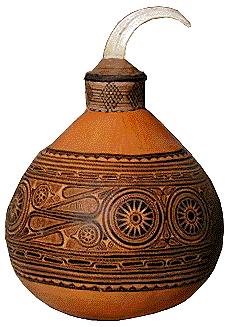
Lime pot from Trobriand Islands, PNG

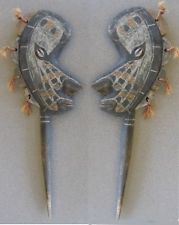
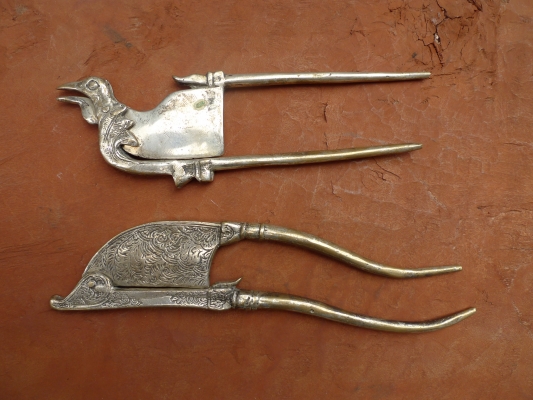
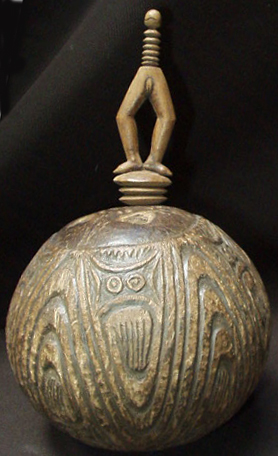
I have  previously made a post about the betel nut culture. I wanted to show some art and objects made for the betel nut culture. This is a collection of objects that were used by those who chewed betel-nut in Asia and the Pacific islands. While the habit may be disgusting to some, indigenous artists have specifically crafted a wide collection of ‘tools’ that can break the nut open to containers that store lime or referred to as lime pots as the one pictured above.  Often, these objects are quite small and are hand carried in a bag by the users. As a museum curator, I find the tribal patterns exquisite and many represent cultural and spiritual meanings. The objects also tell stories. Perhaps in the future, on this blog, I may be able to bring some interpretations and explanations about some of the traditional Papua New Guinea patterns showed here. To introduce the art of the betel nut culture, here is a small collection I found on the public domain.

Betel nut 1
Lime pot lid and also sticks for dipping into lime for chewing. Sepik, Papua New Guinea.


TK400 (1)
Lime container from Timor


.Etched-Lime-Pots

A collection of lime post from Pacific Islands. Image Courtesy: Second Nature


AT0844a
Betel nut cutter: Borneo – Public Domain


OLYMPUS DIGITAL CAMERA
Lime pot: Indonesia. Public Dormain


Seeking Humanity


Asylum Seekers centre and Wendy Sharp Project
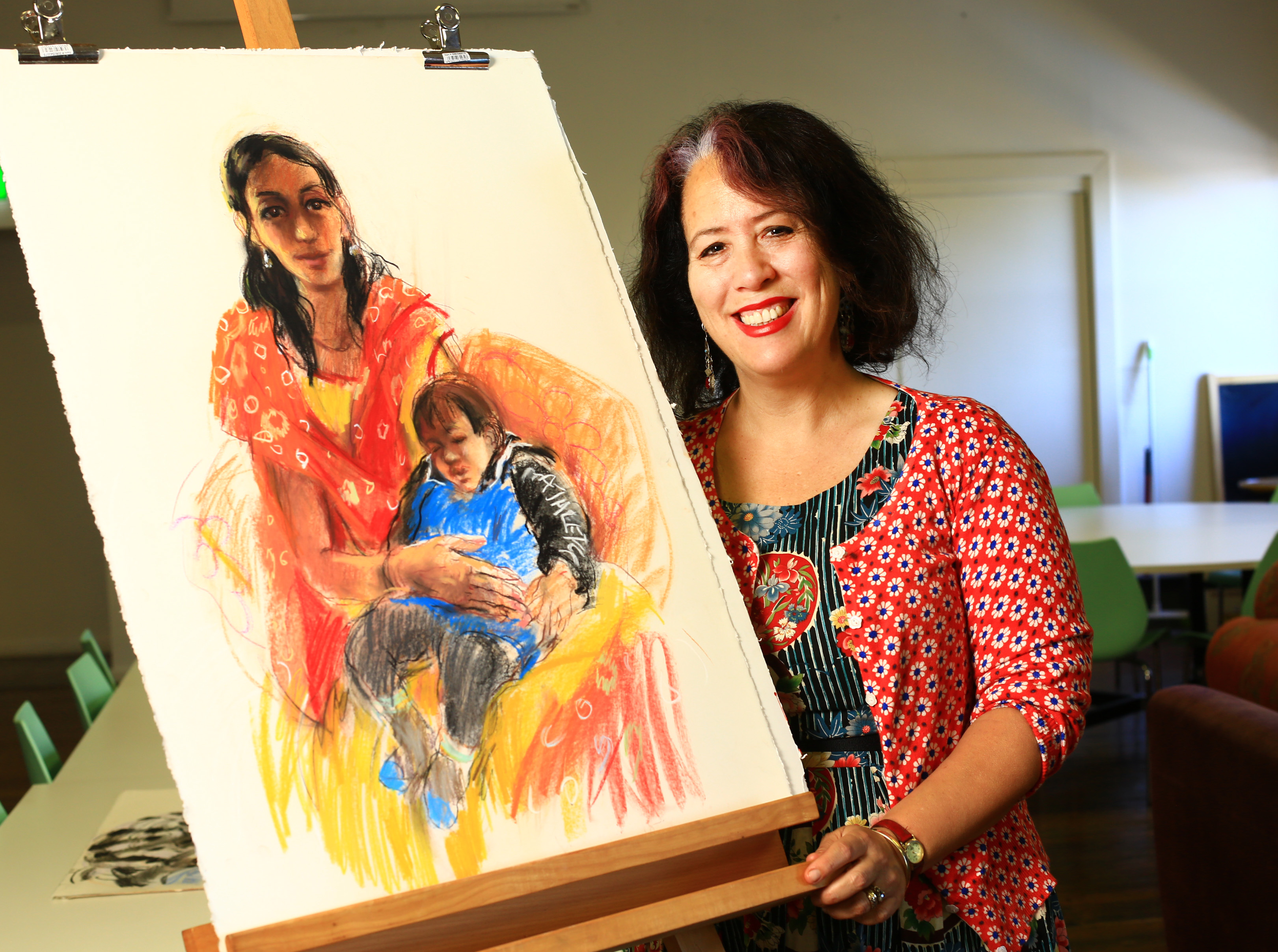
The artist, Wendy Sharpe.

Seeking Humanity’ is an art exhibition by renowned Australian artist, Wendy Sharpe. It is not about politics, but puts a human face to those who have fled situations of great danger in their home country in search of safety and freedom in Australia.

A previous Archibald winner and 2014 finalist, Wendy has drawn portraits of 39 asylum seekers and refugees. Through her art, she shares their lives with us to show that underneath all the troubles and politics around the issue, we are all the same; we all have the same hopes and dreams. The show will start on February 17 and end on May 24 in Penrith, Sydney and Canberra.

‘Seeking Humanity’ is brought to you by the Asylum Seekers Centre. All portraits will be on sale with proceeds going to the Centre to help provide practical and personal support for asylum seekers.

Click on the link and press play to watch Wendy draw live.

http://asylumseekerscentre.org.au/seeking-humanity/


A Spiny Visitor


IMG_8663
Curled into a ball, our spiny visitor on the floor of the workshop in Bellbowrie – Picture by Flynn and Chris.

One of the luxuries of living in the Australian bush is the unusual ‘visitors’ we get. So, far in the three years we have lived in Bellbowrie, Queensland, we have had some interesting ‘visitors’. We have had the slithering kinds, the furry kinds, and scaly kinds, and two days ago, a spiny kind.

My younger son Chris and his friend Flynn were downstairs in Chris’s workshop and they heard a noise of something knocking thinks over.  With their phone lights, they saw a dark mop run to the corner and wedge itself between a child’s chair legs. I kept these chairs for children’s art classes. Even when they had switched the lights on, they could not tell what it was. When they got closer, they were surprised and started yelling in excitement. We all rushed downstairs to see what it was.

Wedged between the small chair legs was a frightened little spiny ‘visitor’ – an echidna. The poor echidna was so frightened that it  rolled up in a ball with its head between its front legs. The boys carefully removed the chair to take the picture above and then put it back. We never got to see its face and after half hour or so, with the lights off, it disappeared.

profile_315_600
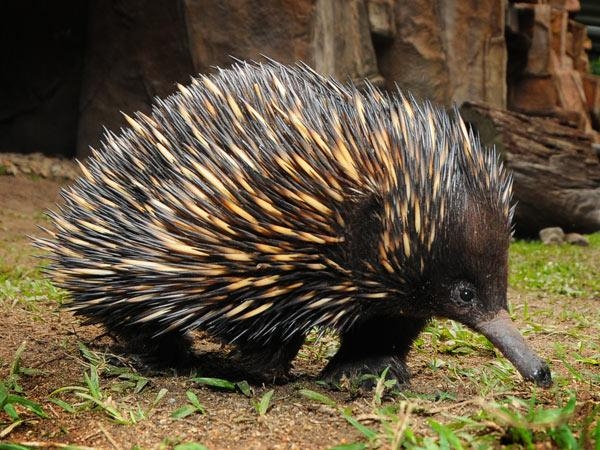
‘Dame’ here is a male short beak echidna that lives in Australia zoo and is much-loved by all the zoo keepers. Photo: Australia Zoo

Judging from what I saw and the image Chris and Flynn took, this spiny visitor was a short-beak echidna (Tachyglossus aculeatus). It is also known as the spiny anteater. There are five sub-species of this echidna in Australia. The Echidna generally is a highly adaptable creature and can be found in coastal forests, alpine meadows and interior deserts of Australia. They weigh up to 6 kilogrammes and can grow up to 45 centimetres. Read more here

After all this time, this spiny ‘visit’ finally solves the mystery of the half-moon shape hollows dug into the base of plants in my garden. The markings would have been made when it was looking for ants, baby roots and worms to eat. I have been blaming my chickens and the bush turkeys for these markings.


Tiny Ornate Rainbows Under Threat


R.ornatus (Evan Heads) GS
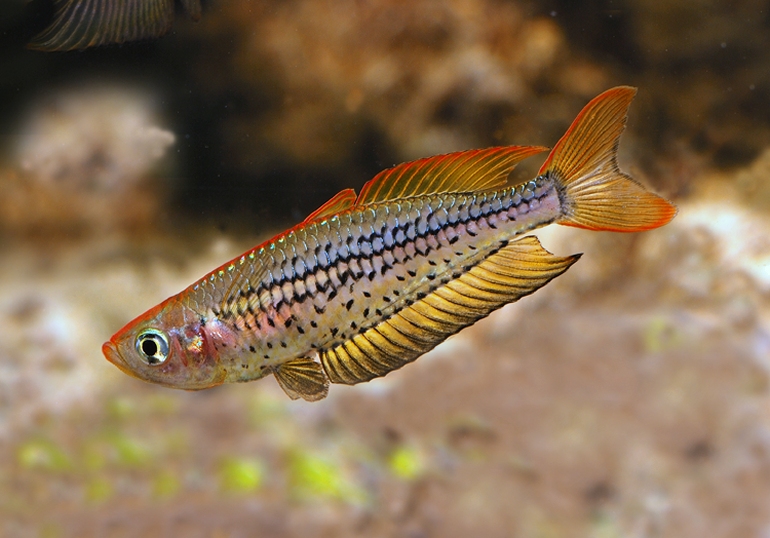
Rornatus (Evans Head), Wildlife Queensland picture.

The ornate rainbow fish (Rhadinocentrus ornatus) is a small and beautifully coloured freshwater fish. You don’t often spot them straight away in dark creek ways because their colours show when the light catches their scales. Few populations of these fish are scattered in freshwater creeks in parts of Brisbane where I live, and some creek systems in Queensland’s Redlands, Moreton Bay and Byfield regions.

ornatesunfish
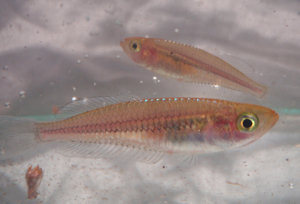
Ornate rainbowfish (R.ornatus) Castaways Creek Photo Leo O’Reilly/ANGFA

The ornate rainbow fish, also known as soft-spine sun-fish can also be found in Nambucca, New South Wales. Four distinct populations have been found in the areas between Queensland and New South Wales.

The numbers of the ornate rainbow fish have decreased rapidly due to human impact. Urban and rural development have caused experts to fear that certain species of the fish have already been lost forever. Every creek in the parts of Australia where the fish is found, has its own unique population which varies in colour and scientists believe they could also be genetically exclusive. The ornate rainbow fish on average grows five to six centimetres long. They can grow up to 8cm long.

“The sad tale is that every time we lose a population of ornate rainbow fish from a creek system we are effectively losing a very unique group of fish forever”, Wildlife Queensland.

ornatesunfish3
Female ornate rainbowfish (R.ornatus) Redlands Photo © Simon Baltais/WPSQ

Wildlife Queensland has issued a fact-sheet for voluntary information on spotting of the ornate rainbow fish. They hope this data collection would determine where the fish are still found and how many types are left. The information would also assist Wildlife Queensland to educate the public and minimise threats to the fish life.

ornaterainbowfish
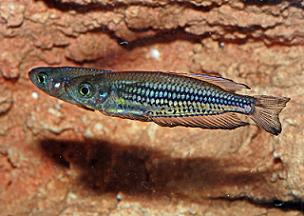
Male ornate rainbowfish (R.Ornatus) Stradbroke Is – Aranerawal Creek Photo ©Leo O’Reilly

To assist in voluntary spotting and documentation, and more information on the ornate rainbow fish, visit:  Wildlife Queensland