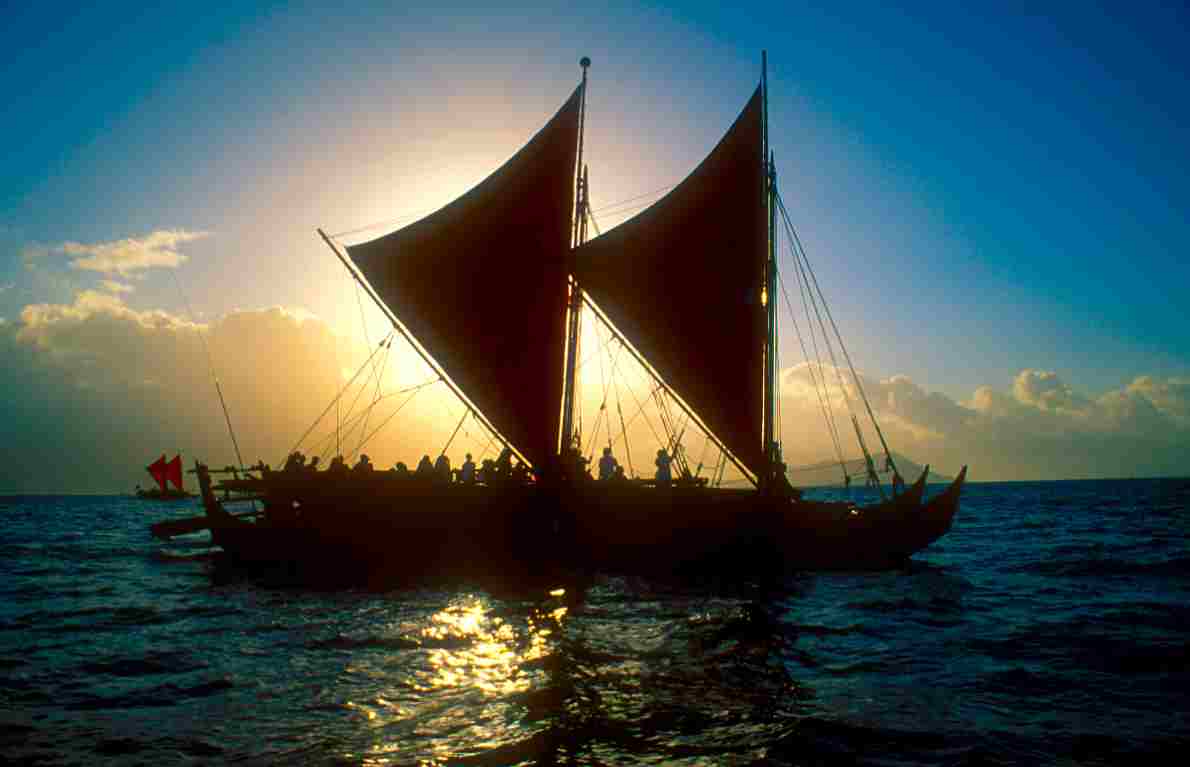
In 1978 Hōkūle‘a set out for Tahiti again. The heavily loaded canoe capsized in stormy seas off of Moloka‘i. The next day, crew member Eddie Aikau (pictured below) on a surfboard to get help. Crew member Kiki Hugho remembers, “We were hours away from losing people. Hypothermia, exposure, exhaustion. When he paddled away, I really thought he was going to make it and we weren’t.” But the crew was rescued; Eddie was lost at sea. After the tragedy, Nainoa Thompson recalls, “we could have quit. But Eddie had this dream about finding islands the way our ancestors did and if we quit, he wouldn’t have his dream fulfilled. He was saying to me, ‘Raise Hawaiki from the sea.’”
Read more in this legendary quest by the Polynesian Voyaging Society to re-live and hold on to a significant intangible culture of the Polynesian people.
I have heard about the Hokulea and recently saw a post in LinkedIn by a friend, Rob Bryan which peaked my interest to make a post. Rob had mentioned that Nainoa Thompson, of the Polynesian Voyaging Society and chief of Hokulea, was back in Hawaii after the first leg of Hokulea’s journey around the world this time (2014). Some of you that read my blog may not know about the story of this great canoe.
Polynesians, Melanesians and Micronesians have for many centuries sailed across the Pacific Ocean on journeys for goodwill and cultural exchange. If you make comparisons to the canoes used in the olden days to our time, you may think that it is much easier, but it isn’t. Even with better ships and technology and better information and transportation systems, sailing across the Pacific ocean is dangerous. Many of us ask the question; why do it when it is so dangerous?
For one man, even when lives are at risk the significance of this voyage is very clear. Thompson said, this voyage is not about the canoe itself but the message of peace and love Hokulea brings. Watch his interview in the link below where Thompson speaks about what it is that Hokulea does and how his crew connect and strengthen relationships with many other cultures with a common object – to safeguard the planet.
Founded on a legacy of Pacific Ocean exploration, the Polynesian Voyaging Society seeks to perpetuate the art and science of traditional Polynesian voyaging and the spirit of exploration through experiential educational programs that inspire students and their communities to respect and care for themselves, each other, and their natural and cultural environments. (http://www.hokulea.com/vision-mission/)
There is a lot of information on the web about Hokulea and her sister canoe Hikianalia. Here are links to view an insight into what takes place on the journeys and meet some of the people onboard. The other link is the important interview with Nainoa Thompson about the significance of Hokulea and what the journey and its culture means to his family, Hawaii people and other Polynesians. The links also provide some background about the history of Polynesian voyaging canoes.
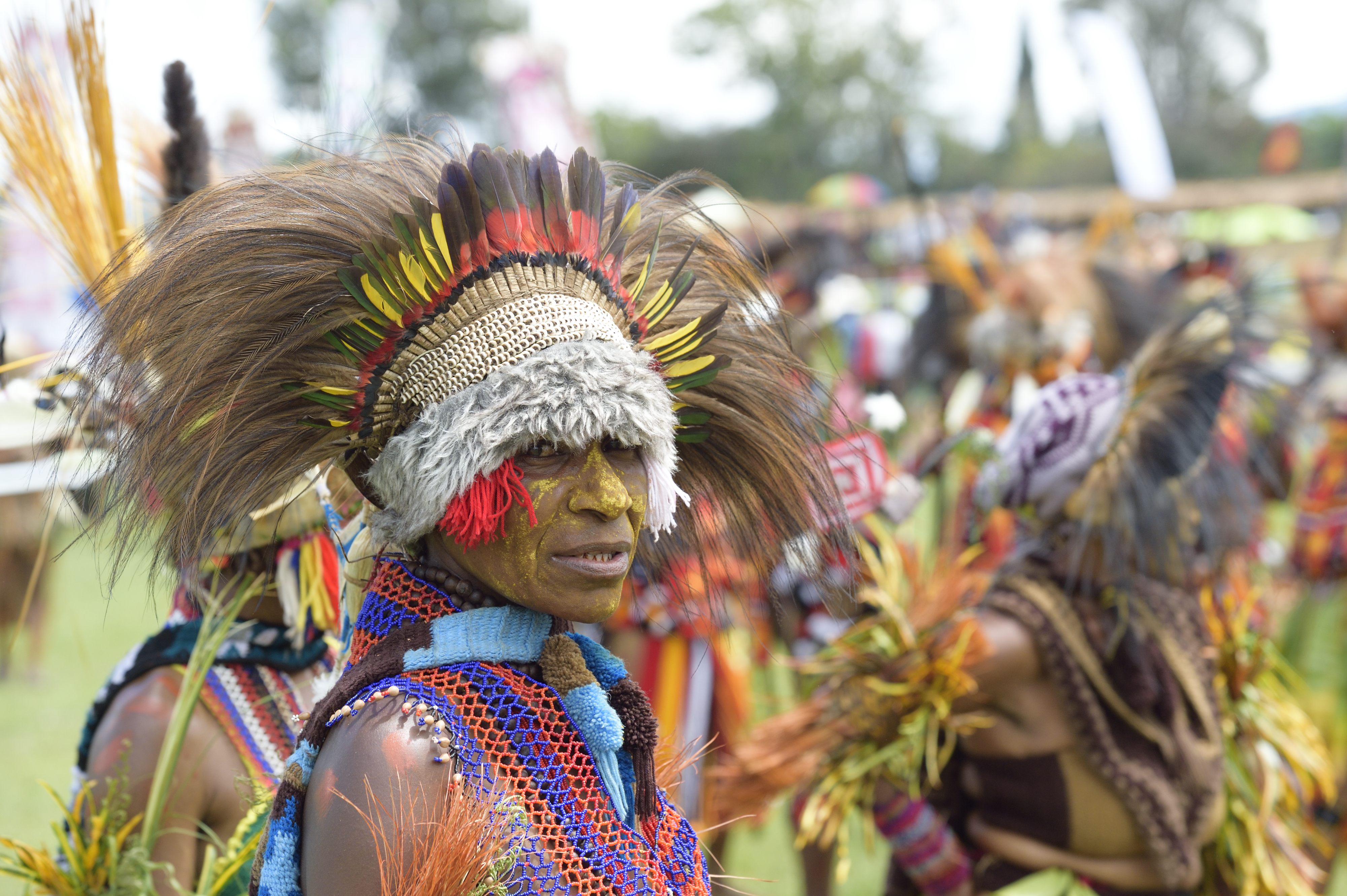
In my last post, The Centrepiece, I wrote about learning and making my own headdress. Here, I wanted to show in colour, some of the most beautiful headdresses from Papua New Guinea (PNG). There are too many to show but I have made a random selection of headdresses in these unpublished photos from a recent cultural show. Our culture, the art and body adornment are some of the most colourful things that attract photographers from across the world. In every tribe and the work we put into most of our traditional costume preparation before we show, the headdress remains the centrepiece.
These images were taken by a close friend and a well-known PNG-based photographer. Lucky for me, he had just returned from the annual Goroka Show where he captured these images.
For more pictures from this photographer, please visit: http://www.rockyroephotographics.com/
At the age of 15, in high school, I wore the same headdress my grandmother and I made. To date, I have this precious item with me. It has changed, lost some feathers but it still works as a centrepiece every time I wear it on my forehead.
Memoir series by JLeahy
Mother returned from the Lae city markets. It was a Saturday afternoon. Today, we were preparing for a big singsing in our village. We were preparing our best for the Annual Morobe Show. There would be hundreds of tribal groups and performers so, we had to wear only authentic costumes. We had to wear the costumes carrying markings and stories of our people and the costumes we inherited from our ancestors. I needed a centrepiece for my headdress.
As she came up to me, I searched Mother’s face for emotion. She teased my un-spoken questions with the twinkle and mystery she showed in her eyes. Finally, she was smiling. Her lips remained sealed more so because she was chewing but I knew she got it. I broke a smile at her and completed my task.
“There was only one Highlander selling two tiyeng ngawahu (Bird of Paradise plumes) and I bought one”, she said.
“Ohhh ngayam!” grandma responded in Bukawac, meaning “good”.
Grandma was pleased the mission was accomplished.
I sat next to Grandma, helping her to twist the sisal fibres on my thigh into strings. We twisted two separate bunches of single fibres which formed a string. Then, we dyed the strings yellow and orange with turmeric roots, and red from Mbuec, a tree that gave red dye in its seed pods. To get grey, we buried the other strings in the muddy banks for a few weeks. For the black we used crushed charcoal with coconut oil. Once dried, Grandma used a ‘needle’ made from a 15cm long re-cycled and sharpened wire. This ‘needle’ came from the inside of a broken umbrella bone. Grandma sewed the strings into bilums (string-bags). The new bilums will be worn in the dance on the day.
We used some of the strings to thread scented leaves and herbs for breast decoration. These same leaves were used for magic, but I was not allowed to know. Not yet, Grandma said.
As she tried to speak, Mother’s mouth was full of red chewed betel nut and she needed to spit. She eased her bilum of food down in a heavy thud. She fished in her smaller shoulder bilum and spat. She held out her hand with a crumpled newspaper wrap.
I jumped up to grab it.
“Careful!.. be careful!”
I was thrilled. Without searching her bag as I usually do for the market gifts of peanuts, green margarines and cucumbers, I turned away from Mother. I smiled at the faded newspaper as I bent and laid the small light bundle on the dry sand next to my twisted strings. I sat down and brought Mother’s parcel to my lap and un-wrapped it.
I was afraid to touch her at first. The bird was beautiful and so soft. A spot of black around her beak. Green velvet on her neck and breast. The rest of her body was a burnt butter yellow with a white centre and a beautiful pale yellow outer-feathers. The base of the main feathers was an intense, vibrant golden-yellow which faded out into white. Her inside was gone. It was shallow. She had been dried, smoked and flattened.
I suddenly felt a pang of guilt and pain swept over me. I thought of the bird flying high and calling out in the trees and I wondered if she suffered. I felt more guilty about this bird than the chickens which I already had feathers from. I was seven and never held a real Bird of Paradise in my hand, even a dead one. I had seen many on headdresses during the festivals. I have held other birds and had parrots as pets. I looked at the bird a little more, each faint wiry piece that joined the next. Then I reached out and touched her.
Of the 39 species of the Birds of Paradise in the island of New Guinea (PNG and West Papua), this one, known as “Greater Bird of Paradise” was the most precious centrepiece for our tribal headdress. The birds did not live in our bush. Our people traded and bought the feathers from the highlanders.
Mother had to seek out hunters from Western and Southern Highlands who rarely brought the feathers to the main market in Lae. She was very lucky today.
To have a Bird of Paradise as your centrepiece was the ultimate dream of every dancer in our tribe. Many other Papua New Guinean tribes wore numerous plumes in singsings. Many more longed for such honour but only settled for parrot, cassowary, and chicken feathers. This bird was our National emblem.
In our Wagang village singsing group, most people wore cockatoo, parrot, cassowary, turkey, guinea fowl and chicken feathers – all made into spectacular head pieces.
I laid out the Bird of Paradise plume and stitched it into my headdress. The headdress was made of feathers and shells, sewn onto a tapa cloth. Most of the headdress was completed days before. I was only waiting for the centrepiece. The cloth would be tied around my head. The Bird of Paradise would be the centre feature. When I wore the headdress, the golden-yellow, wispy and silky soft feathers would sit high above and dance. The beak would be looking down at me and her tail would move with me as I danced the we-e si-ing (war dance).
Protected Species – the Birds of Paradise are a protected species in both Papua New Guinea and West Papua (Indonesia)
Birds
Much sought after as pets or for their feathers, several birds of the forests of New Guinea such as parrots, lorries and birds of paradise are illegally exported for trade. But just the local use of a species can be detrimental to its survival; wildlife capture and trade of cassowary for traditional use has severely reduced their populations in some areas and where they remain, there is increased pressure for trade.7
Birds of paradise have also been historically traded, especially for their feathers. While West Papuans’ use of the birds’ feathers in cultural celebrations is part of their tradition, Europe was once the main market for the plumes, to be used for women’s hats and accessories. Trade peaked in the late 19th century, when plumes from more than 50,000 birds were exported every year, generally to Paris for capes and hats.8
Birds of paradise continue to be smuggled out of Papua Province, Indonesia. The trade in the birds adds to the pressure they already get from continued hunting and the destruction of their habitat by logging, road construction and conversion for human use. Although banned by the Indonesian government since 1990, trading in the feathers of the birds of paradise is still ongoing.9
I bet most of you are thinking these questions while safe and comfortable in your/our homes and watching the news. Some of us are probably thinking “those poor people” with some relief thinking we may be far enough that we are not exposed to this deadly virus.
Perhaps this was why, we/the world reacted too late?
Do we even stop to wonder about the children who lost their parents or a parent to the Ebola but no one wants to hold them while they cry, not their aunts, uncles, not even their grandparents. Their own family won’t touch them.
A similar situation occurred when HIV/AIDS broke out in Papua New Guinea over two decades ago. I remember whilst volunteering with the Action For Community Health group we found a large number of children abandoned. Fortunately these children were taken in by a Catholic nun. Eventually “Friends”, a Not-For-Profit organisation was set up by a PNG mother to care for the children.
Often, when we cannot understand something or something does not affect us personally, we distance ourselves.
There are so many lives being lost to the Ebola virus in such a short time. “Ebola” when mentioned, is a frightening word.
Today I listened on MMM radio to the Queensland (Australia) doctor, Dr Jenny Stedmon who volunteered to work with Red Cross in Sierra Leone and returned to Brisbane. She is in quarantine for three weeks. Dr Stedmon’s concerns were that the numbers of those affected by the virus was a lot higher than what we hear on the news.
I admire people like Dr Stedmon who give their lives to save and help others. There are many others like her out there and some of them have already lost their lives in this epidemic.
My son Nathan wants to work in Medicine and in particular, the Epidemic field. I remember discussing this year’s Ebola virus outbreak earlier this year with my 18-year-old after he covered the topic in BioChem in his university studies. He was explaining the virus, its symptoms and what was happening in west Africa.
It seemed at that time, Ebola was a subject of interest but I guess no-one thought it would spread this much. The costs and the process of treatment is incredible. During the MMM radio interview, Dr Stedmon described how hot it was in the “space suits” which was worn on top of their normal clothes and given the African humidity and heat – each worker or doctor has up to 45 minutes each time to see and treat the patients before taking a break and writing up reports. The ‘space suit’ got too hot after 45 minutes.
Reading all the articles about the epidemic and how wide-spread it has become makes we wonder if we (as the world) reacted too slow and too late…As the Australian reported, the first case of the Ebola virus was diagnosed in US today; now will we do more?
AFP AND NETWORK WRITERS AFP OCTOBER 01, 2014
Queensland’s Redland Hospital anaesthetist Dr Stedmon returned home this week to quarantine after three weeks in West Africa, helping treat infected Ebola patients as part of the Australian Red Cross effort to contain the spread of the virus.
Director of Medical Services at Redland Hospital, Dr Rosalind Crawford said Metro South Health was proud to be able to support Dr Stedmon to participate in the response to the Ebola crisis in Africa when she left in July this year.
“We are all very proud of her and the challenging mission on which she is about to embark. Dr Stedmon, as the Director of Anaesthetics and a key medical leader of Redland Hospital, is willing to take on a significant personal risk to assist in the containment of the virus in the third world,” Dr Crawford said.
“The team at Redland Hospital praise her courage and look forward to welcoming her back safe and sound in a few weeks’ time.”
Dr Stedmon will spend one month in Sierra Leone’s main Ebola hospital in Kenema and will work as a general medicine specialist before spending three weeks in quarantine.
According to the World Health Organisation, the Ebola outbreak is the worst since the virus first appeared in 1976, and is currently affecting Liberia, Guinea, Sierra Leone and Nigeria.
Dr Stedmon has worked in a number of war zones over the past 20 years with the Australian Red Cross, including East Timor, Yemen and the Thai-Cambodian border. She was one of only two Australian doctors the Australian Red Cross sent to the Philippines when the country experienced a devastating typhoon late last year. She will be one of only three Australian doctors working in Sierra Leone over the next month.
The international Red Cross has been one of the lead agencies trying to prevent Ebola from spreading. Close to one thousand volunteers and staff have been working around the clock to educate communities on how to prevent the disease since Ebola first broke out in Guinea in March. Over 1000 people have died in West Africa from Ebola and 1,848 people have been infected, according to the World Health Organization.
Metro South Health wishes Dr Stedmon a safe journey and looks forward to her return.
(Some facts about the Ebola virus – see link below)
Life and the prison cells we all build for ourselves over our lifetimes. How true are these words? I enjoyed reading this piece by ESGEE musings and wanted to share this with you.
At the age of ten, I had the first realization of what a gang was and what it could do to me. I do not recall how it started but one thing led to another and soon all my neighbourhood friends and playmates had ganged up against me. One evening, I had climbed up on the roof of our house with our servant as he was fixing the radio antenna. I saw my ex friends and playmates holding hands, dancing and skipping together and then with a shock, I heard their voices mocking, mimicking and making fun of me. In that moment I heard an inner voice saying, ‘There is something wrong here. There is something wrong with me.’
In July (when it was pretty cold) I went to Adelaide to surprise my friend Anne Stanley who turned 50. I had known her since we were 16 and 17. We have lived in different countries for the past 30 years but whenever we spend time together, it seems like we have never parted. Anne, not only is my best friend, but a sister. I will feature her one day on this blog if she lets me. While I visited Anne, I went to South Australia Museum (SAM). http://www.samuseum.sa.gov.au
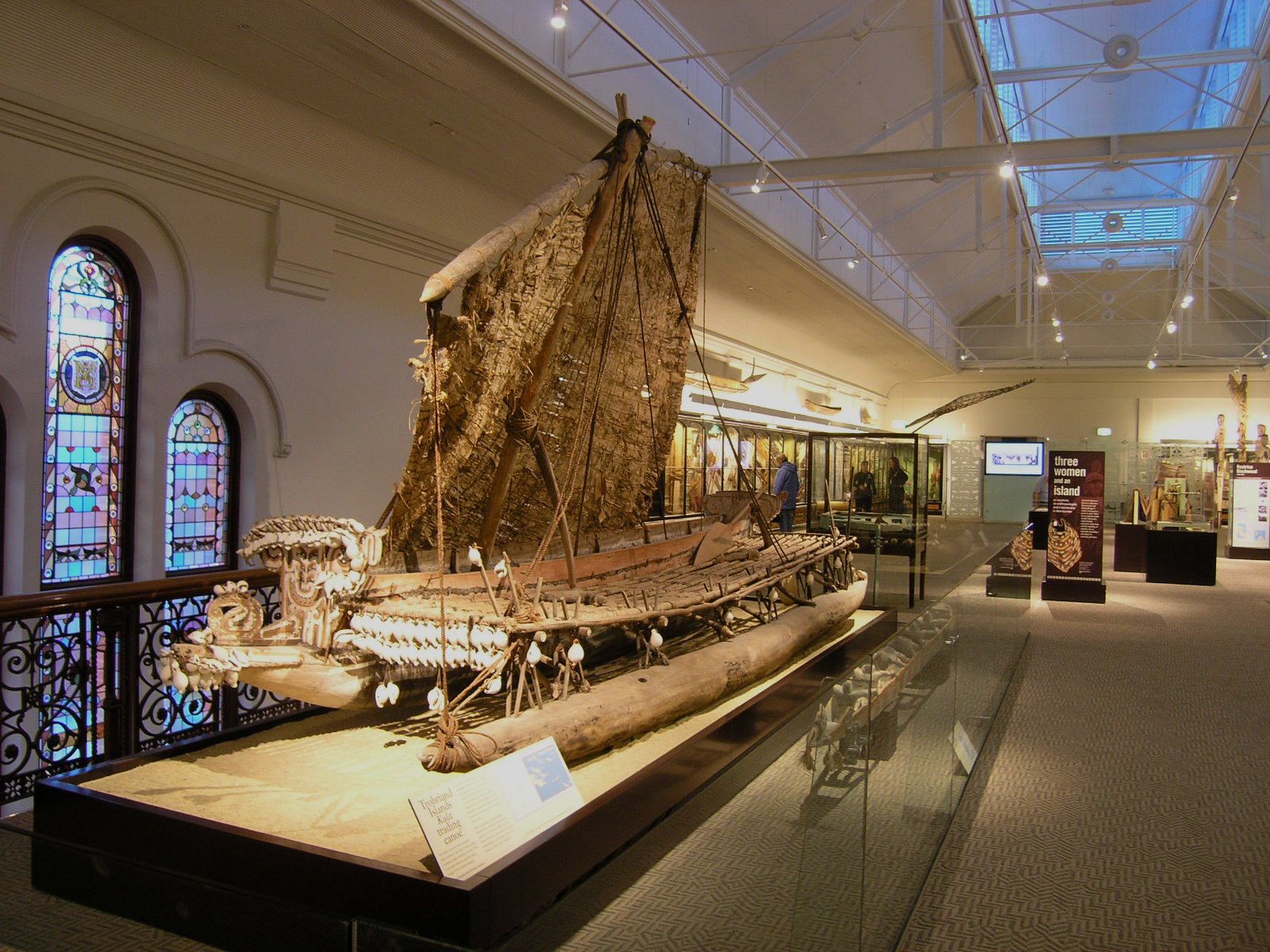
In a way, I have Anne to thank for my museum visit. In fact it was Kolohie, Anne’s eldest who gave me a guided tour of the city and took me to SAM, but guess what, it was Aunty Joyce who gave Kolohie the guided tour of the Oceanic/Melanesian collection at SAM, so he could learn a little about his culture. While we were in SAM, it was an opportune time to visit an another ‘old’ friend, Sopikarin. Of course she is not a person but this outrigger canoe from the Trobriand Islands of Papua New Guinea. I had done some research and with tremendous help from Dr Barry Craig, written an article about the Sopikarin’s journey from PNG to Australia during my museum studies in University of Queensland 2008. I had never seen the canoe until I went to Adelaide. The funny thing was, all this time I had thought Sopikarin was a much larger canoe.
Can you just imagine the number of men with all their goods, trading in this canoe for weeks on open seas?
Skull collection at South Australia Musuem (SAM) which I did not like personally but I love the two round shields positioned at the bottom of the skulls. I have never been a great fan of museums collecting skulls or other remains of humans.This is Sopikarin, the supposedly the last of the Kula trading canoes purchased by SAM which I featured on my blog in February 2014. https://tribalmystic.me/2014/01/09/sopikarins-new-journey/
Below are links to SAM and a picture of Dr Barry Craig taken during his field work in Papua New Guinea.
I live in Brisbane City, Australia. In the west, Monday (today) was our rubbish pick up day. I usually make my teenagers do a big yard clean-up just to fill the green bin the day before. Then, usually, they fought over who was NOT going to take the bin to the roadside in the evening. Our house is at least 50 metres from the public roadside where the council truck picked up our weekly rubbish.
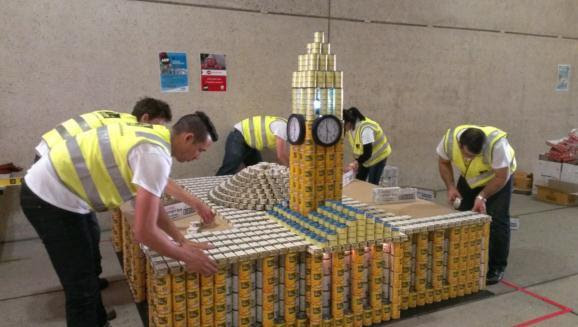
On the way home from work this evening, I saw that the green bin was still full. The recycle bin was empty. This was the third time the council had not picked up our green bin rubbish since we moved here three years ago. It may be due to the fact that we were the first or the last on the street, depending on which way they looked at it. In the past I had phoned in and the Council sent a contractor to pick up the bin. The Council had always been good. Today, I could only find the web contact which the council wants you to make a full report – so I did. While going over the forms on the council site and completing the necessary information like your contact details, I saw this photograph and thought it was very cool.
This group of Council engineers got together to build a mini City Hall sculpture from canned foods for a competition. I wanted to post the picture as my “cool stuff” but it had a story.
Brisbane City Council Seven of Council’s young engineers gave their time to take part in ‘Canstruction’ – a global competition that creates giant sculptures out of tinned food which is then donated to charity. Hosted by Engineers Australia, our team of seven gave their own time to design and ‘canstruct’ a 1:32 replica of City Hall using 3300 cans. Donations and sponsorships helped drive this fun initiative for the engineers, with the cans then given to Foodbank for distribution to those less fortunate across Queensland. You will be pleased to note the replica was structurally sound.
Marshall Islands Poet Kathy Jetnil-Kijiner promises to protect her seven-month-old baby and what it means to fight for her heritage in light of sea level rise and the ultimate loss of her cultural identity. Click the link below to watch her presentation to UN and listen to her poem, “Dear Matafele Peinem”.
Kathy Jetnil-Kijiner presents her poem Dear Matafele Peinem to the UN Climate Summit. Vision from UN.
The UN Climate Summit has been graced by the likes of actor Leonardi DiCaprio and US President Barack Obama, but the haunting words of a young mother from a tiny Pacific Island nation have made the most lasting impression.
Spoken-word poet Kathy Jetnil-Kijiner, 26, from the Marshall Islands, was just one of four people chosen from 544 nominees to address the opening of the UN Climate Summit in New York.
In front of an audience of 120 state dignitaries, Jetnil-Kijiner performed a poem she wrote for her seven-month-old daughter, in which she promises to protect the child from the threat of climate change, which she says world leaders are ignoring.
Read more: http://www.smh.com.au/environment/climate-change/poet-brings-world-leaders-to-tears-at-un-climate-summit-20140925-10lq5x.html#ixzz3EPnPtJvf
A Turkish fashion designer has been accused of “misappropriating” Pacific Island designs in her collection at London Fashion Week recently.
Gul Agis’s “Tribal Attitude” is said to have been inspired by Turkey’s heritage and recent protests in Istanbul.
Some of the designs are based on the Ottoman Empire and Turkey, many others bear a strong resemblance to Maori design.
The accusation comes less than a month after global sports giant, Nike was forced to stop production on a women’s line of tights.
The Samoan tattoo-inspired collection caused a huge global backlash from the Pacific community worldwide.
Aroha Mead, Program Director of Maori Business at Wellington’s Victoria University told Pacific Beat Gul Agis’s collection stole from Maori culture.
“We are all inspired by the beauty of other cultures,” Ms Mead said.
“But there’s a big difference between being inspired by something and then outright stealing it.”
Unfortunately Pacific designs are not protected by intellectual property laws or copyright, so international designers have been able to use them without permission.
“You can prove in quite tangible ways that the ownership of them is retained by the community,” Ms Mead said.
“There’s enough work that’s been done that you can track a design down to the artist or to the community that it comes from.”
Sports brand Nike makes public apology
Nike recently found itself at the centre of controversy over a pattern of women’s tights that closely resembled a traditional Samoan tattoo reserved only for male chiefs.
The collection sparked an uproar within Pacific communities around the world who protested on social media and rallied together by signing a global petition.
Samoans found the range exploitative and succeeded in getting it pulled off the shelf.
Samoan Prime Minister Tuilaepa Sailele Malielegaoi told the Savali newspaper “Those are our Samoan measina (cultural treasures). It’s our heritage and our cultural property. We should all be protective of it.”
“It should not be randomly exploited for commercial use as it has been in this case. Especially when we are getting absolutely nothing from Nike.”
Nike made a public apology to the Pacific community worldwide saying the collection was inspired by tattoo graphics and they did not mean to be insensitive or offensive to any specific culture.
Samoan prime minister has since instructed the Ministry of Commerce and Industry to look at how they can protect their traditional designs.
Alongside Nike, New York designer Nanette Lepore also apologised on Facebook for a collection of dresses she had designed featuring Fijian kesakesa motifs.
The apology came after Fijians around the world protested on the brand’s Facebook page.
What seems to be particularly offensive within Pacific communities is international designers appear to have not bothered researching the background of the designs they are using.
“[Nanette Lepore] took those Fijian prints and didn’t even bother finding out where they came from before she called them Aztec – she promoted those designs as Aztec designs.” Ms Mead said.
Samoans around the world were upset about their traditional tatau designs being exploited but were more angered by the fact that the cultural meaning behind the design was disregarded.
One petitioner on change.org complained that seeing women wear a tattoo specifically designed only for a male chief was both wrong and offensive.
Another wrote: “This reduces [tatau] to patterned tights rather than assigning it the mana (strength/respect) that it warrants.”
Hollywood star Dwayne ‘The Rock’ Johnson alongside Rugby heroes like Sonny Bill Williams have added to the growing popularity of Pacific tattoo designs.
In many creative industries there is a common misconception that some traditional cultural expressions are public domain.
World Intellectual Property Organisation are currently in negotiations to arrange an international convention on intellectual property and genetic resources as well as traditional knowledge and folklore.
Museum Loan Network: Pacific Instruments Collection
For over a century, The Field Museum of Natural History has amassed a world-class permanent collection of over 55,000 objects that represent the varied cultures of the Pacific. The Field Museum’s Pacific Musical Instrument Collection includes over 1,000 specimens from a number of different localities, the majority of which (4/5 of the collection) come from Papua New Guinea. Also represented in the collection are musical instruments from Vanuatu,IrianJaya / West Papua, Indonesia, Fiji, Hawaii, New Zealand, Samoa, the Solomon Islands, New Caledonia, Tahiti, the Marquesas Islands, Palau, Micronesia, and the Austral Islands.The musical instruments in the Pacific collection represent all 4 classifications of musical instruments:Aerophones (wind instruments),Chordophones (string instruments),Idiophones (percussion instruments), andMembranophones (drums with membranes). The 384aerophones in the collection include a number of bamboo flutes, panpipes, whistles, shell and wooden trumpets, and a variety of woodenbullroarers. The 11 chordophones in the collection include a few musical bows and tubezithers. The 249idiophones in the collection include large wooden slit drums, friction blocks, rattles made from shells and nutshells, and a number of bamboo mouth harps. The 381membranophones in the collection include an impressive number of 330kundu, or hourglass-shaped drums, usually topped with a reptile-skin head, from Papua New Guinea.As with many of The Field Museum’s collections, the first musical instruments in the Pacific Collection, 21 in number, were acquired in 1893 for the Chicago World Columbian Exposition. The largest addition to the Pacific Musical Instrument Collection (approximately 335 specimens) came to the Museum in 1913 when curator A.B. Lewis returned from the South Pacific. Having joined The Field Museum’s Department of Anthropology in 1908 as Assistant Curator of African and Melanesian Ethnology, Albert B. Lewis immediately went to Melanesia to lead the Joseph N. Field South Pacific Expedition. The four-year long expedition netted some 12,000 objects of Pacific material culture that Lewis spent most of the rest of his career cataloguing. A complete analysis of the expedition was recently published by The Field Museum’s Adjunct Curator Robert Welsch (1998; An American Anthropologist in Melanesia: A.B. Lewis and the Joseph N. Field South Pacific Expedition, 1909-1913. University of Hawai’i Press). An early proponent of systematic anthropological research, A. B. Lewis left behind a richly documented ethnographic collection. The most recent additions to the Pacific Musical Instrument collection include the donation by Eugene Giles of a rare pottery drum with reptile-skin head from Morobe, Papua New Guinea and an impressive collection of instruments, 55 in total, donated by ethnomusicologist Dr. Vida Chenoweth, who between the years of 1959 and 1975 amassed a collection of 700 artifacts in the Usarufa community in the Eastern Highlands of Papua New Guinea.
Museum Loan Network: Pacific Instruments Collection
For over a century,The Field Museum of Natural History has amassed a world-class permanent collection of over 55,000 objects that represent the varied cultures of the Pacific. The Field Museum’s Pacific Musical Instrument Collection includes over 1,000 specimens from a number of different localities, the majority of which (4/5 of the collection) come from Papua New Guinea. Also represented in the collection are musical instruments from Vanuatu, Irian Jaya / West Papua, Indonesia, Fiji, Hawaii, New Zealand, Samoa, the Solomon Islands, New Caledonia, Tahiti, the Marquesas Islands, Palau, Micronesia, and the Austral Islands.
The musical instruments in the Pacific collection represent all 4 classifications of musical instruments: Aerophones (wind instruments),
Chordophones (string instruments), Idiophones (percussion instruments), and Membranophones (drums with membranes). The 384 aerophones in the collection include a number of bamboo flutes, panpipes, whistles, shell and wooden trumpets, and a variety of wooden bullroarers. The 11 chordophones in the collection include a few musical bows and tube zithers. The 249 idiophones in the collection include large wooden slit drums, friction blocks, rattles made from shells and nutshells, and a number of bamboo mouth harps. The 381 membranophones in the collection include an impressive number of 330 kundu, or hourglass-shaped drums, usually topped with a reptile-skin head, from Papua New Guinea.
As with many of The Field Museum’s collections, the first musical instruments in the Pacific Collection, 21 in number, were acquired in 1893 for the Chicago World Columbian Exposition. The largest addition to the Pacific Musical Instrument Collection (approximately 335 specimens) came to the Museum in 1913 when curator A.B. Lewis returned from the South Pacific. Having joined The Field Museum’s Department of Anthropology in 1908 as Assistant Curator of African and Melanesian Ethnology, Albert B. Lewis immediately went to Melanesia to lead the Joseph N. Field South Pacific Expedition. The four-year long expedition netted some 12,000 objects of Pacific material culture that Lewis spent most of the rest of his career cataloguing. A complete analysis of the expedition was recently published by The Field Museum’s Adjunct Curator Robert Welsch (1998; An American Anthropologist in Melanesia: A.B. Lewis and the Joseph N. Field South Pacific Expedition, 1909-1913. University of Hawai’i Press). An early proponent of systematic anthropological research, A. B. Lewis left behind a richly documented ethnographic collection. The most recent additions to the Pacific Musical Instrument collection include the donation by Eugene Giles of a rare pottery drum with reptile-skin head from Morobe, Papua New Guinea and an impressive collection of instruments, 55 in total, donated by ethnomusicologist Dr. Vida Chenoweth, who between the years of 1959 and 1975 amassed a collection of 700 artifacts in the Usarufa community in the Eastern Highlands of Papua New Guinea.








 Tribalmystic Stories