I personally have always admired Dame Josephine. She has lived an extraordinary life and will continue to inspire the women of Papua New Guinea and other Pacific islands. Thank you Veronica Peek for writing this story and sharing it with us.
When I look back now on those seventies years in Papua New Guinea, there is one politician who stands out as personal favourite, and that is Dame Josephine Abaijah. In those days when she had no title, Josephine and I were neighbours of sorts. She owned a news agency in the Port Moresby suburb of Boroko and it was at street level, of course. Up one flight of stairs and directly above her shop was a suite of rooms where I had my photography studio and darkroom. If the acrid chemical smells emanating from said darkroom ever troubled her, she didn’t say so.
My memory of Josephine, then, is of a dainty, impeccably groomed lady behind a counter who served me my copies of Australian newspapers and magazines. Thing is though, she wasn’t always there. This little lady had bigger fish to fry.
According to the Chivoko people, anything and everything you need comes from the forest and the sea. Food, building materials, things they could wear, are all provided by Mother Nature. If Mother Nature was destroyed, that would be the end of life. This is a story about a community coming together to make a conservation effort to protect their land, sea, environment, and their heritage for their further generation. What is great about this short film is that the future generation are taking action and are part of this effort.
Written and filmed by the storytellers themselves from Chivoko Village, Northwest Choiseul, the Solomons Islands. Choiseul Province is the northernmost island in the Solomon Islands double chain archipelago and lies approximately 45 kilometres southeast of Bougainville, Papua New Guinea.
It is not often that you find musicians using nature to aid in their musical performances. In the Melanesian culture, a rare tradition passed down from generation to generation of women still lives on. Lakes, rivers or the sea water is used as a percussion in this tradition, to provide the music with singing. In recent years, this beautiful tradition has been shared with the world through international tours and festival performances. The performers of the Vanuatu Women’s Water Music group (two pictured) hail from the remote northern tropical islands of Vanuatu. They travel the world performing the Na Mag and Ne Lang dances as a prelude to the mystical water music, dressed in their traditional costumes of Gaua and Mere Lava made from flowers and leaves, coconuts and pandanus. Their performance is truly mesmerizing as they reimagine the old with contemporary expressions of Matto – bringing together traditional beats and rhythms with ukulele-led melodies and soaring vocal harmonies.
“And in an age when most bands are dominated by just a handful of instruments — drums, bass and guitar — I encounter a new way of making music every year at the RWMF. In 2011, women from a village in Vanuatu turned the lake of the cultural village into their instrument, cupping their hands under the water to make booming percussion sounds”, wrote Michael Switow when reviewing the women’s performance at the Rainforest World Music Festival.
Onoda (second left) walking from the jungle where he had hidden since World War II, on Lubang island in the Philippines
I found this story deeply moving.
Hiroo Onoda was the last Japanese imperial soldier to emerge from hiding. He finally surrendered in 1974 on Lubang island in the Philippines. Onoda’s imperial army uniform, cap and sword were still in good condition.
Two weeks ago, one of the most fascinating story about the war came to an end when a former imperial soldier, Hiroo Onoda died at the age of 91 in Japan. When the war had ended in 1945, and his troops surrendered, Onoda had refused to surrender and hid in the jungles of the Philippines for 30 years. He was accidentally discovered by a traveller, and through conversation, the traveller returned and reported Oneda’s existence to the Japanese army.
When approached, Mr Onoda still could not believe, the war was over. Only his own superior and commander from 30 years ago, had to go to the Philippines and convince Mr Onoda – the war was truly over.
Onoda struggled to adapt to normal life on his return to Japan and he emigrated to Brazil in 1975 to become a farmer. He finally returned and settled in his homeland in 1984 and opened nature camps for children.
He did not consider his 30 years in the jungle to have been a waste of time.
‘Without that experience, I wouldn’t have my life today’ he said. ‘I do everything twice as fast so I can make up for the 30 years. I wish someone could eat and sleep for me so I can work 24 hours a day.’
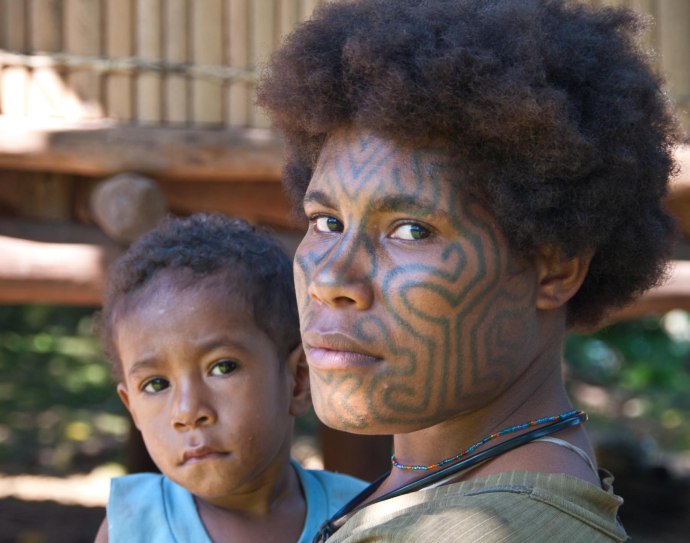
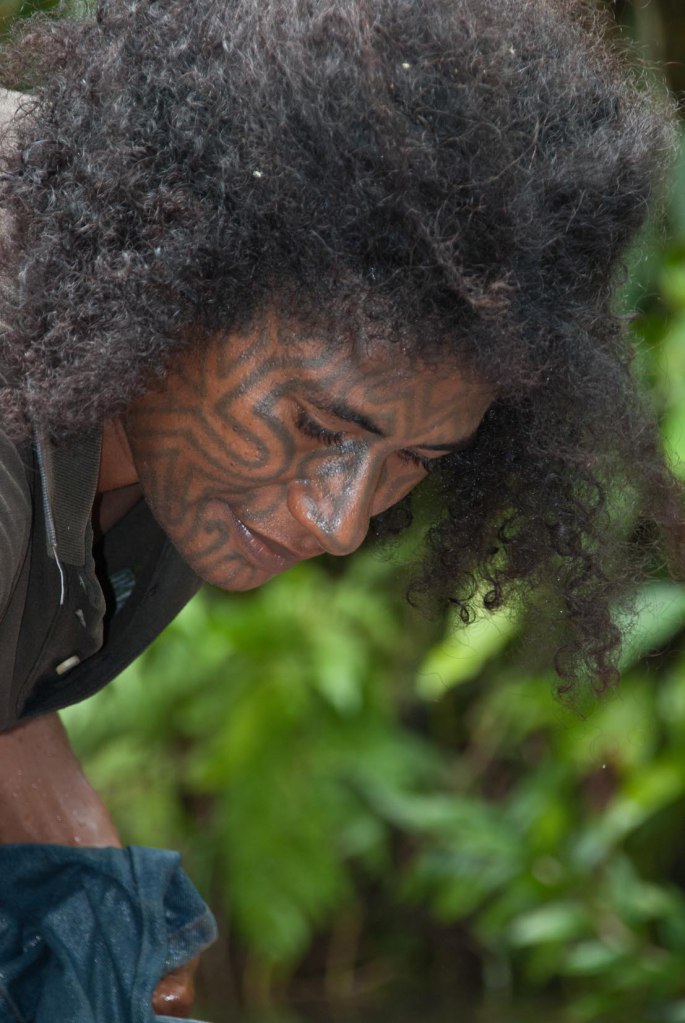
The Tufi tattooing is a beautiful tradition that remains alive in Oro Province. The art of traditional tattooing is dying, but, traditional artists and master tattooist in Tufi have kept the tradition alive for women in this culture. Tufi is known world-wide for its enchanting natural beauty. The town of Tufi is surrounded by reefs. It is one of the top diving spots in the world and a place of rich cultural heritage. The Tapa cloth also comes from Tufi. The town is located in the Eastern Peninsula of Cape Nelson in Oro Province, Papua New Guinea.
When a Tufi girl is ready for marriage she might, for some weeks, enter the hibernating process of getting a facial tattoo. The tattooing is an old traditional practice that has faded away and disappeared in most communities, but there are some areas where the tradition lives on.
Ethel is proud of her tattoo
The girl stays in seclusion during the time of the application, which is made by a qualified tattooist – sometimes a relative; always a woman. First the pattern is drawn in black, and when the girls’ parents have expressed their appreciation the tattooist starts the actual process. Dulcie at Kafuaruru village and Levinia at Angorogho, two of the still active tattooists, use a modern needle instead of the bush needle that was tapped by a stick, which was the old way. The dyes today are also mixed with modern ingredients that give a stronger…
A full documentary about ancient Ireland’s myths and monuments
Some of you know about this archeology site in Ireland. I found its story and the artwork very intriguing. The High Man documentary is about a fascinating giant figure of a warrior god in the ancient landscape of Ireland.
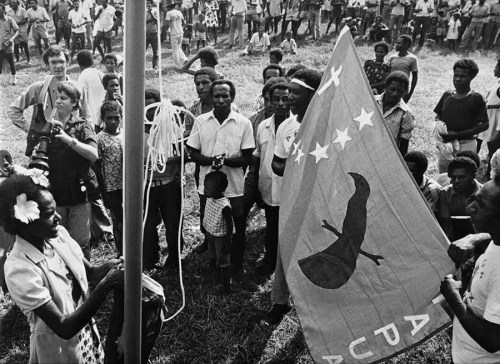
Spirit of Mambesak was initially formed in the 70’s and 80’s by West Papuan artists Arnold Ap and Eddie Mofu. They understood the importance of culture and strove to use music as a medium to convey their basic human right: the freedom of expression.
Mambesak was formed to revitalise traditional West Papuan dance, music and song and eventually provided a certain colour, form and inspiration for the birth of music and dance groups throughout Papua, actively promoting and strengthening West Papuan identity. However, Arnold Ap and Eddie Mofu’s popularity and the conscious pride in being Papuan Mambesak’s music engendered, brought them to the attention of the Indonesian military who accused them of being separatists. They were finally murdered. Today, the spirit of Mambesak endures with new faces and new songs. This album was released in 2004.
You can listen to more or purchase their music here
“Life is easy” says Jon Jandai. “Why do we have to make it so difficult?”
After pursuing “success” in Bangkok for several years, Jon dropped out of university to return to village life. There, he went back to the life he knew as a child, working two months of the year to grow rice (with an additional 15 minutes a day to grow vegetables), dug a couple of fish ponds, built his own homes using earthen bricks, and gave up buying clothes (he has so many clothes from friends and visitors that he has to give them away). Jo contends that to be happy, we cannot just rely on money; we have to reconnect with each other.
“Before I thought that stupid people like me … cannot have a house… because people who are cleverer than me and get a job need to work for 30 years to have a house. But for me, who cannot finish university, how can I have a house. It’s hopeless for people who have low education like me. But when I start to do earthen buildings, it’s so easy! I spent two hours per day… and in 3 months I have a house. A friend who was the most clever in the class he has a house too but he has to be in debt for 30 years, so compared to him I have 29 years and 10 months of free time. I feel life is so easy.”
Jon runs Pun Pun an organic farm, seed-saving operation, and sustainable living and learning center. At Pun Pun they use ancient natural building techniques with readily available, local, natural materials with little embodied energy and salvaged materials to make homes, a practical and affordable alternative to resource intensive conventional building.
On March 7th, 1979, a week before I turned 14, I heard at school and on the news that a famous explorer named Michael James (Mich) Leahy had died. This man took an epic journey into the undiscovered, and untamed central highlands of British New Guinea in 1930s. I was in year nine at Busu High School, Lae, Papua New Guinea. During that time, I had been searching for my father and I already knew I was a child of the Leahy family. None of the information about the Leahys including those of the famous explorer were told to me. I was a very inquisitive child with many resources available and many people I could ask. However, only very few of my mother’s family members were responsive. At an early age, I knew that in order to find my father, I had to get my own information and do my own research. I became anxious as I grew older and was faced with the charges of other cruel children. They would constantly question who I was, my life, my father, my colour, and why I was ‘different’. Up until that point, all the information to do with my heritage was bundled into one big secret, kept by my mother. To get the information, I conducted a secret investigation of my own.
And, that was how I knew, the famous explorer who died was my father’s father. On that day, reading the news, I knew I would never meet my grandfather. It was a moment of surrealism, one I could not share with anyone. It felt strange to be paralysed by the thought of losing something great, that I never had. I did not speak about the death with anyone. As days went by, my fears were suppressed by my curiosity. Wherever I went and whoever I spoke to, I continued my research for every information I could get about my father. (Read more when I publish my memoir.)
Mich Leahy
My final Australian story tonight is about Australian Michael Leahy, the first white man to enter the central highlands of Papua New Guinea with his three brothers. This is a long story, however, this post will be brief, and I will give you as many links as I can for you to read more about Mick Leahy.
Born in Toowoomba on February 26, 1901, fourth child of nine to Daniel and Ellen Leahy, an Irish migrant family, Mick completed his education at Christian Brothers College, Toowoomba. His first job was as a railway clerk, but, his entrepreneurial spirit drove him to leave and become a freelance wood-cutter. When the news of the gold rush in Eddie Creek, New Guinea, in 1926 reached him, Mick was driving a lorry. He had stopped the truck and the story was that, he jumped on the first ship to Port Moresby. His three brothers, Paddy, James and Dan joined him later. His brother Tom remained in Toowoomba.
In the same year Mich was born, June of 1926 the Permanent Mandates of the League of nation met in Geneva to discuss Australia’s takeover of New Guinea. It was noted that the total area of New Guinea was 16,000 square miles. This was only one sixth of the actual total area and the reason being, the rest of New Guinea was unexplored and unknown.
Mich started his gold prospecting; mostly down along the Bulolo and near and around areas close to the Eddie Creek. During his prospecting years in New Guinea, Mich became ill with Malaria and nearly lost his life. He took a construction job and stayed out of the bush until 1930.
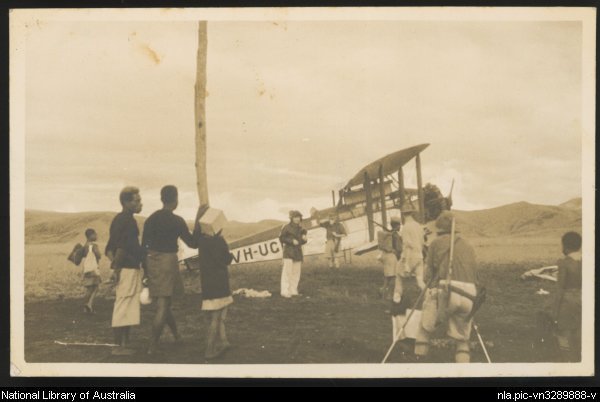
http://www.nla.gov.au/apps/cdview?pi=nla.pic-vn3289888 Mich with his back to the camera is making a movie of the plane Canberra being prepared for surveying expedition into the highlands. Ken and Irish Spinks collection at National Library of Australia photos.
He returned with Mick Dwyer and walked across parts of interior New Guinea. Their main aim was to prospect for gold. However, as they approached some parts of the interior, they discovered that they were the first white men to be seen by the natives of the area. The natives of the interior could not communicate readily and many reacted as if the Mich and Dywer were ghosts or spirits. They had brought workmen from the coast, and some could speak and translate in pidgin. Mich and Dwyer had been warned the inland area was unpopulated with no Australian government administration and it was very dangerous. They were told that they could lose their lives. This did not deter Mich’s passion for prospecting and his inquisitiveness to see inland New Guinea. Mich had not wanted to take his brother Dan, the youngest, because he felt, Dan was not ready. Both Mich and Dywer kept personal diaries, notes, and they took photographs of their expedition. In the first part of the Epic journey, Mich and Dywer crossed the Purari/Gulf of Papua which began his taste to return and walk deeper into the highlands of New Guinea. In his book, The Land That Time Forgot, Mich Leahy wrote that in their first expedition, on the foot of the hills before him and Dwyer entered the highlands, one of the missionary workers tried to scare Ewunga, Mich’s boss-boy in pidgin. Mich more or less wrote it in his version of Pidgin-English:
“Moun-tain ee big fella more. No got road, Kanaka long hap, man belong fight true. Allee can killum you fella, now kai-kai.”
(Translation – the mountains are bigger, there is no road and the natives are fearful warriors. They can kill and eat you.”)
To which the fearless Ewunga replied: “No can! Kanaka something nothing. Suppose allee like fight, me fella can tryum.”
Translation: (“No, they cannot! Natives are nothing. If they want to fight, we can all try.”) Mich was really glad that Ewunga was fearless.
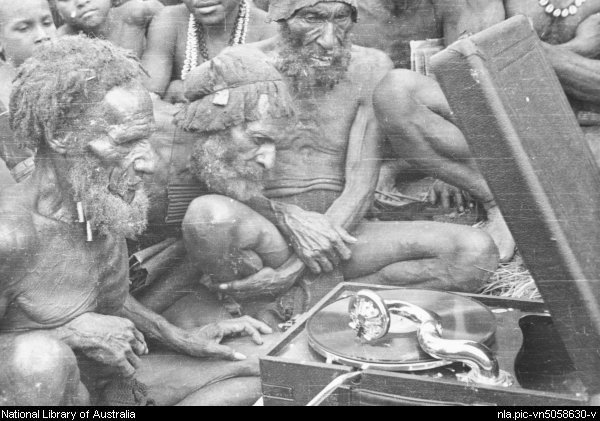
Leahy, Michael J., 1901-1979. Papuans looking at first gramaphone, Mount Hagen, Papua New Guinea, 1933 PPIc: National Library of Australia.
Mick and his brother Danny were leaders of the next and the 1933 expedition that opened up the Wahgi Valley of the Western Highlands and this was where Danny would eventually settle. From what he had written, I believe, Mich loved the Waghi Valley and the Western Highlands the most. He admired the architecture of the houses, the adornment and dress of the people. he also thought the people were intelligent and warm.
“The landscaping and the sing sing (dancing) grounds resembled that of the upper Waghi and we were continually admiring their beauty and arrangement. I was invited to enter one of the ceremonial houses and found them to a well-made, circular grass house, with a roof ten feet high, divided into five compartments, one of them being a sort of hallway down the centre.” Leahy, The Land That Time Forgot”, p.218.
Mich’s gold prospecting adventures turned out to be one epic journey which has gone into the history books of both Australia and Papua New Guinea. A trilogy of the Leahys’ story can be purchased from ABC stores. There are previews on YouTube. I have posted a link to the Australian Screen.







 Tribalmystic Stories