All posts by tribalmysticstories, lazylittlefrog.com

Author, Artist, Arts Curator, Climate Activist, Anti - Violence against Women, and Entrepreneur

The Nude Book Was a Flop!


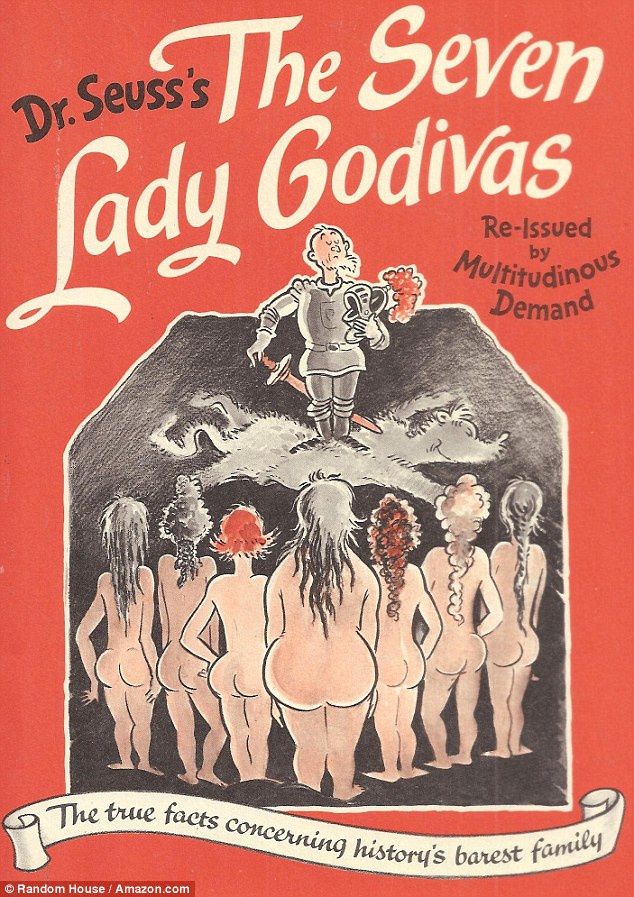
The story of how Dr Seuss wrote a little-known adult book about seven medieval sisters who never wore clothes. The book was a flop.
26493C9100000578-0-image-m-26_1425414782659
Not the usual: Dr Seuss penned this saucy book in 1939 – but it never gained much popularity despite featuring pages of cartoon nudity

I love Dr Seuss’s Children’s books and found this story very funny. In fact my 19-year-old who grew up on Dr Seuss children’s stories and learnt a lot of his first words from the rhymes was quick to point out, he knew about the Seven Lady Godivas when I shared my discovery today.

As a writer, I think that sometimes you have to try writing in more than one genre before you know where your strength lies. It was how Dr Seuss did it – trying his writing and drawing talents at adult cartoons before he discovered his true calling was in children’s books. I often see writers going from general genres to adult/erotic books but not the opposite as Dr Seuss who celebrated his birthday yesterday did. He wrote the failed exhibitionist tome in 1939.

In this Daily Mirror article Seuss, also known as Theodor Geisel only sold 2500 copies of The Seven Lady Godiva. He wrote that he was in fact telling ‘a beautiful story of love, honor and scientific achievement’. His best-known characters are famous for their clothes. But the Cat in the Hat and the Fox in Socks have little in common with the stars of another The Seven Lady Godiva.

The gang of naked sisters who star in The Seven Lady Godivas: The True Facts Concerning History’s Barest Family, are famous for wearing no clothes at all.

Publishing the book was allegedly a condition for Random House, Seuss’s new publisher, when he jumped ship to them. However, it seems few agreed with his own high opinion of the bawdy tale. While 10,000 copies were printed, only 2,500 were ever bought.

He later accepted that the book was no good. According to The Atlantic, he said: ‘I attempted to draw the sexiest babes I could, but they came out looking absurd.

26493C9A00000578-0-image-m-28_1425414989715

The famed author’s birthday, March 3rd is now celebrated as a national reading festival. The Dr Seuss’s children’s books were the favourites of both my two boys when they were growing up.

26493C9500000578-0-image-m-24_1425414586182
One of Seuss’s better known characters, the Cat in the Hat


The Daily Mirror 


Language and Culture Dominance on Stories


5792984-3x2-340x227
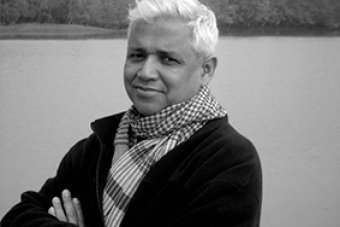
IMAGE: AMITAV GHOSH, A GUEST AT THE UBUD WRITERS & READERS FESTIVAL

This is an interesting interview by with author Amitav Ghosh by ABC’s Michael Cathcart.  In the discussions, Ghosh talks about his life and his work, but he also points out a very important aspect of story-telling;  how a language or culture can dominate a story.

Amitav Ghosh was born in Calcutta, an Oxford graduate.; his life and work span countries and cultures.

In this program ABC (Australia) talked to Ghosh about what he has sensed in the ways in which people and cultures mix and adapt, especially with storytelling and his passion for telling the untold story. Often, in Amitav’s view, the colonial narratives are so often deaf to hearing particular voices.

ABC spoke to Ghosh about his novels The Hungry Tide (2004), and Sea of Poppies (2008) which are the first two absorbing instalments of the Ibis trilogy set in the port town and on the high seas between India and China.

On to Amitav’s audio interview with ABC: here, then click Audio

http://www.abc.net.au/radionational/programs/booksandarts/ubud-writers-26-readers-festival3a-amitav-ghosh/5792940


A Very Inspiring Blogger Award


very-inspiring-blogger-award

Over two weeks ago, I was very honoured to be nominated by Kathleen from KBailey373 blog for A Very Inspiring Blogger Award. I am very grateful to accept this award from Kathleen who has only been following my blog for a month. At the end of last year I was also nominated by Steve from Life in Russia for this award, but unfortunately, I had too much on and was ill, and did not attend to the requirements of the award. To Kathleen and Steve – a sincere thanks for finding something to inspire you from my blog. It means a lot to me. I have linked both blogs so you can visit and enjoy stories in KBailey373 and Life in Russia.

Blogging is fun, but not often easy. It is hard to know what appeals to readers.  After a year of blogging, I am slowly getting the idea of what not to post. Unfortunately some of the “not to post” are what I believe in, for example, the climate exchange issues.  Thank you for continuing to read and supporting this blog despite your preferences. Thank you for pointing out my errors, I like that.

On WordPress, I have come to treasure the work of many fellow bloggers. I told a friend yesterday that I have some great my readers and bloggers who have now become friends. This friendship inspires me to write or posts something good in each posts. I may not have pleased every reader in every post, but I try my best. I have learnt more from others in the blogging  community. WordPress has a large community of amazing people with interesting stories. I am a student of life and each time I come to blog world, I get very excited. I know I will learn something new. Thank you very much friends for inspiring me too in your content, comments and readership.

To meet the requirement of the award, I must;

  1. Display the award on your blog.

  2. Link back to the person who nominated you.

  3. State 7 things about yourself.

  4. Nominate 15 bloggers, link to them, and notify them about their nominations.

Seven things about me

  1. I almost drowned at the age of 10 during a fishing trip. It was in a flooded Busu, one of the fastest flowing river, several kilometres from our village (in Lae, PNG). My uncle flung the fishing net into the river,  caught me and pulled me up. (I am a good swimmer by the way).

  2. I have lived in Brisbane, Australia for 10 years. Where we live used to be a pineapple plantation and there is an 18th century cemetery behind us, separated by my neighbour’s house.

  3. When I was in Year 10, in high school, I was nominated to represent our school and compete in a national high school speech competition. It was sponsored by the Lions Club, (a charity and youth advocate). I gave a speech about the History of Lae Town, my town and how my people first came to settle on that land. I won some cash and $500 worth of books for my high school, the Busu Provincial High School. (It doesn’t sound like much now, but it was a lot then – 1980).

  4. I had straight blonde hair when I was a child. The more my grandmother cut my hair (so it would be an afro like hers) my hair curled. Now I have large dark curls.

Photo_8DE7B5D9-2471-DCF7-E84A-7BBDF2250576 2
My crazy hair.
  1. Fish is my favourite food.

  2. I love birds and can watch them for hours.

  3. I was told by two doctors I was having a baby girl before I had my second son, now 16. We named ‘her’ Nisha until at birth. He had no name for two days. He became Christopher Eric Harris on the third day.

……………………..

Here are come of the blogs that inspire me for various reasons, mostly personally. They are not in any particular order of preference. I enjoy reading these blogs because of their rich and in-depth content and the each writer’s dedication and enthusiasm in sharing, exchange and helping others. Sorry if I did not list you here, I  can only list 15.

The Blogs that Inspired Me 

The Story Reading Ape

Life In Russia

Millie Thom

After Midnight: A Christian Bipolar

Publishing Insights

A Writers Path

A Refugee’s journey – Vietnam to Australia

Pmsspeak Blog

Nomzi Kumalo

Crime Fiction Writer Sue Colletta

When Women Inspire

Broadblogs

How the Cookie Crumbles

gordoneaglesham

O at the Edges

Words You Can Touch


An artist transforms written words on paper into work of art you can touch.

Jennifer’s practice focuses on creating work from paper; by bonding, waxing, trapping and stitching she produces unusual paper ‘fabrics’, which are used to explore the ‘remaking’ of household objects. The papers are treated as if cloth, with the main technique employed being stitch; a contemporary twist on traditional textiles. The papers themselves serve as both the inspiration and the media for my work, with the narrative of the books and papers suggesting the forms. Jennifer tends to find items then investigate a way in which they can be reused and transformed; giving new life to things that would otherwise go unloved or be thrown away.

jennifercollier.co.uk

Short Story: Swamped


Final part of  SWAMPED

(JLeahy on Creative Writing with Isabel De Avila Winter ) ©

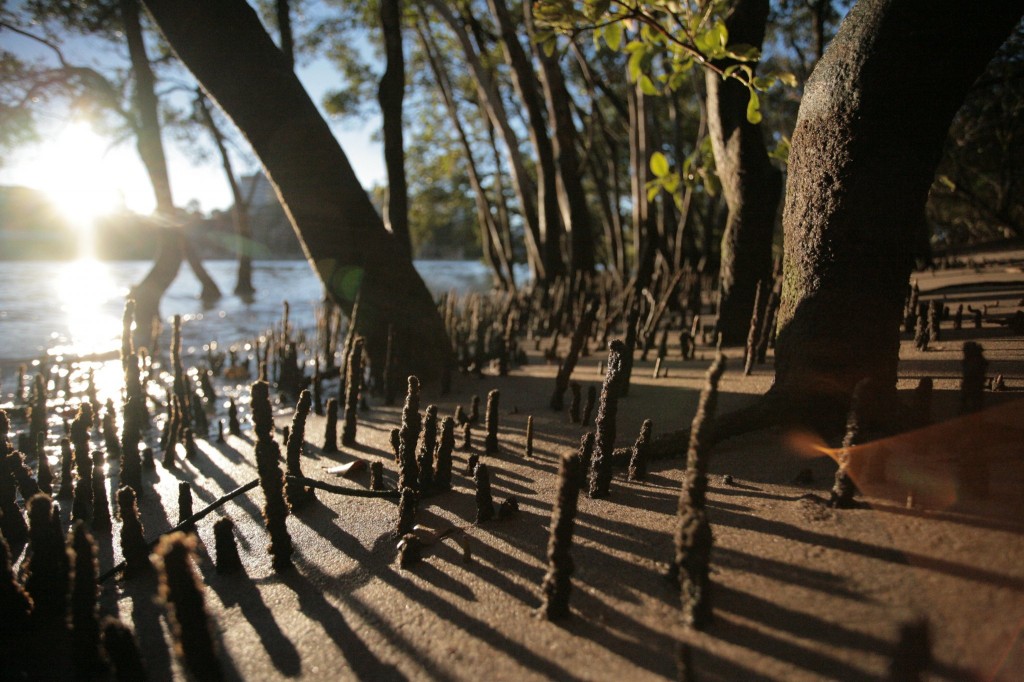
Mangroves-1024x682
Public Domain image.

I remained standing at the T-junction and my attention shifted to where the two waterways met. I wondered where the birds were today. By now, the sun rays would have come through the leaves and woken the birds, causing an eruption of an electrifying orchestra. There was not a single bird-song. That part of the equatorial rainforest norm was missing.

My arms hung loose and lifeless, I could not feel them. I tried to, but I could not lift my arms nor move my legs. I was not terrified; I only felt stuck and this alarmed me a little because the mud was not deep. When I drew breath, it was slow, restrictive, and my chest was constricted. Something large of several layers like a heavy coil of thick, soft, rubber hung around my neck and shoulders. It weighed me down. I was tall for a teenager, but my thin, weak and small shoulders were crushed by this weight. I thought it was a heavy towel as we often hung towel around our necks to keep warm while fishing. I shut my eyes.

And then it moved, so suddenly. I realised this was not a towel. It was a large snake, a python! A different set of knots, the horrid kind, started tightening inside me. On me, I saw the coils move and could feel it tightened.

My eyes re-focused. The snake’s colour reflected that of the greyish mud, faint yellow like a banana skin, and the brown mangrove tree bark. I could see the diamond-shaped outline of each scale. It was detailed vividly in intricate patterns on its centre spine above my breasts and just beneath my chin. The scale patterns, beautiful and seamless, disappeared under the next coil. I became more aware, alarmed and numbed by the weight, closeness and firmness of its grip. I shifted my eyes ahead beyond the mangrove. It did not make sense to scream and it seemed too hard to remember how to scream. I refused to imagine where the snake’s head would be, I did not want to meet it nor look into its eyes. Now I remember how that poor pig must have felt when the python took it behind our house. Was this the same snake?

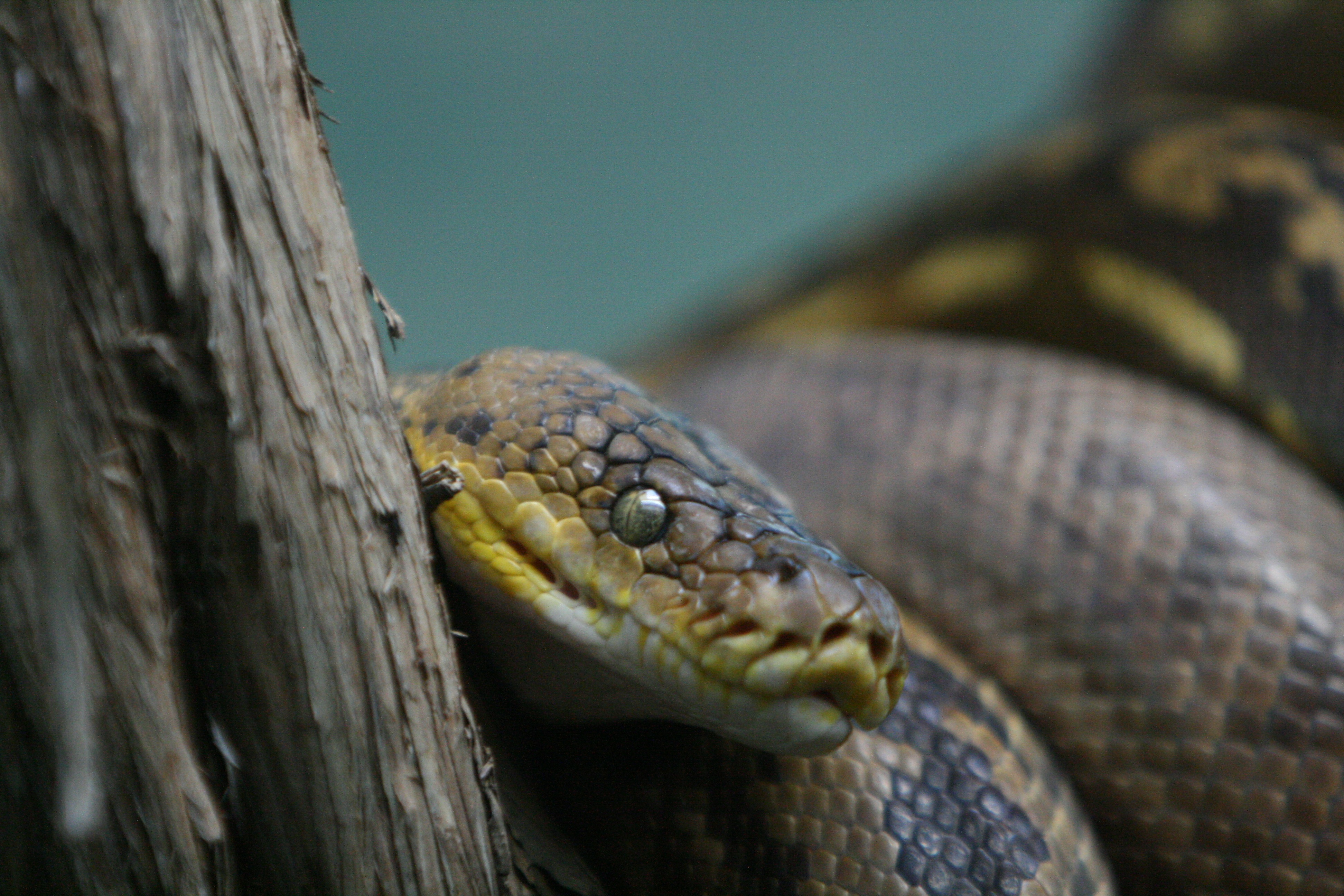
TimorPython
Timor Python: Public Domain image

I waited for a few more minutes and I sensed the snake was not trying to kill me. That was strange. It seemed comfortable the way it restricted and detained me, and I was afraid to move and disturb it. The dank smell re-appeared and honed the swamp stink. I could not feel the mosquitos. I wondered if that stink was the snake. Its weight became too much and I wondered how long I would be standing there in the mud, carrying the snake.

Then, a single call of a Sock-ngkwing bird, the spirit bird, pierced the silence and my eardrums. I moved to the bird’s cry. The python tightened its grip, and squeezing .. and I screamed just like the bird, feeling my body become alive. I moved my arms and legs. I flipped over and woke up with my bed sheet tight around my neck. It was THAT dream. Before I went to high school, in my early teens, I had this dream so many times. It was always the same dream. I shuddered. Still tense and terrified, I went to see grandma.

I re-told the dream to my grandmother; she looked at me for a long time.  Her eyes searched, speaking to my face, without words.

“There is a decision you have to make, a path you have to choose. What is stopping you from choosing, is your fear”, she said.

I looked at Tinang, afraid.

“Don’t be afraid” she said and hugged me. I shut my eyes and fell against her soft, tattered, spun rayon dress. Grandma’s scent of Chinese White Flower lotion, mixed with mustard and chewed betel-nut soon erased the swamp stink. I had thought about this dream interpretation often when I was growing up, and it always frightened me because I knew what it was, but it was not a single thing; it was many…

The Extraordinary in the Ordinary


An exhibition of images taken of the ordinary day-to-day things we use and see. It is best to watch this show on a full screen with the sound.

Tomorrow: Short-story, final part of Swamp.

Island Living in Papua New Guinea


I found this short documentary made by Planet Doc and presented in Spanish. I tried to watch it and work out what the narrator is saying (without the sub-titles). Don’t worry, for you, there are English sub-titles. There is a sequel to this film which I can post later. I believe a cultural heritage of a person can influence what they value is important and how they present that value in a story. There were certain practices of intangible cultures from Papua New Guinea island tribes presented in this film. It stretched from the Trobriand Islands to the islands of New Britain. I don’t understand what the language (Spanish) the narrator is speaking, but watching the pictures, and knowing the culture, I can see what he is trying to show. Perhaps some Spanish speakers here can figure it out what the narrator is trying to say about the shell money he is showing , from both island traditions.  

This is the magic of story-telling. Simply, what you can show your readers. As good writers, we need every possible word that can draw a picture well in our reader’s mind.

Sokushinbutsu: Mummified Japanese Monks


I have found these stories very fascinating. One story is about the Japanese monks and the other story is about ancient Chinese statues and an interesting discovery.

Sokushinbutsu4[4]

Scattered throughout Northern Japan around the Yamagata Prefecture are two dozen mummified Japanese monks known as Sokushinbutsu, who caused their own deaths in a way that resulted in their mummification. The practice was first pioneered by a priest named Kuukai over 1000 years ago at the temple complex of Mount Koya, in Wakayama prefecture. Kuukai was founder of the Shingon sect of Buddhism, which is the sect that came up with the idea of enlightenment through physical punishment. A successful mummification took upwards of ten years. It is believed that many hundreds of monks tried, but only between 16 and 24 such mummifications have been discovered to date.

The elaborate process started with 1,000 days of eating a special diet consisting only of nuts and seeds, while taking part in a regimen of rigorous physical activity that stripped them of their body fat. They then ate only bark and roots for another thousand days and began drinking a poisonous tea made from the sap of the Urushi tree, normally used to lacquer bowls. Read more

Here is another story relating to the same.

dnews-files-2015-02-mummy-found-inside-buddha-statue-150223-jpg

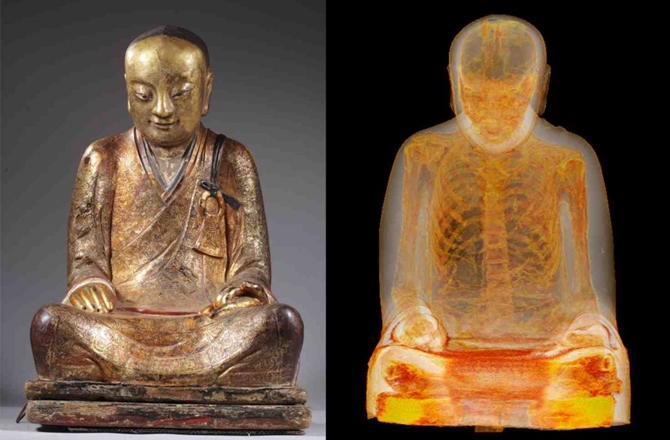
Researchers at the Drents Museum in the Netherlands made a shocking discovery when they imaged an ancient Chinese statue and found a nearly 1,000-year-old mummy inside.

Sitting in the lotus position, the mummy fits within the statue perfectly.

“On the outside, it looks like a large statue of Buddha,” the museum said in a release. “Scan research has shown that on the inside, it is the mummy of a Buddhist monk who lived around the year 1100.”

Read More

The Dance for Love


Here is a documentary (49 mins) by Tadashi Shimada about the Birds of Paradise, one of my favourite creatures on earth.

New Guinea is a true garden of Eden for birds. Some of the most unique are birds of paradise. With plenty of food such as nuts and fruits and very few natural predators, they’ve been able to leisurely hone their courting skills. The ribbon-tailed astrapia flaps its long white tail feathers, while the blue bird-of-paradise unfurls its feathers to create a pulsating eye-like shape. Since they live deep in the jungle, their courtship displays have long been steeped in mystery. Tadashi Shimada, a wildlife photographer who’s made numerous visits to New Guinea over the years, has for the first time ever captured images of the blue bird-of-paradise’s courting behavior. This program delves into the fascinating world of these beautiful and mysterious birds.

Published on Jun 25, 2014 – For more please visit NHK World.

Reuben’s Poetry in Kinetic Art


I really enjoyed this video and as one of the viewers, Bob Bobowiz commented, “Let’s face it. He’s a poet. He found another form than words but it still is poetry.”

Reuben is a very talented kinetic artist, who transforms solid mechanical parts into beautiful organic and fluid kinetic movements. In this PopTech presentation he shows his fascinating process with beautiful insight.