The coconut is one of the most valuable trees in the islands across the Pacific, Asia, Latin America and Africa. The coconut tree has many uses. The nut, its husk and shells, the trunk, leaves, even the bone of a single leaf is used. Children use the leaf for toys and women weave and cook rice in the leaves. Hats, baskets, mats and many other useful items are also made from the coconut leaves.
The coconut juice, coconut oil and coconut cream have become a recent rage in nutrition and diets in the western world. Ask abungac (grandpa) Google about the many uses of the coconut.
What happens when you destroy the tree that gives life?
This is a unique flash fiction challenge where Barbara W. Beacham provides a new photo and the first sentence of a story each week. The challenge is to finish the story using 100-150 words. This challenge runs from Monday to Sunday.
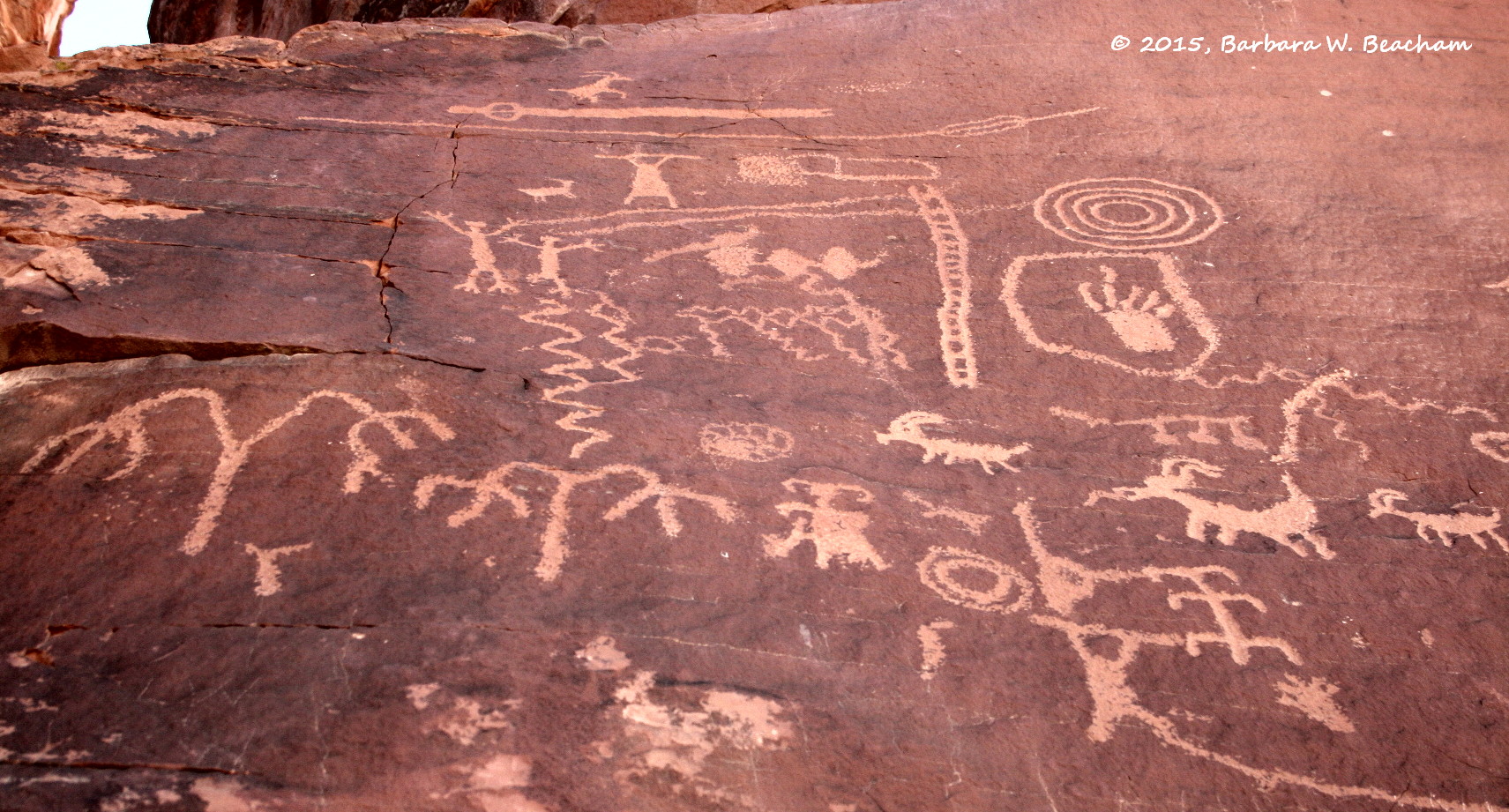
The petroglyphs told the story of an unusual event.
The old man’s eyes widened. He blinked from the petroglyphs and stared into the sky. The interpretation led to the present. Something was happening. Yawing, seven, could sense the fear in his grandfather’s voice.
Yawing followed Old Manu’s eyes; the clouds gathered into a thick dark cover.
“What is it, grandpa?”
“There’s no time”
“No time for what?”
“Go! Get your mother!” Old Manu ordered Yawing. “We need to move quickly. It is coming for us”.
“What is coming for us?”, Yawing asked, wide-eyed. He reversed to the door.
“Go!”
Yawing quickly turned and ran to find his mother among the women at the river. He tripped and fell.
“Mother! We must leave, now”, Yawing shouted with a mouthful of sand. He spat.
“They are coming for us!”
Yawing’s alarmed voice chilled into silence, his three little sisters, playing outside their house. As they watched, he ran to their mother.
Geraniums flower beautifully, keep a lush appearance in some of the hottest, driest conditions, yet here she is blooming in the middle of Australian winter. JKLeahy pic.
The Melanesians including Papua New Guineans produced war shields they used to protect themselves but these shields have a great artistic value. While these large hand-carved rectangular, square or oval-shaped cultural objects were made for protection in tribal war, they are also very beautiful. It is hard to visualise a work of art being used to protect one’s life, but made of hard-wood, the shields serve their purpose.
A shield of the Melanesia is a fascinating object. Many are made from wood and carry intricate tribal and clan markings representing profound spiritual meanings. The maker ensures that the markings incised or painted on this shield would protect someone’s life. In all the cultural objects that come from my heritage (the Melanesia), fighting shields would be my favourite.
From the 80s, I started collecting shields whenever I travelled across PNG. Once the West Papua community had a trade show in Port Moresby and I was extremely delighted to visit and I purchased a couple of shields and a door which was carved with intricate shield designs. West Papua shields, the Asmat, top my list of favourites. Over time, my obsession with shields resulted in over 30 pieces collected.
I have some pictures tucked away in my old computer, unfortunately, I could not find them for this post. Most of the shields from my collection were displayed in a cafe I owned and ran with a friend.
From JKLeahy collection: Eastern Highlands shield-PNGBefore we migrated to Australia, there was a feud over lack of electricity and water to a cafe business I owned with a friend. The landlord kept charging us astronomical amounts when we had to operate the cafe without water nor electricity. We lost business and customers. When we demanded to pay less rent (with power and water), we were locked of the cafe. Th landlord took everything, exceeding the value of the disputed rent. It was not just losing $50,000 worth of cafe equipment and furniture, my shield collection were stolen from the cafe. All gone. What happened after is another story.
It has taken me all these years to put this memory behind me. The pain returns often when I gaze at a beautiful Melanesian shield in a gallery or the thousands of beautiful pictures on Google. While most of the best and unique pieces in my life have gone, I still have a few beautiful pieces to make me smile. And I have this book (pictured below).
With Harry Beran, my friend Dr Barry Craig, anthropologist and a longtime serving curator in Papua New Guinea published a comprehensive compilation on the war shields of Melanesia in their book, “Shields of Melanesia”. The volume illustrates more than one hundred types of shields from all culture areas of Melanesia that used fighting shields. Approximately eighty percent of the shields illustrated in the book have never appeared in print. The book has images of some of the best Melanesian shields.
When you are growing up, and as a child, it is not always clear what your parents tell you, and often, you end up learning the lesson the hard way. How To Catch a Bird is one of those tough lessons Vera van Wolferen learnt as a child.
In Vera van Wolferen‘s own words: “How To Catch a Bird is a stop motion short film based on a childhood memory. It’s the graduation film I made for my masters in animation at AKV St. Joost Breda. When I was eight; my dad taught me how to fish. He told me to take the worm off the hook after fishing, but I had no idea why. After fishing I forgot about the worm and left it dangling on the hook. If I only knew then what the consequence of this action would be.”
Animation by Vera van Wolferen
Music by Gerard van Wolferen
The Guardian Picture: In 2009, the crater of the extinct volcano Mount Bosavi, in the Eastern Highlands Province, PNG was found. The green beetle pictured was one amongst many species discovered, except that this specie is iridescent.
The green beetle is one of my favourites and the insect possesses a beautiful rainbow shine. The beetles come out in millions during fruit seasons. In Papua New Guinea beetles are eaten as food, but the green beetle is so beautiful that tribal dancers use the insect as part of their fashion. The fashion or their traditional dress, especially headbands and headdresses are worn in singsings. A singsing is a performance of song and dance by a group and it is one of many living rituals, handed down through generations.
An Eastern Highlander (PNG) spotting a row of green beetle in his headdress. The beetles are woven intricately into the golden orchid fibre in diamond patterns.
I have seen the beetles myself in Goroka, Eastern Highlands Province and found these ones on headdresses in Simbai, Madang Province, which prompted this post.
Simbai tribesmen (Madang, Papua New Guinea) wearing their fashionable head wigs made from the green beetle.
An oiled wood coaster made by Chris Harris. 15/7/2015
Three nights ago, it was one of the coldest nights ever recorded in Brisbane in 103 years. It was very cold in the office all day and we increased the heat several times, but I had no idea it was six degrees. It was one degree in one of the suburbs – that morning. Up the river, near our home, it was below two degrees at Ipswich. This may not be cold for some of you readers that have temperatures measuring below zero at all times, but here, Brisbane is supposed to be one of the warmer states of Australia so we are feeling the cold.
Tonight was predicted to be another cold night, but so far, it has been around eight degrees celsius in Bellbowrie. On return from my evening walk, my 16-year-old son Chris brought me these little wood coasters he made while cutting firewood for our fireplace. The wood came from a tree that fell in a previous storm in our yard. We have been slowly using the tree up for various projects. And despite the cold, Chris was out making art.
A set of six wood coasters from Chris Harris. 15/7/2015
Each coaster is large enough to place under a hot cup and has beautiful grains of the hardy Acacia tree (a native to Brisbane) running through them in various shades. I decided to oil some to really bring out the grain.
Like some of the more unusual legal tender in other cultures of the world, the stone money from Yap is quite unique, and grand.
This is not your typical gold coin or silver coin you could flip. You would need all your friends to help you flip it and I would not wait to catch it coming down.
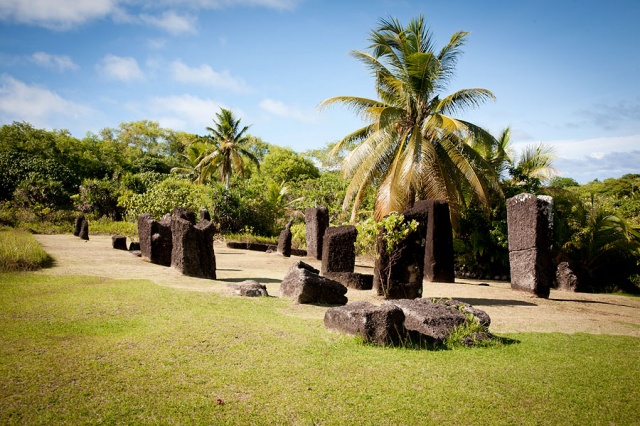
To continue from my post about the giant Easter Islands Monuments and this is my own theory; I’m speculating that the people who build the giant statues of the earlier post on this blog were part of the same (tribe of) people who manufactured the Rai or the giant stone coins of the Micronesian islands of Yap and Palau. My reason for thinking there may be a connection is because of what I have seen in Palau and Northern Marianas. There are giant statues all over the world and I am no archeologist. The Micronesians also have giant stone monoliths and statues. Yap became part of this ring of exchange and sharing giant objects when they brought the coins from Palau into Yap.
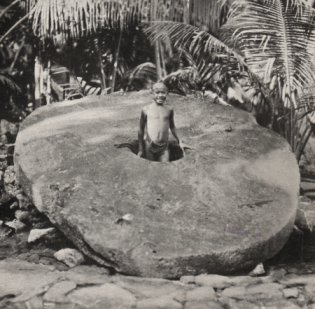
Yap is one of four states of the Micronesia. The large coins pictured above and below were made from limestone disks and each represent wealth in a family group. There is a lot of reading in the history of all these large objects and studies are still being carried out on the mystery that surrounds the objects.
Amusing Planet Picture
Why did the Yapese take to this new kind of money?
John Tharngan, historical preservation officer of Yap explained that the coins were invented during a period when the chiefs on Yap were struggling for power.
“In those days all sorts of commodities were being used as valuables, including shells and turmeric and so the concept of bringing something in from outside, that didn’t exist on Yap, was very attractive. So when they brought this piece home and called it money, it encouraged other people to make the journey and bring stones back. So they went and brought more, this time in the shape of a full moon with a hole in the middle, for ease of transportation, like the ones you can see here on Yap”, Tharngan said.
Jaime Hernandez – March 12, 2012 – Making the Rai.
The value of the stone coins is determined by the number of lives lost during the process of transportation and the workmanship on each stone. They are used for buying land and bride price.
I first saw the Rai at the National Museum of Palau in 2008. I asked many questions and got bemused looks from locals, to say that these coins were part of everyday trades, an undying culture passed through generations. I could not imagine a piece of coin carried by six adult male compared to a dollar you could pull out of your pocket and flick in the air, and in Papua New Guinea, we mostly used shells as our legal tender. Perhaps at one point, we also used stones.
What a wonderful life blog picture.
Yap is about 100 square kilometres and home to 12,000 people. The island of Yap has no precious material like gold or silver instead, they use these giant disks of limestone called Rai as currency for large trades and still use them as small as seven to eight centimetres in diameter to trade with. The larger ones stand as high as 3.65metres (12 feet tall) and weigh five tonne. Many of the Yapese coins were carved in Palau and shipped 400 metres to Yap. There was a story that once a large Rai was transported across the water between the Yapese and it tipped the canoe and sank. This coin was always remembered and its value (for the family that owned that coin) was continued to be used in the trades. Read more on the Yap’s coins on the links below.
A Report from Radio New Zealand International’s Johnny Blades.
Papua New Guinea is at a juncture, experiencing unprecedented economic growth but still mired by poverty, tribalism and parlous human development outcomes. Exxon Mobil’s $US19 billion Liquefied Natural Gas project in PNG began exports last year, marking a major milestone in the country’s development as a foreign investment destination and energy hub.
Yet the benefits from development of PNG’s abundant natural resources – mineral, oil, forestry, fisheries and others – appear mainly confined to a tiny part of the population. RNZI’s Johnny Blades travelled to PNG and, in this video report, he asks if PNG can convert its significant resources wealth into tangible gains for its burgeoning population.



![20150718_122849[1]](https://tribalmystic.me/wp-content/uploads/2015/07/20150718_1228491.jpg)




 Tribalmystic Stories