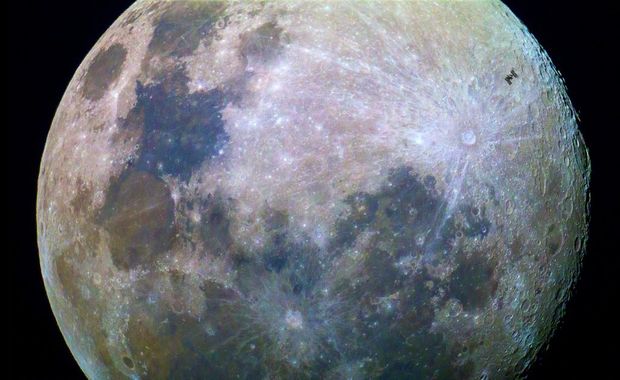
Byron Bay photographer Dylan O’Donnell took this stunning photo of the International Space Station passing the moon on Tuesday. Photo Contributed
The media has called it the holy grail of astro-photography. The Cool Stuff of the week is Dylan O’ Donnell’s fantastic photograph of the full moon with the incredible capture of the space station on the top right.
The BYRON Bay (Australia) photographer who captured the shot on Tuesday with International Space Station passing over the moon said this was his second attempt to take the stunning shot.
“I’ve only tried once before and I completely botched it, it looked like a blur,” he said.
“The International Space Station ISS passes through the sky semi regularly, but for it to line up like it did with an almost full moon is quite rare.
“Some people go chasing around the world to try to line it up but I just waited from my home and it was about 12 months from the last time it lined up that way for me.”
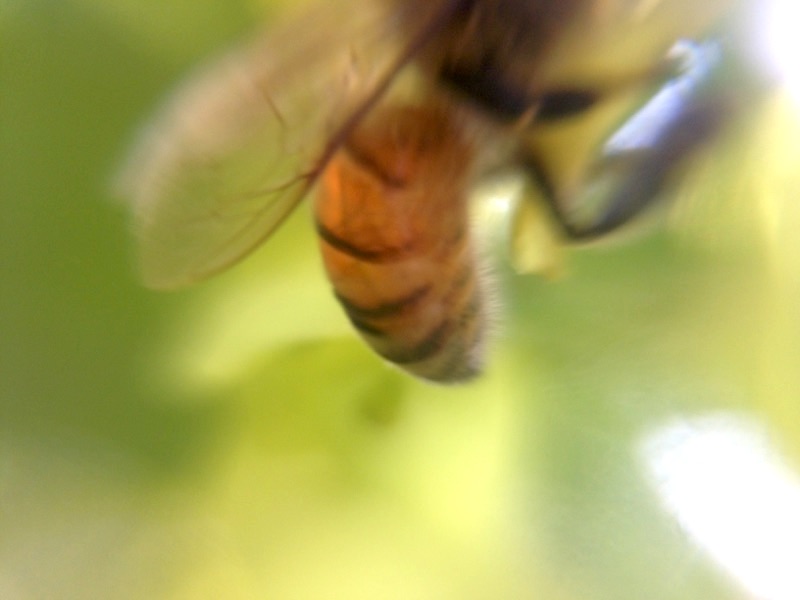
A little creative genius lives with me and is sometimes called my younger son, Chris. He is over one 190 cm tall so he is not that little, but this 16-year-old always comes up with amazing ideas. One of his discoveries was how to magnify or shoot micro pictures with his iPhone using a recycled attachment from an old torch. Here are a couple of images Chris was excited to share with me for their artistic value – he deliberately softened the lines.
Chris Harris Picture. Bee. May 25, 2015
When I asked him what camera he had used to take the pictures, he showed me his phone and explained, he took apart an old torch and stuck a glass lens from the old torch on his iPhone camera lens to take the super micro images. I was so excited, we went everywhere in the garden to take more pictures from deep inside centre of petals to the eye-balls of family members so we could see the colour spectrums. It is quite incredible. The bee pictures are two of Chris’s images.
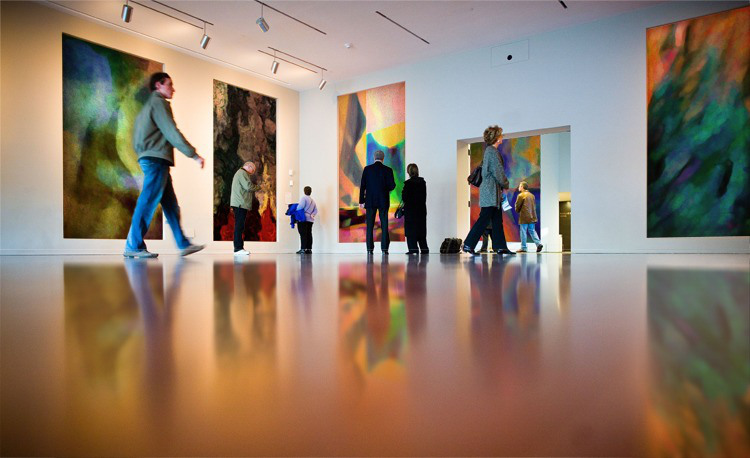
I recently met (virtually) Solomon Walker, Canadian Artist and owner of the Museum of Digital Fine Arts(MoDFA). A virtual museum was something I had been thinking about and was excited to find MoDFA and how well Solomon has set it up. An Australian curator friend, Jenny Fraser has had several; digital curatorial projects for Pacific Arts and I thought it would be a great idea for some of the projects I was involved in. A digital museum provides an opportunity for those of us that are limited by location, time and money to go and see some wonderful art. For curators, a digital space requires less funding and all the hassles that come with running a real exhibition. One can argue that nothing beats the real thing, but if you cannot travel to Paris or New York to see something beautiful and amazing work, digital space is the place to go in this day and age.
“I was really looking for a place to show my own artwork, and that’s how I thought of establishing the virtual museum”, Walker said.
Established in 2008, Walker through the museum, quickly filled a void in establishing a collective space for online art world, showcasing some of the very best work rendered in the new Digital Medium. The MoDFA provides essential exhibition opportunities for both emerging and established artists and photographers on an international scale. Artists who create stunning works of art primarily with modern electronic tools that includes computers, tablets, scanners and digital cameras can show their work in this space. Though existing virtually online, the MoDFA provides a unique public exhibition space and forum for introducing and displaying brilliant contemporary Art and Photographic images from some of today’s most creative individuals across the globe.The MoDFA is dedicated to Digital medium creativity. To show or to curate or volunteer for the museum, visit link below and speak with Solomon Walker.
I love most art forms. To show and tell a story, I have often wondered if film and photography are the art form that truly capture the essence of a story. As a story-teller, I often ‘cheat’ by throwing in an image to complete the imagery ‘in’ my story. I see many bloggers use images this way, and it is great. As you are reading my stories, I want you to see and visualise the events, emotions, and actions with me. We are in the story together. Now, imagine if we did not have pictures; how could we, story-tellers, tell a story? I know how hard it is to describe a scene, simply. How many words and sentences do we need to describe every picture, and every scene we wish to create in our readers’ minds?
Between 1980-2000, in my news print days, I carried a Nikon FE2 with me in PNG. I must admit, I was in-love with this camera. It took two decades of pictures with me. These pictures hit front newspaper pages and glossed magazines. I entered and won competitions. I could not have been a true journalist without it. Being a photojournalist, assisted by FE2, we took stories to another level.
Sadly, I do not use this camera anymore. Apart from losing the mirrors inside the FE2’s body to some hungry mould, I paid over $AUD600 for repair, and never got the mould completely removed. The mould began feeding and grew again. I still have the FE2 with me because we have too many memories together. I cannot use it, and I cannot bare the thought of losing it.
These days, everything has moved to digital. Over the years, trying to save money for a new ‘real’ camera has not been successful. Family, mortgage and many other urgencies always top the priority list. Without a good camera, I often wonder how many great shots I have missed in so many years. I stare for hours at photographs and pin them on Pinterest and the net. I wonder how I could have taken these pictures differently; using light, better angle or simply, showing the object better. Fellow blogger/photographers, you know I am checking your pictures out, and I am looking at your pictures in awe and with some jealousy. This is envy that is not evil but respectful. A somewhat sad feeling about how much I have missed in my photography. I have long resigned to the fact that –that’s life!
Going Digital
In-coming tide on Tami Island, Lae, Morobe Province, PNG. Picture JLeahy. 2008
I still take pictures with the phone, and small digital cameras. A few years ago, I had a digital pocket sized Nikon I bought from a Cash Converters store. It accompanied me conveniently for its size. The FE2, and its lenses was sometimes hard to lug about. After doing some solid photographic work, the little camera’s bottom broke. There is a pin inside the battery cage which broke and the camera batteries would protrude out and lose power. So, I taped the bottom and kept using the camera. When a moment presented itself, the photographer would need to press harder on the tape to keep the batteries in and take the shot. Only I used it expertly. It was hard work instructing others to handle the little camera in her special needs. If less pressure was applied, the camera did not work. Sounds like a joke right? The camera worked most times and I was proud of it.
The Right Equipment
Anyway, the point I am making is that, when and if you have a great equipment for your work or even artwork – everything flows beautifully. Just imagine when you don’t and the moment presents itself. In 2008, I was on Tami Island, Papua New Guinea doing my field research into how climate change affected intangible cultures.
I travelled with my mother and my broken-bottom pocket Nikon. The bottom was taped and, we went to a place at least a few hours in up the coast, in a boat, so there was no such thing as batteries nor camera shops.
I took several photos with the bad-bottom camera, and one picture has become a favourite. I had to mention this picture because, it is not only I that thinks it a wonderful picture, but strangers have complimented the photo, hundreds of times. I posted this picture on About Me, on my Page and each day, I can get numerous compliments and comments about this picture.
The Story of This Picture
Morning light on Awaho flowers, Tami Island, Lae, PNG. Picture, JLeahy. 2008
In the days my mother and I stayed on Wanem Island, we would wake in the morning to crisp breezes, beautiful skies and chatters of seagulls and other birds flying by, searching for food. The village was a separated by trees and coconuts. The only sound was the soft waves, gently slapping the sandy beach. At least three metres in, from the water’s edge, the beach was lined with various soft and hardwood natives, and one we call the Awaho. This tree has many uses. Its timber is used for building, the leaves for cooking food in, and the bark for making clothing, as well as ropes. At the end of its life, the Awaho wood is a very good firewood.
Each morning, before we woke, the Awaho trees would start dropping their flowers on the hardened, cleaned sand, left by the receding low-tide. The flowers would be placed randomly but precisely, so it did not clutter. These droppings ravished the beach with these delicate burnt orange flowers with deep carmine centres. From each of the rich red-wine centre protruded a pale feathery, sticky pale stem with a red tip. Seeing the flowers on that beach for the first time, I thought someone had laid the flowers out. By the end of the day, before the flowers have completely wilted, the tide would come in, and sweep the flowers away before the shadows melted into darkness. If you swam at night, you would see the flower floating amongst the flotsam. In the morning, the white beach would be cleaned and ready. Once again, the Awaho’s bouquets would arrive, and scattered across the white sandy beach. The cycle began all over, a picture and a moment of Mother Nature’s artwork. I would have never captured this images without the broken-bottom pocket Nikon.
Ryan Lobo has traveled the world, taking photographs that tell stories of unusual human lives. In this haunting talk, he reframes controversial subjects with empathy, so that we see the pain of a Liberian war criminal, the quiet strength of UN women peacekeepers and the perseverance of Delhi’s underappreciated firefighters.




 Tribalmystic Stories