I turned 50 a few days ago and I got asked how I felt and what were my plans etc. I have had a good life so far. To be honest, I felt nothing different physically nor mentally. My present goal is to publish my memoir and a book of short stories. I also want my boys to complete university and do what they love.
At half my age I had travelled and seen over 50 countries. Here in Geneva, in 1989, I was eating strawberries and ice-cream. If you had asked me then, how my life would be in the next half – I would have had no idea. Life is full of surprises. I love it.
When I look back at it, I have led a life that has not been ordinary and I am so grateful for many things. One thing worth mentioning is that I do know now as I have grown older, life is not complete without love. Every human craves love and nothing can replace love. I treasure the love in bonds I have with my sons and my family and friends. My belief in love came from those who loved me and the ones who continue to love me. Every human deserves to be loved.
I am a ‘closet poet’ that writes love poems sometimes. I was asked recently if I could write poetry (and I guess I can) and if I had any. I have never been taught, but I love to read poems and I have written a few as gifts over the past decades for friends and family. I believe poetry is one great way to express love. Lucky for those men I have loved and written free poems for, I hope they still appreciate the verses, even if they don’t want to remember…
Here is one such collection of lines which you may call poetry if you wish to. I am happy for my blogger friends and the real poets out there to critique me.
Chimamanda Ngozi Adichie a renowned Nigerian novelist was born in Nigeria in 1977. She grew up in the university town of Nsukka, Enugu State where she attended primary and secondary schools, and briefly studied Medicine and Pharmacy. She then moved to the United States to attend college, graduating summa cum laude from Eastern Connecticut State University with a major in Communication and a minor in Political Science. She holds a Masters degree in Creative Writing from Johns Hopkins and a Masters degree in African Studies from Yale University. She was a 2005-2006 Hodder Fellow at Princeton, where she taught introductory fiction. Chimamanda is the author of Half of a Yellow Sun, which won the 2007 Orange Prize For Fiction; and Purple Hibiscus, which won the 2005 Best First Book Commonwealth Writers’ Prize and the 2004 Debut Fiction Hurston/Wright Legacy Award. In 2009, her collection of short stories, The Thing around Your Neck was published. She was named one of the twenty most important fiction writers today under 40 years old by The New Yorker and was recently the guest speaker at the 2012 annual commonwealth lecture. She featured in the April 2012 edition of Time Magazine, celebrated as one of the 100 Most Influential People in the World. She currently divides her time between the United States and Nigeria.
At 9am yesterday, after watching the news on the cyclone in Vanuatu I started cooking pan cakes and my older son Nathan made coffee. My younger son Chris and his friend Cameron, both 16 were outside, moving the soil. I hired a bobcat to move some clean fill (soil) into an area in my garden. We were raising the ground level and turning the spot into an outdoor living place. This change to our landscape would level a slight hill and give us an additional 100 square metres of flat area to entertain and enjoy the gardens outside.
The ‘cat’ was a few hundred dollars per day so time was crucial. The Hire company dropped the machine on Friday afternoon and I had a quick lesson on how to drive the 1.5 tonne machine.
When Chris arrived from high school yesterday, I showed him how to drive the machine. He was excited and took to it easily. He started moving the soil and filling up the enclosure. He had already built the wall and enclosure in the last two weeks.
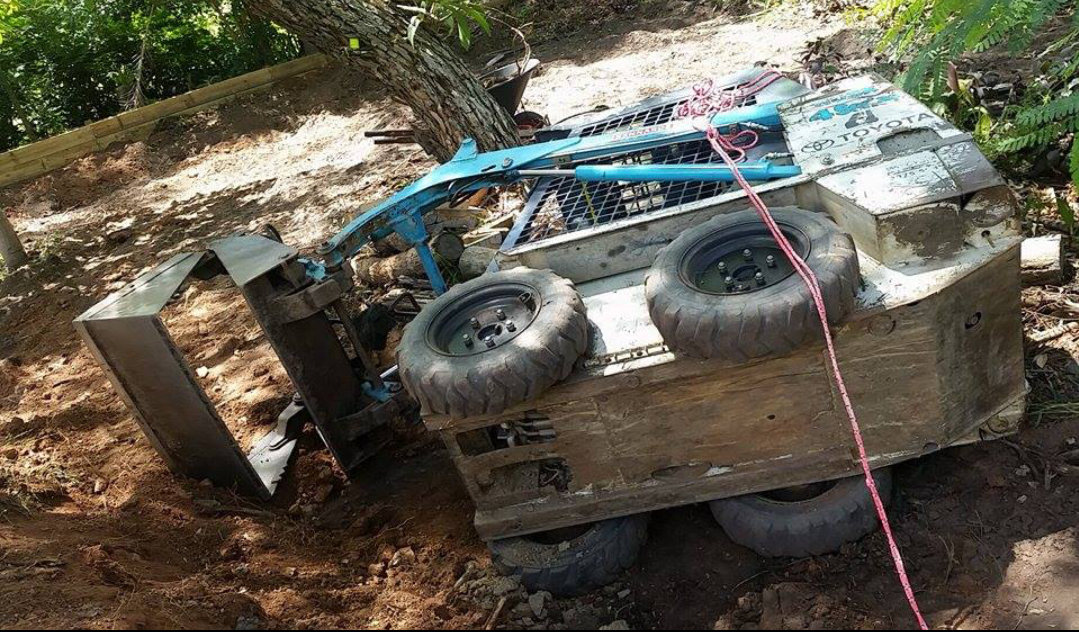
Half hour later, while watching through the kitchen window, I saw the bobcat capsized with Chris in it and started screaming his name and running out to the balcony with his brother. Chris’s friend Cameron had his ear-phones on and did not know, Chris and the bobcat capsized. The machine was on its side, as if it was taking a dirt-nap. I could see Chris inside the sitting cage of the bobcat.
I was still trying to get to Chris when he crawled out shaken, but without any scratch or injuries and said, “Mum, I’m fine”. He had a bemused face on. Apparently he tried to dig into the side on the dirty mount and the bobcat flipped over.
The bobcat’s ‘head’ rested on my garden bed, crushing everything I had been planting the last six months. Its two left tyres were up in the air and the other two buried in the soft dirt.
For the next hour, the boys told me not to ring for help because the cat was only on its side, and we could lift it back up. We could not. We tried.
Two more, and the ropes tied to my Honda to tow were snapped. We were exhausted and the pancake mixture dried in the mixing bowl when I got back into the kitchen to drink water. I was too afraid to leave the boys on their own – for safety reasons and we all decided, best to get a chain to tow the sleeping cat. Our local hardware charged a ridiculous $28 per metre for the largest sized chains. We bought four metres, and returned to the site and used the chain to join the cat to the Honda. We tried to pull and lift it up. The bobcat came up half way and fell back.
My sons decided it was easier to use the car jack to lift the sleeping cat part of the way to help the Honda (to lift it). The boys still refused help from the hire company and I did not want them to feel, I underestimated their intellect or their determination to get the cat back on its feet their way.
Inch by inch, they car-jacked the 1.5 tonne cat up with a combination of counting, wrenching, and inserting off-cut timber slippers to raise the cat. Another half hour and Nathan said, “Mum! we are ready to tow”.
I started the Honda and revved it and at the first go, the cat was till too heavy and rocked back, instantly killing the Honda’s engine. On the second attempt I floored the poor Honda’s accelerator and although I burnt off the outer front tyre skin – it was not an intended burn out, the Honda smoked, jerked forward and pulled the cat to its feet. The boys jumped with joy and cheered and I honked. We all laughed and Chris got back inside and rolled the cat forward. Everything was in good order and we started working about 2pm until seven in the evening. The bobcat stayed on its feet all day today and completed the job. Thanks to Chris and Nathan, all the hard work is done. I am a proud mum.
The project manager Chris and I on the new reclaimed living area.
This is a draft opening of a short story I am working on. I have not decided where the plot is going. I have a few options and will post more later.
Betty picked up contents of their mailbox. It was only 4pm and she was extremely tired having entered her third trimester last week. Her mother was overseas, and still unhappy at Betty’s choice to keep the baby.
In her Mother’s eyes, Betty was the faltered child, not pursuing the right career or man, having wasted her mother’s precious money and now having a baby at 23 before she had her own income. Her choice to follow arts while keeping her casual job as a Cole’s cashier was beneath her mother’s expectations. Her mother wanted a Law, Business or Accounting Degree – not Arts!
“She thinks just because she herself married a rich man, that I have to do the same, Betty complained to her aunt.
On the other hand, Betty mentioned to her aunt, her younger sister Mina, 22 was exceeding their mother’s expectation with a University degree in business and now engaged to a young engineer from a wealthy family.
Betty has been out of work for three months and already she feared her mother was right – that she needed to find some money quickly. Her mother refused to spare a cent from her own millions.
“Betty must earn it herself, she must work for it”, her mother told her aunt. The house they lived in on the hills in Brookfield belonged to her mother’s multi-millionaire lover. He gifted it to her, after his second divorce was final.
As Betty shuffled white envelopes, bills and junk mail, the young mother-to be wondered how she would pay her bills this month. Amongst the pile she noticed a small yellow aged envelope, stamped and posted in Brisbane. The envelope was addressed to her. Betty examined the back but there was no return address. She looked at the stamp again. She could not think of anyone in Brisbane that would send her a letter, most of her friends contacted her on Facebook or emailed her. The enveloped was marked Monday, January 15, 2013, just two days ago.
The Llareta is a flowering plant as much as 2,000 years old.
I am about to celebrate one of my big birthdays and today was a mix bag of events. It started with a premature but a lovely morning tea birthday party from fellow staff. We ate ice-cream cake. Weird, but ok. The morning tea was followed by a reprimand from my ordinary boss, he was throwing a tantrum that is not worth mentioning. Then, I caught up with special friends from PNG during the course of X-rays and scans and medical tests leading to my doctor at 2pm, telling me, I must have surgery. I decided to return to work after the doctor’s visit and take a deep breath and keep going until the end of the day.
I have left that day and I decided that I will forget everything ordinary that happened. I only want to remember the extraordinary things and prepare a huge party for my birthday next week. And speaking of ageing, you may know, I enjoy art, reading and writing when I am not outdoors. I have been working on some art projects and looking at art. I found an interesting story about an artist who documented old things from around the world in the last ten years. I am not posting this because I am getting old, it just happened to be something I unexpectedly discovered and somehow, it made sense to link it to age. Aged things always interest me and it was part of my purpose in completing a Masters programme in Museum Studies. Rachel Sussman is a contemporary artist based in Brooklyn. Her photographs and writing have been featured in Smithsonian in The New York Times, Wall Street Journal, The Guardian, and NPR’s Picture Show. Her book The Oldest Living Things In The World sells for $1500 per copy.
From ABC Environment
8 things in nature so old you’ll feel young
THERE IS SOMETHING about extreme age that fills us with awe.
It’s hard not to feel it, when standing in the presence of a huge eucalypt that has raised its branches to the sun since long before European settlement. Or when watching the silent majestic form of an immense whale, which has outlived several generations of humans, glide through the dark blue.
Sometimes it takes a little more intellectual investment to find that awe, like when staring at a grey-green patch of lichen that grows just one centimetre every century and which has weathered the harsh climate of Southern Greenland for more than 3,000 years.
“In thinking about the natural sublime and awe and that sort of thing, a lot of it is tied to scale and to time,” says Rachel Sussman, a New York-based contemporary artist who has spent 10 years researching and photographing some of our planet’s oldest living entities.
Sussman has taken an extraordinary series of photographic portraits, published in her book The Oldest Living Things In The World.
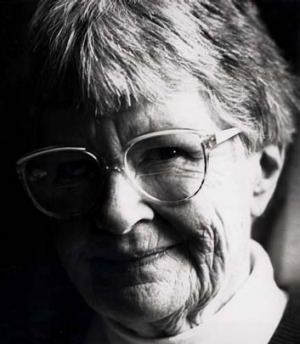
I was recently asked by my younger son Chris to read with him some Australian poetry. Chris wrote a critique for two of the poems for his Year 12 English studies. Chris and I found Critically Acclaimed Gwen Harwood’s words and her life fascinating so I wanted to share her story. Gwen Harwood also grew up in our neighbourhood in Brisbane’s western suburbs. Below is part of Chris’s critique.
Sydney Morning Herald image: Gwen Harwood
Gwen Harwood was born in 1942 and grew up in Taringa, in Western Suburbs Brisbane. She went to Brisbane Girls Grammar School and All Saint High. Harwood had studied music and completed a Diploma to teach music but found herself in a typist job at the War Damage Commission. Although early in her life she had developed an interest in literature, philosophy and music, she was limited to what the society enabled her to do in her career. She would later be described in our time as brilliant but was understated.
Harwood’s father taught her music and her grandmother introduced her to poetry. For years, Harwood could not publish her work under her own name because she was a woman. The society, male editors mostly, thought a woman should not be a writer or get published. As a woman poet in a largely male dominated place, Harwood used Pseudonyms to be allowed or belong to the publishing world. A local Brisbane publisher, Minjiin first published her poem in 1944. From 1960s, Harwood started to publish more of her writings in journals and books. Her discreet life in the literary world reflected the place expected of a woman during that time (from 1940s). Poems such as the Suburban Sonnet reflected Harwood’s strong views about how the society’s view of women was.
Generally in a sonnet, the poem is about a beautiful woman in love. In this case, Harwood depicts a woman in a chaotic household in contrast to the traditional rule of a sonnet.
Drawing from her own experiences, she wrote poems that question the status of women and the right to be whatever a woman aspired to be. She portrayed the suburbia woman to boring and ordinary. In the Suburban Sonnet, Harwood showed the restricted society she and other women belonged to by challenging the norm of the social and cultural ideologies on suburban women, especially mothers.
The dead mouse could be interpreted as her dream of teaching music being dead. In her society, a woman’s artistic ambitions may as well be dead, because her society expected her to do things in certain ways. “The Stale bread” could refer to a woman’s domestic life, which she saw as boring. Harwood was accepted as belonging to the male dominated publishing world only after she made a startling publication. 1961, The Bulletin accepted a sonnet from Walter Lehmann, and after it was published it was brought to the editor Donald Horne that the initial of each line formed the phrase “Fuck All Editors”.
The Suburban Sonnet : Boxing Day (Gwen Harwood)
She practices fugue, though it can matter
to no one now if she plays well or not.
Beside her on the floor two children chatter,
then scream and fight. She hushes them. A pot
boils over. As she rushes to the stove
too late, a wave of nausea overpowers subject and counter subject
drain out with soapy water as she scours
the crusted milk. Her veins ache.
Once she played for Rubinstein, who yawned. The children caper round a sprung mousetrap where a mouse lies dead.
To celebrate us, the women of the world today (March 8th), I share words of a great poet, Maya Angelou. I would like to pay tribute to the phenomenal women (pictured below) that raised me, and whose blood flow in my vein.
From left to right, Mama De-ec, Tinang and Mama (Freda). My aunt, grandma and mum. Guess who is in the bilum…
Phenomenal Woman
Pretty women wonder where my secret lies.
I’m not cute or built to suit a fashion model’s size
But when I start to tell them,
They think I’m telling lies.
I say,
It’s in the reach of my arms
The span of my hips,
The stride of my step,
The curl of my lips.
I’m a woman
Phenomenally.
Phenomenal woman,
That’s me.
I walk into a room
Just as cool as you please,
And to a man,
The fellows stand or
Fall down on their knees.
Then they swarm around me,
A hive of honey bees.
I say,
It’s the fire in my eyes,
And the flash of my teeth,
The swing in my waist,
And the joy in my feet.
I’m a woman
Phenomenally.
Phenomenal woman,
That’s me.
Men themselves have wondered
What they see in me.
They try so much
But they can’t touch
My inner mystery.
When I try to show them
They say they still can’t see.
I say,
It’s in the arch of my back,
The sun of my smile,
The ride of my breasts,
The grace of my style.
I’m a woman
Phenomenally.
Phenomenal woman,
That’s me.
Now you understand
Just why my head’s not bowed.
I don’t shout or jump about
Or have to talk real loud.
When you see me passing
It ought to make you proud.
I say,
It’s in the click of my heels,
The bend of my hair,
the palm of my hand,
The need of my care,
‘Cause I’m a woman
Phenomenally.
Phenomenal woman,
That’s me. Maya Angelou
To mark this year’s International Women’s Day, (March 8th), Indigenous TV (NITV) has put together a list of 20 trailblazing Indigenous women who have changed Australia. I was delighted to find this article and pictures on the SBS News site.
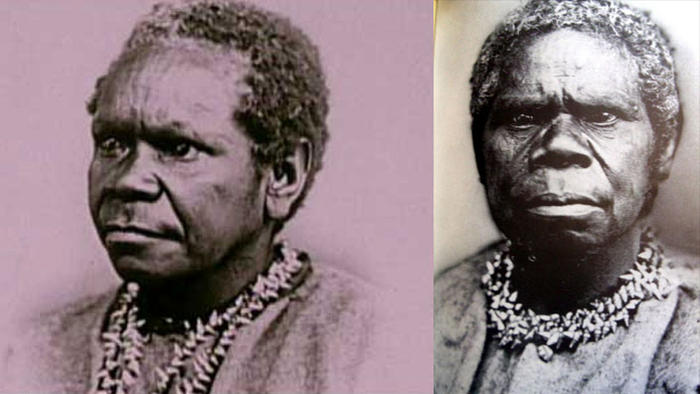
Truganini, last of Tasmania’s tribal inhabitants, 1812 – 1876 on (right) and Bessy Clark.
Truganini was a defiant, strong and enduring individual even to her last breath. She is a symbol of the survival of the Tasmanian Aboriginals and her life epitomises the story of European invasion.
As a young girl, she was taught her culture but when Aboriginal life was disrupted by European invasion this changed her forever. Despite witnessing the most horrific crimes against humanity, Truganini believed the only way to fight against white invaders was to learn their ways in order to gain empathy.
To read about the 19 other amazing women, please click below: SBS News
Over two weeks ago, I was very honoured to be nominated by Kathleen from KBailey373 blog for A Very Inspiring Blogger Award. I am very grateful to accept this award from Kathleen who has only been following my blog for a month. At the end of last year I was also nominated by Steve from Life in Russia for this award, but unfortunately, I had too much on and was ill, and did not attend to the requirements of the award. To Kathleen and Steve – a sincere thanks for finding something to inspire you from my blog. It means a lot to me. I have linked both blogs so you can visit and enjoy stories in KBailey373 and Life in Russia.
Blogging is fun, but not often easy. It is hard to know what appeals to readers. After a year of blogging, I am slowly getting the idea of what not to post. Unfortunately some of the “not to post” are what I believe in, for example, the climate exchange issues. Thank you for continuing to read and supporting this blog despite your preferences. Thank you for pointing out my errors, I like that.
On WordPress, I have come to treasure the work of many fellow bloggers. I told a friend yesterday that I have some great my readers and bloggers who have now become friends. This friendship inspires me to write or posts something good in each posts. I may not have pleased every reader in every post, but I try my best. I have learnt more from others in the blogging community. WordPress has a large community of amazing people with interesting stories. I am a student of life and each time I come to blog world, I get very excited. I know I will learn something new. Thank you very much friends for inspiring me too in your content, comments and readership.
To meet the requirement of the award, I must;
Display the award on your blog.
Link back to the person who nominated you.
State 7 things about yourself.
Nominate 15 bloggers, link to them, and notify them about their nominations.
Seven things about me
I almost drowned at the age of 10 during a fishing trip. It was in a flooded Busu, one of the fastest flowing river, several kilometres from our village (in Lae, PNG). My uncle flung the fishing net into the river, caught me and pulled me up. (I am a good swimmer by the way).
I have lived in Brisbane, Australia for 10 years. Where we live used to be a pineapple plantation and there is an 18th century cemetery behind us, separated by my neighbour’s house.
When I was in Year 10, in high school, I was nominated to represent our school and compete in a national high school speech competition. It was sponsored by the Lions Club, (a charity and youth advocate). I gave a speech about the History of Lae Town, my town and how my people first came to settle on that land. I won some cash and $500 worth of books for my high school, the Busu Provincial High School. (It doesn’t sound like much now, but it was a lot then – 1980).
I had straight blonde hair when I was a child. The more my grandmother cut my hair (so it would be an afro like hers) my hair curled. Now I have large dark curls.
My crazy hair.
Fish is my favourite food.
I love birds and can watch them for hours.
I was told by two doctors I was having a baby girl before I had my second son, now 16. We named ‘her’ Nisha until at birth. He had no name for two days. He became Christopher Eric Harris on the third day.
……………………..
Here are come of the blogs that inspire me for various reasons, mostly personally. They are not in any particular order of preference. I enjoy reading these blogs because of their rich and in-depth content and the each writer’s dedication and enthusiasm in sharing, exchange and helping others. Sorry if I did not list you here, I can only list 15.
An artist transforms written words on paper into work of art you can touch.
Jennifer’s practice focuses on creating work from paper; by bonding, waxing, trapping and stitching she produces unusual paper ‘fabrics’, which are used to explore the ‘remaking’ of household objects. The papers are treated as if cloth, with the main technique employed being stitch; a contemporary twist on traditional textiles. The papers themselves serve as both the inspiration and the media for my work, with the narrative of the books and papers suggesting the forms. Jennifer tends to find items then investigate a way in which they can be reused and transformed; giving new life to things that would otherwise go unloved or be thrown away.







 Tribalmystic Stories