The Intriguing One-LeggedWaiter – Short Story JK.Leahy@
JK.Leahy Picture taken with a Samsung phone.
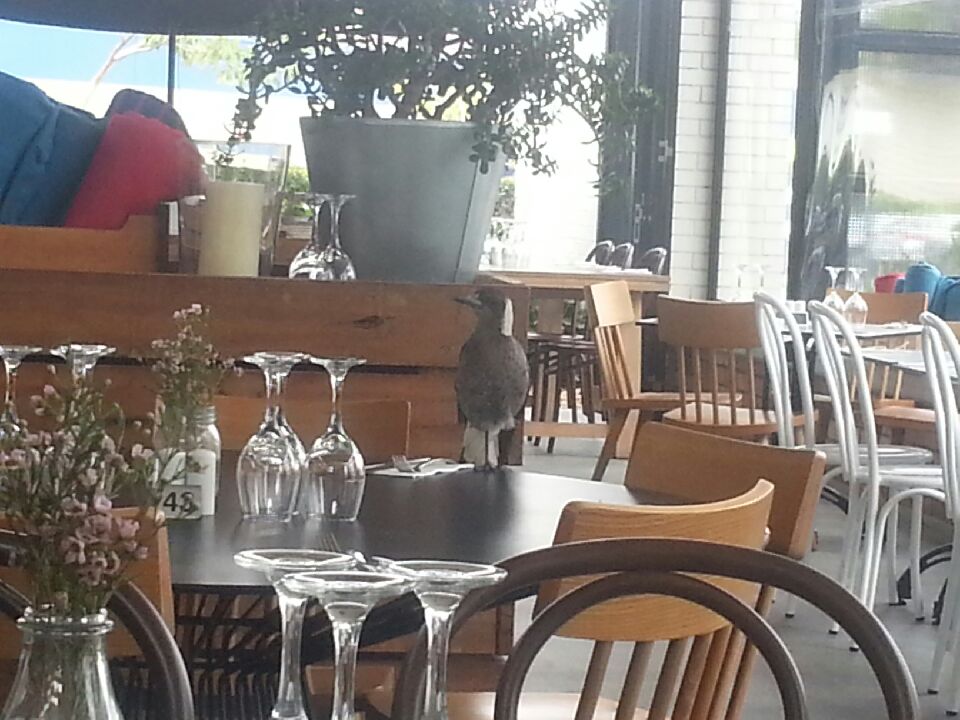
The intriguing one-legged ‘waiter’ perched on a strategic position, high above the dining area, next to an owl’s statue. He waited for his lunch. He caught my eye when I entered the restaurant with my friend Ratna Rashid for lunch today in Brisbane. Next, the one-legged ‘waiter’ flew down to a set table. He blended into the table arrangements.
JK.Leahy picture taken with a Samsung phone
Amongst the cutlery and the wine glasses, his reflections multiplied and moved as he turned his head from side to side – eyeing the patrons. He waited patiently, not missing a single movement as The Kenmore restaurant slowly filled up. When the first three tables were taken, the one-legged ‘waiter’ flew closer to those tables and listened to conversations, at least that’s what I thought. He was striking a prefect balanced pose – on one leg.
The Restaurant Manager walked out to the alfresco and was annoyed. Quickly, the ‘waiter’ flew up to safety on a ledge, eight metres high. It was almost midday.
JK.Leahy picture taken with a Samsung phone.
As the manager turned his back, the ‘waiter’ flew down and landed next to the first plate of entrée. The patron cursed and brushed the ‘waiter’ and he flew to the next empty table and waited.
The manager returned and shooed the ‘waiter’ and apologised to the patrons.
“It won’t go away, it lives here,” the manager said.
Two more tables got filled. The ‘waiter’ scooped down and brushed the new customers behind the manager’s back, in an almost friendly gesture. Then the ‘waiter’ patiently waited. Looking from side to side at each table the waiter inspected what was served.
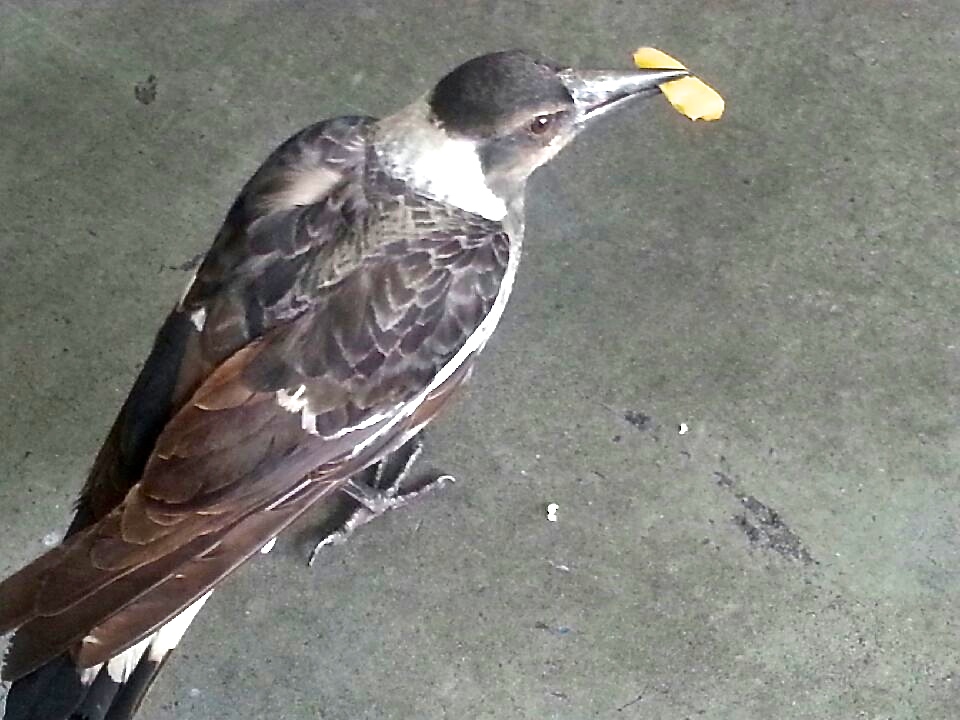
Finally, a customer on the first table departed. The ‘waiter’ swooped in and went for the leftover chips. Who doesn’t like chips? As the ‘waiter’ made himself comfortable, the manager returned and cursing loudly – he chased the ‘waiter’ away.
Up into the ledge and another wait while the manager clears the table, not wanting to wait for his staff to take the plates. The minute the manager turned his back, the One Legged Waiter swooped down to the floor – where the last chip had dropped to the floor. Lunch was served.
JK.Leahy picture taken with a Samsung phone.
The ‘waiter’ is a part of the family of local butcher birds in Western Suburbs, Queensland. Thank you Ratna for the lunch and the enjoyable conversation.
Mondays Finish the Story is a flash fiction challenge by Barbara W. Beacham. The story requires 100-150 words (excluding the first sentence which Barbara writes). She also provides the picture. The challenge runs from Monday to Sunday. Last week, I was away in PNG and missed this one but the picture inspired me so I went ahead and wrote my story. My son Nathan wanted to write a story for this challenge as well so I hope you like what we did.
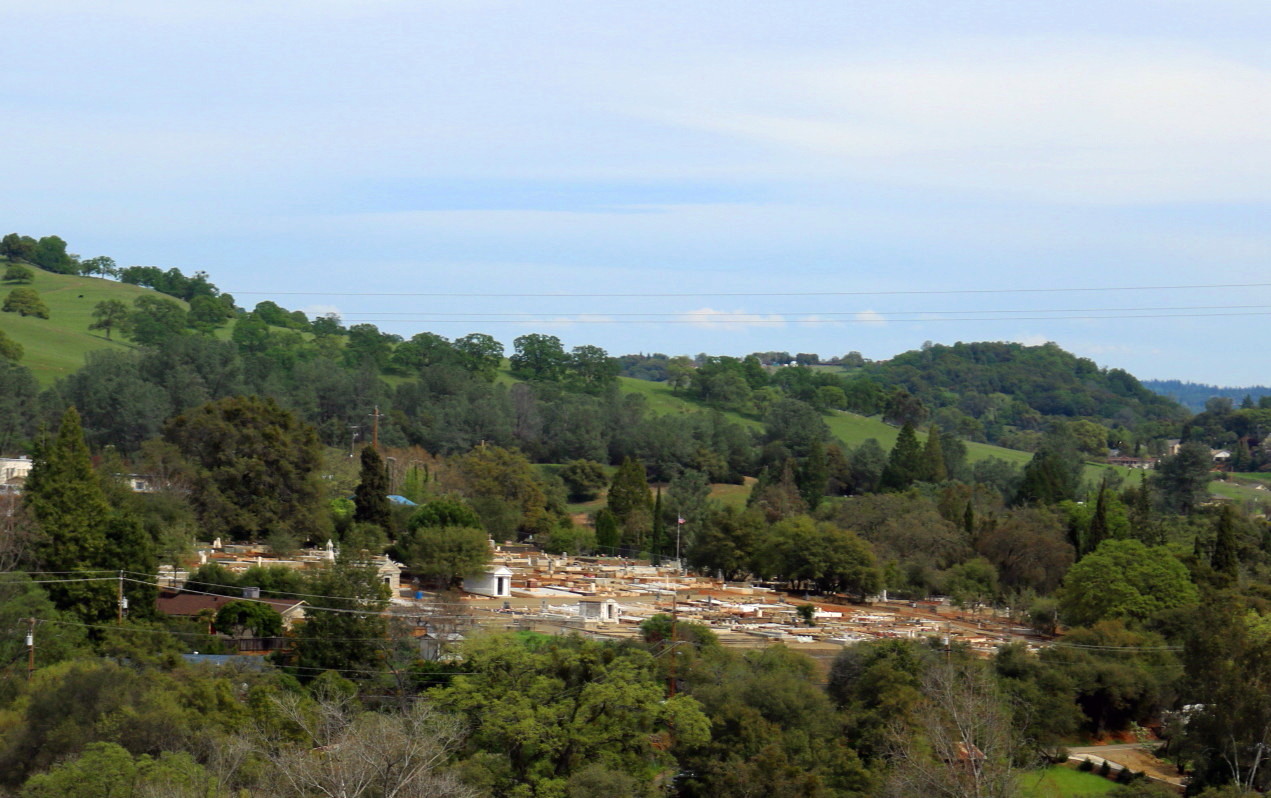
“The cemetery spread along the area known as Devils Abode.”
On the edge, Maine, Tony and Boxer stopped. It rained. Cuffed in a hessian bag, Benny struggled. In turns, they kicked him into a bloody heap. The bag came off.
“Leave him,” Tony said. “The animals will get him”.
“Finish him off – Frank’s orders,” Maine growled and kicked Benny in the crotch.
Benny curled, feeling warm between his legs where his urine could not wait.
“Someone’s coming. Run!” – Boxer yelled and drove away.
A car stopped. Footsteps approached.
“I told those idiots to bury the fucker. He’s alive? Pick him up”. It was Frank.
Four hands shoved under Benny’s arms. They drove to the cemetery and stopped.
“Throw him in there,” Frank ordered. Benny hit the fresh grave landing – hard. He waited for the trigger. Instead, soft, dry soil slapped his wet face. Frank was burying him alive, just like he buried his wife, Benny’s lover of two years.
My son Nathan Harris was inspired to write his own 150 words that takes place after my story. This was Nathan’s own writing and I have not changed a word.
“The cemetery spread along the area known as Devils Abode.”
“Seemed a fitting place as any to leave that shit Benny” Frank smirked as he opened his door, escaping the storm. He had just enough time to notice a set of muddy footprints before the crack of a gunshot hushed the rain, and searing pain through his leg dropped him to one knee. As Frank cursed on the floor, the slender form of a dead man dissolved into view; his pinstripe suit was caked with mud.
“Benny?” Frank gurgled, “How the bloody hell did you – ”
“Rookie…” Benny coughed, lungs choking on earth, and emptied his last 5 shots into Frank’s gut.
Frank clutched himself, frozen in pain and fear. As the last moments of his life drained away, Benny strode to the door and glanced back.
“When you try bury someone, you bury them deep…” he began softly, “because a shallow grave won’t hold a vengeful man down.”
Mondays Finish the Story is a flash fiction challenge by Barbara W. Beacham. The story requires 100-150 words (excluding the first sentence). The challenge runs from Monday to Sunday. Here is my short story for this week’s prompt based on the first sentence below and the picture.
“The family had no idea that little Luigi would grow up to be a…murderer.”
The shock was too much to bear as police led Luigi away from the courtroom. He caught his sister’s gaze and his terrifying eyes softened. Martha turned to her mother; they both buried their faces in uncle Dino’s old, smoke-soaked coat.
“It’s not him, it’s not him – I know… I know,” Martha cried. She felt the 65-year-old Dino’s grip tighten as he led them to his car, barreling through the flashing media cameras and the crowd. Many had come to see New York’s District Attorney Martha Luciano’s brother sentenced today.
“Grim Day for Luciano Family”, headlines screamed across the streets in earlier hours.
Three days later, Martha brought Luigi the aged Polaroid of the family that he had asked for. Her eyes salted as she tried to smile. Trembling, she leaned closer to her beloved 26-year-old brother.
“I can’t Luigi…you can’t go to jail for me,” Martha sobbed.
(You can read my other short stories by clicking on the top menu on Tribalmystic Stories home page)
Flash Fiction Challenge for Mondays Finish the Story with Barbara Beacham.
Picture by Barbara Beacham.
Mondays Finish the Story is a flash fiction challenge by Barbara W. Beacham. The story requires 100-150 words (excluding the first sentence). The challenge runs from Monday to Sunday. Here is my short story for this week’s prompt based on the first sentence below and the picture. (This story is set in Australia where we like to use the term ‘mate’ meaning friend).
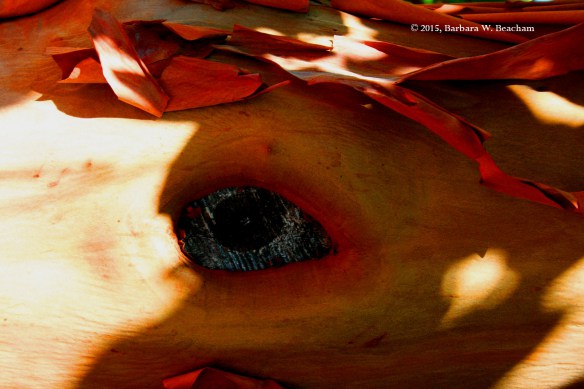
“I see absolutely everything.” Oliver said and stopped. Drawn in by a large black shimmering eye, he placed two fat little fingers up his nose and tried to push them as far as he could.
“What are you doing mate?”
“Trying to find cheese”, the three-year-old replied, ignoring his mother.
“Cheese! Where are you going to put it?”
“On my sandwich.”
“Get your fingers out!”
Oliver pulled his fingers out of his nose and poked the large eye on the tree-trunk. The eye was soft. He pressed harder. Something gave and sucked him into the tree.
“Maaa ummmm!”
Then, minutes went by.
“Oliver! Oliver! Wake up!”
The little redhead stirred. He eyed his mother and sister Georgia.
“You fell and hit your head on the tree mate”, his mother said trying to hug him. Pushing her hands away, Oliver said, “my cheese sandwich?”
“Oh Oliver…” his mother said.
“Never a dull moment”, Georgia agreed.
……..
(Note: Oliver is my friend Celise’s three-year-old son. He has fiery hair and large blue eyes and is an inquisitive and mischievous little boy. Oliver also has something to say about everything).
Mondays Finish the Storyis a flash fiction challenge by Barbara W. Beacham. The story requires 100-150 words (excluding the first sentence). Here is my short story for this week’s prompt based on the first sentence below and the picture.
The Red Tomb – short story
“Where did they go?”
The two owls following her seemingly disappeared. Together yesterday, they watched the horizon quickly swallow the sun. Now they’re gone.
The mud on her feet lifted a coat of ochre from the red track. Dusk soaked and chilled her body, while blood from cuts drawn on her bare arms and legs marked her run through the arid country in search of the Red Tomb.
Tia stopped. The wind tapped her silky hair gently against her waist. Beyond the treetops, the sun stretched the shadows of the peaks, reaching to clutch her.
At last, she had reached the Red Tomb. She must borrow from her ancestors to save her five-year-old daughter.
“Go to the Red Tomb. Collect red dust from your ancestors’ graves. Their spirits will travel with you. When I bath Luhana in that dust, she will return to us”, the witch doctor whispered, before Tia left her dying child.
……………………………
(Click on short story category to read my other stories)
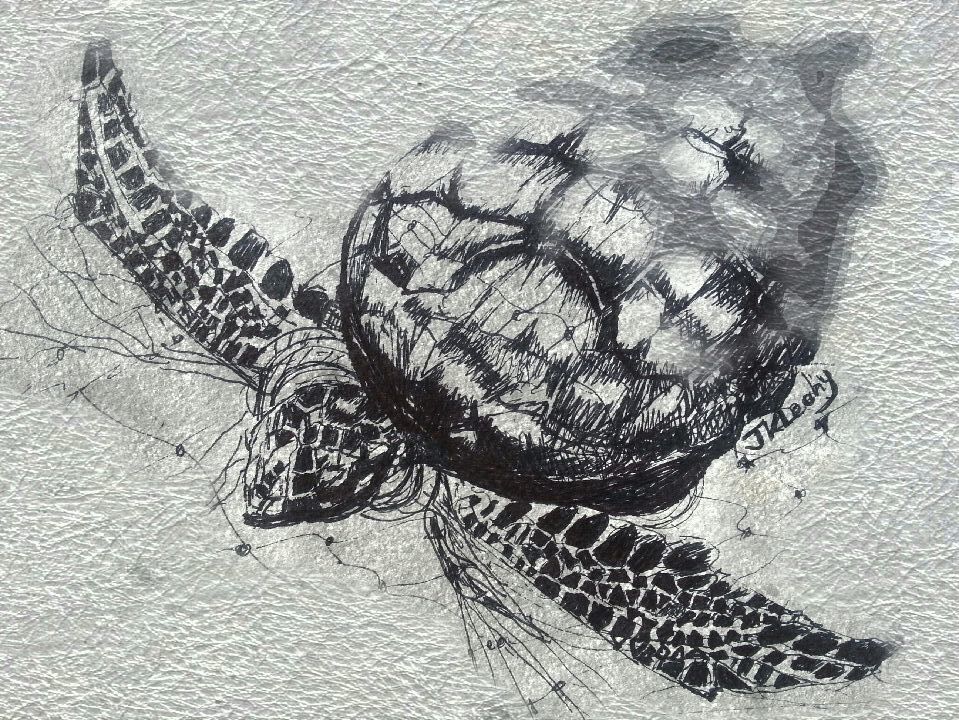
The Song of the Turtle – JK.Leahy Illustration, 2015. Pen and Ink on paper.
My entry into the The Crocodile Prize, Papua New Guinea’s National Literature Awards, won the children’s category. “The Song of the Turtle” is a fiction based on events that happened when I was growing up in Wagang Village, Lae, Papua New Guinea. I will post the story here, tomorrow.
I had watched turtle eggs being found and gathered on our beach and watched sea turtles captured and eaten. Today, the large sea turtles do not lay on our beach anymore.
Across the Huon Gulf on coastline Labu, turtles are being protected and a certain coastline has been declared as a protected habitat. The locals are part of the turtle protection programme. I am glad this has happened. Read More on the Labu Turtle project here.
I hoped that “The Song of the Turtle” will teach Papua New Guinea children about how important it is to care for wild-life and wild-life habitat in our country. PNG is lucky to have so many beautiful species and with effects of climate change and human development, numbers of species and wildlife habitat is becoming fewer and soon, some will disappear forever.
There were over 800 entries in the Crocodile Prize this year. 160 entries including The Song of the Turtle has been published in the 2015 Crocodile Prize Anthology. It is on sale on Amazon.
WRITERS from seven provinces feature in the nine prizes awarded in this year’s Crocodile Prize – Papua New Guinea’s national literary awards.
And one of the winners, 20-year old medical student Hazel Kutkue, not only won the Martens’ Award for Young Writers but the national short story prize – a prodigious achievement at such an early age and against some very stiff competition.
The Ok Tedi Mining Award for Book of the Year saw Baka Bina’s Man of Calibre triumph in a strong field of 10 contenders while the inaugural SP Brewery Award for Illustration went to another Eastern Highlander, Emmanuel Landu, brother of two-time Crocodile Prize winner, poet Lapieh Landu.
Other provinces represented in the prize winners are Enga, Simbu, Milne Bay, Morobe, Madang and the National Capital District.
The other winners include Philip Kaupa Gena (poetry), Busa Wenogo (essay), Joycelin Leahy (writing for children), Ronnie Dotaona (heritage) and Daniel Kumbon (tourism, arts & culture).
The writers’ ages range from 20 to 56, averaging 36, and their professions include economist, teacher, court officer, journalist, artist and student.
Mondays Finish the Storyis a flash fiction challenge by Barbara W. Beacham. The story requires 100-150 words. Here is my short story for this week’s prompt based on the first sentence below and the picture.
“The team employed the use of Nightshade to get the information they wanted from their captive.”
Viola smiled to herself as she finished the paper and her coffee. “Nightshade”, her ‘weapon’ was right next-door, she thought. All this time, her plan to make his death appear subtle, wasn’t working.
Wearing her garden hat Viola strolled to her neighbour’s yard, pretending to tidy her garden beds. Her blood roses were peeking at her, but she won’t pick them today, the day was fading fast and in a few hours, Greg arrives.
Crouching, she reached through the fence and cut a few shoots and flowers off her neighbour’s nightshades. A dog barked loudly and so close that Viola leaped, dropping her hat and all the cuttings. She ran back into her house. Shaken, she watched the large doberman sniffing where she sat, seconds ago.
Oh well, if that dog is going to guard the damn nightshade – the rat poison will have to do, she decided.
This is a unique flash fiction challenge where Barbara W. Beacham provides a new photo and the first sentence of a story each week. The challenge is to finish the story using 100-150 words. This challenge runs from Monday to Sunday.
Black feet peeked from under and two green eyes pierced through the curtain. It was a dog. We didn’t have a dog, and neither did Jessy.
My mind went back to yesterday.
“I don’t want you to play with Jessy”
Why not mother?”
“You are eight and he’s 16, and there is something weird about that boy”.
“Like what mother?”
“Those large green eyes – when he grins, I cringe”.
“That’s not fair mother!” I yelled and ran to my room.
Today, my parents went to dad’s work party. Aunty Anne was coming over, but she was late. Jessy stopped by. We played video games and then I went to the toilet. When I returned, Jessy was nowhere to be found…
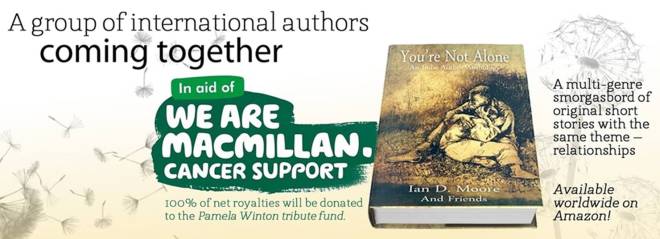
“You’re Not Alone” an anthology in aid of MacMillan Cancer Care has been released. A paperback version is also available! Get your copy now!
Twenty-seven writers from around the world, including myself have entered an assortment of short stories for your pleasure, show your support by liking the new page on Facebook and expressing an interest in buying the book.
100% of the royalties earned or accrued in the purchase of this book, in all formats, will go to the Pamela Winton tribute fund, which is in aid of Macmillan Cancer Support.
An anthology, themed on relationships, of more than 20 authors
from around the world – from urban fantasy to stories that bring tears to the…
This is my second entry into the short story category in PNG National Literary Awards. Some of you know this story. It has been cut down to 1000 word limit. For more stories and entries into the competition, please visit the following links;
I felt his eyes piercing into my back as I struggled over the grassy hill. The air was tight and chilly so early in the morning.
“Walk faster!”
I needed my three-month-old baby Boni’s softness, and the laughter of his older siblings. I was exhausted and wished I could stop. A sudden breeze brushed over the tall grass. Shoosh. I shivered.
Usually, when we returned from the garden, Bomoga walked proudly ahead, carrying his prized spear with a small bilum strapped across his bare chest. The children and I fumbled behind him: me with a child on my shoulder, another in the bilum on my back together with our second bilum of food and pulling our eldest by the hand.
Today, I was in front. I wore my favourite red meri blouse. In haste, I had worn it inside out – its flimsy seams waved loosely.
We reached the top of Kasu Hill. I gasped for air.
“Hurry Up!”
My heart pumped. From the only hill in Domogu Village in the wallaby plains of the Western Province, pale yellow-green lowland laid before me. The grass had been burnt in patches to entrap wild game. The lowland was also known for Papuan black, a deadly snake.
I marched down the ridge, as ordered. Cold mud numbed my sore foot. We reached the place where the Ok Tedi Mining had caused hundreds of fish and plants to die along the riverbank. Usually, there were people here. But it was still early – no one was about as we passed.
My milk dripped down my blouse. Without bra, my breasts swung full and uncomfortable. It was feeding time for Boni. The rising sun cast faint shadows and the warm air caressed my face. We had crossed Domogu tribal land. Bomoga’s ancestors, nomads like mine, had decided to settle in this fertile land.
My eyes scanned the mountains that Ok Tedi had exploited. To the south, there was an airstrip where planes flew in weekly. Our village looked like a jewel, deep jade opal, festooned with glassy lakes of many sizes.
“Move!”
I stumbled forward.
We entered a forest. Strangely, the birds here were silent. I heard sorcerers came here for bush medicine and magic making. I searched for sunlight through the tree openings.
“Keep walking,” he hissed.
I had not looked once in Bomoga’s eyes. When his sweaty hands had touched me that morning, I thought he wanted sex, but instead he shook me roughly and ordered me out of the house. His shadow had loomed over me as I took Boni off my breast and put on my meri blouse and my rubber skirt. Boni nestled into his blanket, eyes still shut. He didn’t cry for more milk, thank God. My other children, Eka and Maria were asleep. I heard Bomoga pick up something in the house before closing the door behind us. He was quiet and cagey, which was not like him.
He was never a warm person, not even to his family members, though he was loud to his male friends. He liked sex that was rough and on demand. In any argument, a sudden punch to my face or stomach was a possibility. If the children screamed, he yelled at them. The beatings only worsened if he thought I challenged him. “No one will help you, because you are MY wife,” he said. I felt he was right and did not seek help, not even from his family or other villagers. Recently his best friend Tommy had returned from Port Moresby. I heard Bomogu now liked Tommy’s sister who was younger and prettier than me. He wanted her, I heard.
I stepped on a stump with my sore foot. The pain almost made me cry out. Two of my toes had broken when I fell in the last fight. We continued through the gloomy undergrowth into a flat area. Through an opening I saw sunlight sprinkling light of various colours onto leaves and moss. I saw a beautiful butterfly on a fern. Its brilliant blue wings and black outline set against the leafy greens. I felt a flash of hope.
We walked on and soon I could hear rapids and the forest thinned out as we reached a Y junction. At my feet a Papuan black, unaware, slithered quickly across my path.
“Turn to the river,” Bomoga commanded.
I turned towards the rapids. My throbbing foot distracted me and I was afraid to fall. The river frothed, full from recent rain. Watching water as it rushed away, a thought stirred my mind. Was he going to toss me into the river?
I imagined where my body would lay after death; my treasured red meri blouse, still inside out, clinging to my slim frame. Dragged ashore with a paddle shafted under the hem of my blouse, a trail would be imprinted on the sand on the silky Suki River banks. Villagers rushed to screaming children who discovered me. A woman bellowed my name, “Sulita!, Sulita!” But after hours in the muddy river, half-dressed and impaled by a black palm spear, I would no longer be Sulita.
“Stop!” he yelled.
I halted.
The ground looked easy to dig in places. I kept my face down. My feet were covered in mud and grass
“Turn around. Look at me!”
I turned and raised my eyes to the point of his most prized black palm spear.
With this spear Bomoga had speared the biggest pig, the fastest wallaby and driven the largest cull of deer. Many feared Bomoga because of his mastery with the weapon. My eyes shifted from the spear to my husband’s eyes for the first time that day. They were bulging and blood-rimmed. His nose flared and his sweat drenched eyebrows twitched. Ten long years and we still stared at each other like strangers.
He raised and pointed with the spear. “Where would you like to be buried?” he asked.
I dropped to my knees, closed my eyes and prayed.
This story is based on a true story set in Suki, Western Province. It is dedicated to the strong women and the survivors of domestic violence in Papua New Guinea and other Melanesian societies.








 Tribalmystic Stories