I found this short documentary made by Planet Doc and presented in Spanish. I tried to watch it and work out what the narrator is saying (without the sub-titles). Don’t worry, for you, there are English sub-titles. There is a sequel to this film which I can post later. I believe a cultural heritage of a person can influence what they value is important and how they present that value in a story. There were certain practices of intangible cultures from Papua New Guinea island tribes presented in this film. It stretched from the Trobriand Islands to the islands of New Britain. I don’t understand what the language (Spanish) the narrator is speaking, but watching the pictures, and knowing the culture, I can see what he is trying to show. Perhaps some Spanish speakers here can figure it out what the narrator is trying to say about the shell money he is showing , from both island traditions.
This is the magic of story-telling. Simply, what you can show your readers. As good writers, we need every possible word that can draw a picture well in our reader’s mind.
Here is a documentary (49 mins) by Tadashi Shimada about the Birds of Paradise, one of my favourite creatures on earth.
New Guinea is a true garden of Eden for birds. Some of the most unique are birds of paradise. With plenty of food such as nuts and fruits and very few natural predators, they’ve been able to leisurely hone their courting skills. The ribbon-tailed astrapia flaps its long white tail feathers, while the blue bird-of-paradise unfurls its feathers to create a pulsating eye-like shape. Since they live deep in the jungle, their courtship displays have long been steeped in mystery. Tadashi Shimada, a wildlife photographer who’s made numerous visits to New Guinea over the years, has for the first time ever captured images of the blue bird-of-paradise’s courting behavior. This program delves into the fascinating world of these beautiful and mysterious birds.
Published on Jun 25, 2014 – For more please visit NHK World.
The rain eased at noon in Bellbowrie, Queensland today, but only for a few minutes. It has been storming for two days. The rain’s destruction was evident in washed garden beds and the main road overflows. I found some of my cuttings and seedlings floating in odd places, near the main road.
Yesterday, at the Coles Supermarket we were unable to purchase staple food like bread and rice. A Cole’s staff member said residents had a panic buy, stocking up in case it flooded like the 2011 Queensland floods. The supermarket was empty.
Several places outside our house were flooded. I had kept indoors and started a new artwork and read blogs. Only two days of wet weather and storms – yet there was too much water. On the news Brisbane was supposed to have 500mm of rain over the weekend. More rain will come.
In the distant, I heard a familiar cry that tugged at my heartstrings. I left the watercolour and went outside to the balcony.
“Listen!” I told my son Nathan.
We both waited and the cry was muffled by the sound of rain on our iron rooftop. It came again and I knew the cry was coming from the open field and then it moved around the back, near the duck’s nesting ground. She did come back. Her cries were strange, long and despondent. I knew.
“It’s her, something has happened”, I said.
I put my raincoat on and walked through the drizzle in the soft mushy flooded ground to her. The male duck, her partner was by her side, quiet. They made a striking couple. Her brown and white spotty breast and belly topped with deep brown-black wings, and he with a touch of spotty chest, blue-grey and black flumes. They stood on the fuzzy open plain of short stubby blue couch, Queensland’s native grass. The rain water was caught in the grass blades giving it a wet, fuzzy sheen.
I looked around the two ducks. The seven ducklings were nowhere to be seen. My heart sank. The inevitable had happened. The mother’s face was turned towards the pool, where she had hatched them. Her neck stretched forward and long in a breaking curve. Her mouth was wide opened, showing her pink insides as she wailed. Her cries were louder as I got closer. My eyes warmed into tears.
She looked at me and stopped crying. I stopped a few meters away. I wished I had some duck-words to comfort her. I could only offer her some food and walked away.
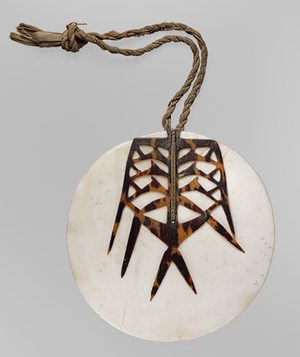
Breastplate (Tema, Tambe, or Tepatu), late 19th–early 20th century Santa Cruz Islands, Solomon Islands Tridacna shell, turtle shell, trade cloth, fiber; Diam. 7 3/8 in. (18.7 cm) The Michael C. Rockefeller Memorial Collection, Bequest of Nelson A. Rockefeller, 1979 (1979.206.1519)
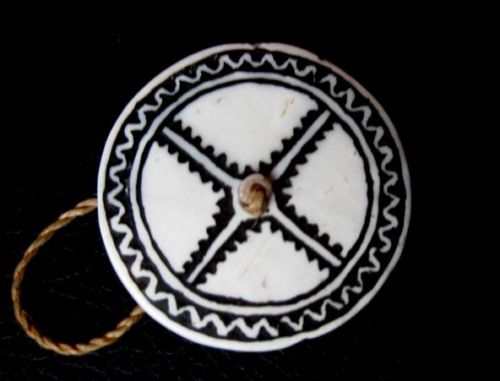
The tema or kapkap are flat, round breast plates or disks made and worn as men’s chest or forehead ornament in the Solomon Islands. Tema is one of my favourite ornaments from the Melanesian region.
Tema from Malaita. Public domain image.
I particularly like the tema because of its spiritual meaning, its stunning appearance and temas take a long time to make, by hand. A A tema in the Melanesian culture is regarded as a spiritual object. They are worn as a protective shield during tribal warfare and for general well-being. The white part of the tema represents the moon. It is made from the giant clam shell. In the Santa Crus Islands, the traditional symbol of the frigate bird, shark or dolphin is intricately carved out of the turtle shell and embedded or attached to the clam shell base. The brown necklace is made from bark and bush ropes.
The wild duck we saved twice, once from the drought (in December last year) and the second time from the python has hatched seven ducklings today in our backyard at Bellbowrie, Queensland. The python had taken one of the two ducks we saved (see story here) last February and the rest of its siblings died from the drought and the cold.
Today, my two sons already saved the seven ducklings from being eaten. As I write this story, I can hear the ducklings quacking in high baby pitches and I am torn between separating them for a safer enclosure or leaving them out in the bush with their mother and father. I have made a warm bed and tried to make their hiding place as safe as it can be but the babies could be eaten before day break. As babies do, they are making too much noise and soon, others will know their hiding place – the swimming pool skimmer box.
If you have missed the story opening published last week, click here
Although peeking through the pale mud with life and vibrancy, the young mangrove regrowth looked naked and vulnerable against the open swamp, and without the mother-tree nearby. In the distant, under the long shadows, piles of de-skinned fallen mangrove laid like stacked cadavers. This was part of an extensive wetland area used for fishing and gathering food like sugo, small snails and Kina, a fresh water mussel. There was some kind of an order in the distribution of the mangrove shoots along the random waterways. It was a peculiar, and neat arrangement. Amongst this orderly disarray, I stood out like the tallest cross in a dwarfed graveyard. The young mangrove shoots only came to my knees, just like the old stumps.
I must remove myself from here, I had thought although this had always been our favourite fishing spot. Today, the place felt strange, unlike before. Before, we would fish for hours and take our breaks on the logs. We ate with one hand and smacking of mosquitoes, then wiping their blood off and scratching the small bite mounds with the other hand. I had been to this place with my Grandma and Aunty Yellow. I also came here with my cousin Alison before she lost her mind to Malaria. I should not have been here alone today.
Once when Alison was eleven and I twelve we spotted a stranger here. On that day, we had brought with us Tinang’s (grandma) bush knife, which we were forbidden to use. The bush knife had cost a lot of money and one bush knife served many families in many ways. It turned out, the man we had seen was not a stranger, nor was he real. From his actions and the way the Sockwing (a type of wag-tail) birds were calling, my cousin and I became alarmed and we ran off, leaving grandma’s bush knife behind. I had to run back and get it. If we had left the knife there, we would have been punished for taking the bush knife. We were told that same evening, the man we had seen was a spirit of a dead great-uncle. This too was his favourite fishing spot.
I thought I saw a movement and my eyes tried to focus. Nothing seemed out-of-place, and everything around me looked like it had always been.
The Japanese bombing in the Second World War left a large gap in the wetlands. The bombs opened the place as wide as a soccer field, and made it lifeless; right in the middle of the thick mangrove that was relished by fish, birds, snakes, lizards and all kinds of insects. My Aunty Yellow said, in the open centre, mangrove regeneration since the bombing struggled for decades. The bomb explosions took both natural and human lives; our great-uncle was amongst those.
Apart from the war, this place was a landmark because the mouths of many small creeks gathered into the head of the largest one, which flowed into the main river, named Bu-dac. Budac meant Blood River, a name that reminded us of our history.
Our house was built along the river near its centre and at the entrance to our village. In pidgin, it is called, maus-rot which means mouth road.
I was standing at the head of Budac. There was a large T-junction, where the main creek met the river. The swamp clay was very soft and pale and covered with dead rotting leaves. In the dark river, life existed; a place where fresh-water fish feeding, spawning and nursery took place. Fish gathered daily to feast on other fishes and debris collected and deposited by the creek as well as the river at this meeting point. Not today, I had not seen fish movement breaking the water rhythm nor its surface. I could not understand nor remember why I was here today, and alone – only a few kilometres away from our village, just outside Lae, Papua New Guinea.
Many coastal communities in Papua New Guinea are particularly vulnerable to change. Global drivers such as peak oil, fluctuating economic conditions and climate change all have complex impacts on local livelihoods.
In response to rapid and accelerating rate of change and uncertainty, CSIRO research helps make predictions of their potential impacts and allowing groups to plan proactively. This requires designing flexible strategies that can bring benefits under a variety of future conditions.
Planning sustainable development for such uncertain futures is a key area of research for CSIRO. The design of development programs which can improve livelihoods and achieve the United Nations Human Development Goals, while also being adaptive and flexible to uncertain futures, is a big challenge. Such planning must include the multiple groups which have an interest in development, including members of the local communities, government, civil society and international donors.
Our research project “Climate futures, ecosystem services and livelihood adaptation strategies in West New Britain Province, PNG” explored these issues. From 2011-2013, we worked with local communities, non-governmental organisations and government groups to develop a framework using CSIRO science to help inform future decision-making in a collaborative way. We hope you enjoy the video report.
SWAMPED (Copyright JLeahy on Creative Writing Wk 3)
Mangrove stumps – Public Domain
The river emptied rapidly as the new day reluctantly begun. The sun had not yet arrived for warmth was lacking. I stood facing the river, able to see the creek. A war that was not ours took many of my family’s lives here, on this customary landmark. The small creek had reduced to a thin flow of a silver running snake. It slithered along a dark swampy path, often picking up flashes of light from the sun on its scales. The flashes only came when the mangrove trees allowed the sunlight trickle through its dense, green-yellow leaves. In contrast to the creek, the river was fuller, darker and moved in a quiet menacing meander. I was the tallest, standing amongst the mangrove stumps. Around me was hazy with un-condensed dew and I could not find my way, even though I had been here many times. I could almost smell the dank, which hung in a strange and familiar blanket.
This is the opening of a short-story (non-fiction) for our exercise in the Creative Writing Workshop – Kenmore. I wanted to share the opening with you. I may post more depending on how the story ends up. It may become a chapter in the JL memoir. I hope you like it.
The SBS News brings us the first carbon positive pre-fab home in Australia. This house and the news made my Cool Stuff list.
Carbon zero is the benchmark for best practise when building today, but in the future the federal government expects so-called “carbon positive” buildings to play an increasingly important role limiting global warming.
In a significant step forward in efforts to reduce emissions, Melbourne-based architects have designed what is being billed as Australia’s first carbon positive pre-fabricated home.
Here is a short video of the house and to read more click on the link below. SBS News clip or read more here




 Tribalmystic Stories