I had been keeping an eye out for my Giant Apostles to bloom in my garden. Two weeks ago, I thought the flower buds were showing in two of my beds, but when I got there, I realised the flowers had already bloomed and wilted. Today, three sets opened. You can imagine the joy of the anticipating gardener. Each flower opens only for one day. If I did not spot these beauties from my bedroom window today, I would have missed them completely.
Extra large, richly colored, fragrant flowers distinguish the versatile walking iris ‘Regina.’ Native to Brazil, this tender perennial is very easy to grow and propagate. It grows and spreads from underground stems or rhizomes, and plantlets form at the end of the flower stems after blooming. As the plantlets grow in size and weight, the stems bend down to the ground and they root.
The Walking iris is clump-forming and its leaves are broad, sword-shaped and pointed at the ends. They grow in flat, fan-like arrangements, as do most members of the Iris family. The brilliant purple-blue iris flowers are marked with white and burgundy-brown spots and borne in clusters on leafy stems held above the foliage. This species tends to bloom in succession from summer to spring, but ‘Regina’ may bloom for longer than average. My collection only bloomed this Autumn.
A COLLABORATIVE FILM BY GNARLY BAY + FOREST WOODWARD + FRIENDS
Special thanks to Doug Woodward, Brendan Leonard, Skip Armstrong, David Marx, Jeff Scholl, Elliot Ross, Jess Lowe, Howl Collective, Story & Heart
One of my proudest moment as a gardener is when my Cattleya trianae tipo ‘Baronessa blooms. I have several on a poinciana tree and the grey-green mid truck bursts into speckles of translucent white, dabbed with bright pink and golden centres. The Cattleya orchids tell me Autumn is here.
The flowers remain for three and half to four weeks before they finally wilt. These pictures were taken by my niece Jaradeenah Danomira this morning.
Things you find in the Australian outback: man-eating crocodiles, snakes, lots of spiders, and a Delta 2 rocket casing.
A Delta 2 rocket launched way back in 1990 and came back down to earth a few months later. One of its casings, however, took a little longer to find its way home – 18 years to be precise.
The rocket was used to launch the Indian INSAT – 1D geosynchronous spacecraft from Cape Canaveral Air Force Station in Florida. The Delta rocket motor was part of the third stage rocket launch. It was discovered in 2008, on a three million acre cattle station. Station owner Arthur Taylor was out flying a Cessna aircraft to muster cattle when he spotted the odd sphere.
Bet you knew the outback was big, but never realised it was big enough to hide space junk in someone’s backyard for 18 years!
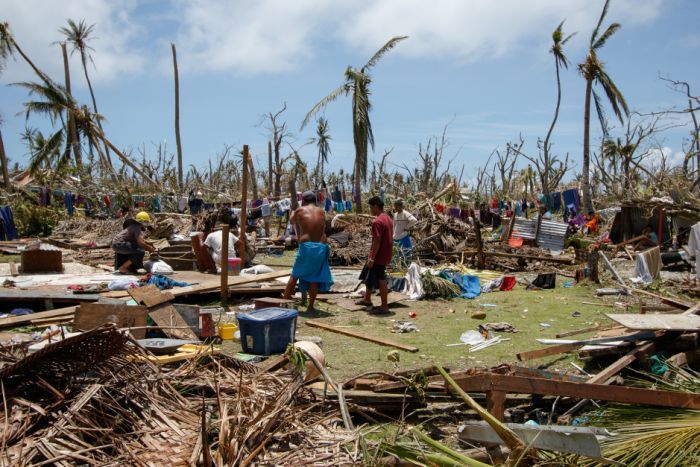
Another devastating natural disaster had hit a small Pacific Island nation. Five people died and thousands have lost everything in winds up to 250 kilometres per hour in Chuuk and Yap states in Micronesia about ten days ago. Photographer Brad Holland is hoping to raise awareness of the devastation caused by Super Typhoon Maysak with a series of images captured just days after it hit the islands of Yap, in the Federated States of Micronesia.
The typhoon tore through islands in Micronesia at the end of March, killing at least five people and leaving thousands displaced. Because of their location, it took a while before the news became known.
Dramatic photos taken from the International Space Station show super Typhoon Maysak as it moves towards the Philippines.
The states of Chuuk and Yap, which were the worst affected, declared states of emergency with some islands experiencing damage to 90 per cent of homes.
Last month, many butterflies hatched on my lime trees. I have been looking through some of the You Tube videos to see how Butterflies transform – well, I have seen hundreds but they are still very interesting. The ones that grew on my two lime trees are now flying about in the yard which is wonderful to see. In this YouTube video, the complete life-cycle of the Monarch butterfly is shown from a tiny caterpillar hatching from an egg on a Milkweed leaf through metamorphosis to become a glorious adult butterfly. Filmed utilizing high-powered microscopic cameras and time-lapse photography. Produced for the Chicago Nature Museum in Chicago, IL.
Every year on 22 March we celebrate World Water Day. But this year is different. It will go to history as the year when we set the course for the future.
When the post-2015 development agenda is finalized this fall, it will shape the global agenda for water. But not only for the 10 to 15 years to come: the decisions we make this year and the paths we choose will influence generations to come.
Today, freshwater resources and their ecosystems are being degraded and depleted at an alarming speed – this despite our awareness of their pivot role to life on earth and the production of food, energy, goods and services.
This is a nice ending to a horrible story last week about Cyclone Pam, a category 5 cyclone that swept across several Pacific Island countries before hitting Vanuatu. Lessons to learn from the Melanesian villagers.
Destruction in a village on Togoa Island, Vanuatu.
Reuters reported that villagers in Vanuatu buried food and fresh water as one of the strongest storms on record bore down on them, fleeing to churches, schools and even coconut drying kilns as 300 kph winds and massive seas tore their flimsy houses to the ground.
Despite reports of utter devastation six days after Cyclone Pam pummelled the Pacific island nation, Vanuatu appears to be providing something of a lesson in how to survive a category 5 storm.
The United Nations says the official death toll is 11. Many officials anticipate that number will rise once they are able to more thoroughly inspect the outer islands of the scattered archipelago.
Still, the absence of a much higher toll has amazed aid workers and those who lived through it.
“It’s absolutely unbelievable the death toll is so low,” said Richard Barnes, 43, a property valuer from New Zealand who has lived near the capital Port Vila, on Efate island for seven years.
Two days ago, a helicopter flight over the north of Efate revealed scenes of total devastation with at least one coastal village destroyed and no sign of life.
When visited a day later, dozens of villagers were back rebuilding with what materials they could find and reporting only one injury, said Barnes, who was on Cayman Island in 2004 when Hurricane Ivan hit.
“The resilience is amazing … Everyone is just getting on with it, which was different from Cayman where everyone just sat around waiting for something to be done,” Barnes said.
Perched on the geologically active “Ring of Fire”, Vanuatu suffers from frequent earthquakes and tsunamis and has several active volcanoes, in addition to threats from storms and rising sea levels.
China joined in with Australia and New Zealand, pledging $4 Million to assist Vanuatu in the recovering process.
From ABC News, Australian Foreign Minister Julie Bishop has pledged long-term support for Vanuatu during a visit to the Pacific nation ravaged by Tropical Cyclone Pam.
Ms Bishop, who flew in on a Royal Australian Air Force flight, toured the command centre for cyclone relief efforts in the capital Port Vila, and visited a school and hospital being rebuilt with Australian assistance.
She also met with Vanuatu’s prime minister Joe Natuman and promised on-going support.
“Australia has responded quickly to requests from the government of Vanuatu, we have sent more than 11 military planes over with equipment, lifesaving supplies, humanitarian support personnel,” she said.
Thousands of people remain homeless in the stricken country, as Vanuatu’s government coordinates relief efforts to get immediate aid to more than 60 inhabited remote islands in the archipelago.
It has begun to send out food aid and seedlings to parts of the country hit hardest by Cyclone Pam after a week of assessments and planning.






 Tribalmystic Stories