Category Archives: Living

Could you live in this giant ice cube?


At first, I thought a house had fallen off a cliff-side when I saw this image. There were no crash pieces, no dents and the house seemed in good shape. I have to admit the picture also made me disoriented. I probably would feel dizzy standing next to the actual building. I had even thought it was a Photoshop ‘nonsense’ when I saw the picture.  That first impression led me to research.  It took me a little while before I discovered that the house was real.  It is a retreat cabin. And of course it made the “Cool Stuff” category in my blog.  I think it is an amazing piece of architecture. I love the sustainability aspect of the cabin and how clever the designers were in blending this work-of-art into its surroundings in a subtle and playful way. View links to take you inside the ‘ice-cube’.

Block of Tumbling Ice Inspiration

Czech architects Atelier 8000 designed this monolithic cube retreat for the mountains of northern Slovakia. Inspired by glaciers, the architects envisioned a block of ice tumbling down a mountainside and crashing into the snowy landscape. The building was designed for the Kežmarská Chata (Kežmarská Hut) international competition, and it contains a restaurant, a sleeping area and ski storage for visitors.

Read more: This Crazy Solar-Powered Cabin Looks Like a Giant Ice Cube Atelier 8000 Kežmarská Hut – Inhabitat – Sustainable Design Innovation, Eco Architecture, Green Building

Atelier 8000 Kežmarská Hut

Overtime – Earning more or Losing more?


One of the things I love about being older and having “been there, done that” is that I am beginning to understand what life is all about. Everything is starting to make a lot more sense. I keep learning and one of those things I have come to realise was, how much time I have spent/lost in a nine to five job. The nine to five job routine has never appealed to me. Sometimes I wonder if I had gained enough money doing that extra time in comparison to the living that I have lost.

Sadly, we are conditioned to believe that our nine to five job IS what life is all about. We often get stuck in the routine…forever! Before we know it, we are too old to enjoy what we truly aspire to do. I wasn’t going to blog about “overtime” tonight – really.

It was London Live celebrating the National Poetry Day and while listening to some poetry I came across Mr Gee’s interpretation of the 9 to 5 job and the More Overtime. I could not have put my view about a day job any better. Mr Gee’s spoken word inspired this post. I would like to put it out there that if there is something good you really want to do in life – go and do it!


Pakistani teen, Indian activist win Nobel Peace Prize


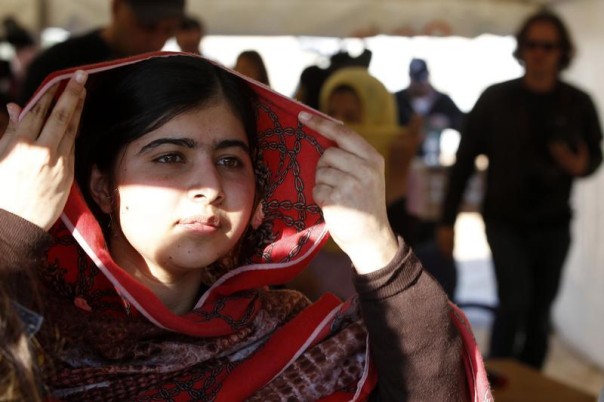
I love this story. Malala Yousafzai is a brave young woman who chose a path many teenagers would have never considered. Her journey started as an 11-year-old activist blogger, putting her life at risk to speak out against women being denied education.

Today (Friday) she wins and shares the Nobel Peace 2014 with 60-year-old Indian campaigner against child trafficking and child labour Kailash Satyarthi.  To combine and make winners out of two amazing people from two conflicting cultures and religion is not something you hear often.


604
Pakistani teenage activist Malala Yousafzai leaves after speaking at a news conference at the Zaatri refugee camp, in the Jordanian city of Mafraq, near the border with Syria, February 18, 2014. REUTERS/Muhammad Hamed


By Balazs Koranyi, Alister Doyle and Gwladys Fouche

OSLO, Oct 10 (Reuters) – Pakistani teenager Malala Yousafzai, who was shot in the head by the Taliban in 2012 for advocating girls’ right to education, and Indian campaigner against child trafficking and labour Kailash Satyarthi won the 2014 Nobel Peace Prize on Friday.

Yousafzai, aged 17, becomes the youngest Nobel Prize winner and 60-year-old Satyarthi the first Indian-born winner of the accolade.

They were picked for their struggle against the oppression of children and young people, and for the right of all children to education, the Norwegian Nobel Committee said.

The sharing of the award between an Indian and a Pakistani came after a week of hostilities along the border of the disputed, mainly Muslim region of Kashmir – the worst fighting between the nuclear-armed rivals in more than a decade.

“The Nobel Committee regards it as an important point for a Hindu and a Muslim, an Indian and a Pakistani, to join in a common struggle for education and against extremism,” said Thorbjoern Jagland, the head of the Norwegian Nobel Committee.

Satyarthi said he now hoped to work with Malala for peace.

“I will invite her to join hands to establish peace for our subcontinent, which is a must for children, which is a must for every Indian, for every Pakistani, for every citizen of the world,” he told reporters at the New Delhi office of his organisation, Bachpan Bachao Andolan, or Save the Childhood Movement.

Kristian Berg Harpviken, head of the Peace Research Institute in Oslo, described the joint award “an innovative prize that brings attention to the problems of the young”.

“A BREATH OF FRESH AIR” AMID VIOLENCE

Yousafzai was attacked in 2012 on a school bus in the Swat Valley of northwest Pakistan by masked gunmen as a punishment for a blog that she wrote for the BBC’s Urdu service as an 11-year-old to campaign against the Taliban’s efforts to deny women an education.

Unable to return to Pakistan after her recovery, Yousafzai moved to England, setting up the Malala Fund and supporting local education advocacy groups with a focus on Pakistan, Nigeria, Jordan, Syria and Kenya.

Norway’s NRK TV said Yousafzai had been told she had won but decided not to make any immediate public comment – because she was at school.

“This is a breath of fresh air, a gift for Pakistan, at a time when we are embroiled in terrorism and violence and wars,” Ahmed Shah, Malala’s former teacher, told Reuters by telephone from the Swat Valley.

“Those who oppose her, extremist elements or whoever else, they have been rendered irrelevant. They are a weak minority.”

Yousafzai addressed the U.N. Youth Assembly last year at an event Secretary-General Ban Ki-moon called “Malala Day”. This year she travelled to Nigeria to demand the release of 200 schoolgirls kidnapped by the Islamist group Boko Haram.

“To the girls of Nigeria and across Africa, and all over the world, I want to say: don’t let anyone tell you that you are weaker than or less than anything,” she said in a speech.

“You are not less than a boy,” Yousafzai said. “You are not less than a child from a richer or more powerful country. You are the future of your country. You are going to build it strong. It is you who can lead the charge.”

FIGHTING CHILD SLAVERY

Satyarthi, who gave up a career as an electrical engineer in 1980 to campaign against child labour, has headed various forms of peaceful protests and demonstrations, focusing on the exploitation of children for financial gain.

“It is a disgrace for every human being if any child is working as a child slave in any part of the world,” Satyarthi said. “I feel very proud to be an Indian that in India I was able to keep this fight on for the last 30 years or so. This is a great recognition and honour for all my fellow Indians.”

In a recent editorial, Satyarthi said that data from non-government organisations indicated that child labourers could number 60 million in India – 6 percent of the total population.

“Children are employed not just because of parental poverty, illiteracy, ignorance, failure of development and education programmes, but quite essentially due to the fact that employers benefit immensely from child labour as children come across as the cheapest option, sometimes working even for free,” he wrote.

Children are employed illegally and companies use the financial gain to bribe officials, creating a vicious cycle, he argued.

Last month, based on a complaint filed by his organisation in a Delhi court, the Indian government was forced to put in place regulations to protect domestic workers who are often physically and sexually abused and exploited.

Satyarthi joins a handful of Nobel Peace Prize winners with ties to India – even though the most famous peace activist of them all and father of independent India, Mahatma Gandhi, never received the honour.

Mother Theresa, an Albanian-born nun, was recognised in 1979 for her work with the poor in the Indian port city of Calcutta. The Dalai Lama, the exiled Tibetan spiritual leader who won the prize in 1989, resides in India.

Many commentators say that the omission of Gandhi from the list of laureates is the biggest error in the history of the Prize, first awarded in 1901.

“Maybe there is a little nod to Gandhi there,” Harpviken said of the award to India’s Satyarthi.

The United Nations’ Childrens’ Fund in South Asia said the joint award recognised “their struggle against the suppression of children and young people” in a region where nearly 17.5 million girls aged between 5 and 13 are out of school and over 12 percent of children between 5 and 14 are engaged in labour.

The prize, worth about $1.1 million, will be presented in Oslo on Dec. 10, the anniversary of the death of Swedish industrialist Alfred Nobel, who founded the award in his 1895 will.

The previous youngest winner was Australian-born British scientist Lawrence Bragg, who was 25 when he shared the Physics Prize with his father in 1915. (Additional reporting by Terje Solsvik, by Krista Mahr, Douglas Busvine and Nita Bhalla in NEW DELHI and by Maria Golovnina and Mehreen Zahra-Malik in ISLAMABAD; Writing by John Chalmers; Editing by Angus MacSwan)

The Nightmare of Story-writing


I haven’t forgotten to publish a new short story. I have written a few for my Creative Writing workshop and my memoir. The thing with writing stories is that every time you read it, you want to re-write it. It is not verbal so you could just correct yourself as you tell the story. And, just like the critical eye of an artist about his or her work, I feel that the story is never finished. When I do attempt to re-write, I often lose the magical essence I applied during free writing. For example, a short story of 800 words may flow so well on my first draft but when I start to add more descriptions and enrich the content, I start to lose the tension building or the essence of the conflict.

Then, you still have the general structure and language of the story to worry about. I cringe sometimes when I read my writing that I have published and I had missed a typo, grammar or perhaps a paragraph could be better placed or written. You could pick up something in this piece of writing and I would be in trouble again. What a nightmare it must be for all writers. Thank goodness we have editors and ‘know-it-all’ friends who will point out our mistakes. Sometimes you feel like saying, “You think it is easy; why don’t you write it then?” But without them, these “auto-corrector assistants”, we would not be able to bring good stories out to our readers in good writing.

Anyway friends, that was really my reason for delaying a new short story on this page. I am still editing some of them but let’s just call this one a work-in progress so I can give it to you as promised. It is a non-fiction short story from what I am writing for my memoir.

The Windy Curse 

JLeahy Memoir

The wind was howling curses. Footsteps ran on gravel. People were rushing up the main road, away from Wagang, our small coastal village. It had stormed all night and all day. The waves rose in great heights over the far end of Wagang outside Lae, Papua New Guinea. It was 1972.

My uncle Sam said: “Yesterday morning, some houses were washed away with part of the coastline”. I could not go to school.

“The sea is coming!” I heard a woman call out. She half ran with two crying children behind her. Mounted on her back, the woman had three bilums filled with clothes and food. Dusk had approached when she threw that warning at Tinang, my grandma. There was panic in the woman’s voice as she hurried with her children up the road. We lived at the mouth of the main road to Lae town. Other men, women and children with bags walked quickly by, some dragging or carrying smaller children and animals.

I grabbed my clothes, towel and blanket then followed my own mother out of the room. Mother grabbed a few things. She packed them madly in a handbag and a large bilum. I was not sure what to take.

“Quick, come!” she called.

“Where are we going?” I said.

“We must leave now,” she said. I followed her out of our room.

The village was in danger. We had to follow the rest of the villagers inland. The wind had not stopped for two days. The dry coconut leaves and nuts dropped randomly, making it dangerous to walk outside our house. There was some flying debris of plastic, paper, Tuk and Abong leaves. I wanted to run to grandpa’s house, next to our big house but I was scared. I also thought our roof might fly off.

“I will get the mosquito net,” Mother said. She disappeared and returned with a white bundle with pink ropes and added it to my arms. She made eyes at me to go to Tinang.

I could hear the waves getting louder in the distance and heard my aunty Giuc screaming that the sea was coming in. She was also yelling curses at her cousins to leave the village and run up the road. Aunty Giuc was a few years older than I and tough.

“Hurry!” mother said. I had no idea where mother meant. There was no further instructions.

“Are we running up the road?”. It did not make sense to me, I thought – the road was too flat. The sea would get us.

Yesterday, the government radio said we needed to move quickly as the waves would be at the village on the second day.

“Where are we going?” I asked again.  Mother left me in the lounge and headed for grandpa’s house. I stood near the window and watched through the broken fly-wire. There were no louvres so I felt the wind.

Grandpa once dreamt that our village, less than a metre above sea level was going to sink into the sea. He told villagers that one day the water was coming in and we would disappear because the two rivers that surrounded our village joined on both ends.  Grandpa also told the villagers our house was built on the stone so even if the village sunk,  our house would remain standing, just like the biblical house that was built on the stones. I think that part made the villagers angry because they thought he meant our house was better than theirs. The villagers thought my grandpa’s dream was a crazy story.

As I watched everyone running past, I wondered if today was “The day” grandpa predicted. I walked to the front of the house to see where grandma was. I stopped at the top landing of our steps shocked at what was on our front yard.

There was sea-froth on the sand. The bubbles on the browny white foam slowly burst and disappeared into the sand. It left curly wet sandy trails. It was not normal for the sea to come this far, I thought. We were over 100 metres away from the beach. I scanned the ground to see if there would be fish. It was weird. In the last King tides, my cousins caught some tuna in the middle of our village soccer pitch.

I turned to look in our backyard; my eye caught the river rising. The river seemed angry like the wind. The dirty brown water twirled and rushed along debris and household rubbish.  I could smell the sea from my left and at the same time, from my right, I smelt the swamp coming to meet the sea. Watching it, the swamp swell drowned everything in its path as it spilt over the banks and leaked towards me rapidly. Mother’s garden of maa-le, a scented deep green waterlily used for curing fever, disappeared under the brown smelly water. Just like the swamp people’s houses, I saw our kitchen house posts and the fireplace disappearing into the water. Where grandma had planted the Chinese Kangkung and watercress, flotsam mixed with village rubbish of empty Marvolene bleach bottles, Ommo packets and old thongs pushed in, crushing the green healthy vegetable carpet with its filthy weight.

I looked to grandpa’s small house and I could not see mother. I wondered if father and daughter were praying. It made sense. Tamang (grandpa) believed in God.

“Mamaa!” I called out.

She did not answer. I looked at the people passing our house again. No-one waved goodbye or passed greetings. Everyone looked anxious. I decided they were going to walk to town and climb Mt Lunaman. That was the only high ground I knew.

“Mama! Mama!” I called. I sat on the cold timber floor and waited. The sand caught between the timber gaps caught my eye. There was so much sea-sand in the house.

In the past, the waves had come like a thief and took three village houses on the beach. Luckily no human lives but only pigs, dogs and some chickens went with the houses in the waves. The villagers became smarter and built away from the shoreline. On bad days like this one, we all left the village. The waves were left to what to do what they wanted.

“Yupla kisim ol samting na igo antap long rot”, the loud voice interrupted.

Get your things and move up the road. It was the village councillor. The village bell rang three times signalling emergency. Three times also meant someone died. I was confused.

“Hariap!” a loud voice called. I did not see my uncle Sam but he was barking instructions too at my family to hurry. He told them not to bring rubbish.  He also told his wife, his sisters, cousins and brothers to make sure they brought their underpants as he did not want anyone making pictures he did not want to see in the bush. This remark made everyone scream in laughter. It eased their tension only slightly.

I knew mother was with Grandpa. I stood up and looked out through the broken fly wire again. Then I saw Tinang, my grandma and ran down to her near the main road.

I waited near Tinang. My head reached her shoulders. I could smell lime and betel nut. I felt my way into her colourful nylon bilum to see if she had any betel nut. I was nervous and wanted to chew. In Tinang’s bilum, my hand touched empty nut skins, a towel, her Koala skin purse and other small things and not betel nut.

Tinang said, “it would be hard to move grandpa.”

“Why?”

“Because he is stubborn,” she said in Bukawac.

Grandpa can walk. I could not see how grandpa would walk all the way – but to where? The nearest mountain was miles away.

“Where are we going?” I asked Tinang.

“We are just going to go into the bush,” she finally told me. It finally made sense to me. In the bush, if we had to, we could climb up trees.

Soon, sea water ran in from the front of grandpa’s small house. It was made of bush material. There was froth and I knew more sea would come.

Then, I heard a truck coming. It was my grandma’s brother Mambu’s truck, Maac Kalac. A flat-top Mitsibishi with passenger seats. Its name, Maac Kalac in Yabem means the “proud bird”.

“Ampom!” I heard mother calling me and I ran to her. She came over to grab our things. She pulled my hand and took me to the truck and told me to get up. Someone lifted me and sat me on top of some clothes.

Below the truck engine, and all the chattering, I heard the village boys splashing and laughing in the distance and I knew they were having fun. I thought how silly they were to not see danger coming. Mother continued to madly pack food, matches and torch into our bag. Uncle Sam was giving final directions to all our family members to get on Awac Mambu’s truck.

This was a Public Motor Vehicle (PMV) licensed to transport the villagers into town for 10 cents. Tonight it was a free ride. Packed from top to bottom, it was loaded with bags, food, pots, pans, coconut. I could not believe it. Some people brought everything. There were dogs and chickens. Someone brought a duck! A duck could swim and fly. Why did they bring a duck?

“Tamang?” I turned my attention back to mother for my grandpa.

“He will come,” mother lied. Perhaps she was hoping he would come, I thought.

We loaded in less than an hour and the water started to sweep across the road to the tyres. Awac Mambu wanted to drive off and someone said grandpa was not on the truck. I sat up and looked back to the deserted house. I started crying and wanted to get off. Everyone started arguing. My mother ran back with the kerosine lantern. She disappeared behind our big house. Ten minutes later, mother ran back without the lantern and without grandpa. She whispered to me that we had to leave now and Uncle Sam would come back to get grandpa. We drove off. I thought about grandpa’s dream. I put my head on the bag of clothes next to the food and animals and closed my eyes.


A Physical Stance Counts


Among many talents, skills and expertise they have on environment, my dear friends Rae and John Sheridan are scientists and climate activists. Last week I posted a picture and brief story about their new pup Chaos who they adopted while fighting to protect the environment in New South Wales, Australia. This protest event took place in July. Here is a short factual account by Rae Sheridan about the events that took place when Rae, John and the members of 350.org took a stance on the establishment of a coal mine in Whitehaven Coal’s Maules Creek mine site.


Rae arrested1JPG

Above, Rae Sheridan on the scene of the protest when she got arrested.

P1300117-2

Far right and in front, Rae and John Sheridan hold banners with members of the 350.org.


A Physical Stance Counts

by Rae Sheridan

The police road block two kilometres from camp was our first taste of being part of a ‘suspect’ group. After the road-block, we were welcomed at camp and immediately given a tour of the very considerable facilities; kitchen, information tent, campfire gathering circle, farm barn-cum meeting hall, solar recharging nook, communications unit, toilets, showers and a little further  the tepee belonging to indigenous activist Muzz the owner of an impressive part dingo Mother, Dubi, and her irresistible ten 7-week-old pups.

The NSW convoy arrived as we put up our tents.  A flurry of activity followed with a walk up a nearby hill led by Muzz and Dubi.  From a craggy summit lookout we had a good view of the surrounding rural farms and in the glancing rays of a winter sunset we learnt of what was at stake with the clear felling of the critically endangered Grassy Whitebox woodland, and cultural heritage sites of the Gomeroi people, the traditional owners of the Leard State Forest.

There were around 200 people in camp.  Before dinner we met in the barn for a basic briefing which covered some of the history of the campaign, legal aspects and an outline of the two planned actions for the next day.  We decided along with about 40 others to be in the band that would seek to trespass on Whitehaven Coal’s Maules Creek mine site to disrupt the logging operations knowing that if successful we would be arrested.  Others planned to blockade a mine approach road.  Dinner was a buzz with folk meeting and sharing stories. There was a sense of anticipation and excitement.  For many of us, this was our first foray into deliberate arrestable illegality.  Further planning followed.   Our band was asked to form sub groups to devolve care, making checking on each other and monitoring of the whole group easier.  We choose intrepid as our foursome’s name … fitting for the most senior of the smaller groups. We put together our provisions for the next day in our back packs and set alarms for 1:30am. With a 2am start planned we realised that the moon would have set and we’d be walking in the dark.

The trip to the mine site had to be overland as the roads were policed on every approach. As our 12 kilometre route passed houses and crossed roads we had to walk in silence and without lights. Led by three local ‘scouts’ we evaporated in single file into the darkness …along tracks, across recently sewn fields, along fence lines, across creeks and finally into forest.  For our subgroup of veteran bushwalkers this was an unusual variant in which a loftier purpose added to the fun. Our timing was spot on. At dawn we crossed onto the mine site and past the Whitehaven Coal signage warning of trespassing. Within minutes flickering orange lights announced the arrival of 2 ‘security’ utes. Both ‘sides’ knew their ‘rights’.  The security guards could not touch us, just advise. We marched on shepherded by security fore and aft, stopping to plant eucalypt seedlings and greet the dawn with photographs of the landscape intact on one side of the road and levelled on the other. Girt by pink plastic ribbons, some isolated ‘habitat’ trees still stood erect.  Their wild inhabitants had 24 hours to evacuate before their homes would also be felled.

We moved to a road junction attracting more security officers on all sides.  They warned us to be careful, not to venture off the road in case we should ‘trip’. More sapling planting was accompanied by singing, a banner display and a bite to eat.  Eventually three police vehicles arrived stimulating another round of photography on both ‘sides’. We were charged with trespassing, our packs examined and as two Greenpeace paragliders sailed overhead, each of us was photographed, our details taken and, in groups, we were ferried off the site in paddywagons to a road junction near our camp.  The entire 4 hour standoff was marked with civility touched with a cast of theatricality.  John’s request for a senior’s discount on the fine was taken in good spirits. Back at camp we learnt that the other larger party had made a colourful ‘act up’ on one of the roads leading to the mine site.  There was a short debrief after lunch.

How do you assess the impact of the protest?  Social media, local media and some mainstream news outlets reported the action. The deforestation ceased the next week after the company was threatened with a court injunction. The fight will be back in court in September. Meanwhile the site is being thoroughly cleansed of trashed forest in preparation for explosion-driven excavation. The fight to save what remains of this unique forest is ongoing.

The experience left me convinced that physically taking a stand counts. I feel it is a necessary frontline strategy to combat environmental injustice.  For me it is the logical next line of action – a restorer of mental health in the face of so much frustration and it was fun.  Taking action has had a ripple effect. In my immediate circle of friends and relatives taking direct action has raised awareness of the threat of coal mining. It has stimulating self reflection in others leading to a reassessment of what getting arrested means.  My 70th birthday could not have been spent in a better way for a better cause.  On a less personal level non-violent direct action definitely feeds the voracious media and brings wide awareness.

I was impressed with the organisation, preparation and the monitoring of this direct action by the numerous supporting groups especially 350.org.  I was impressed by the commitment of the wonderful local farming families. My quandary is why more ‘affected’ people are not involved?  I’m convinced that the arrest of one popular ‘famous’ person such as a football player or singer would overcome a crucial hiatus in changing attitudes to non-violent direct action. More folk would be motivated and mobilised. It is reassuring to hear that there is a growing demand for non-violent direct action workshops. I cannot help but feel that the more  the public  hear  stories from individuals at the protest line the more non-violent direct actions will be seen as an effective, risk adverse and safe form of protest…. especially for the retired who do not have the threat of a career being compromised by having a ‘record’.

It is now two weeks after the action. I have been fined $100 and not the $350 that was expected. John, as yet, has not received notification. A collateral benefit is that we have become besotted parents to one of Dubi’s pups.

We look forward to being part of further non violent direct actions as an effective way to support farmers such as Rick Laird and the climate change movement.

Rick Laird, fifth-generation farmer from Maules Creek, said, “We have exhausted every legal and political avenue to make our voices heard. Whitehaven’s mine will destroy our community and our livelihood. We’ve seen this happen in mining areas all over the country – eventually the farmers will be forced to move out. My family has lived here for generations: we are prepared to fight for this place.”

(https://www.greenleft.org.au/node/55615)

http://350.org

Rae Sheridan

7th  July, 2014


Tavurvur Erupts Again


Over a decade ago, I lost one of my closest friends, Anzac Rabbie. He was a talented Papua New Guinean banker who was very well respected amongst his peers and the community. Anzac, named after the famous Anzac Day was from Rabaul. We took Anzac back to Rabaul to bury him. His wife Delma, children Rachael and William and their families who lived in capital Port Moresby, all travelled back to Rabaul for Anzac’s funeral. While we were in Rabaul, the Tavurvur Volcano erupted. It was one of the scariest things I had ever experienced in my life. Anzac’s village was position quite high and inland on a hilltop. However, the eruption shook and destroyed houses, schools and other structures. We were completely covered in ashes. This natural disaster left a very significant memory for me. In PNG we do cover ourselves in some of our regional cultures to show respect for the dead. For the case of my dear friend Anzac, even nature gave him it quite a ‘send off’.

Today I read, Tavurvur erupted again this morning. Here is the story from ABC.

http://www.abc.net.au/news/2014-08-29/papua-new-guineas-mount-tavurvur-volcano-erupts-back-to-life/5705032

Papua New Guinea’s Mount Tavurvur volcano erupts back to life

By PNG correspondent Liam Cochrane

Updated about 6 hours agoFri 29 Aug 2014, 2:28pm

A major volcanic eruption in Rabaul on Papua New Guinea’s East New Britain Island has left the local community concerned for their safety, as residents flee and businesses close.

The eruption came from Mount Tavurvur, which destroyed the town of Rabaul when it erupted simultaneously to nearby Mount Vulcan in 1994.

Authorities said the most recent eruption began in the early hours of Friday morning.

“An eruption commenced from Tavurvur form between 3:30am and 4:00am,” a bulletin from the Rabaul Volcanological Observatory said.

“The eruption started slow and slowly developed in a stromblian eruption with incandescent projections accompanied by explosion noises and ongoing loud roaring and rumbling noises.

“Stronger explosions are generating air phases and rattling windows.”

A strombolian eruption is characterized by short-lived, explosive outbursts of fluid lava ejected tens or hundreds of meters into the air.

Local resident David Flinn described the eruption of lava and rocks as savage and said lightning strikes could be seen amongst the ash cloud.

He said the volcano is currently emitting light steam and occasional booms, with about one centimetre of light brown ash covering surrounding areas.

Mr Finn said locals on nearby Matupit Island, about one kilometre from Mt Tavurvur have fled and yachts have left the harbour.

Authorities have not yet issued an evacuation order for Rabaul residents.

Schools and some shops have been closed, but Rabaul Hotel employee Susie McGrade said locals just want to get on with their lives.

“People still live here, we have to get on with our daily lives,” she said.

“We’re up on the rooves, cleaning off the ash, we’ve got to save our property, try and get back to normal, so what can we do? We’ve got no where else to go.”

It is yet to be confirmed whether the eruption will disrupt local or international flight plans.

Rabaul was the provincial capital in 1994, but after the town was destroyed by volcanic ash the capital was moved to Kokopo.

By comparison this eruption is a relatively small event.

Mount Tavurvur is considered one of the most active volcanos in the region, most recently erupting in early 2013 and recording other erruptions in 2011, 2010, 2006, 2005 and 2002, since the major 1994 explosion.

Living in the Wild West


Our Suburb is Bellbowrie. It is one of several in western Brisbane, Queensland (Australia). Most people here are very friendly and the atmosphere is like a village. We have lived here for three years and seven in Chapel Hill (also in the west) so I am comfortable to speak about the western suburbs. The council offers daily, free buses for the students travelling out from here

With large open spaces and beautiful landscape, just near the river, this part of the west is regarded as one of the richer parts of Brisbane. House prices range from $AUD400,000 upwards. In parts, prices are as high as $2-3 Million. Our house is a fifty-year-old termite ridden renovator with some land I grow vegetables and my sons raise their chickens for eggs. Our neighbours have horses. The area is beautiful and full of wild-life. You can understand why the early settlers came here and eventually made it a pineapple farmland.

Over a year ago a body of a beautiful woman was found at Kholo creek three minutes drive from where we live. This was a very quiet place. The spot was between Mt Crosby and Anstead. In these two suburbs, families live in acreage properties, some farming and these two edge onto Bellbowrie. The discovery of this woman was shocking to all surrounding communities.

As it turned out, the story unfolded very slowly and pieces came together as police worked through the case. From the original story that hit the media; a mother of three daughters going out jogging and not coming home (according to her husband) to the wife being murdered by the husband himself. It has been a year but slowly the pieces have come together. The family lived in Brookfield which is about five minutes from us. The husband has been charged with murder.

Last night my 15-year-old son rung me from Canberra while on a school trip. He told me yesterday  police were canvassing another suburb next to us, Pullenvale. It was an interesting piece of information. I had thought it may have been some drug related search. But, as it came on the news channel tonight, police had made a discovery of large quantities of chemicals they suspect were for bomb-making.

It turned out, the house owners were away in Italy and had rented their house to someone who police now suspect was trying to make bombs.

The suspect had been arrested in another incident in Sydney, NSW and traced back to this rental house on Cedar Rd, Pullenvale.

Today police were unable to move the large quantities of chemicals due which were declared unsafe. To ensure the safety of the nearby residents, Instead, most of the explosives were blown up after police secured the area.

It just goes to show that anything can happen anywhere and people can never be what you think they are. We always have to trust our gut and our instincts but in the end, if anything is going to happen, it will happen. Isn’t that a scary thought?

Links to the news stories;

http://www.abc.net.au/news/2014-07-15/gerard-baden-clay-guilty-of-killing-wife-allison/5548628

http://www.couriermail.com.au/news/queensland/man-living-in-pullenvale-home-where-dangerous-chemicals-found-was-using-navy-divers-id/story-fnihsrf2-1227024766390

Re-cycled Birthing Suites


Photo_0EAF98DF-F286-2068-7B58-294B7B7174D2-2


This morning, I heard scratching noises and thought of snakes. We get a few snakes and since we are almost on the end of winter, it is time to come out of hibernation. My friend Heather at work lives in the western suburbs of Brisbane, Australia like me. Heather said she and husband Gary found a python on their dining table when they got home last week.  My family lives about 15 minutes away from Heather so snakes have been on my mind.

The scratching noises seemed to only come from one place, unlike snakes which move and travel  fairly quickly. I followed the sound outside to our flood lights and found a Butcherbird. She was re-arranging one of two nests outside my son’s bedroom. The nests are on our floodlights so they are at least 15 feet off the ground. I smiled, feeling good about this nesting effort because this would be the third time the magpies used these nests. They had cleverly positioned the nests away from everything, including snakes.

The twig nests have been sitting on those lights for almost two years since the first two magpies build them. They served almost like a magpie birthing suite.

I had thought the Butcherbirds would be territorial and build their nests new. The previous Butcherbird babies live in the yard. They sit on the verandah rail and sing their hearts out for food. While we live in an rural suburb, and there are still a lot of trees they could build their nests on, these birds preferred the existing nests. I was curious about these nests being re-used so I Googled to see if it was normal for Butcherbird to re-cycle nests. Here is a link I found that did not have much information on the re-cycled nests but provides an in-dept information on the bird’s life.

http://www.wildlifeqld.com.au/bird-conflicts/butcherbird.html

While searching, I also spotted something similar with re-cycling and crows. Similar in the sense of using what they can find to make their nests. This made me more curious about birdlife and how they adapt to the way we humans live and destroy many of their natural habitation. I also wondered about how much we really understand about the re-cycling and controlling our wastes.

In Japan, crows have taken nesting to a somewhat artistic and highly intelligent way of using wire clothes hangers to build strong nests. It could also be a case of doing the best with what is on hand.

crow-nest-hanger-1[2]

Picture by Goetz Kluge

http://www.amusingplanet.com/2014/04/city-crows-build-nests-out-of-coat.html


The Garma Festival


I missed the Garma Festival last week from August 1-4.

Garma is one of the most colourful and vibrant festivals in the world. I cannot explain Garma better than what I found on their website.

The ancient sound of the Yidaki (didjeridu) is a call to all people to come together in unity; to gather for the sharing of knowledge and culture; to learn from and listen to one another. Each August, the Yidaki call announces the start of Garma, the largest and most vibrant annual celebration of Yolngu (Aboriginal people of north east Arnhem Land) culture.


Garma is Australia’s most significant Indigenous event, and a model for self-determination, reconciliation, Indigenous knowledge sharing, transfer and exchange. Garma  is a colourful event with a greater, deeper purpose. Indigenous and non-Indigenous Australians experience and are directly involved in a spectacular yet substantive display of cultural practice and cross-cultural learning.
Garma incorporates visual art, ancient storytelling, dance – including the famous nightly Bunggul – and music, as well as other important forums and education and training programs relevant to cultural tourism, craft, governance and youth leadership.
It aims:

  • To provide contemporary environments and programs for the practice, preservation, maintenance and presentation of traditional knowledge systems and cultural traditions and practices, especially Bunggul (traditional dance), Manikay (song), Miny’ tji (art) and ceremony.
  • To share knowledge and culture, thereby fostering greater understanding between Indigenous and non-Indigenous Australians.
  • To develop economic opportunities for Yolngu through education, training, employment, enterprise and remote Indigenous community development.

Garma is presented by the Yothu Yindi Foundation, a not-for-profit Aboriginal corporation with tax- deductible status, and all Garma entry fees and other revenues go to the programs and projects of the Foundation.

Home

Thank you!


I write to you – genuine readers of this blog. I want to thank you from the bottom of my heart. I just logged back into my Blog and saw the ‘stats’. It warms me to see you are still reading the blog even when I have written very little in the past two months. I owe you. Your commitment shows that I am doing something important and it inspires me to keep writing and, try to write better stories.

I apologise for the long delay in bringing you new stories. Things have happened in my life. However, I am truly honoured you hung on. I did write a little about my life while I was away and I will share some of these stories this month.

When I had been in Adelaide over a week ago to surprise my childhood and closest friend Ann Stanley for her 50th birthday, her son Kolohie asked me about one of my stories he had read. ‘Kolo’ wanted to know more about the story which I posted on this blog. I told him a bit more but I was really pleased. It was a story that was significant to his life too because his mother was also there in Port Moresby (Papua New Guinea) and we were working together at the time the body of the young man was found on Ranuguri Hill.

Another recent highlight for me was a visit to the Sunshine Coast in Queensland, Australia to interview Jim, (James Sinclair) an author of 32 books about his life and his continuing involvement in Papua New Guinea.  An amazing man Jim lived his dream based on one of his heroes in his stories as a ‘kiap’ in Papua New Guinea. What Jim did not realise then was that dream got him hooked on a country that he never got out of his system. Jim is working on two more books. I will be posting some of my Sunshine Coast visit and interview with Jim here.

My absence from this blog was a result of recent personal attacks on Facebook. I share my blog on Facebook and use Facebook to stay in communication with my family and friends. After a few years and a previous threat last year, I was threatened and blackmailed. I tried to contact Facebook but it became apparent that after you sign up – it is a one-way traffic. It seemed that all the security and the settings you could possibly use to protect yourself are merely a bunch of buttons you press on your key-board and nothing more. I have copies of what FB write back to me several times, one of their comments was to contact my attacker and ask him nicely to remove the threat.  The matter is being handled by police and experts.

I had made my last post on Facebook in that first week of July to not have a FB presence. I was very touched to get offers to help from many family, friends and other people I knew around the world.  I had written to many to explain the reason.

How crazy is it to be in the virtual world? There are always risks involved when you are in public eye.  What you do for the good is never taken into account when there is some low-life with a sick ulterior motive. You always know deep inside you, you know you are never safe. It takes a real incident to truly understand how vulnerable you are. It takes years to become visible and seconds to become invisible. It is not just terrorists with guns that will get us. Our security, dignity, privacy and that basic human right is always ripe for manipulation, distortion and exploitation. All in the name of our virtual world.

I listened to Hack, a Triple J Australian radio programme I respect as I was coming home from work and the discussion was on the public say on ‘metadata’ and how the Abbott government is talking about collecting and keeping all our data. (see link here) http://www.smh.com.au/digital-life/digital-life-news/what-is-metadata-and-should-you-worry-if-yours-is-stored-by-law-20140806-100zae.html

Well, that metadata thing is worrying. I guess we have to decide if it is acceptable that information/images about us can be collected with or without our permission and used by someone else. In the end – would be really have any say or even have the power to control it?

On a lighter note, our creative writing class began again after Isabel had a break, and two of us from our class, Bill Heather and myself tried to write screenplays with Henry Tefay. I don’t think I was really good at it. I loved it though. The pictures were all in my head, but the challenge was to make it a film. I have been working on a screenplay and feel a lot more confident but it may be a year before I can get it read by an expert. Henry teaches this class on Monday nights at Kenmore and Isabel’s class is now on Tuesdays.

The Creative Writing group with Isabel has resumed.  We read, write and learn by talking and sharing our stories. It’s fun!

The core of our small writing group meet after our Tuesday night classes in a Seven Eleven down the road. It is the only place that opens after 9pm. We drink cheap coffee or hot chocolate and talk about our writing projects. We squeeze our seats, milk crates, in a narrow passage behind the freezers that hold ice-cream. The Seven Eleven customers give us funny looks over the freezers as they drop in to get their conveniences. The kind store owner gave us milk crates to sit for the past two terms.

Over my last three terms with the Creative Writing group (this being my fourth), I have learnt a lot from these wonderful people and our teacher Isabel D’Avila Winter. Thank you Gavin, Bill, Judy, Kat and now we have Pam joining the ‘crate squatters’.