An exhibition of images taken of the ordinary day-to-day things we use and see. It is best to watch this show on a full screen with the sound.
Tomorrow: Short-story, final part of Swamp.

An exhibition of images taken of the ordinary day-to-day things we use and see. It is best to watch this show on a full screen with the sound.
Tomorrow: Short-story, final part of Swamp.
I found this short documentary made by Planet Doc and presented in Spanish. I tried to watch it and work out what the narrator is saying (without the sub-titles). Don’t worry, for you, there are English sub-titles. There is a sequel to this film which I can post later. I believe a cultural heritage of a person can influence what they value is important and how they present that value in a story. There were certain practices of intangible cultures from Papua New Guinea island tribes presented in this film. It stretched from the Trobriand Islands to the islands of New Britain. I don’t understand what the language (Spanish) the narrator is speaking, but watching the pictures, and knowing the culture, I can see what he is trying to show. Perhaps some Spanish speakers here can figure it out what the narrator is trying to say about the shell money he is showing , from both island traditions.
This is the magic of story-telling. Simply, what you can show your readers. As good writers, we need every possible word that can draw a picture well in our reader’s mind.
I have found these stories very fascinating. One story is about the Japanese monks and the other story is about ancient Chinese statues and an interesting discovery.
![Sokushinbutsu4[4]](https://tribalmystic.me/wp-content/uploads/2015/02/sokushinbutsu44.jpg)
Scattered throughout Northern Japan around the Yamagata Prefecture are two dozen mummified Japanese monks known as Sokushinbutsu, who caused their own deaths in a way that resulted in their mummification. The practice was first pioneered by a priest named Kuukai over 1000 years ago at the temple complex of Mount Koya, in Wakayama prefecture. Kuukai was founder of the Shingon sect of Buddhism, which is the sect that came up with the idea of enlightenment through physical punishment. A successful mummification took upwards of ten years. It is believed that many hundreds of monks tried, but only between 16 and 24 such mummifications have been discovered to date.
The elaborate process started with 1,000 days of eating a special diet consisting only of nuts and seeds, while taking part in a regimen of rigorous physical activity that stripped them of their body fat. They then ate only bark and roots for another thousand days and began drinking a poisonous tea made from the sap of the Urushi tree, normally used to lacquer bowls. Read more
Here is another story relating to the same.
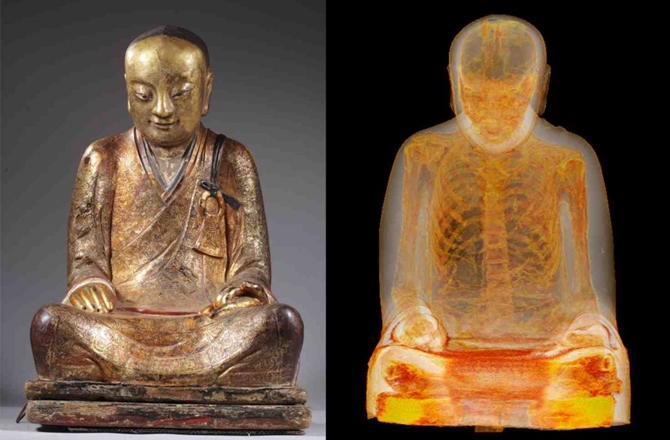
Researchers at the Drents Museum in the Netherlands made a shocking discovery when they imaged an ancient Chinese statue and found a nearly 1,000-year-old mummy inside.
Sitting in the lotus position, the mummy fits within the statue perfectly.
“On the outside, it looks like a large statue of Buddha,” the museum said in a release. “Scan research has shown that on the inside, it is the mummy of a Buddhist monk who lived around the year 1100.”
Here is a documentary (49 mins) by Tadashi Shimada about the Birds of Paradise, one of my favourite creatures on earth.
New Guinea is a true garden of Eden for birds. Some of the most unique are birds of paradise. With plenty of food such as nuts and fruits and very few natural predators, they’ve been able to leisurely hone their courting skills. The ribbon-tailed astrapia flaps its long white tail feathers, while the blue bird-of-paradise unfurls its feathers to create a pulsating eye-like shape. Since they live deep in the jungle, their courtship displays have long been steeped in mystery. Tadashi Shimada, a wildlife photographer who’s made numerous visits to New Guinea over the years, has for the first time ever captured images of the blue bird-of-paradise’s courting behavior. This program delves into the fascinating world of these beautiful and mysterious birds.
Published on Jun 25, 2014 – For more please visit NHK World.
I really enjoyed this video and as one of the viewers, Bob Bobowiz commented, “Let’s face it. He’s a poet. He found another form than words but it still is poetry.”
Reuben is a very talented kinetic artist, who transforms solid mechanical parts into beautiful organic and fluid kinetic movements. In this PopTech presentation he shows his fascinating process with beautiful insight.
Will posting chapters and parts of your book on your blog take away from your publishing success?

I have been told often that I should save more of my blog posts to include in my memoir. Usually this advice comes from people who love and care for me. I really appreciate that concern. I know this concern was not expressed for the fear of copyright, although I should be concern about that too; I am told I am ‘giving away’ a section of writing that may be building up tension or crucial to the climax of a chapter or even the memoir itself.
We choose what we share on our blogs. I know I could be just giving away the important parts in my memoir without realising it, but as I write the story evolves. I also feel the need to challenge my self even more by improving that story after I have posted it. Often I feel that if I re-write as much as I can, I like it more and the story becomes another story – an even better story. I remember things and add them. I show what I am saying better, with the right words. I enjoy details, sound, smell, how it feels and colours. When I re-write often, I speak the English word better, because it is not my first language and I need the practice. This may sound confusing, but it is about the evolution of the story and how the story journeys through its form until it becomes the one invention I and hopefully the editor is satisfied with.
I am grateful for the good advice, and without being too cocky, I must admit, my other fault lies in wanting to share immediately. My enthusiasm and thrill of a draft completion leads to, the need to read the story to someone. I want to tell the story. This may not be what other aspiring authors do. And, I am not advising anyone on what they should do with their potential best-seller. I wanted to make a point that whatever bits and pieces you read of my memoir is a piece of the story. I hope by the time I complete the memoir, I would still offer you a whole story and not six chapters of what I have left – from blog posts. Perhaps some of the blogger/author friends can share in the comments, how they manage this issue. Now, I have another story to tell…..
Recently through my friend and fellow WordPress blogger hiMe, I found another Papua New Guinea/Australia woman writer, June Perkins. As we bloggers do, we socialise while we write. For me to find a wantok, someone from your place, it is quite special. Perkin’s work has been published on Australia Broadcasting Commission(ABC Open) that hiMe writes for. Once hiMe gave me the link and I reached out, it did not take long for June to come to the meeting place – this blog.
I am very happy to get to know June (virtually) and read some of her stories. It is also wonderful to find stories between us that have similarities and that common place. Reading through June’s posts, I found this piece of writing and I was thrilled that it was related to my post tonight about how much is too much to share on blogs. I hope you enjoy June’s post and have time to visit June Perkins‘ blog in the future.

My blog is the place where the journey to my books has begun.
I have fed them continuously like journals with drafts and polished works.
Blogs have helped me make writing, remembering, reflecting and imagining a regular practice.
Blogs have encouraged me to make photography a regular practice.
Through reading other blogs I have found storytellers, poets, writers, travellers, film makers, and people who want to bring peace to the world through art. These people have inspired me with their journeys, writing, and photographs in their blogs.
Blogs have helped me so much so that when I have lived in the outer/country, I sometimes felt cut off from this larger creative world.
Blogs helped me heal from the damage of a cyclone to my old home and become a community journalist.
My own blogs have become a resource, full of roughly cut books. They have become archives for my family and friends to search our shared history.
Now I begin another journey. On this one, I take the rough cuts and unstructured writings shared the blogs and begin to place them into book structures.
It is time for me to polish more.
I move beyond the relatively free form of my blog and start to create anthologies and memoirs with sections, and chapters, and titles. I edit my blogs and add and subtract from them.
I create new pieces to connect blogs posts, and put them in these books, and save up for when they go public. They are held back from my blog to be surprises. My blog increasingly becomes a place for sharing the process of what I am up too rather than the final product.
The most inspiring things about blogs are:
1- The way they can potentially connect with the writer with readers and invite an immediate response.
2- The way blogs can respond to national and international events in the moment.
3- Their cheap access to a publishing platform for many in the world.
4- Their global reach.
5- Their capacity to build an audience for an emerging storyteller.
The challenges of a blog can be:
1- Blogging becomes addictive. You keep feeding your blog and not get on with sending off works for publication.
2- You share work you could or should be publishing as a book or article.
3- Copyright protection.
4-Some blogs focus too much on sales and not enough on content or connection. These blogs concentrate more on sale pitches and some are scammers.
5-Blogging can be challenging to build a large audience for your blog, and requires time, good quality content and social skills.
I will still blog when I have something I don’t want to forget, or something that moves my heart, or maybe a photo to share, but now I truly have to share a little less on my blog, and make you some SURPRISES.
More soon…..
(c) June Perkins
I hear you..I like how you said this. That was my time in journalism – a third got chopped. I bet the editors love it.
Besides my scribblings in Cor Novus, I also contribute to a Community Newsletter where I live. For the very large part, the contributions to the newsletter are simply a regurgitation of stuff I already put in here. Like nearly all regurgitions, not everything comes back in the same form that it went in.
In the blog I am free to let my writing Muse roam and ramble at will. I DO edit for length and comprehension but for the most part I just let the inner-voice speak as it wills and wants. It’s a different story for the newsletter. Space is premium and I sometimes have to cut as much as a third from the original that you see published here.
A THIRD! Oh My God, the PAIN!
Every writer of any worth that I have ever heard speak will tell you that words and stories and articles and essays…
View original post 138 more words

The rain eased at noon in Bellbowrie, Queensland today, but only for a few minutes. It has been storming for two days. The rain’s destruction was evident in washed garden beds and the main road overflows. I found some of my cuttings and seedlings floating in odd places, near the main road.
Yesterday, at the Coles Supermarket we were unable to purchase staple food like bread and rice. A Cole’s staff member said residents had a panic buy, stocking up in case it flooded like the 2011 Queensland floods. The supermarket was empty.
Several places outside our house were flooded. I had kept indoors and started a new artwork and read blogs. Only two days of wet weather and storms – yet there was too much water. On the news Brisbane was supposed to have 500mm of rain over the weekend. More rain will come.
In the distant, I heard a familiar cry that tugged at my heartstrings. I left the watercolour and went outside to the balcony.
“Listen!” I told my son Nathan.
We both waited and the cry was muffled by the sound of rain on our iron rooftop. It came again and I knew the cry was coming from the open field and then it moved around the back, near the duck’s nesting ground. She did come back. Her cries were strange, long and despondent. I knew.
“It’s her, something has happened”, I said.
I put my raincoat on and walked through the drizzle in the soft mushy flooded ground to her. The male duck, her partner was by her side, quiet. They made a striking couple. Her brown and white spotty breast and belly topped with deep brown-black wings, and he with a touch of spotty chest, blue-grey and black flumes. They stood on the fuzzy open plain of short stubby blue couch, Queensland’s native grass. The rain water was caught in the grass blades giving it a wet, fuzzy sheen.
I looked around the two ducks. The seven ducklings were nowhere to be seen. My heart sank. The inevitable had happened. The mother’s face was turned towards the pool, where she had hatched them. Her neck stretched forward and long in a breaking curve. Her mouth was wide opened, showing her pink insides as she wailed. Her cries were louder as I got closer. My eyes warmed into tears.
She looked at me and stopped crying. I stopped a few meters away. I wished I had some duck-words to comfort her. I could only offer her some food and walked away.
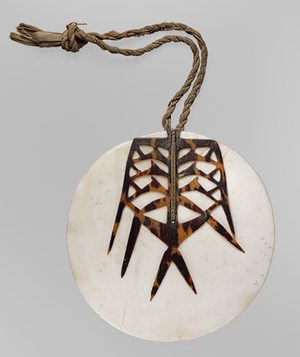
The tema or kapkap are flat, round breast plates or disks made and worn as men’s chest or forehead ornament in the Solomon Islands. Tema is one of my favourite ornaments from the Melanesian region.
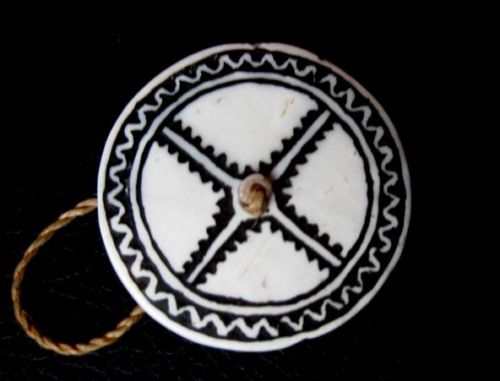
I particularly like the tema because of its spiritual meaning, its stunning appearance and temas take a long time to make, by hand. A A tema in the Melanesian culture is regarded as a spiritual object. They are worn as a protective shield during tribal warfare and for general well-being. The white part of the tema represents the moon. It is made from the giant clam shell. In the Santa Crus Islands, the traditional symbol of the frigate bird, shark or dolphin is intricately carved out of the turtle shell and embedded or attached to the clam shell base. The brown necklace is made from bark and bush ropes.





 Tribalmystic Stories