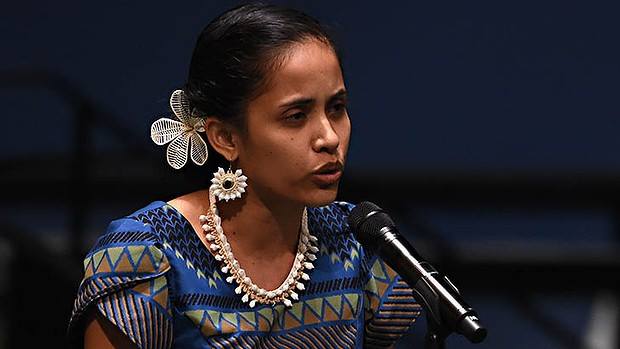
Kathy Jetnil-Kijiner, acclaimed poet and activist from the Marshall Islands, reflects on her time at this year’s Festival of the Pacific Arts in Guam and what it means for the people of the Pacific to safeguard that which is most important.
Through the postings from Culture-Talk, a newsletter on Pacific cultural affairs, I came across this story from one of Pacific Islands’ great storytellers and poet, Kathy Jetnil-Kijiner. I personally did not attend this year’s Festival of Pacific Arts , but I have in the past participated in several events and share the same belief that it remains one of the most sacred festivals of the Pacific islanders and must be protected at all cost. Some readers here may remember Kathy’s poem on climate change I posted here in September 2014.“Dear Matafele Peinem”, a poem Kathy wrote for her seven month old baby moved world leaders during the UN Climate Summit in New York.
Kathy Jetnil-Kijiner, acclaimed poet and activist from the Marshall Islands: “This past May I was one of thousands of islanders who flew into Guåhan for the annual Festival of Pacific Arts, alongside the delegation from the Marshall Islands, which rolled more than a hundred deep with Chiefs, weavers, dancers, dignitaries, Tobolar coconut businessmen, canoe builders, and tourism representatives (amongst others).
The festival was an amazing, transformative experience. There was always an event, performance, demonstration or something to see at any point. And if I wasn’t at one of these, then I hung out at the “Chamorro Village” – the center for FestPac that was surrounded with food stands, a stadium and newly built hut-like concrete booths for all of the different Pacific cultures or countries represented. The Marshallese booth was constantly overcrowded with shoppers. It burst with rainbowed Marshallese earrings, yawning woven flowers, an array of fans and fine mats, fashionable hats and just-woven headbands. Each display overlooked by smiling women undoubtedly weaving, talking story, debating prices, and every once in a while breaking out in a dance to the music floating in from the stadium.”
My cousin Greg returned to Papua New Guinea with his family after six years in Brisbane. It was a sudden decision and he wanted his family to move back with him to assist with his new business. Greg’s wife and children packed up the house and left yesterday morning on the flight to the capital, Port Moresby. We were all very sad. Greg and his brother Bob’s children and my sons were all about the same age and they enjoyed growing up together as a family. It was the same with us, their parents. We were close.
For the past two days, I had gone to cheer up my cousin sister-in-law Ufi, Greg’s wife while she packed. Yesterday we shared food, cups of tea and lots of stories as she started cleaning. I helped her with some tenancy documents and returned home late. The next day, after the family had left for the airport, I returned to the house they had rented about 3pm, to tidy up, remove rubbish and pick up some hand-woven mats and coconut brooms from PNG that Ufi had left for me. These were treasured items and knowing how valuable they were, my sister-in-law left her old ones for me.
On arrival, I saw a truck parked and loaded up to the brim. Two men, one Pacific Islander and the other, a Caucasian, I was not sure where he was from, were loading furniture and everything they could get. Then they tried to tie it down with ropes. Greg’s wife had told me she sold some furniture to a Samoan. She had said, the buyer was coming to pick up the three pieces of furniture, but, these two men loaded everything.
The Islander (Samoan) asked who I was and if I had come to pick up things I bought. I told him I was family and I had come to clean and pick up my Pandanus mats and coconut brooms.
“I can’t find them, they were suppose to be here in the corner”, I said looking at him.
After some hesitation, the man said, he had loaded the brooms and mats. I wanted to laugh but I kept a straight face. I knew these were old and used. The mats were ripped. I looked at him and smiled.
He went to the truck and unpacked the load. He found and gave me back the brooms and the two mats. He asked, embarrassed, if he could keep the mattresses and the other household items and I told him, he could keep them. He explained to his friend, he had to return the “island stuff”.
I thanked them and explained that the brooms and mats were from PNG and I could not let him have them because they were hard to get into Brisbane, Australia. The man knew the quarantine process for importing such items would have been horrid. He understood. I felt sorry for him because as an islander himself, I knew he would have been so excited to find these treasured island ‘rubbish’ before I had arrived on the scene and ruined it for him.
At the age of 15, in high school, I wore the same headdress my grandmother and I made. To date, I have this precious item with me. It has changed, lost some feathers but it still works as a centrepiece every time I wear it on my forehead.
Memoir series by JLeahy
Mother returned from the Lae city markets. It was a Saturday afternoon. Today, we were preparing for a big singsing in our village. We were preparing our best for the Annual Morobe Show. There would be hundreds of tribal groups and performers so, we had to wear only authentic costumes. We had to wear the costumes carrying markings and stories of our people and the costumes we inherited from our ancestors. I needed a centrepiece for my headdress.
As she came up to me, I searched Mother’s face for emotion. She teased my un-spoken questions with the twinkle and mystery she showed in her eyes. Finally, she was smiling. Her lips remained sealed more so because she was chewing but I knew she got it. I broke a smile at her and completed my task.
“There was only one Highlander selling two tiyeng ngawahu (Bird of Paradise plumes) and I bought one”, she said.
“Ohhh ngayam!” grandma responded in Bukawac, meaning “good”.
Grandma was pleased the mission was accomplished.
I sat next to Grandma, helping her to twist the sisal fibres on my thigh into strings. We twisted two separate bunches of single fibres which formed a string. Then, we dyed the strings yellow and orange with turmeric roots, and red from Mbuec, a tree that gave red dye in its seed pods. To get grey, we buried the other strings in the muddy banks for a few weeks. For the black we used crushed charcoal with coconut oil. Once dried, Grandma used a ‘needle’ made from a 15cm long re-cycled and sharpened wire. This ‘needle’ came from the inside of a broken umbrella bone. Grandma sewed the strings into bilums (string-bags). The new bilums will be worn in the dance on the day.
We used some of the strings to thread scented leaves and herbs for breast decoration. These same leaves were used for magic, but I was not allowed to know. Not yet, Grandma said.
As she tried to speak, Mother’s mouth was full of red chewed betel nut and she needed to spit. She eased her bilum of food down in a heavy thud. She fished in her smaller shoulder bilum and spat. She held out her hand with a crumpled newspaper wrap.
I jumped up to grab it.
“Careful!.. be careful!”
I was thrilled. Without searching her bag as I usually do for the market gifts of peanuts, green margarines and cucumbers, I turned away from Mother. I smiled at the faded newspaper as I bent and laid the small light bundle on the dry sand next to my twisted strings. I sat down and brought Mother’s parcel to my lap and un-wrapped it.
I was afraid to touch her at first. The bird was beautiful and so soft. A spot of black around her beak. Green velvet on her neck and breast. The rest of her body was a burnt butter yellow with a white centre and a beautiful pale yellow outer-feathers. The base of the main feathers was an intense, vibrant golden-yellow which faded out into white. Her inside was gone. It was shallow. She had been dried, smoked and flattened.
I suddenly felt a pang of guilt and pain swept over me. I thought of the bird flying high and calling out in the trees and I wondered if she suffered. I felt more guilty about this bird than the chickens which I already had feathers from. I was seven and never held a real Bird of Paradise in my hand, even a dead one. I had seen many on headdresses during the festivals. I have held other birds and had parrots as pets. I looked at the bird a little more, each faint wiry piece that joined the next. Then I reached out and touched her.
Of the 39 species of the Birds of Paradise in the island of New Guinea (PNG and West Papua), this one, known as “Greater Bird of Paradise” was the most precious centrepiece for our tribal headdress. The birds did not live in our bush. Our people traded and bought the feathers from the highlanders.
Mother had to seek out hunters from Western and Southern Highlands who rarely brought the feathers to the main market in Lae. She was very lucky today.
To have a Bird of Paradise as your centrepiece was the ultimate dream of every dancer in our tribe. Many other Papua New Guinean tribes wore numerous plumes in singsings. Many more longed for such honour but only settled for parrot, cassowary, and chicken feathers. This bird was our National emblem.
In our Wagang village singsing group, most people wore cockatoo, parrot, cassowary, turkey, guinea fowl and chicken feathers – all made into spectacular head pieces.
I laid out the Bird of Paradise plume and stitched it into my headdress. The headdress was made of feathers and shells, sewn onto a tapa cloth. Most of the headdress was completed days before. I was only waiting for the centrepiece. The cloth would be tied around my head. The Bird of Paradise would be the centre feature. When I wore the headdress, the golden-yellow, wispy and silky soft feathers would sit high above and dance. The beak would be looking down at me and her tail would move with me as I danced the we-e si-ing (war dance).
Protected Species – the Birds of Paradise are a protected species in both Papua New Guinea and West Papua (Indonesia)
Birds
Much sought after as pets or for their feathers, several birds of the forests of New Guinea such as parrots, lorries and birds of paradise are illegally exported for trade. But just the local use of a species can be detrimental to its survival; wildlife capture and trade of cassowary for traditional use has severely reduced their populations in some areas and where they remain, there is increased pressure for trade.7
Birds of paradise have also been historically traded, especially for their feathers. While West Papuans’ use of the birds’ feathers in cultural celebrations is part of their tradition, Europe was once the main market for the plumes, to be used for women’s hats and accessories. Trade peaked in the late 19th century, when plumes from more than 50,000 birds were exported every year, generally to Paris for capes and hats.8
Birds of paradise continue to be smuggled out of Papua Province, Indonesia. The trade in the birds adds to the pressure they already get from continued hunting and the destruction of their habitat by logging, road construction and conversion for human use. Although banned by the Indonesian government since 1990, trading in the feathers of the birds of paradise is still ongoing.9


 Tribalmystic Stories