Tag Archives: Nature

The Story Behind The Picture


My Life With Cameras

I love most art forms. To show and tell a story, I have often wondered if film and photography are the art form that truly capture the essence of a story. As a story-teller, I often ‘cheat’ by throwing in an image to complete the imagery ‘in’ my story. I see many bloggers use images this way, and it is great. As you are reading my stories, I want you to see and visualise the events, emotions, and actions with me. We are in the story together. Now, imagine if we did not have pictures; how could we, story-tellers, tell a story? I know how hard it is to describe a scene, simply. How many words and sentences do we need to describe every picture, and every scene we wish to create in our readers’ minds?

Between 1980-2000, in my news print days, I carried a Nikon FE2 with me in PNG. I must admit, I was in-love with this camera.  It took two decades of pictures with me. These pictures hit front newspaper pages and glossed magazines. I entered and won competitions. I could not have been a true journalist without it. Being a photojournalist, assisted by FE2, we took stories to another level.

Sadly, I do not use this camera anymore. Apart from losing the mirrors inside the FE2’s body to some hungry mould, I paid over $AUD600 for repair, and never got the mould completely removed. The mould began feeding and grew again. I still have the FE2 with me because we have too many memories together. I cannot use it, and I cannot bare the thought of losing it.

These days, everything has moved to digital. Over the years, trying to save money for a new ‘real’ camera has not been successful. Family, mortgage and many other urgencies always top the priority list. Without a good camera, I often wonder how many great shots I have missed in so many years. I stare for hours at photographs and  pin them on Pinterest and the net. I wonder how I could have taken these pictures differently; using light, better angle or simply, showing the object better. Fellow blogger/photographers, you know I am checking your pictures out, and I am looking at your pictures in awe and with some jealousy.  This is envy that is not evil but respectful.  A somewhat sad feeling about how much I have missed in my photography. I have long resigned to the fact that –that’s life!

Going Digital

Tami Is Research photos 061
In-coming tide on Tami Island, Lae, Morobe Province, PNG. Picture JLeahy. 2008

I still take pictures with the phone, and small digital cameras. A few years ago, I had a digital pocket sized Nikon I bought from a Cash Converters store. It accompanied me conveniently for its size. The FE2, and its lenses was sometimes hard to lug about.  After doing some solid photographic work, the little camera’s bottom broke. There is a pin inside the battery cage which broke and the camera batteries would protrude out and lose power.  So, I taped the bottom and kept using the camera.  When a moment presented itself, the photographer would need to press harder on the tape to keep the batteries in and take the shot. Only I used it expertly. It was hard work instructing others to handle the little camera in her special needs. If less pressure was applied, the camera did not work. Sounds like a joke right? The camera worked most times and I was proud of it.

The Right Equipment

Anyway, the point I am making is that, when and if you have a great equipment for your work or even artwork – everything flows beautifully. Just imagine when you don’t and the moment presents itself. In 2008, I was on Tami Island, Papua New Guinea doing my field research into how climate change affected intangible cultures.

I travelled with my mother and my broken-bottom pocket Nikon. The bottom was taped and, we went to a place at least a few hours in up the coast, in a boat, so there was no such thing as batteries nor camera shops.

I took several photos with the bad-bottom camera, and one picture has become a favourite. I had to mention this picture because, it is not only I that thinks it a wonderful picture, but strangers have complimented the photo, hundreds of times. I posted this picture on About Me, on my Page and each day, I can get numerous compliments and comments about this picture.

The Story of This Picture

Tami Is Research photos 056-2
Morning light on Awaho flowers, Tami Island, Lae, PNG. Picture, JLeahy. 2008

In the days my mother and I stayed on Wanem Island, we would wake in the morning to crisp breezes, beautiful skies and chatters of seagulls and other birds flying by, searching for food. The village was a separated by trees and coconuts. The only sound was the soft waves,  gently slapping the sandy beach. At least three metres in, from the water’s edge, the beach was lined with various soft and hardwood natives, and one we call the Awaho. This tree has many uses. Its timber is used for building, the leaves for cooking food in, and the bark for making clothing, as well as ropes. At the end of its life, the Awaho wood is a very good firewood.

Each morning, before we woke, the Awaho trees would start dropping their flowers on the hardened, cleaned sand, left by the receding low-tide. The flowers would be placed randomly but precisely, so it did not clutter. These droppings ravished the beach with these delicate burnt orange flowers with deep carmine centres. From each of the rich red-wine centre protruded a pale feathery, sticky pale stem with a red tip. Seeing the flowers on that beach for the first time, I thought someone had laid the flowers out. By the end of the day, before the flowers have completely wilted, the tide would come in, and sweep the flowers away before the shadows melted into darkness. If you swam at night, you would see the flower floating amongst the flotsam. In the morning, the white beach would be cleaned and ready. Once again,  the Awaho’s bouquets would arrive, and scattered across the white sandy beach. The cycle began all over, a picture and a moment of Mother Nature’s artwork. I would have never captured this images without the broken-bottom pocket Nikon.



Saving Harry


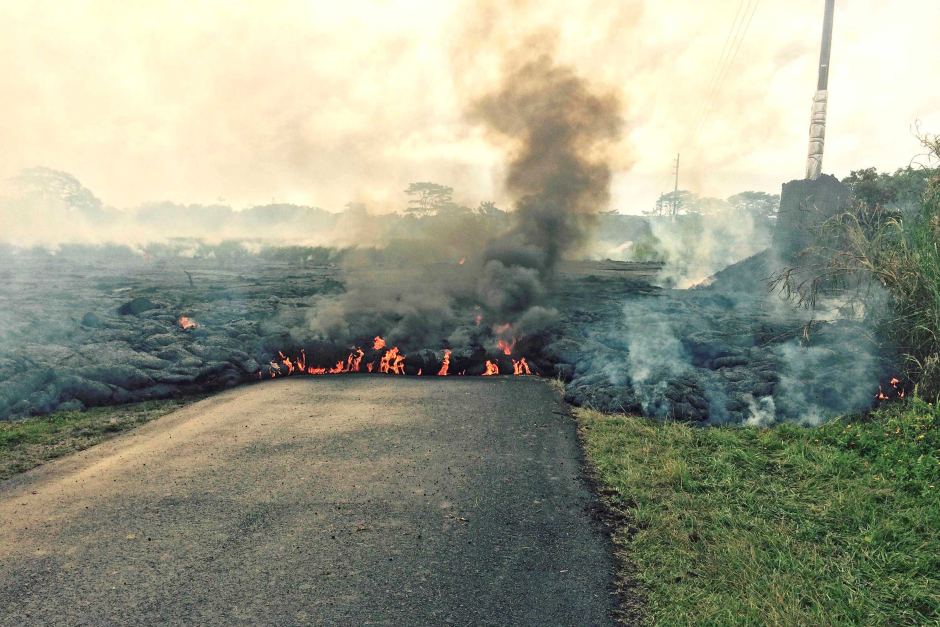
Hawaii Homes Threatened by Molten Lava


5853824-3x2-940x627
Pictures from Hawaii four hours ago.

A slow-moving river of molten lava from an erupting volcano is edging closer towards dozens of homes and businesses in a seaside town on Hawaii’s Big Island.

The lava has already crept across a residential property and incinerated an outbuilding.

The lava flow from the Kilauea volcano has been moving towards the village of Pahoa for weeks and was clocked at speeds of up to 14 metres an hour as it bubbled over a road and overran a cemetery.

On Wednesday afternoon, the Hawaii Civil Defence agency said the lava advanced to within 250 metres of Pahoa Village Road, the main street through the town of about 800 people, built on the site of an old sugar plantation.

5846118-3x2-940x627

Civil Defence administrator Darryl Oliveira said Pahoa’s commercial district lies mostly to the south of the area in greatest danger, and most homes and businesses are believed to be out of harm’s way, based on the lava’s current trajectory.

“Right now where the flow is moving we’re very fortunate because the number and concentration of structures is very low,” Mr Oliveira said.

“But the caution to that is even though the flow front is very narrow at this time, if the eruption continues and the flow continues to be supported by the tube system a widening of the activity or flow is likely to occur.”

However residents of about 50 dwellings in what civil defence officials called a “corridor of risk” were urged to prepare to leave, and many were slowly emptying their homes of furniture and belongings.

Mr Oliveira told a news conference that no mandatory evacuations had been ordered but 83 national guard troops were undergoing training and would be deployed to the community on Thursday.
VIDEO: Lava flow from Hawaii’s Kilauea volcano (YouTube: Ena Media Hawaii/Blue Hawaiian Helicopters)
On Tuesday the molten rock topping temperatures of 900 degrees Celsius engulfed a utility shed but spared the adjacent house on the property, already evacuated and cleared of furniture and other belongings.

“So far we have been very fortunate that the flow has not taken any other structures,” Mr Oliveira said.

Officials said they would close an endangered elementary school on Wednesday and shutter four more schools on Thursday.

The US Geological Survey’s Hawaiian Volcano Observatory said the leading edge of the lava stream had narrowed to about 45 metres wide.

Provan Crump, a marine biologist who lives locally, said residents were well prepared.

“[They’re] just moving all their valuables out and then moving,” he said.

“There’s not much else you can do, it’s a force of nature.”

http://www.abc.net.au/news/2014-10-30/lava-edges-towards-dozens-of-homes-on-hawaiis-big-island/5852676

http://www.abc.net.au/news/2014-10-30/hawaii-volcano-youtube/5853178

Owls: The Silent Aerodynamic Hunters


White Owl - wash and ink
My art: A study of snowy owl in ink and wash.
Photo_36753DD6-2554-92BC-5038-7B51BC3AF9FF
My Art – Owl. Acrylic on canvas.


Above are two  of many artwork I created, purely because I love owls and I find them very interesting.

Growing up in my culture, owls have been linked to death. If you hear an owl consistently calling or crying then, death is near. This was the belief. An owl crying or calling is quite rare but when it does happen, it is quite scary.

Unusual visitors

In some Brisbane (Australia) suburbs and out where we live, there are a few species of owls. The most common one is the Frogmouth. My family and I have had several occurrences with owl visits that I find very interesting and hard to understand. Once we had three owls come into our garden and sit for three days in the same spot. There was another incident where two large owls appeared at the front of our house and sat on a very low dead tree. They must have arrived before we woke up. At first, we thought they were part of the branches of the dried tree trunk. These two sat in the same position for almost a week. I went up very close to them one day and the taller of the two opened its eyes and glared at me – so I left. I hope to find their photos that I took that day and post it here in the future. Despite my cultural learning and spiritual beliefs about these birds, I find them especially interesting because of how quiet and often secretive they are. Sometimes, you don’t know they are there. They can camouflage very well.

Xyli_Snowy_Owl
Snowy owl picture from http://www.sodahead.com

Many owl species have developed specialized plumage to effectively eliminate the aerodynamic noise from their wings — allowing them to hunt and capture their prey in silence. Almost a year ago, a research group started working to solve the mystery of exactly how owls achieve this acoustic stealth — work that may one day help bring “silent owl technology” to the design of aircraft, wind turbines, and submarines. I found this small clip on reddit.com. Click the link below to see the wing action.

http://i.minus.com/iOdEkaHhIXl2b.gif

131124093515-large

To read more: 

http://www.sciencedaily.com/releases/2013/11/131124093515.htm

A rare find on Newcastle shores


Locals found a rare beaked whale beached on Newcastle this morning. “For a very, very long time not much has been known about them and so every time we even find one that is dead on the beach, it is a treasure trove for the scientists”, said ORCCA vice-president Shona Lorigan.


5811792-3x4-340x453


5812516-3x2-700x467

Marine experts are examining the rare beaked whale. The three to four-metre-long animal was found dead on Redhead Beach, south of Newcastle, this morning.

Marine experts have been called in to examine the whale and take specimens.

Organisation for the Rescue and Research of Cetaceans in Australia (ORCCA) president Ronny Ling said the find was extremely rare.

“It’s a deep sea animal called a beaked whale,” he said.

“We’re yet to identify the exact species but what we can tell you about these animals is they are rare animals.

“You normally only find them when they wash up or when they strand and they are very, very seldom seen at sea, so it has great scientific value there. It is rare everywhere and not just Australia”.

http://www.abc.net.au/news/2014-10-14/rare-whale-washes-up-on-a-newcastle-beach/5811774