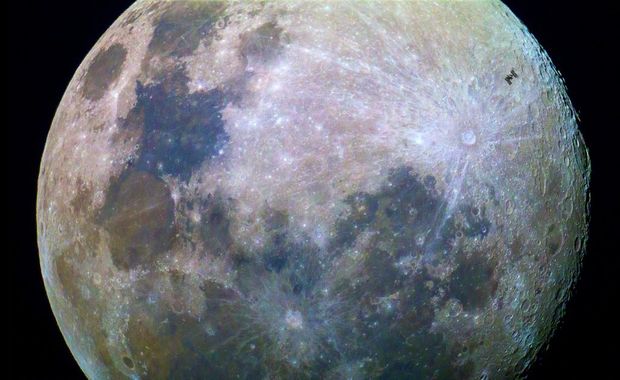
Byron Bay photographer Dylan O’Donnell took this stunning photo of the International Space Station passing the moon on Tuesday. Photo Contributed
The media has called it the holy grail of astro-photography. The Cool Stuff of the week is Dylan O’ Donnell’s fantastic photograph of the full moon with the incredible capture of the space station on the top right.
The BYRON Bay (Australia) photographer who captured the shot on Tuesday with International Space Station passing over the moon said this was his second attempt to take the stunning shot.
“I’ve only tried once before and I completely botched it, it looked like a blur,” he said.
“The International Space Station ISS passes through the sky semi regularly, but for it to line up like it did with an almost full moon is quite rare.
“Some people go chasing around the world to try to line it up but I just waited from my home and it was about 12 months from the last time it lined up that way for me.”
Written, Directed & Animated by Nicolas Ménard
Sound & Music by Rich Vreeland
The mundane story of a heartbroken man,
an online gambling addict, an alcoholic kleptomaniac
and an anxious loner living in the same apartment building. Additional animation by Iris Abols, Anne-Louise Erambert, Nicole Kozak & Robert Loebel
This is my second entry into the short story category in PNG National Literary Awards. Some of you know this story. It has been cut down to 1000 word limit. For more stories and entries into the competition, please visit the following links;
I felt his eyes piercing into my back as I struggled over the grassy hill. The air was tight and chilly so early in the morning.
“Walk faster!”
I needed my three-month-old baby Boni’s softness, and the laughter of his older siblings. I was exhausted and wished I could stop. A sudden breeze brushed over the tall grass. Shoosh. I shivered.
Usually, when we returned from the garden, Bomoga walked proudly ahead, carrying his prized spear with a small bilum strapped across his bare chest. The children and I fumbled behind him: me with a child on my shoulder, another in the bilum on my back together with our second bilum of food and pulling our eldest by the hand.
Today, I was in front. I wore my favourite red meri blouse. In haste, I had worn it inside out – its flimsy seams waved loosely.
We reached the top of Kasu Hill. I gasped for air.
“Hurry Up!”
My heart pumped. From the only hill in Domogu Village in the wallaby plains of the Western Province, pale yellow-green lowland laid before me. The grass had been burnt in patches to entrap wild game. The lowland was also known for Papuan black, a deadly snake.
I marched down the ridge, as ordered. Cold mud numbed my sore foot. We reached the place where the Ok Tedi Mining had caused hundreds of fish and plants to die along the riverbank. Usually, there were people here. But it was still early – no one was about as we passed.
My milk dripped down my blouse. Without bra, my breasts swung full and uncomfortable. It was feeding time for Boni. The rising sun cast faint shadows and the warm air caressed my face. We had crossed Domogu tribal land. Bomoga’s ancestors, nomads like mine, had decided to settle in this fertile land.
My eyes scanned the mountains that Ok Tedi had exploited. To the south, there was an airstrip where planes flew in weekly. Our village looked like a jewel, deep jade opal, festooned with glassy lakes of many sizes.
“Move!”
I stumbled forward.
We entered a forest. Strangely, the birds here were silent. I heard sorcerers came here for bush medicine and magic making. I searched for sunlight through the tree openings.
“Keep walking,” he hissed.
I had not looked once in Bomoga’s eyes. When his sweaty hands had touched me that morning, I thought he wanted sex, but instead he shook me roughly and ordered me out of the house. His shadow had loomed over me as I took Boni off my breast and put on my meri blouse and my rubber skirt. Boni nestled into his blanket, eyes still shut. He didn’t cry for more milk, thank God. My other children, Eka and Maria were asleep. I heard Bomoga pick up something in the house before closing the door behind us. He was quiet and cagey, which was not like him.
He was never a warm person, not even to his family members, though he was loud to his male friends. He liked sex that was rough and on demand. In any argument, a sudden punch to my face or stomach was a possibility. If the children screamed, he yelled at them. The beatings only worsened if he thought I challenged him. “No one will help you, because you are MY wife,” he said. I felt he was right and did not seek help, not even from his family or other villagers. Recently his best friend Tommy had returned from Port Moresby. I heard Bomogu now liked Tommy’s sister who was younger and prettier than me. He wanted her, I heard.
I stepped on a stump with my sore foot. The pain almost made me cry out. Two of my toes had broken when I fell in the last fight. We continued through the gloomy undergrowth into a flat area. Through an opening I saw sunlight sprinkling light of various colours onto leaves and moss. I saw a beautiful butterfly on a fern. Its brilliant blue wings and black outline set against the leafy greens. I felt a flash of hope.
We walked on and soon I could hear rapids and the forest thinned out as we reached a Y junction. At my feet a Papuan black, unaware, slithered quickly across my path.
“Turn to the river,” Bomoga commanded.
I turned towards the rapids. My throbbing foot distracted me and I was afraid to fall. The river frothed, full from recent rain. Watching water as it rushed away, a thought stirred my mind. Was he going to toss me into the river?
I imagined where my body would lay after death; my treasured red meri blouse, still inside out, clinging to my slim frame. Dragged ashore with a paddle shafted under the hem of my blouse, a trail would be imprinted on the sand on the silky Suki River banks. Villagers rushed to screaming children who discovered me. A woman bellowed my name, “Sulita!, Sulita!” But after hours in the muddy river, half-dressed and impaled by a black palm spear, I would no longer be Sulita.
“Stop!” he yelled.
I halted.
The ground looked easy to dig in places. I kept my face down. My feet were covered in mud and grass
“Turn around. Look at me!”
I turned and raised my eyes to the point of his most prized black palm spear.
With this spear Bomoga had speared the biggest pig, the fastest wallaby and driven the largest cull of deer. Many feared Bomoga because of his mastery with the weapon. My eyes shifted from the spear to my husband’s eyes for the first time that day. They were bulging and blood-rimmed. His nose flared and his sweat drenched eyebrows twitched. Ten long years and we still stared at each other like strangers.
He raised and pointed with the spear. “Where would you like to be buried?” he asked.
I dropped to my knees, closed my eyes and prayed.
This story is based on a true story set in Suki, Western Province. It is dedicated to the strong women and the survivors of domestic violence in Papua New Guinea and other Melanesian societies.
The Hillside Find is a short story I wrote when I first started blogging over a year ago. It is based on my life as a young journalist working in my first job in Papua New Guinea’s leading daily, The Post Courier.
I have entered this story in the PNG’s annual literature competition which closes on June 30th. If you are interested, please visit also the two links below to see other entries from PNG writers. I will post my second entry tomorrow. The word limit is 1000 words.
We climbed together, side by side. Chief Superintendent Roy Tiden and I stepped through the tall kunai grass and up the rocky Ranuguri hillside. The mid afternoon sun fought with its last strength, throwing an orangey tinge on the grass and on vibrant houses on the hillside. Ranuguri is in Konedobu. Below, the sound of traffic in Kone died down as we moved further up. It was a Tuesday in February 1985; the year Papua New Guinea would celebrate its ten years of independence from Australia. It was also the year the country recorded the highest crime rate in Port Moresby. Solving crimes excited me. At nineteen, and reporting for PNG’s leading daily, life was never dull.
My mother had called the night before from Lae, asking me to bring my little brother to Port Moresby and care for him. I was the eldest of four and Rivona was turning eleven. Port Moresby crime figures were escalating and living here was hardly safe enough for me. I wondered how a historical government post such as Kone boasting the best harbour and a bustling business centre could also be afflicted with such a high crime rate. In the newsroom the talk was that a state of emergency would be declared for Port Moresby. I stopped briefly to wait for Supt Tiden. As he got closer, I continued climbing.
I wanted to care for my brother, knowing how hard it was for my mother with three young children. But I was afraid journalism work would keep me away for long hours. This was my first job, and I wanted to do well. Maybe I could also bring my grandmother, so she could help me with my brother. With my mind absorbed, I didn’t realise I’d left the superintendent behind. Glancing down at him for directions, Supt Tiden pointed to the top of the hill. I headed there with my bag and notebook, stepping carefully over the loose gravel and scattered boulders.
Down the hillside, Mr Tiden’s blue uniform showed through the green swaying Kunai grass. Further past him I could see some of the old colonial buildings. Colourful clothes danced on makeshift lines and smoke escaped from open fires. Next to the police headquarters other old buildings had been converted into the mining department offices. Several dozen vehicles were parked there. I brushed the sweat off my forehead and wiped it on my skirt.
When I got the call, Mr Tiden had mentioned a rise in death amongst gang members, especially young boys. He said he’d been called out a week ago to a crime scene where the body had already decomposed. While moving the remains onto a stretcher, the rotting arm dropped onto the superintendent, and as it brushed him the fingernails came off. Thinking of that story and what we might discover today, I felt nauseous. I wanted to get it over and done with and return to the comforts of the Post Courier newsroom. My workmates there have become my second family, away from my hometown Lae.
I neared the hilltop. Supt Tiden was several meters downhill. His large body restricted his speed up the hillside. He’d started puffing at the foot of Ranuguri and joked about racing me to the top, making light our reason for being there. By then he was already an astute detective with over 20 years of police work.
With the incident report descriptions of the crime location, I figured I would see a crime scene near where I stood. I expected the obvious: signs of damage to the land surface, a scrap of bloody clothing, and any kind of evidence. “Maybe, I am ON the scene,” I whispered to myself. The hairs on my skin stood. At my feet the ground was bare and uneven with rough limestone.
I called out, “Mr Tiden!’ Mr Tiden!” Out of respect I always referred to the superintendent as Mr Tiden. I could hear the wind blowing my voice down the valley. No response. My throat dried up as I hugged myself.
I looked around and across the hilltop trying to see where the sound of buzzing flies came from. I didn’t want to step on anything or anyone. I could not even see those damn flies, but I heard them very close. A crow soared and two others joined the circle, just metres above me. I held my notepad tight. I pulled my bag up to my chest and smelt the leather. Inside it were my no-brand cinnamon lipstick, an extra pen, a bunch of keys and the police issue can of chemical mace. Mr Tiden said I might need it one day.
“The mace!” I almost said out loud. But what help would it be? Apart from spurts of kunai, there was nothing else here. Whatever there was would not be too hard to find, but my legs refused to take me further. I waited. The flies buzzed and the grass shooed. I wished the police helicopter would blast up the hillside and break the silence.
I was about to call Mr Tiden again when I heard muffled cursing and knew he had arrived. “There you are, Joycelin.”
“Am I in the right place?”
“You are! That is great detective work,” he answered cheerfully.
I pretended to smile.
“Come this way.” He started turning down the opposite side of the hill then halted suddenly.
I walked up to him and looked down. Stretched out before us was a boy’s body. He had three large rocks weighing him down – on the neck, the abdomen and the legs. The head had a massive dent and the rock on his neck was covered in blood. “He can’t be more than 11 or 12 years old,” said Supt Tiden after a complete circuit around the body. I had not moved yet.
Supt Tiden looked up at me, waiting for a reaction. The only thing running through my head was my brother, Rivona.
It could have been him, I thought.
Thank you Isabel for all your help. This story is a tribute to Chief Supt Roy Tiden and also my brother, Rivona who are both no longer with us. Roy died years later and Rivona lived to be a young man in Port Moresby. Almost 20 years later and two weeks before his 32nd birthday, Rivona died suddenly.
https://www.youtube.com/watch?v=7xVb5pW6Ess AFP News Agency: On the Pacific islands of New Caledonia, it’s feared many of the 28 indigenous languages are dying out. But the success of a local band scoring hits in a native tongue is giving traditionalists cause for hope. Here is one of my own New Caledonian favourites. Ok!Ryos – Kini Kinibut https://www.youtube.com/watch?v=E6y-uCME1Ts
Here is a story about a storyteller and how he told his grandfather’s story.
This is an interview I found on Malum Nalu blog about a friend and a Papua New Guinea writer and scholar, Steven Winduo. I wanted to feature Steven on my blog because some of the things and the way he wrote his novel is interesting and we can learn from them as writers. In his own words below, Steven explained how he wrote his book, Land Echoes (2014), based on his grandfather’s life story.
It is challenging to write fiction, based on actual history, than on pure imagination. The challenge is to be as close to history, but aided with literary license to reconstruct a storyline that maps out the narrative. The technique known as fictionalizing history is taken on board to plough the field of history and fiction to make something grow out of it.
Land Echoes (2014) is my first novel based on my grandfather, Holonia Jilaka, whose life inspired this book. Although not a biography the novel’s timeline is based on the part of my grandfather’s history.
I recorded my grandfather’s story on tape when I was a University of Papua New Guinea (UPNG) student many years ago. The part that I was interested in was the part where he went to the Highlands of Papua New Guinea in 1933 as a shepherd boy with the Catholic missionaries. He spent three years (1933-1935) in Simbu area before being discharged as a mission boy. He then joined the police force, taking his training in Rabaul depot under the instructions from Ludwig Somare and a sergeant from Buka. Kiap Jim Taylor recruited him into the police unit to make the historical Hagen Sepik patrol in 1938/1939.
My grandfather told me only part of the story. The rest I had to read and discover for myself. From the transcript I had of his story I began the writing project in December 1994/January 1995. At that time I was studying for my PhD in English at the University of Minnesota, USA. It was winter holidays but I could not return home.
To keep me busy and distracted from homesickness in the middle of Minnesota winter I decided to write five pages a day the early drafts of the novel, Land Echoes. I wrote every day without for two months, completing the first draft of the novel by the time February 1995 came around. I was quite happy with the self-productivity that winter. I think I completed around 500 pages of hand written notes.
I then started the process of typing the manuscript into my laptop. By the time classes started again I shelved the writing project for my PhD program. From time to time I returned to my manuscript in the next 20 years, even after my doctoral studies. I had some help along the way from colleagues and writers in PNG and Australia. I received documents, manuscripts, and books about the famous Hagen Sepik Patrol that Jim Taylor, John Black, and Pat Walsh, but only as sources of reference to contextualize the history that was made with the help Papua New Guinean policemen like my grandfather.
I was interested in highlighting the life of my grandfather against the early work of the Catholic Church in the Highlands and the Australian government’s administration of the newly discovered highlands region of Papua New Guinea.
The only way I could make sense of this was to delve into history that I was born too late to know. I equipped the writing life with raw imagination to enter into the period beginning late 1920s and 1930s to juxtapose that with periods from 1960s to the 1970s. The challenge with a project such as mine was to make history interesting to read through fictional narrative, while making sure to remain close to actual events in history.
Lately, I have been tested a few times by local pharmacists and I wonder why they would not hand over what has been prescribed by a doctor without giving you a third degree. I find their comments and questions unnerving either to myself or other patients in the queues. This is especially so when you are decently presented and what you are trying to buy off the counter is not dangerous in any way, AND or the medication has been prescribed by a doctor. It is especially annoying when you are sick and all you want is to buy the medication and go home.
Thalassemia is a disease that affects your body’s haemoglobin production – so the body does not produce Alpha globin. It is an inherited blood disorder. I have the minor trait which only got out of hand recently. Apart from eating well, loading up on green vegetables and staying healthy – I have to take iron tablets (pills). I have taken iron tablets before the birth of my sons and later as a precaution when my haemoglobin count dropped.
Last December and January 2015, I became very ill and stayed ill for almost three months. While doctors could not work out what was specifically wrong, my red count was low. It was found that my haemoglobin level dropped dangerously low and my cells lost their ability to make the other part of cells that complete the haemoglobin process. My doctor gave me the choice between an instant blood transfusion or taking more iron tablets. I was a little scared. I chose to take the tablets over a period of time with a super diet. I have been on the iron tablets for five months.
But, whenever I go to purchase the iron at any of our three local pharmacies, I get questioned over it. I don’t need a prescription for them. Here are some of the questions;
“Have you taken this before?”
“Why do you need it?”
“How long are you taking this?”
“Do you want to try other brands?”
You may say these are normal precautionary questions a pharmacist needs to ask. To me, it is all verbal diarrhoea. The fact is, if you can buy something off the pharmacy counter – you can. If the doctor gives you a script – you can get the medication too. There is not much a pharmacist can do – really – even after questioning.
So two days ago when I got to a crowded pharmacy and handed over the empty box and said – I need one box; the pharmacist (female) walks to the back of the room, picks up my new box and shouts to me: “Do you get constipated when you take these?”
Everyone in the queue, at least seven people looked from the pharmacist to me.
“Have you taken them and got constipated?” I replied (in pretend innocence).
Those that were in the queue giggled.
Embarrassed, she walked up to me and smiling said “I was just asking”.
“Yes, I know and I was asking too, I just love talking about things like that in front of strangers in a public place”. I said.
Giving old and broken toys a new life in art and colours.
Car Atlas – above and below, created by David T. Waller.
This installation – our cool stuff for this week was created by David T. Waller using 2,500 Matchbox cars on a room floor. It goes to show that not all broken and used toys end up in landfills and rubbish dumps. The UK-based artist arranged the toy cars in a giant circular rainbow pattern to create the Car Atlas installation. David’s work was displayed at Artsdepot’s Apthorp Gallery where visitors voted it their favorite art piece. If you visit David’s website, you would be surprised by the contrast between this artwork and his typical creation. Go to David’s gallery by clicking here – David T. Waller
Mondays Finish the Story is a unique flash fiction challenge where Barbara Beacham provides a new photo and the first sentence of a story each week. The challenge is to finish the story using 100-150 words, not including the sentence provided. This challenge runs from Monday to Sunday.
At first, it looked like an ordinary marble, but it was far from it. Magda got to it, reached down awkwardly and picked it up. It was big and heavy.
Years of factory work damaged her back. Magda longed for an easy way to survive. The ball was larger than a cricket ball yet smaller than a soccer ball.
“Perrr-fect!” she smiled to herself and wiped off the red dirt.
This was a sign. She closed her eyes in prayer. She has seen it done in the markets with no truth in it and told Chek. Besides, who would know? Her husband Chek died last year.
With her gypsy olive skin, a pair of wild gooseberry eyes set against her greyish black hair, Magda was ready.
She pushed her Coles trolley to Brisbane’s West End markets. Already she could predict her own future. Her years of struggle are about to end in a few hours when she starts her new career – predicting people’s futures.







 Tribalmystic Stories