Curled into a ball, our spiny visitor on the floor of the workshop in Bellbowrie – Picture by Flynn and Chris.
One of the luxuries of living in the Australian bush is the unusual ‘visitors’ we get. So, far in the three years we have lived in Bellbowrie, Queensland, we have had some interesting ‘visitors’. We have had the slithering kinds, the furry kinds, and scaly kinds, and two days ago, a spiny kind.
My younger son Chris and his friend Flynn were downstairs in Chris’s workshop and they heard a noise of something knocking thinks over. With their phone lights, they saw a dark mop run to the corner and wedge itself between a child’s chair legs. I kept these chairs for children’s art classes. Even when they had switched the lights on, they could not tell what it was. When they got closer, they were surprised and started yelling in excitement. We all rushed downstairs to see what it was.
Wedged between the small chair legs was a frightened little spiny ‘visitor’ – an echidna. The poor echidna was so frightened that it rolled up in a ball with its head between its front legs. The boys carefully removed the chair to take the picture above and then put it back. We never got to see its face and after half hour or so, with the lights off, it disappeared.
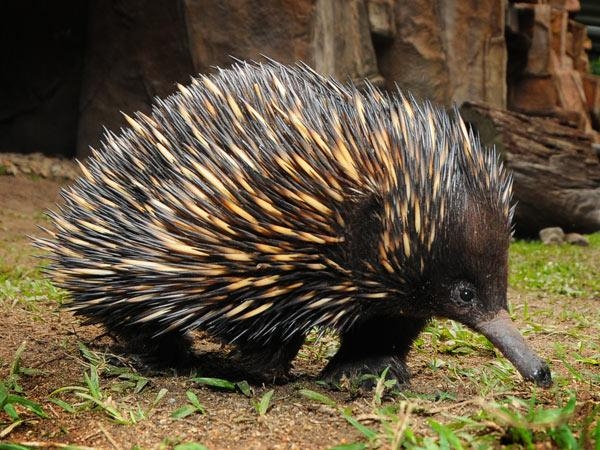
‘Dame’ here is a male short beak echidna that lives in Australia zoo and is much-loved by all the zoo keepers. Photo: Australia Zoo
Judging from what I saw and the image Chris and Flynn took, this spiny visitor was a short-beak echidna (Tachyglossus aculeatus). It is also known as the spiny anteater. There are five sub-species of this echidna in Australia. The Echidna generally is a highly adaptable creature and can be found in coastal forests, alpine meadows and interior deserts of Australia. They weigh up to 6 kilogrammes and can grow up to 45 centimetres. Read more here
After all this time, this spiny ‘visit’ finally solves the mystery of the half-moon shape hollows dug into the base of plants in my garden. The markings would have been made when it was looking for ants, baby roots and worms to eat. I have been blaming my chickens and the bush turkeys for these markings.
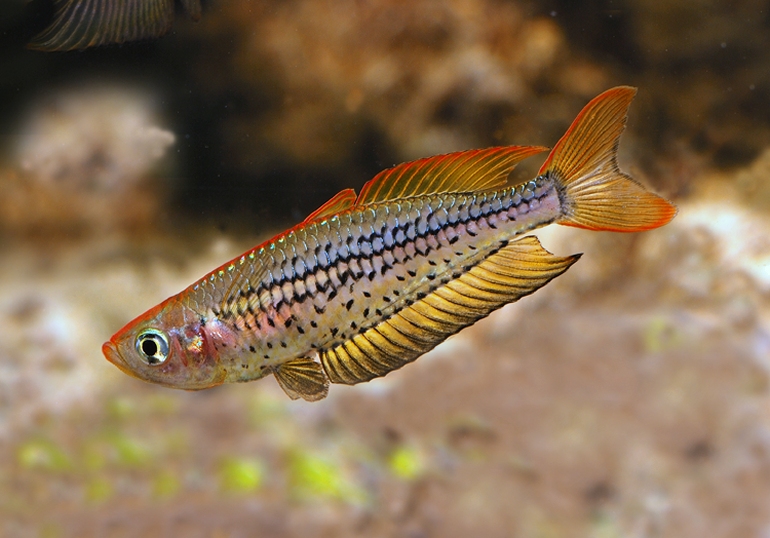
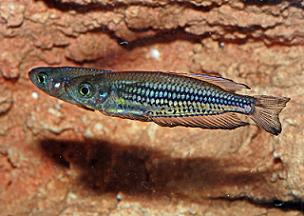
The ornate rainbow fish (Rhadinocentrus ornatus) is a small and beautifully coloured freshwater fish. You don’t often spot them straight away in dark creek ways because their colours show when the light catches their scales. Few populations of these fish are scattered in freshwater creeks in parts of Brisbane where I live, and some creek systems in Queensland’s Redlands, Moreton Bay and Byfield regions.
Ornate rainbowfish (R.ornatus) Castaways Creek Photo Leo O’Reilly/ANGFA
The ornate rainbow fish, also known as soft-spine sun-fish can also be found in Nambucca, New South Wales. Four distinct populations have been found in the areas between Queensland and New South Wales.
The numbers of the ornate rainbow fish have decreased rapidly due to human impact. Urban and rural development have caused experts to fear that certain species of the fish have already been lost forever. Every creek in the parts of Australia where the fish is found, has its own unique population which varies in colour and scientists believe they could also be genetically exclusive. The ornate rainbow fish on average grows five to six centimetres long. They can grow up to 8cm long.
“The sad tale is that every time we lose a population of ornate rainbow fish from a creek system we are effectively losing a very unique group of fish forever”, Wildlife Queensland.
Wildlife Queensland has issued a fact-sheet for voluntary information on spotting of the ornate rainbow fish. They hope this data collection would determine where the fish are still found and how many types are left. The information would also assist Wildlife Queensland to educate the public and minimise threats to the fish life.
According to the Chivoko people, anything and everything you need comes from the forest and the sea. Food, building materials, things they could wear, are all provided by Mother Nature. If Mother Nature was destroyed, that would be the end of life. This is a story about a community coming together to make a conservation effort to protect their land, sea, environment, and their heritage for their further generation. What is great about this short film is that the future generation are taking action and are part of this effort.
Written and filmed by the storytellers themselves from Chivoko Village, Northwest Choiseul, the Solomons Islands. Choiseul Province is the northernmost island in the Solomon Islands double chain archipelago and lies approximately 45 kilometres southeast of Bougainville, Papua New Guinea.
It is not often that you find musicians using nature to aid in their musical performances. In the Melanesian culture, a rare tradition passed down from generation to generation of women still lives on. Lakes, rivers or the sea water is used as a percussion in this tradition, to provide the music with singing. In recent years, this beautiful tradition has been shared with the world through international tours and festival performances. The performers of the Vanuatu Women’s Water Music group (two pictured) hail from the remote northern tropical islands of Vanuatu. They travel the world performing the Na Mag and Ne Lang dances as a prelude to the mystical water music, dressed in their traditional costumes of Gaua and Mere Lava made from flowers and leaves, coconuts and pandanus. Their performance is truly mesmerizing as they reimagine the old with contemporary expressions of Matto – bringing together traditional beats and rhythms with ukulele-led melodies and soaring vocal harmonies.
“And in an age when most bands are dominated by just a handful of instruments — drums, bass and guitar — I encounter a new way of making music every year at the RWMF. In 2011, women from a village in Vanuatu turned the lake of the cultural village into their instrument, cupping their hands under the water to make booming percussion sounds”, wrote Michael Switow when reviewing the women’s performance at the Rainforest World Music Festival.
“Life is easy” says Jon Jandai. “Why do we have to make it so difficult?”
After pursuing “success” in Bangkok for several years, Jon dropped out of university to return to village life. There, he went back to the life he knew as a child, working two months of the year to grow rice (with an additional 15 minutes a day to grow vegetables), dug a couple of fish ponds, built his own homes using earthen bricks, and gave up buying clothes (he has so many clothes from friends and visitors that he has to give them away). Jo contends that to be happy, we cannot just rely on money; we have to reconnect with each other.
“Before I thought that stupid people like me … cannot have a house… because people who are cleverer than me and get a job need to work for 30 years to have a house. But for me, who cannot finish university, how can I have a house. It’s hopeless for people who have low education like me. But when I start to do earthen buildings, it’s so easy! I spent two hours per day… and in 3 months I have a house. A friend who was the most clever in the class he has a house too but he has to be in debt for 30 years, so compared to him I have 29 years and 10 months of free time. I feel life is so easy.”
Jon runs Pun Pun an organic farm, seed-saving operation, and sustainable living and learning center. At Pun Pun they use ancient natural building techniques with readily available, local, natural materials with little embodied energy and salvaged materials to make homes, a practical and affordable alternative to resource intensive conventional building.
The Australia Day will be next Monday, January 26, and I would like share a few Australians that have extraordinary stories and make me and the country proud. There many Australians I am proud of. It would even be impossible to fit them all into my blog in the 1000 posts I had promised in September. However, given the limited time between now and the actual day, I will share only a few stories. I would like to start with someone my sons and I admire for his musical talent, his love for his culture and nature. It is a little like me, except, my musical talent appears when there is no audience and I have had a few wines.
On a serious note, please ask Abung (Google) to help find Xavier Rudd and listen to many of his beautiful songs. I am sure many of you will know him. He is a one-man band and plays most of the instruments himself. His life as a nature activist makes me particularly proud and this is his story from The Nature Conservancy
Xavier Rudd
Hometown: Bells Beach, Australia
Day Gig: Environmental Activist, Surfer
Night Gig: Internationally Acclaimed Singer Songwriter and Didgeredoo Master
Environmental Concern: Oceans
Singer-songwriter, musician, activist and surfer Xavier Rudd is considered to be an iconic voice in Australian music. Using a range of instruments, including guitars, yidakis (also known as didgeridoos), stomp box and percussion, Rudd has become known for marrying uplifting music with thought-provoking lyrics.
Since his first studio album, To Let, debuted in 2002, Rudd has earned a reputation as a strong mult-instrumentalist who writes, sings and plays from the heart. Solace, his second album, was recorded in Vancouver with friend and producer Todd Simko. It debuted in 2004 in the top 20 of the ARIA charts and three of its songs were voted into triple j’s annual Hottest 100. It was followed with the ARIA-nominated albums, Food In The Belly and White Moth. In 2008, the gritty, dark and dynamic Dark Shades Of Blue redefined Rudd as a lapsteel player and lyricist. His sixth album, Koonyum Sun, was recorded as “Xavier Rudd And Izintaba,” and featured a collaboration with bassist Tio Moloantoa and percussionist Andile Nqubezelo.
In 2012, Rudd released Spirit Bird. His seventh studio-recorded album, Spirit Bird debuted at #2 on the ARIA album chart, and has earned critical acclaim as well as a 2012 Australian Independent Record Labels Association Awards nomination for Best Independent Blues And Roots Album.
As a review in the Seattle Post Intelligencer notes: “over the course of his career [Rudd] has evolved from being the accompaniment for surfers and late night beach parties (not only were some of his songs featured in the movie Surfer Dude, he wrote parts of the movie’s score) with an environmental conscience to singing about having a spiritual bond with the planet and the compassion required to create it… he gives us his vision of the potential for a better world.”
While suffering in the heat in Brisbane, Australia, the past 48 hours, I have been re-thinking the whole debate about climate change and how little is being done by our leaders. It seems to me that many of us are just happy in our little pockets of the world, as long as we feel comfortable and climate change issues do not affect us. Scientists are telling us in more studies that things are getting serious. We are seeing more physical destructions such as violent storms, long periods of drought, very high temperatures, all happening right before our eyes. Reuters reported climate migration numbers are increasing at an alarming rate across Asia and India. In the Pacific Islands, people from small, low-lying islands low-lying countries are also migrating. So, in the big picture, we know MORE about our own destructions to this planet than we have ever before. The media even reminds us what we are doing, daily. Why are we not reacting?
2014 was the hottest year ever recorded. These figures finally challenged the climate skeptics. Is that alone, not scary enough? Does it not mean anything to us? Do we care and as humans, does it matter that we only have ONE planet to live on? I wanted to pick up this topic again and share this Guardian article about how we have accelerated the rate of our destruction to our planet. Please read and share the link below.
Humans are ‘eating away at our own life support systems’ at a rate unseen in the past 10,000 years, two new research papers say.
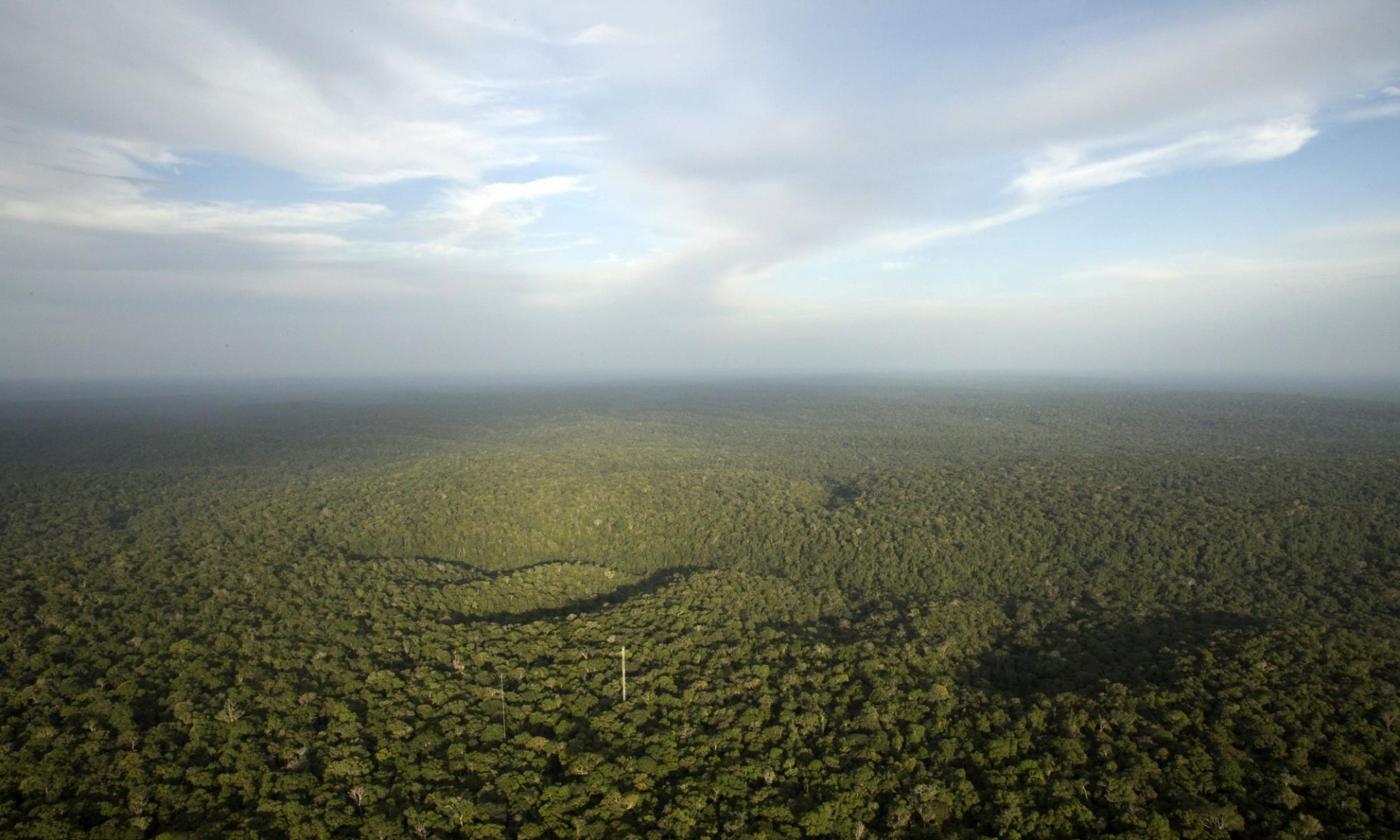
The view from the Amazon Tall Tower Observatory in the middle of the Amazon forest. Researchers say that of the nine processes needed to sustain life on Earth, four have exceeded “safe” levels. Photograph: Reuters
Humans are “eating away at our own life support systems” at a rate unseen in the past 10,000 years by degrading land and freshwater systems, emitting greenhouse gases and releasing vast amounts of agricultural chemicals into the environment, new research has found.
Two major new studies by an international team of researchers have pinpointed the key factors that ensure a livable planet for humans, with stark results.
Of nine worldwide processes that underpin life on Earth, four have exceeded “safe” levels – human-driven climate change, loss of biosphere integrity, land system change and the high level of phosphorus and nitrogen flowing into the oceans due to fertiliser use.
View of aluminium-polluted water, which flows into the Yuanjiang River, in Taoyuan county, Changde city, central China’s Hunan province, 19 November 2014. Photograph: Imaginechina/Corbis
Researchers spent five years identifying these core components of a planet suitable for human life, using the long-term average state of each measure to provide a baseline for the analysis.
They found that the changes of the last 60 years are unprecedented in the previous 10,000 years, a period in which the world has had a relatively stable climate and human civilisation has advanced significantly.
Carbon dioxide levels, at 395.5 parts per million, are at historic highs, while loss of biosphere integrity is resulting in species becoming extinct at a rate more than 100 times faster than the previous norm.
The Zhangye Danxia is located in the Gansu Province of China. I found these mountains absolutely stunning! Red sandstone and various other mineral deposits ‘paint’ these spectacular series of coloured landscapes, depending on light, and which angle you look from. Watching the video is like watching a series of landscape paintings. Tourist board walks and trails have been built over the land formation, making it easier for visitors to see it up close. The colours of these surreal mountains have been referred to as the Paint Palate of God.
The mountains and surrounding areas covered with red sandstone and conglomerate has intrigued geologists for many years. Six of the Danxia landform sites have been inscribed as part of the World Heritage sites.
Picture by Brian Cassey showing boys fishing in the islands, Manus.
When the Australian government announced it would make Manus Island, Papua New Guinea, as its third island prison for asylum seekers, I was appalled. I had always been on the side of refugees and issues concerning their safety. However, for using this peaceful small group of islands as a prison was something I felt strongly about. The Regional Resettlement Arrangement (RRA) goes further than the Pacific Solution introduced by Julia Gillard in August 2012. It was referred to as the PNG Solution. Mid 2013, Australia announced it will no longer process any refugees arriving by boat.
For me, the Manus decision not only showed a rich and powerful country bailing out of its problems, but using, and forcing a weaker and poorer nation to take on these problems. The decision was against human rights at many levels. I also felt that PNG was still being treated as an Australian state and the PNG government seemed to be too eager and voice-less somewhat, in allowing the asylum seeker policy decision to proceed. The other reason for voicing my concern was that the Manus people were never consulted over accepting the refugees on their land. Given they are tribal people, I was surprised that PNG government had not thoroughly considered this, nor chosen another land, perhaps somewhere on the mainland location for the detention centre. That remains a puzzle – why did PNG government choose Manus? Land is the most important asset in the Melanesian culture. For generations, lives were lost in PNG constantly over land disputes. Further to these concerns, bringing into and pre-settling the refugees would not only have long-term effects on land ownership but it disrupt the Manusians cultural dynamics. I do not mean this in a racist way. Melanesians kill each other over land, regardless of who they are. I believe that Australia is rich enough and has enough place to facilitate genuine refugees seeking asylum.
I had joined demonstrators in Brisbane City. Hundreds of people from all over the world took to Brisbane’s main George street to show their anger and frustrations at the Australian government’s treatment of the refugees and that decision to use Manus as the next prison. As time passed, it seemed that no-one paid any attention to the nation-wide public outcry nor the media reports in both countries. The Australian government’s asylum seeker policy was enforced, with the first group of refugees being moved to Manus Island soon after.
Picture: Wikipedia – The Manus detention centre.
Things have not been going as planned in Manus. Within the confinements, refugees have suffered appalling conditions. Recent media reports showed clashes between refugees and PNG securities resulting in death and now, the latest claims are that the islanders will not accept the refugees to be re-settled in Manus and PNG. Settling into a foreign land is an issue world-wide and there are reasons for people becoming refugees, however, in my opinion, governments have to take more and careful considerations of parties involved, as in the case of Manus Island detention centre. Politicians cannot just sign-off on policies without consultation with the people; the costs are always high for those decisions they make. This part of the post is merely my opinion.
I found two related stories about the Manus asylum-seeker decision which I wish to share. The two articles give different perspectives to this story. There are not too many articles on the views of the Manus people. The Oral history of Manus and the migration of its original people could be another story. The second article shown on a link below was published in the Australian Museum blog a year ago. This story offers a history of the origins of Manus.
Here is the first story. The other is on the link at the end of the post.
A Vlad Sokhin photograph
By Jo Chandler and photographs by Vlad Sokhin on Manus Island
The 60,000 people of Manus province, a remote island outpost of Papua New Guinea, had no say in the decision by Australian and local leaders to detain, process and at least temporarily resettle foreign asylum seekers on their shores.
“We heard about it on the radio,” says Nahau Rooney, a pioneering political leader, former PNG justice minister and Manus’ most famous daughter.
In the 14 months since Australia’s “PNG solution” was brokered, sending asylum seekers trying to reach Australia by boat to Manus for processing and eventual resettlement in PNG, the operation has also sent a tsunami of change crashing through every dimension of island life.
It has delivered a booming economy, jobs and desperately needed services. It has also brought social and environmental damage, deaths, dislocation, disputes and deep anxiety about what will come next. What is certain is that life in Manus will never be the same.
Any day now the first 10 recognised refugees are expected to move out of detention and into the $137m village Australia has built for them in Lorengau, the provincial capital. More refugees are expected to follow each week. Here they will live freely, but many are deeply anxious about how they will be received and fear for their lives.
Manusians are famously welcoming, but some are resentful about the uninvited arrival of these new neighbours; some are nervous and have little information to quell their concerns; and many worry about the strain they will place on the island’s limited jobs and services.
This exclusive investigation for Guardian Australia explores from the ground the consequences, good and ill, of Australia’s asylum seeker policy on the land, sea and people of Manus.






 Tribalmystic Stories