Published on Nov 20, 2014
George Marshall, writer and co-founder of the Climate Outreach Information Network talked about why our brains are wired to ignore environmental threats at TEDxWWF. Brussels, 13 October 2014.Climate Campaign
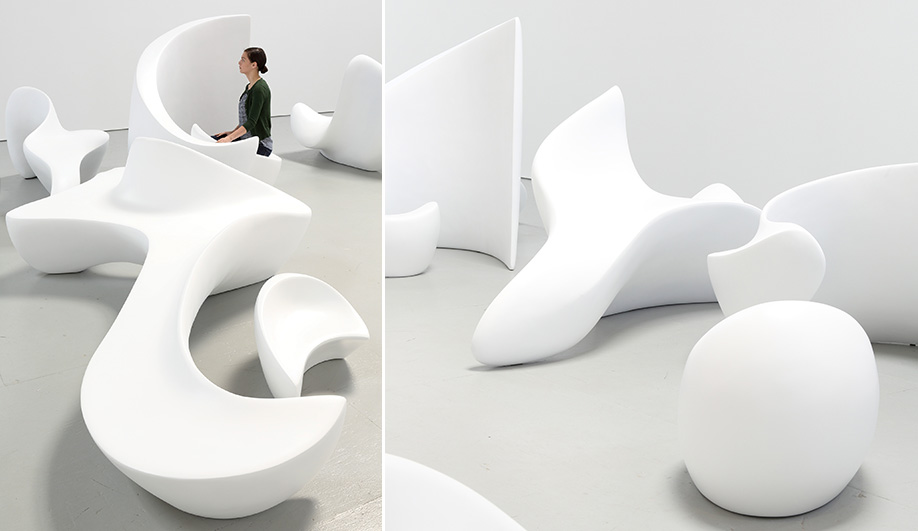
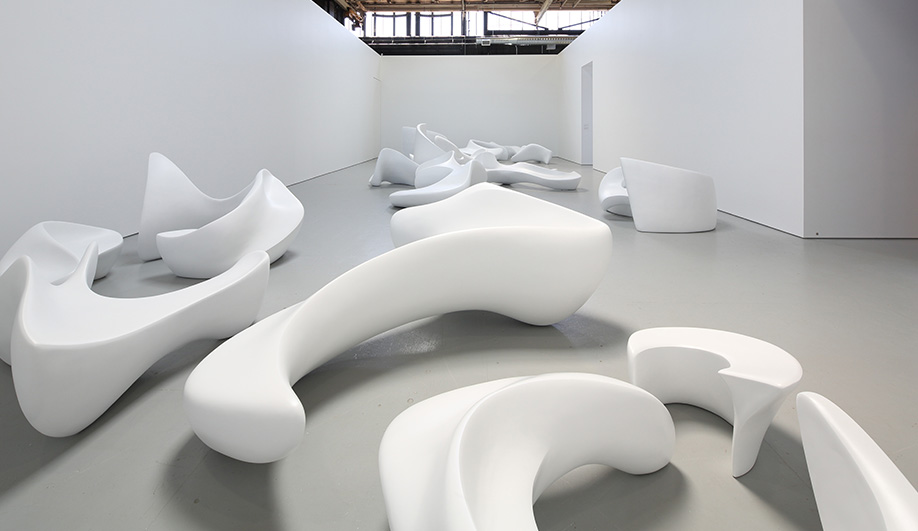
Made of ultra-dense Styrofoam coated with polyethylene, the furniture-like sculptures are three-dimensional renditions of Arabic script.
My Cool Stuff feature for this week are these 3D sculptures by Marie Khouri. I fell in love with these lounges, a design truly created for dialogue. The beautiful pieces are on a touring exhibition. Look at them, aren’t they exquisite? What a clever design!
The sensual shapes in Marie Khouri’s installation, recently on view at Vancouver’s Equinox Gallery, spell out “Let’s Sit and Talk” in Arabic.
Design speaks to us on the most visceral level, but few can render its language as literally as Vancouver-based artist Marie Khouri. Her latest installation, Let’s Sit and Talk, exhorts us, in word and form, to connect with one another. Each of the 15 pieces is a sculpture you can sit on.
Together, they spell out the exhibition’s title, sculpted in beautiful cursive Arabic script. The quintilingual Khouri, born in Egypt, raised in Lebanon and trained in Paris, has made a career of conflating art with function: through her design studio, she also makes and sells jewellery, wine racks, benches, chaises longues and planters – all of which double as discrete sculptures.
This article was re-blogged from Malum Nalu Blog. Malum Nalu is the most read blogger, journalist from Papua New Guinea. He also happens to be my cousin. Thank you bro for sharing this article from Geoffrey Luck.
I was ten-years-old when Papua New Guinea received Independence from Australia. I remember that day and what we had to do in school. As a Papua New Guinean and a child at that time, I never understood what the change in my country meant; I guess I was too young to understand. However, over the years, I noticed how things have changed.
· GEOFFREY LUCK
· THE AUSTRALIAN
· NOVEMBER 04, 2014
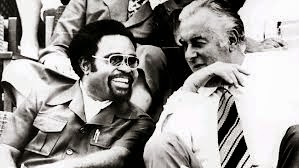
Gough Whitlam and a young Michael Somare at Independence celebrations. Credit: Whitlam Institute.
In all the words written about Gough Whitlam, little has been said of one of his greatest ideological and opportunistic initiatives, one of which he was inordinately proud, yet inevitably became one of his many disasters. We know it as the failed state of Papua New Guinea.
Gough Whitlam and a young Michael Somare at Independence celebrations. Credit: Whitlam Institute.
In the 1960s Whitlam used PNG as a lever to advance his ambitions in the Labor Party. His regular visits culminated in his 1970 tours of the territory inciting radicalism and disparaging the efforts of government, business and settlers in his crusade against what he termed Australian colonialism.
Whitlam has been seen as a visionary, but in reality he was a fashionista, shrewdly sensitive to ideas already current in the wider world to which he could sincerely subscribe and could appropriate.
So it was with anti-colonialism, the grand international theme of the 60s. It swelled to the nationalistic drumbeat as former colonies gained independence, then blossomed as their petty tyrants took triumphant control of the UN organs of moralistic reform.
In the first few years of that decade, 30 former colonies of France, Britain, Belgium and Italy secured independence, some after bitter and protracted bloody struggles.
The steady Australian policy of uniform development of PNG was contrasted to the frantic Dutch efforts to produce a political elite in West New Guinea, as Indonesia sprinkled paratroopers into the swamps of Manokwari.
Hugh Foot, the British colonial administrator who lowered the Union Jack around the world, became Britain’s ambassador to the Trusteeship Council in 1961, gamekeeper turned poacher. The next year he led the UN visiting mission that critiqued Australia’s management of PNG, demanding a local parliament.
In response to these growing pressures, a House of Assembly of 100 members was elected from a common electoral roll in 1964, but the Trusteeship Council and the UN Special Committee on Decolonisation increasingly demanded independence. It was a campaign Whitlam wholeheartedly endorsed, oblivious to the realities of PNG or the wishes of the great majority of the native population.
ALP policy under Arthur Calwell supported the Menzies government policy of uniform development. Calwell visited New Guinea regularly and was well-informed on territory affairs. Whitlam set out to destroy the bipartisan approach to PNG development. It fitted conveniently with his efforts to reform the party and replace Calwell as leader.
Paul Hasluck, minister for territories and author of the gradualist policy of development, told parliament in April 1961 that Whitlam was using New Guinea as “just another rung on a borrowed ladder” for his climb to leadership.
In 1965, Whitlam told a World Bank seminar in Goroka that “the world will think it anomalous if Papua New Guinea is not independent by 1970”.
A few days later he went much further, in a dinner speech to the 400 most influential Australians in Port Moresby. That speech has never been reported because he pulled one of his most reprehensible stunts.
Before he spoke, he called for any journalists in the room to stand up, then asked the four of us to undertake not to report what he was about to say — “otherwise I will not be saying it”, he said. What he went on to say shocked everyone in the room.
Only deputy leader and speaking against Labor policy, he warned that as soon as Labor came to power it would announce full self-government for PNG, and immediately set the constitutional wheels in motion to grant independence.
Whitlam hoped to unnerve Territorians, but not let his party or Australia know. To this day I have been ashamed I didn’t break that undertaking, extorted under such disgraceful circumstances.
By 1967 Whitlam was leader, but he narrowly lost the 1969 election. In his notorious tour of PNG in 1969-70, he courted small radical elements such as Pangu Pati while ignoring government officers, and insulting conservative native leaders as “Uncle Toms” and their massed supporters as stooges of Australian colonialism.
The tour climaxed in Rabaul where Whitlam blundered into a land and local government dispute. At a mass gathering of more than 10,000 wildly cheering Tolais at Queen Elizabeth Park, what he said, further exaggerated by deliberate mistranslation, was interpreted as support for their rebellion and a promise of independence. Senior administration officers were furious that he had allowed himself to be used.
Six months later prime minister John Gorton faced a similar crowd at the same site, but this time raging in fury against Australian government policies. The situation became so threatening the district commissioner slipped Gorton a pistol. In the event, the tension evaporated when the sound system failed.
PNG achieved self-government in 1973 and independence in 1975. It was all too early, with too little done. The pressures had come from outside, but Whitlam forced the pace by encouraging and magnifying the ambitions of unrepresentative elites.
In his book The Whitlam Government, he wrote: “If history were to obliterate the whole of my public career, save my contribution to the independence of a democratic PNG, I should rest content.”
Last month, a Papua New Guinean writer, Mathias Kin, marked Whitlam’s contribution to his country’s independence with this bitter comment: “It lasted only 15 years before self-interest and corruption grabbed it by the throat.” Geoffrey Luck was the ABC’s news editor, PNG, from 1962 to 1967 and trained the first Papuan and New Guinean journalists
The day was hot, thick and sticky with humidity. School was over yesterday. I was nearly nine. My mind was lost. Mother was going away. I had no idea when and for how long. She had a new job in Kundiawa, Simbu Province, Papua New Guinea.
It was so hot. I was dying to have a swim. Already, the children in the village were swimming in the river near our house. I looked down and saw them. Then my eyes caught the broom on the ground. I knew I had to get down there and sweep.
Mother trained women to sew clothes and make a living. She loved her job with the Lutheran Mission at Ampo (Lae), but now the government welfare office gave her a real job, she had said. Werner Knoll offered her this job. Werner was a German kiap who became a welfare manager and headed the office in Lae. He had told me he was my guardian. I knew being a guardian meant, he was not my father, but something like an angel. I heard that word “guardian” used in our church. I also saw it in grandma’s bible.
I went to our room to get my red towel and walked back to the kitchen. I stood there and looked at the children. They were jumping off a platform we built on a tree, and landing in the river with a bombing sound. The water splashed everywhere. I was jealous. I looked at them but my mind went back to my mother. May be Werner could not pay us any more. Maybe, he ran out of money.
Mother and I visited Werner each month to collect money. Mother said we collected $AU20. When we arrived at the Welfare, Werner would beckon me with his pointer. He then lifted me onto his lap and pinched my cheeks. Then he pecked me on both the cheeks with his beard scratching me roughly. He had a large pink mole on his cheek. Then, he would order me to open my mouth so he would check my teeth for betel nut stains. I was terrified but I did as I was told. Mother and all the women in the welfare thought it was funny and laughed. After, Werner would tell me to promise to be a good girl. He would warn me not to chew betel nut and wink at my mother as he handed her a pink slip to go with to the bank. This ritual started when I was able to walk and speak.
I was to find out much later, this money came from my father whom I had never seen nor heard about. No one told me the money was from my father then, so I never knew. I had always thought Werner was related to me somehow and it was Werner’s money that he gave us. He was being kind. Mother had to bring me every time she visited Werner to get this money. I thought the whole ritual with Werner was part of the reason for getting the money. It was Werner’s rule.
“I will make a lot of money in this job”, Mother had said last night.
“Yamandu?” Really? I said, not convinced.
Mother promised me with such excitement in her eyes, I started to wonder what we would do with a pile of money. I did not think it was ever possible for us to have money except for Werner’s $20. Grandma said too much money was evil. Not many people made money, unless you had a bank; that’s what the village children said.
Mother’s job sounded ok. We could share the money with everyone. However, I was also concerned it would be too cold for Mother in Simbu. She needed to keep warm. She was smart, she could make fire in the evenings, I thought. I could not imagine how we would be apart. Deep inside, I had too many questions and felt uneasy about this job as I embarked on my own jobs for Saturday morning. I decided not to think about Mother. I went and started my chores.
“Kalem! Kalem!” the children were calling me from the river. I could see them from our house. I waved and made hand signs that I was busy, and would join them later.
To get my chores done I started with the coconut broom. I picked up the bundle of dried brown coconut sticks. They were held firmly at the thick end with re-cycled black rubber from tyre tube. I started sweeping from the back of the big house. My chores had increased with my age. Each day the chores changed, but most of the tasks were the same. We shared the chores between all the women in my family. The boys and men shared theirs. My chores were cleaning, washing, cooking, and helping Mother. Sometimes I helped my grandmother and aunties. If not fishing, the girls and women would be gardening together or making art and singing. On special occasions we would prepare our costumes and dance. The evenings were for story telling, and laughter after the church service. There was an occasional women gathering or village meeting. On Sundays we went to church and cooked a feast after. If someone died, we all gathered and cried together for at least two days before we buried them in our village cemetery. As we carried the dead to the cemetery, we sang in Yabem:
“Where is the mouth of the road?
At the entrance of the cemetery.
That’s where my body will rest and become soft.
But my spirit would fly to you,
Where I will see your face Lord”
………………………………
(Draft only, and to be continued in my memoir series).
Blogging is isolated and lonely. I am not writing in a newsroom where I can see writers and editors bustling in a typical newsroom I knew. In a newsroom, I could discuss my story with an editor or another fellow writer, or work with a photographer. In this blogger-world sometimes I feel, I am alone. I am reaching out to someone, somewhere, whom my story may appeal to. My story is like fresh bait on a hook, dropped in the middle of the deep, dark ocean. I want the right fish to bite the hook, not any fish. So, the ‘bait’ has to be right. But how do I know if the bait is right? As writers, we don’t. Well I don’t, not 100 per cent anyway. Unless, we get feedback, research data and see some kind of recognition, we really don’t know if what we write is appreciated.
When my site-visit numbers were increasing recently, there were very few comments and ‘likes’ on each post. I have to admit, I felt doubt. I wondered why I would have many people visit my blog each day, and not interact. I would visit the few writers that “liked’ my post and be astounded by how many followers and hits they have had. I searched through their contents. What makes this blog great?, I asked myself. Some blogs were interesting and it made sense as to why they would have such an audience. Others did not make sense at all – they were just popular. Like everything else, it really does not matter what you write and how you write it. That ‘bait’ will catch the reader that was meant for it. You have to catch your own niche market. I learnt, and told myself only to worry about my next story.
In the background, I did do some content research, adjusted my theme, and the layout. I took a course on content and UX with Open University and shortened my posts. (This post will not be one of those short ones). I kept on writing; refusing to use popular social networks to get my readers – or lure people who knew me. I covered most topics I loved and cared about. The risk was, that I could lose readers because of the varied topics. I borrowed some hints from Opinionated Man. Jason could scratch himself and blog it to get 400 “likes”. He was always true to himself. I enjoyed his narrative posts the most. I kept writing about the things I loved or believed in. It is real. So, my readership doubled in a month. And, somewhere in that increased number, someone connected with my content. My bait was taken.
I won’t call her the right bait but a friend.
On November 2, a stranger appeared on my blog. She was wearing a China-red dress/top, armed with a natural straw hat with a black band that mysteriously and securely hid her face. I saw this picture after I received the first message from WordPress. It said: “millithom liked your post”. I have had other “likes’ before so I paid no notice. I thought I would follow-up and view each respond when I had time in the evening. Then there was another ‘like” and another, by the same person. I immediately visited millithom’s blog and was very impressed with what she wrote. I learnt a lot from her. As an aspiring author myself, I was impressed with her book posts on writing in general and helpful advise on publishing. I was really grateful that she could relate to my post and COMMENT! On that same day, after the fourth “like”, millithom was hooked, I think. I say that with no malice. I got a notification that she started “following” me. It was the kind of ‘stalking’ that every blogger loves. The baited hook was taken by that fish. Each day since, this woman I have never seen her face except in an old photo, warmly responds to all my posts. She also writes very encouraging and heart-felt comments. For me and any writer or any blogger who is starting and ‘afraid’, we all need a millithom to put that hope into our doubting minds. I have mine. I also have L.T.Garvin, Poetheart! and Seafarrwide. There is a kind of sisterblog-hood going.
Thank you Millie Thom, blogger, author (Shadow of the Raven), with a gorgeous heart for nominating me for this award. It means a lot to me. I will continue to strive to keep the content of Tribalmystic blog interesting. Thank you Millie, my followers, and returned readers and I would appreciate any feedback to improve this blog. I also appreciate the quiet ones. Your silence and presence are both appreciated and acknowledged.
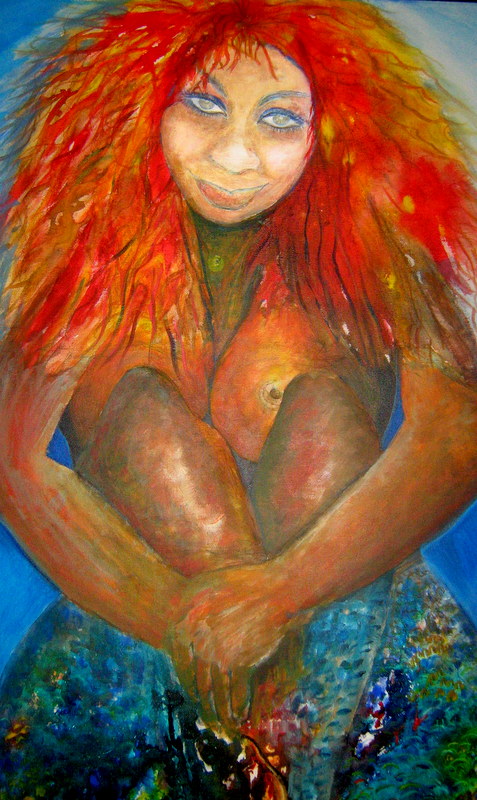
Self-portrait. JLeahy, Acrylics & Inks on canvas. 2012.
Seven Lovely Things…
As requested by the conditions of this award, I have to tell you seven “lovely” things about me. Ahhhumm.. (I asked my sons and my colleague today) and they made some comments I shall not repeat; so I have to do this task the best I can.
1. I am a queen of surprises. (I am that confident). Even after all these years, I can still surprise my sons in their ‘older age’, family members and friends. I love the intrigue. I love mysteries. I love how happy I make them.
When I was growing up, the children in my village used to call me a spirit. I was lighter skinned but had tanned from hours in the sun. I had straight hair which was blonde from swimming in the sea every day. All that time, I thought I was black. The children kept telling me, I was white. I think it is lovely to be both.
I easily make friends with strangers and people from all walks of life. I could connect and have a deep conversation with a stranger, that I had just met. It scares my children.
I love nature. The Ocean, forest, and all life forms. I believe that Earth is in danger. We should all be seriously concerned about what is happening in climate change and each make a commitment to do something about it.
I am who I am because I am the thread that runs in the fabric created by my mother, grandmother and my people.
I love stories – telling and hearing.
7. I make art from anything..but I love drawing with pencil and watercolours.
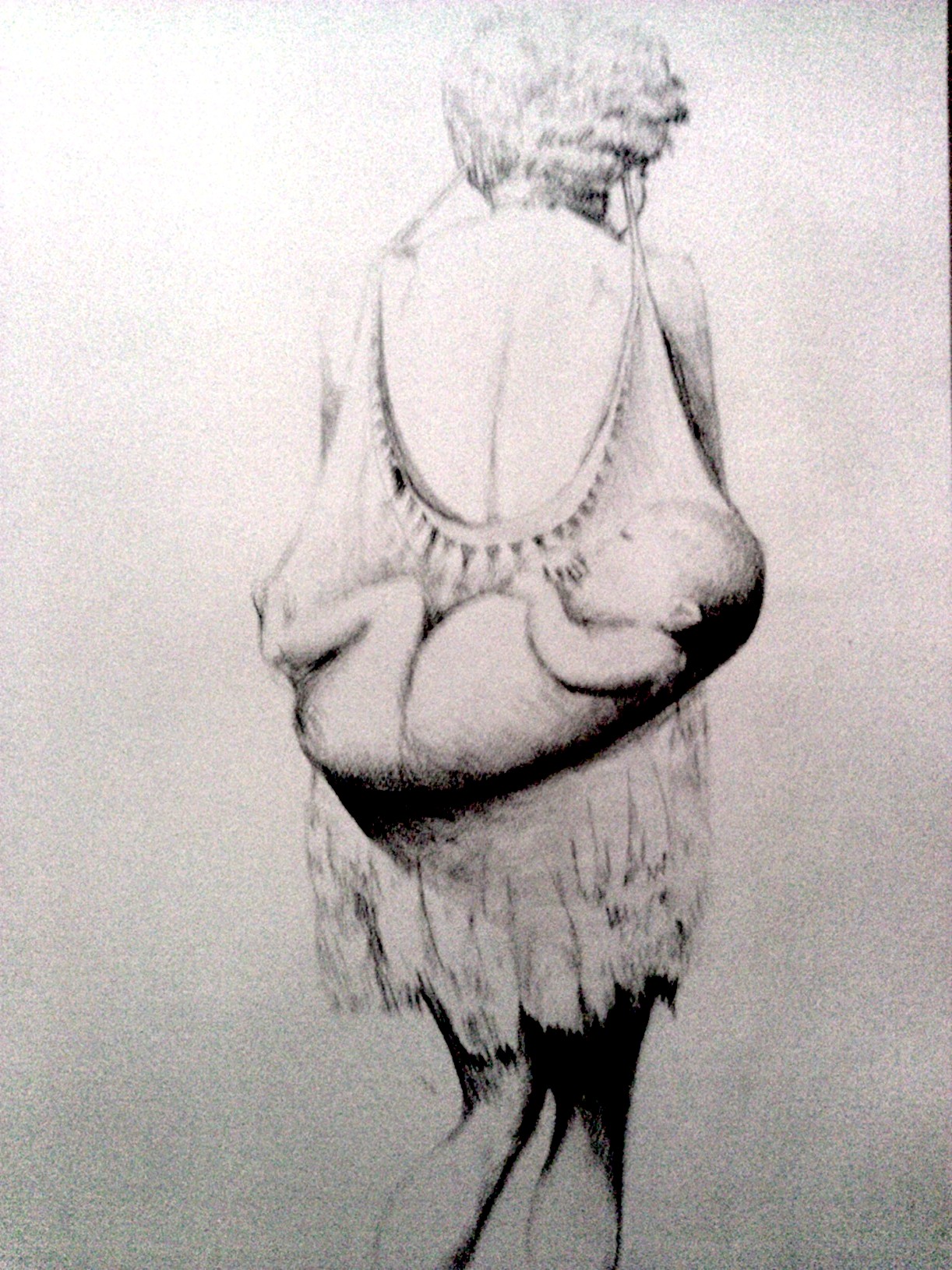
Pencil on paper. “Meri Karim Pikinini” JLeahy. 2014
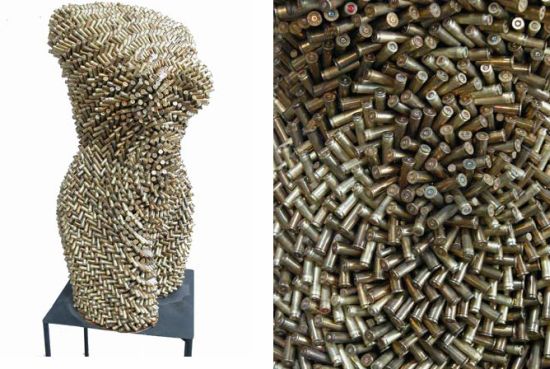
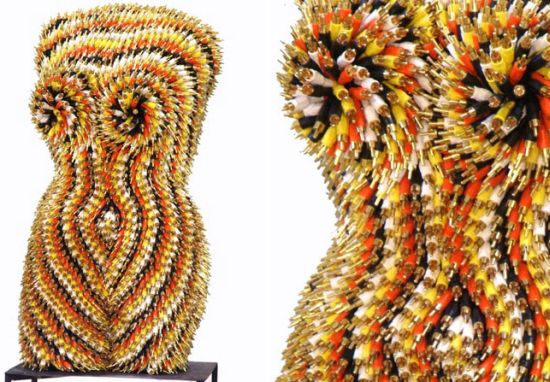
This collection of Columbian artist Federico Uribe’s work may be classified more as a “hot stuff” as well as a cool one. Federico is one of my favourite artists in the world. He is known for his great paintings and other art forms but I chose this collection for “Cool Stuff”. How exquisite is this collection, giving life back into discarded day to day materials?
Federico Uribe
Crafting human form in recycled objects defines Federico’s salvaging act of rediscovering use in things abandoned. Uribe randomly selects material raging from keyboards, coins, locks, dominoes, padlocks, paperclips, plastic fruits etc to transform them into beautifully shaped female torsos with enticing sensual presence.
Art in recycling
The magical pieces of art imbued with great aesthetics assert usefulness in objects discarded. His creative assemblage affirms recycling to save our environment by realizing useful permanence in what had had been sidestepped as throw away.
That was the question of our discussion in creative writing workshop tonight. My friend Bill Heather is an architect. He is also a writer in my creative writing workshop group. The group is tutored by Isabel D’Avila Winter, a published author. Pamela Jeffs, another writer-friend suggested that I should blog this discussion and my own response, to help writers who are planning to write autobiographies and memoirs or fiction based on real life stories. I begin with Bill’s email to me and others in our group.
Bill Heather: Hello all you aspiring and proven writers,
Is there a limit to what you can mine from your own life experiences for a story?
Are authors of autobiographical fiction or memoir at risk of alienating their family and friends in their search for that elusive storyline?
Is ruthlessness in search of your best fiction a necessary attribute of a writer?
Would you publish a story if it could destroy the marriage of your closest friend?
There are good questions to ponder as we head towards the end of another year, and ones which are addressed in the attached article from the November 2014 issue of the Monthly. Link at the end of my response to Bill.
Omar Momani: Ferguson’s pen mightier than the sword
My Response to Bill: Dear Bill and friends,
Thank you Bill. I found the article very interesting and very true. The most safe writing would be fiction.
In my Memoir writing, I question everything I write. I know there will be a lot of ‘hurt’ of others as well as my own. I have created pain in many stories I read in our evening workshop. For example, if I had told my mother the old uncle rubbed my sore leg the ‘wrong way’ I think there would have been some serious charges or bloodshed in my family. The man is dead now but if I spoke about it now – what could happen? I don’t know. I also spoke to my mother and step brother about some stories I have written so far, and we discussed them. These stories were all painful…my stepbrother is my late step father’s son. But my step brother is my best friend – we are very close.
So my point is, as often as I do, I ask, should I just change my memoir to fiction and pretend it is not me or get my ‘freedom to express’ in fiction? Perhaps some stories could be written differently, safely..? Those and others are questions I ask myself all the time. 75% of what I have written, I don’t bring it to our workshop, I am scared to. Sometimes, I write the whole thing and then delete it.
Every now and then, I write fiction for the class exercises, because, this gives me the freedom to write freely without guilt, pain, horror and more. I totally lose myself in the ‘fake’ when I write fiction.
I deal with my writing the truth ‘problem’ this way; I write about me, the events, people and places and things that affect me. I write it all, then I decide what I can manage to live with, and I keep that story. I tell myself, ‘stop thinking about everyone else’. I just write ‘my’ story. I can always pull out what I think is too much at the end of the day. The final choice is mine, and I have to live with it.
Happy Birthday to my older son Nathan. We called him Nathan, as the biblical meaning, the gift from God. Today, Nathan turned 19. Our family celebrates Nathan for many things and one of them is reading and writing. Nathan loves story-telling.
Recently, Nathan started an adventure story on Facebook for all his friends’ birthdays. In this story, he weaves his friends (as characters) into the stories, based on the theme he chooses to fit that friend’s personality.
When his brother and I took him to lunch today to celebrate, Nathan mentioned in disappointment that none of his friends even wrote a paragraph about his birthday on Facebook. I laughed. I told him, it did not matter, and he must understand, his friends are not writers like he is. Writing may not be their thing, and his friends love him anyway.
I wanted to highlight a few things about Nathan.
He was born with a strawberry patch on his stomach which his father and I fought over because we thought one or the other accidentally hurt Nathan’s skin. (I thought he did it. He thought I did it). The mark appeared suddenly then disappeared as he grew older.
Nathan had a split tonsillitis and the paediatrician said Nathan would have difficulty speaking – that never happened.
Before he turned three, he wanted to go to school so badly I took Nathan to a friend’s school. On that first day, Nathan ran out of the car into the school without saying goodbye or a cuddle. I found myself crying in the car while watching my son run to his first class.
Nathan fell off our verandah (about three metres high) at five-years-old, and nearly cracked his skull. When he came to, on the way to the hospital, my then three-year-old apologised to me for falling. He survived the fall; got all clear and doctors thought it was amazing.
When he was seven, Nathan gave a speech about The Importance Of Family in front of 500 people in a United Nation’s gathering; not knowing, a few months later his father and I would separate.
At the same age, he corrected text books and his teachers said, it would be too hard to teach him as he got older.
We migrated from PNG to Australia in July 2004. Nathan exceeded all expectations, and represented the school in Mathematics and other problems-solving tournaments. He continued to excel in learning.
He is currently studying Bio-Med in University of Queensland.
A piece of writing from Nathan’s Facebook posts on his friend Jack’s birthday. (Fiction)
Jack fell out of bed, with all the grace of a bear emerging from hibernation. From memory, he’d set his alarm to 7, even though it was clearly closer to midday. Glancing around, he found his phone had its back cover removed and the battery thrown across the room. Smirking at his own genius aversion to early starts, he gathered the various contents and reassembled his mobile as he approached the kitchen. As Jack fearlessly prepared bacon for his morning sustenance, he realised too late how unwise it was to cook bacon before putting on more than underwear. He recoiled after being struck by a cruel splatter burn, and his phone came dislodged from his waistband. Upon retrieving it, he noticed he’d received a rather mysterious email.
The sender was a mysterious prince called Toban, from a foreign land. A royal in his homeland of Nigeria, Toban’s way of life was in grave danger. The prince requested urgent help, and pleaded to any whom it may concern to transfer the prince some money. These funds were to assist Toban to help Jack travel to his kingdom to combat ‘the thing’ that threatened his livelihood. Jack looked puzzled; he understood a great deal about being cautious, especially with respects to strangers on the internet. he heard about scammers. However, although the email was cryptic, and explained literally nothing, Jack thought, Toban seemed to be in genuine need. Jack righteously decided that $2000 was a small amount to pay to help a kindly stranger.
Naturally, literally everyone Jack mentioned this to were 100% convinced our hero had been repeatedly dropped as a child, but he remained strong. Days became weeks, and weeks became months. Even in the face of friends questioning how many vaccinations he had at the same time, or inquiring about his childhood consumption of lead paint chips (colloquially referred to as “Wall Candy”), Jack braved them all. These people did not know Toban like he did, the brief, one-sided, 53 word exchange had brought them together. Despite this, Jack’s hope was dwindling. He was close to broken before he finally received a positive sign, in the form of a one way ticket to Nigeria from Prince Toban. He boarded the flight.
“Mr Buffington, over here Mr Buffington!!” a stout black man called across the airport when Jack cleared customs.
Ignoring completely how this man knew what he looked like, because I checked and that would need about 150 more words, Jack and Prince Toban made their way home as Toban explained his current dilemma. Firstly, he vehemently refuted the label of “internet scammer”.
“Every dubious website and questionable email that passes the average person by is completely real”, Toban said.
Annually, he told Jack, the powers that be gathered two members of every faction of publicly labelled ‘Internet Scammer’ and forces them to fight to the death in a fierce battle royale, in order to keep them docile and to entertain the public.
Jack realised, Toban was the strongest of all the Nigerian princes, but his people had become weak and feeble. Due to shifting ideals, no one was sending them the money they needed to survive.
To Be Continued..(If I could get Nathan’s permission)
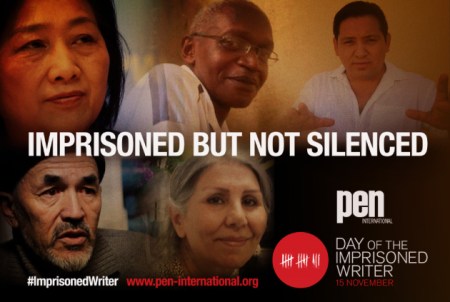
“Each year PEN Centres and members worldwide commemorate the Day of the Imprisoned Writer to raise awareness of the unjust imprisonment and other forms of attack against writers around the globe, to remember those who have been killed, and stand in solidarity with imprisoned and threatened colleagues. – See more here.”
“In order to demonstrate how freedom of expression is being curtailed, each year PEN’s Writers in Prison Committee highlight five cases of writers currently in prison or being prosecuted from around the world that are emblematic of the type of threats and attacks faced by writers and journalists.
“This year PEN is highlighting the cases of five writers from Cameroon, China, Iran, Kyrgyzstan, and Paraguayandcalls for their immediate and unconditional release and for the charges against them to be dropped, along with…
I love most art forms. To show and tell a story, I have often wondered if film and photography are the art form that truly capture the essence of a story. As a story-teller, I often ‘cheat’ by throwing in an image to complete the imagery ‘in’ my story. I see many bloggers use images this way, and it is great. As you are reading my stories, I want you to see and visualise the events, emotions, and actions with me. We are in the story together. Now, imagine if we did not have pictures; how could we, story-tellers, tell a story? I know how hard it is to describe a scene, simply. How many words and sentences do we need to describe every picture, and every scene we wish to create in our readers’ minds?
Between 1980-2000, in my news print days, I carried a Nikon FE2 with me in PNG. I must admit, I was in-love with this camera. It took two decades of pictures with me. These pictures hit front newspaper pages and glossed magazines. I entered and won competitions. I could not have been a true journalist without it. Being a photojournalist, assisted by FE2, we took stories to another level.
Sadly, I do not use this camera anymore. Apart from losing the mirrors inside the FE2’s body to some hungry mould, I paid over $AUD600 for repair, and never got the mould completely removed. The mould began feeding and grew again. I still have the FE2 with me because we have too many memories together. I cannot use it, and I cannot bare the thought of losing it.
These days, everything has moved to digital. Over the years, trying to save money for a new ‘real’ camera has not been successful. Family, mortgage and many other urgencies always top the priority list. Without a good camera, I often wonder how many great shots I have missed in so many years. I stare for hours at photographs and pin them on Pinterest and the net. I wonder how I could have taken these pictures differently; using light, better angle or simply, showing the object better. Fellow blogger/photographers, you know I am checking your pictures out, and I am looking at your pictures in awe and with some jealousy. This is envy that is not evil but respectful. A somewhat sad feeling about how much I have missed in my photography. I have long resigned to the fact that –that’s life!
Going Digital
In-coming tide on Tami Island, Lae, Morobe Province, PNG. Picture JLeahy. 2008
I still take pictures with the phone, and small digital cameras. A few years ago, I had a digital pocket sized Nikon I bought from a Cash Converters store. It accompanied me conveniently for its size. The FE2, and its lenses was sometimes hard to lug about. After doing some solid photographic work, the little camera’s bottom broke. There is a pin inside the battery cage which broke and the camera batteries would protrude out and lose power. So, I taped the bottom and kept using the camera. When a moment presented itself, the photographer would need to press harder on the tape to keep the batteries in and take the shot. Only I used it expertly. It was hard work instructing others to handle the little camera in her special needs. If less pressure was applied, the camera did not work. Sounds like a joke right? The camera worked most times and I was proud of it.
The Right Equipment
Anyway, the point I am making is that, when and if you have a great equipment for your work or even artwork – everything flows beautifully. Just imagine when you don’t and the moment presents itself. In 2008, I was on Tami Island, Papua New Guinea doing my field research into how climate change affected intangible cultures.
I travelled with my mother and my broken-bottom pocket Nikon. The bottom was taped and, we went to a place at least a few hours in up the coast, in a boat, so there was no such thing as batteries nor camera shops.
I took several photos with the bad-bottom camera, and one picture has become a favourite. I had to mention this picture because, it is not only I that thinks it a wonderful picture, but strangers have complimented the photo, hundreds of times. I posted this picture on About Me, on my Page and each day, I can get numerous compliments and comments about this picture.
The Story of This Picture
Morning light on Awaho flowers, Tami Island, Lae, PNG. Picture, JLeahy. 2008
In the days my mother and I stayed on Wanem Island, we would wake in the morning to crisp breezes, beautiful skies and chatters of seagulls and other birds flying by, searching for food. The village was a separated by trees and coconuts. The only sound was the soft waves, gently slapping the sandy beach. At least three metres in, from the water’s edge, the beach was lined with various soft and hardwood natives, and one we call the Awaho. This tree has many uses. Its timber is used for building, the leaves for cooking food in, and the bark for making clothing, as well as ropes. At the end of its life, the Awaho wood is a very good firewood.
Each morning, before we woke, the Awaho trees would start dropping their flowers on the hardened, cleaned sand, left by the receding low-tide. The flowers would be placed randomly but precisely, so it did not clutter. These droppings ravished the beach with these delicate burnt orange flowers with deep carmine centres. From each of the rich red-wine centre protruded a pale feathery, sticky pale stem with a red tip. Seeing the flowers on that beach for the first time, I thought someone had laid the flowers out. By the end of the day, before the flowers have completely wilted, the tide would come in, and sweep the flowers away before the shadows melted into darkness. If you swam at night, you would see the flower floating amongst the flotsam. In the morning, the white beach would be cleaned and ready. Once again, the Awaho’s bouquets would arrive, and scattered across the white sandy beach. The cycle began all over, a picture and a moment of Mother Nature’s artwork. I would have never captured this images without the broken-bottom pocket Nikon.









 Tribalmystic Stories