The story was told that when Kemampum heard strange sounds coming from nearby bushes on the edge of the water, he approached cautiously. He wondered whether it was an animal or a bird.
To his amazement, in a basket on top of a pandanus bush, he found an infant. Such was a case of the biblical story of Moses. He exclaimed: “ngamalac!” (which translated means ‘a human’).
Earlier that day, there was a battle between the Ahi and Labu people at the mouth of Bumbu River where the baby was found. In the late afternoon as Kemampum was trying to fetch sea water for cooking he found the baby. Due to fear, Kemampum was cautious in approaching the baby in the basket. The tide was rising and the child was about to drown, and there was no-one else there. Kemampum rescued the baby.
The next day, Kemampum took the child to known Ahi hamlets to seek the child’s parents, but no-one claimed the baby. Since no-one had claimed the baby, Kemampum kept and raised the child with his two biological daughters, Awelu Jalecsu and Geyamtausu Ngongwe.
The child was named Hamalac, which came from Kemampum’s initial exclamation when he discovered the baby on the water’s edge, near the Yam Hole.
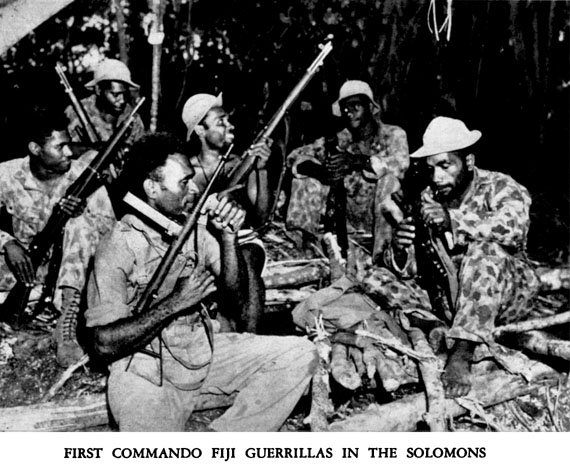
The first Fijian force to undertake service in the Solomons was a special party of 23 guerrillas, commanded by Capt. D.E. Williams, which was drawn from commando units formed as part of the New Zealand 3rd Division and retained in Fiji after the division’s departure. Williams had Lt. D. Chambers as his second-in-command and sergeants S.I. Heckler, L.V. Jackson, F.E. Williams, R.H. Morrison and M.V. Kells as section leaders.
They reached Guadalcanal via the New Hebrides and disembarked at Lunga Beach on 23 December 1942. The Japanese garrison was then still fighting desperately along the Matanikau River/Koli Point line and the American command employed the Fijians to probe the wooded country behind the enemy garrison.
Fiji Commandos with their New Zealand commander.
The first patrol, led by Heckler on Christmas Day, was uneventful, but on the 28th, a small patrol led by Sgt. Williams, acting as…
What the distinguished audience of Lae city that evening did not realise was that 35 years later, a huge development would take place on this particular land, and the question of ownership would become a significant dispute. The speech I gave at age 15 included many important references and landmarks my grandmother constantly repeated to my cousins, aunts and my mother instilling what was ours. None of these important references were documented. Many of our eldest, including my grandmother have since passed away at 89 seven years ago. Still living are her three brothers – Mambu (age 93), Karo and Mendali both in their mid to late 80s. Uncle Max is the eldest son of Mambu Baim.
With Abungac Medali Baim, my grandma’s youngest brother.My sons are in this picture with Abungac Mambu and his Karo. Two of my grandma’s brothers.Uncle Max far right and Mam Malimpu – both are my mother’s first and second cousins.
Oral history as told by Awagia Hampom
As the story goes, “Awagia Hampom is the eldest granddaughter of Iapo Ankwa and her mother is Awelu Yalecsu. Awelu Jalecsu and Geyamtausu Ngongwe are the two biological daughters of Kemampum Iapo. As a result of a tribal warfare at the time, Kemampum, originally from Kamkumung Village sought refuge at Wagang Village. At that time there were main groupings of people already settled at this place in Wagang Village; such as the Wakangbu and Malacbalum and Ong clans. Kemampum and his family hid themselves on a piece of land within the vicinity of the Wakangbu people. He pleaded with the original settlers if they could agree to grant permission for him and his family to settle on a small piece of land called Ambisi, translated as a ‘yam hole’. This was how this portion of land got its name. The Ambisi borders with the neighbouring Butibam clam.
The name ambisi is referred to a hole that is left after yam harvest.
Currently, the case of the Yam Hole (Ambisi) is an ongoing dispute amongst our people in Wagang Village, Lae, Papua New Guinea. The national government is negotiating with the villagers to build a large fisheries wharf on my village. Wagang is a small coastal village less than 20 minutes drive to the heart of Lae City. This is the story about the site of the proposed development which is referred to as Ambisi, or the Yam Hole. The Yam Hole is my family’s inheritance, but due to foul play, the authorities have been negotiating with other people who have claimed to own the land referred to as the Yam Hole. With the permission of my Uncle Ahe Max Mambu, I am proud to tell you this oral history and a story about the Yam Hole as told by my late grandmother Geyam Baim to me. This story was told to my grandmother by her mother Geyamtausu Baim and her aunt Awelu Hampom. In one of the flash fiction stories I wrote in Monday’s Finish the Story, I made a reference to this story in Scatterings of the Blood River (Budac) and how a child was discovered.
My grandmother told this story almost every evening and in between other stories after our dinner. When I was 15, I presented the story of the Yam Hole to a large crowd of Lae City residents in the Lions Club Youth of the Year awards. It was in 1980. I represented Busu Provincial High School in the Lions Youth of the Year challenge. In the competition, an outstanding student was picked from all high schools and tertiary schools to give a five-minute original speech of cultural significance. After a gruelling week of interviews in an elimination process, the final test was to give a five-minute speech in front of business houses, leaders, and distinguished guests of the Lions Club (a large charity organisation) in a 3-course dinner event.
That evening, I borrowed a batik skirt, a white cotton blouse and a pair of sandals from my high school principles’s wife. I did not have anything of such quality and was specifically instructed that it was a high society gathering and I must not even wear slippers. Most children owned a pair of slippers or jandals, which we wore to school. None of my family members had any fancy clothes, let alone shoes of any kind. Despite not having anything smart to wear, my family was excited because I would make this speech about our ancestry. I tried to practice my speech in English because in Bukawac, I knew it by heart. It was after all, out family history.
My speech, although based on the Yam Hole and our family’s oral history; featured my great-grandmother and her sister and how they fought the white men/Australian administration and German missionaries to settle and remain in our village. The two sisters were not prepared to give this land away because it was fertile, had clean drinking spring water and completed with two large rivers circling the entire village portion of the land. Part of this land is where Lae city sits on and part is where our village is.
The Lions Club evening was also the evening I learnt to use knife and fork at a table for the first time. Each finalist Lions youth was sat at a table consisting of dignitaries and business people. Our conversations were also marked. I sat in my ‘borrowed’ clothes, the wrap skirt feeling too tight. I struggled to keep the slightly larger sandals on my feet with my napkin still on my lap while I carried on what seemed to be a normal polite conversation with very important strangers at my table. In front of me, on the huge white dinner plate, I tried to elegantly spear my dead cooked half-chicken while it gracefully danced on this huge white plate. I remembered, how crowded the table was with no room to move. It had too many flowers, candles, cutlery, glasses and people, while the food on the huge plates were in very small neat quantities. I could not really tell you which was scarier; the conversation, avoiding the glasses on the table, using the wrong cutlery, losing my borrowed skirt or shoe or catching and eating the dead chicken on the big white plate without getting any of the sauce on my white cotton borrowed blouse from the principle’s wife. I was very hungry, but I had to keep calm and keep it all together until I told the audience my oral history about the Yam Hole.
For anyone visiting Cook Islands in the next two weeks, here is a cultural beauty show you can see. Miss PNG Abigail Havora will be a contestant. Results will be posted on this blog after the crowning.
This sculpture in a library in Prague was designed by Slovakian artist Matej Kren. There’s a mirror inside so the tunnel of books looks endless when you lean into it.
I have not posted any Cool Stuff for a while so I thought, as a treat, I found a collection of sculptures made from books to share with you.
There aren’t too many details available at the time of the search, but I have this link to the rest of the 13 book sculptures. Enjoy!
Paper sculptor Su Blackwell makes delicate cut-outs that appear to be rising from the center of the book.This sculptor carves angular pathways into books, making convoluted three-dimensional figures worthy of M.C. Escher.
Click or search for Cool Stuff on this blog to see many other cool things.
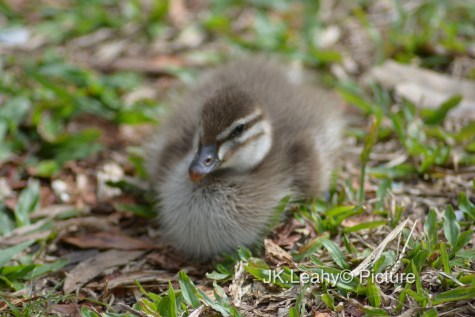
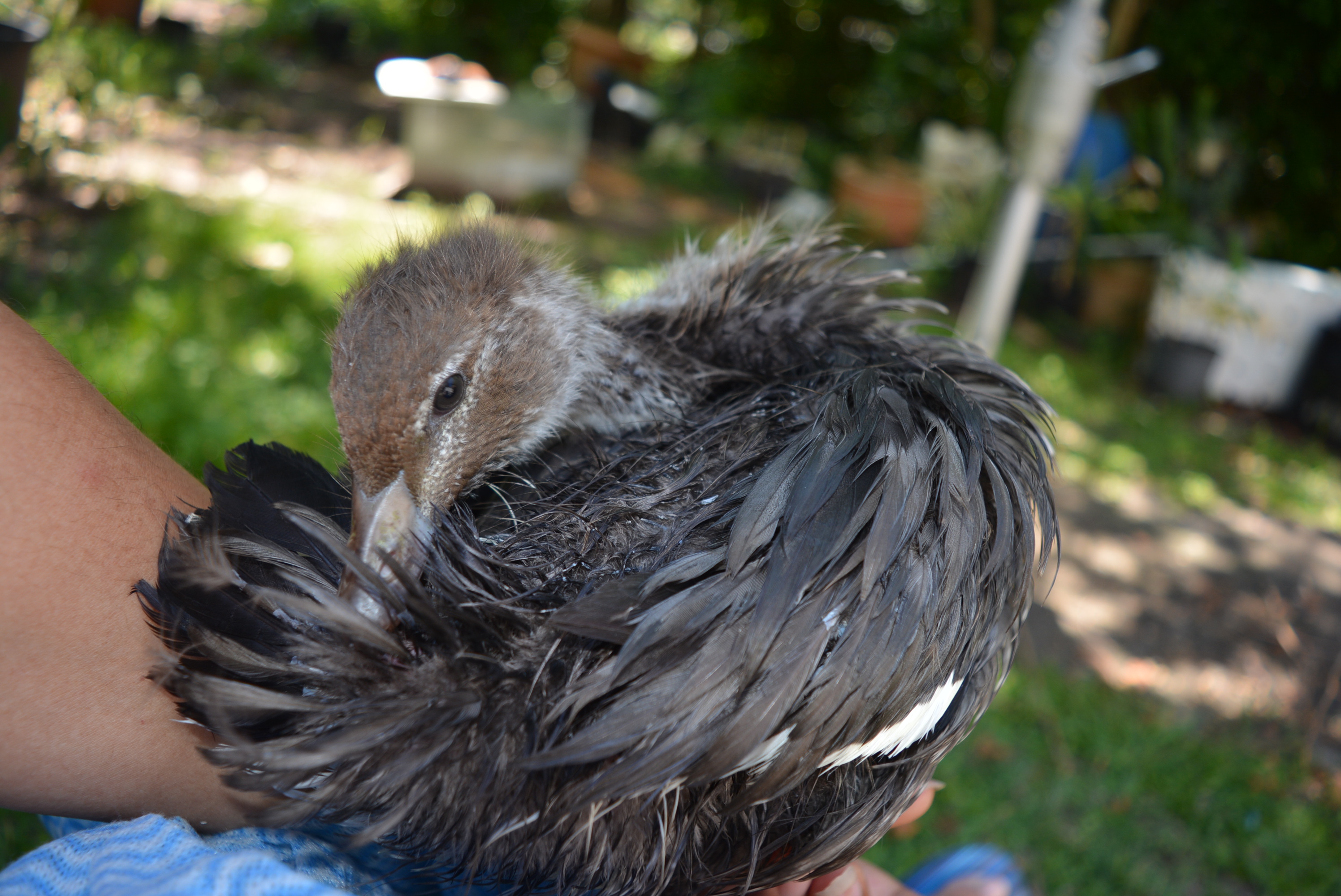
Almost six weeks ago we found a duckling, just a few days old, left in our swimming pool by her parents. She has now grown up and is moving out of our house with some of her new friends. I was getting a little emotional with this story so I had to remove myself and put the story away for two days. The storm in Brisbane last night put my internet off, so I could not post on this blog.
This is the third time we raised a wild duckling, so we know that life changes when you take helpless animals into your home. They become part of the family before you know it. It may be because we have become so attentive to such animals that my sons and I have learnt this duckling’s habits; her favourite place to sit, her favourite weed and her specific cries for different things, similar to a human baby. I found myself finishing work and rushing outside to pick her favourite weeds in the surroundings of my workplace. I have seen people walk or drive by and give me funny looks. It was worth it when I got home and she rushed to me and ripped the weeds out of my hands.
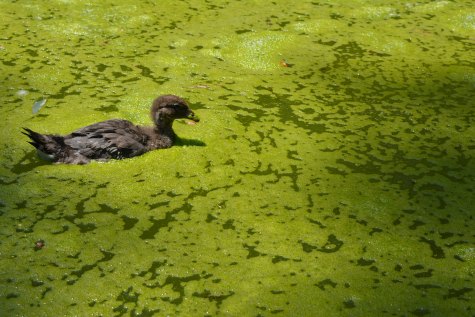
Anyway, it has been over a month since we rescued Goddess Penelope (pictured above). She also turned out to be a female, even though we named her a little early without knowing her sex (see previous post).
Penelope grew up quickly and took to our chickens right away. The other wild ducks gave her scornful looks, pecked and chased her. This behaviour happened with the previous ducklings we had saved, before the flock eventually accepted the house-raised ducks.
The last three days have brought major changes for Penelope. It was her moving out phase. The duckling took to the water and the bushland in front of our property easily. An older male duck hung around nearby. I told my sons the male duck could be a stalker watching her, and my sons argued that it could be her father. Who is to know? I guess I was being an over-protective parent, but I am worried. Penelope has had a tough life so far.
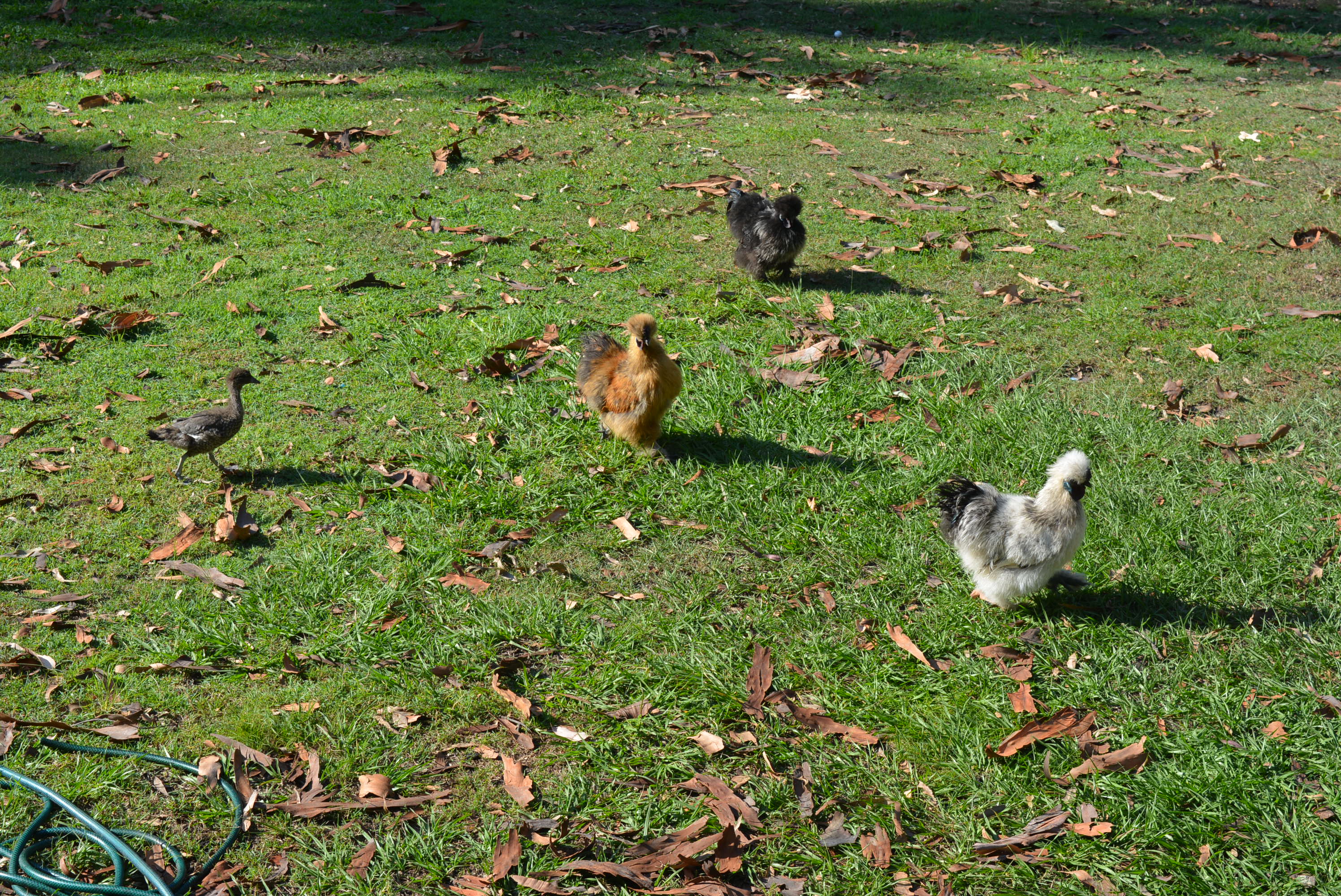
The three silkies.
Once we introduced her to the other birds, the other wild ducks chased and pecked her and in turn, she chased and pecked our chickens. The regular chickens did not entertain her cheekiness, but soft feathery Silky Batemans (silkies) could not get away from her. The silkies as the Australians call them, are slow, soft and cuddly birds.
Her own flock chased her and Penelope chased the Silky Bateman chickens.
Initially Penelope tried to talk to them, walk and sit with them. Then she pecked them, often holding up clumps of feathers in her beak. She got a lot of lectures from me, but we all had to be patient.
Her behaviour scared the silkies and for hours she would run behind them while they fled across the backyard over the weekend. I tried to stop her, but she would run in between the silkies and this confused the chickens even more. The silkies thought I was chasing them too. At the end of her first day out – Penelope was ready to sleep in the chicken pen, with the silkies, but they would not let her in.
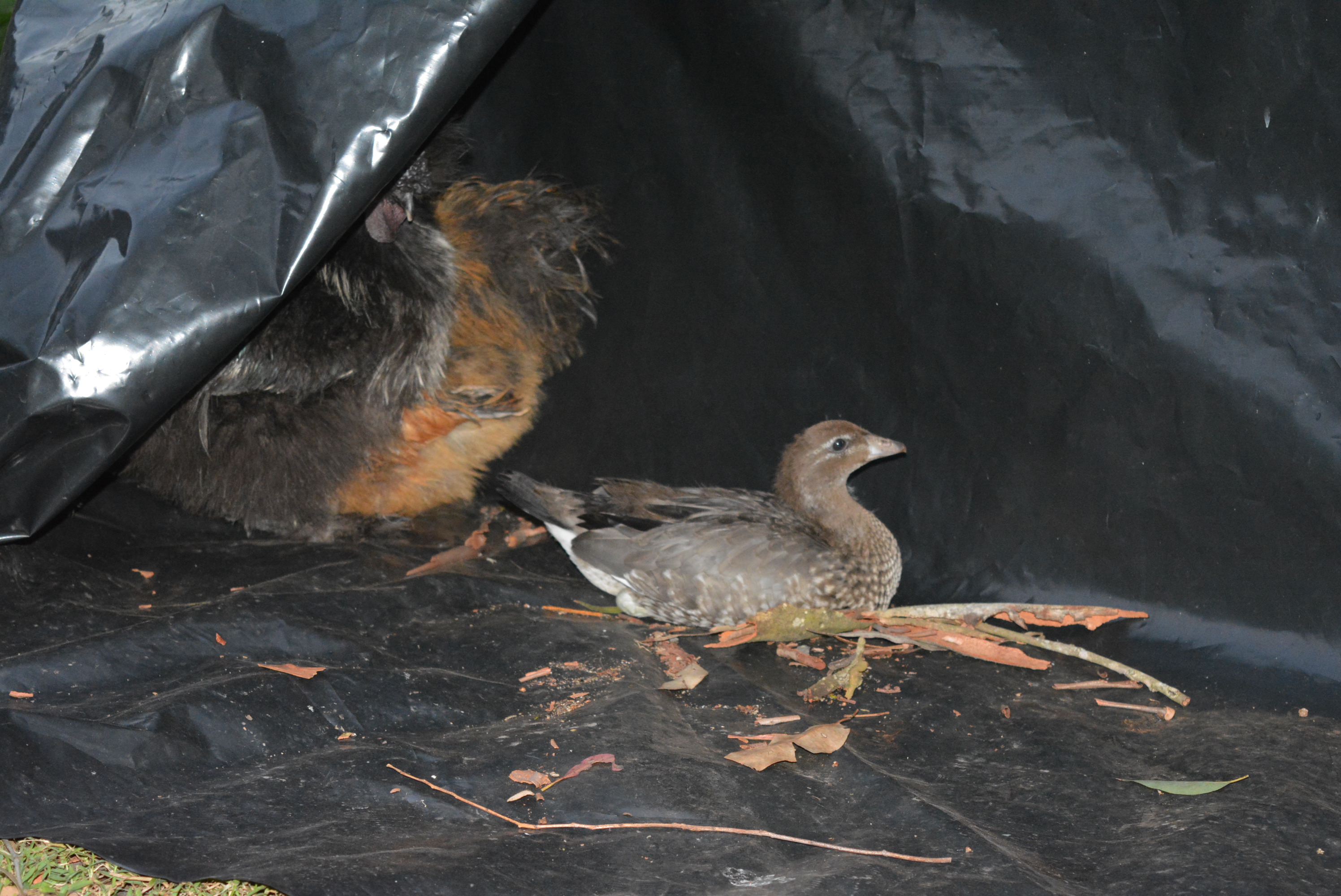
Penelope desperately tried to stay with the three silkies.
After the third day and a stormy night last night, the silkies gave in to Penelope’s charms. The silkies are all males too. The black silky (pictured above) has become her guardian. He shares his food with her.
Today, I tried to lure Penelope with her favourite weeds, but she did not eat any, because the silkies did not like the weeds. She gave me ‘the eye’ like she was saying – “what are you trying to do?” Maybe I embarrassed her, just like I do to my sons sometimes – the awkward teenager thing …
She has to grow up, and I know she is tough and she will survive in the wild. Penelope waits at the cage each evening to be put away for the night with the silkies. In a way, she has officially moved out. She does not make any crying sounds. Penelope has found her temporary home, where she will stay in the meantime until she can fly. My son Nathan commented that, Penelope wants so much to be with the silkies, that he half expects the teenage duck to start crowing in the morning with the three roosters.
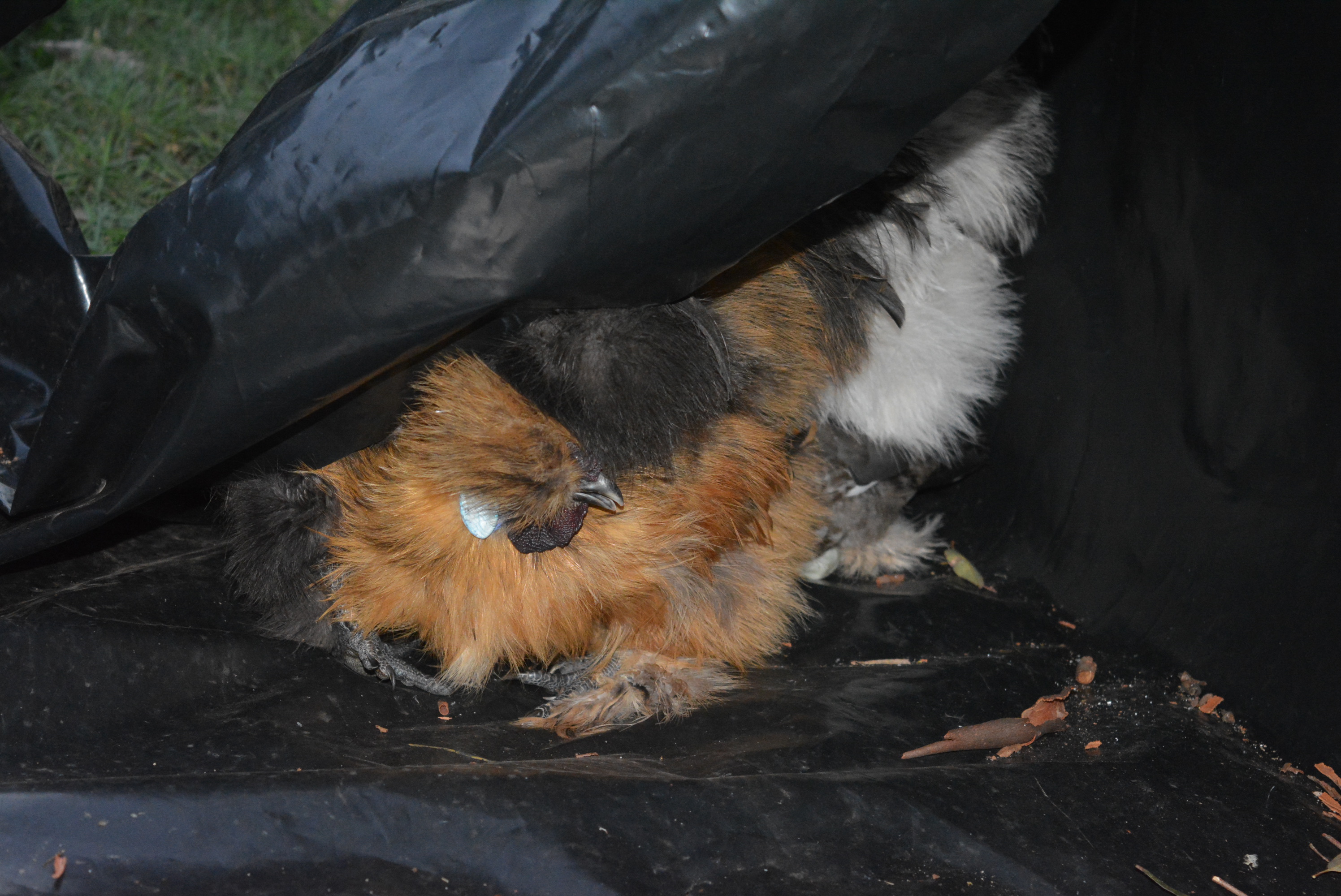
The silkies live in a pen which is closed in so they don’t get attacked by foxes and snakes. In the evenings, they huddle in this corner and wait to be placed inside the cage and locked up. Here are some pictures from Penelope’s first day when she tried to get to spend the night with the chickens.
I was calling the Goddess and she was nowhere to be found, until I spotted her next to the silkies.When I insisted she came to me, she rose and faced the other way – ignoring me.I approached and she dived into the middle of the three silkies.Penelope pushed her way in, disappearing into the chicken feathers.After a few minutes, the silkies kicked her out. But later, when I picked them all up and put them back in their cage, the silkies let her spend the night with them.
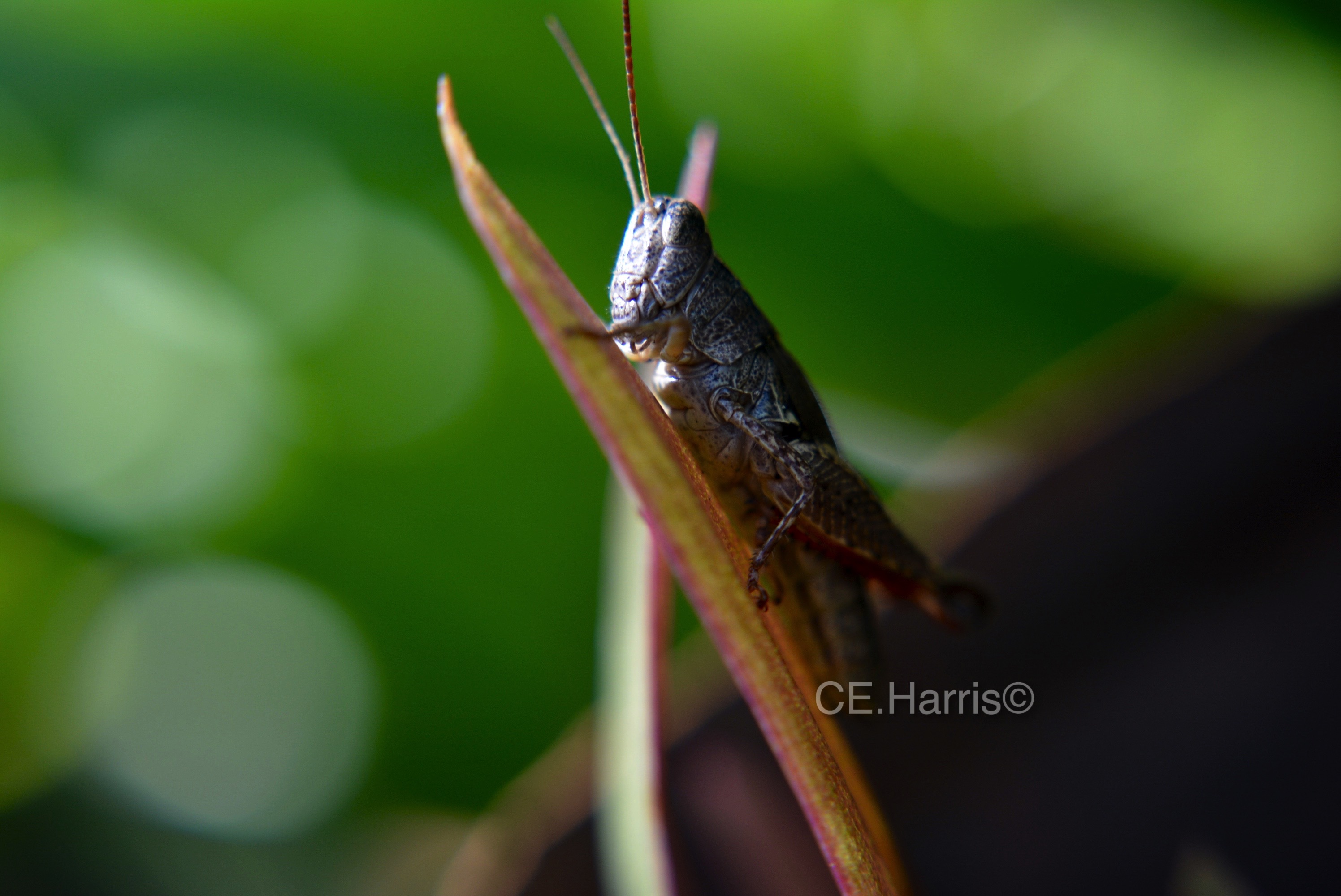
I enjoy this time of the year in Queensland because the bush is full of interesting creatures, both live dead and ones. The garden transforms into a photography playground for me. Not everyone likes insects, I know. Here are some interesting shapes, colours and types of things I found through the lens. My son Chris took the grasshopper shot.
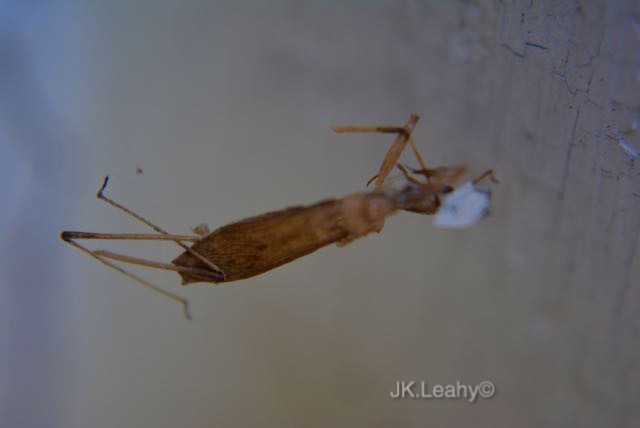
A fly caught in a spider web. See a similar fly, alive, on the golden orchid picture below.
I love these mustard mushrooms – they are creeping out of the dead gum leaves.
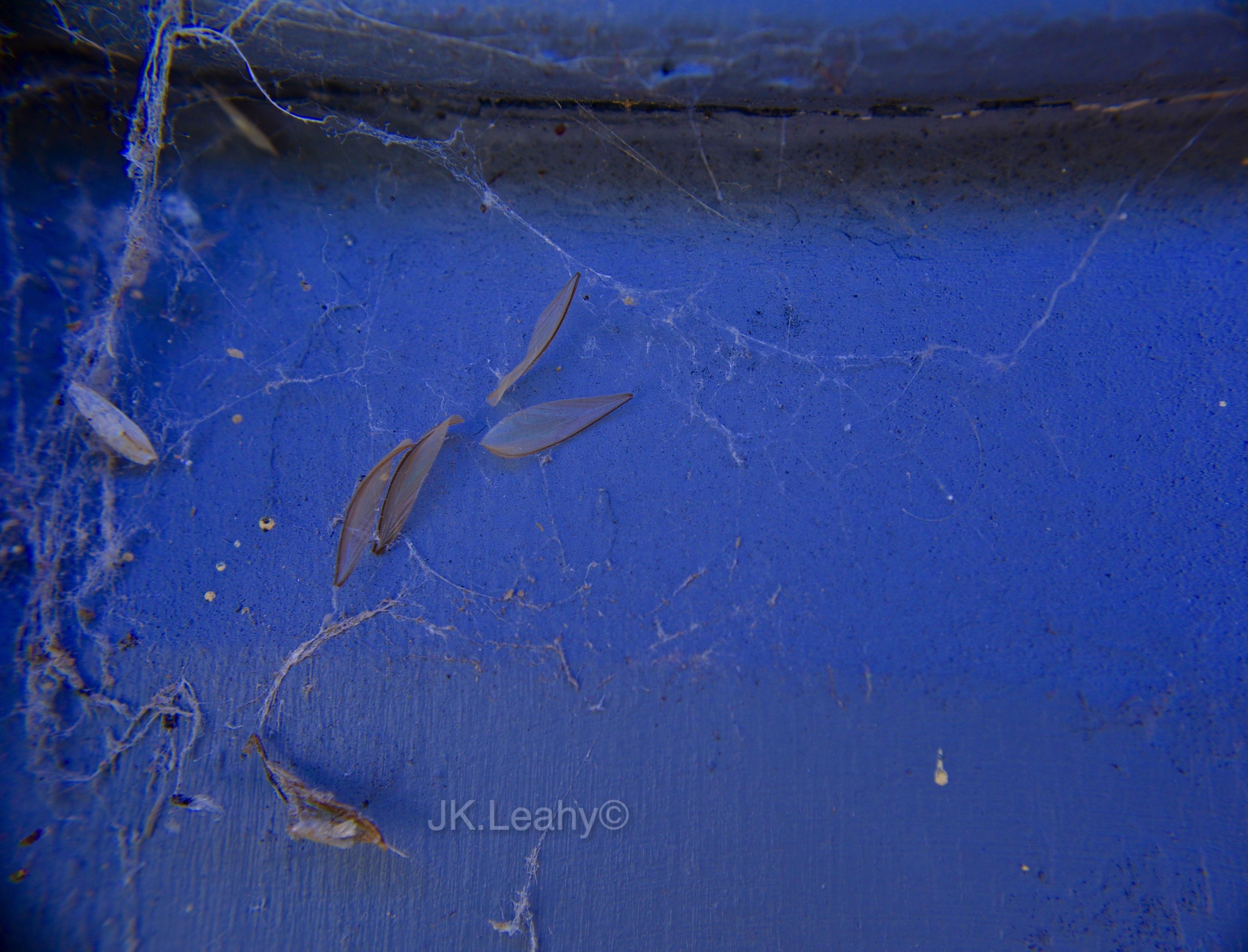
Fly wings on my gallery wall.
A small grasshopper photo by Chris Harris.
A large huntsman skeleton swinging off a bromeliad leaf.
Queensland orchid – notice the small insect on top left.
The album Soul Makassar (released in 2001) by Madagascar’s Tarika was a special project where their leader Hanitra Rasoanaivo travelled to Sulawesi in Indonesia looking for the ancestral origins of the Malagasy people. It was recorded in London, Bandung and Jakarta with Indonesian musicians guesting.
From Hanitra’s album notes:
“I wrote this song on the second day after I arrived on the island of Sulawesi. From my hotel room window every evening I could see the red sun setting between the light blue sky and the dark blue sea. I was taken on an imaginary trip by the boat of Tanaberu called Amanangapa which supposedly left the south coast of Sulawesi to go to Madagascar. I saw the pinisi, the outrigger canoes crossing the sea in front of me. I felt like I had been taken back home after many years of being lost. I was in a new Antananarivo, an Antananarivo where there was nobody else but my own tribe. The Makassar people say that I am from the Takalar tribe! There was not even one vazaha (white person) in sight at that time. I felt at home.”

















 Tribalmystic Stories