I haven’t forgotten to publish a new short story. I have written a few for my Creative Writing workshop and my memoir. The thing with writing stories is that every time you read it, you want to re-write it. It is not verbal so you could just correct yourself as you tell the story. And, just like the critical eye of an artist about his or her work, I feel that the story is never finished. When I do attempt to re-write, I often lose the magical essence I applied during free writing. For example, a short story of 800 words may flow so well on my first draft but when I start to add more descriptions and enrich the content, I start to lose the tension building or the essence of the conflict.
Then, you still have the general structure and language of the story to worry about. I cringe sometimes when I read my writing that I have published and I had missed a typo, grammar or perhaps a paragraph could be better placed or written. You could pick up something in this piece of writing and I would be in trouble again. What a nightmare it must be for all writers. Thank goodness we have editors and ‘know-it-all’ friends who will point out our mistakes. Sometimes you feel like saying, “You think it is easy; why don’t you write it then?” But without them, these “auto-corrector assistants”, we would not be able to bring good stories out to our readers in good writing.
Anyway friends, that was really my reason for delaying a new short story on this page. I am still editing some of them but let’s just call this one a work-in progress so I can give it to you as promised. It is a non-fiction short story from what I am writing for my memoir.
The Windy Curse
JLeahy Memoir
The wind was howling curses. Footsteps ran on gravel. People were rushing up the main road, away from Wagang, our small coastal village. It had stormed all night and all day. The waves rose in great heights over the far end of Wagang outside Lae, Papua New Guinea. It was 1972.
My uncle Sam said: “Yesterday morning, some houses were washed away with part of the coastline”. I could not go to school.
“The sea is coming!” I heard a woman call out. She half ran with two crying children behind her. Mounted on her back, the woman had three bilums filled with clothes and food. Dusk had approached when she threw that warning at Tinang, my grandma. There was panic in the woman’s voice as she hurried with her children up the road. We lived at the mouth of the main road to Lae town. Other men, women and children with bags walked quickly by, some dragging or carrying smaller children and animals.
I grabbed my clothes, towel and blanket then followed my own mother out of the room. Mother grabbed a few things. She packed them madly in a handbag and a large bilum. I was not sure what to take.
“Quick, come!” she called.
“Where are we going?” I said.
“We must leave now,” she said. I followed her out of our room.
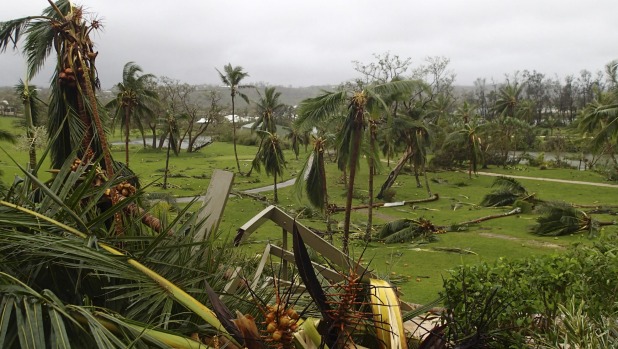
The village was in danger. We had to follow the rest of the villagers inland. The wind had not stopped for two days. The dry coconut leaves and nuts dropped randomly, making it dangerous to walk outside our house. There was some flying debris of plastic, paper, Tuk and Abong leaves. I wanted to run to grandpa’s house, next to our big house but I was scared. I also thought our roof might fly off.
“I will get the mosquito net,” Mother said. She disappeared and returned with a white bundle with pink ropes and added it to my arms. She made eyes at me to go to Tinang.
I could hear the waves getting louder in the distance and heard my aunty Giuc screaming that the sea was coming in. She was also yelling curses at her cousins to leave the village and run up the road. Aunty Giuc was a few years older than I and tough.
“Hurry!” mother said. I had no idea where mother meant. There was no further instructions.
“Are we running up the road?”. It did not make sense to me, I thought – the road was too flat. The sea would get us.
Yesterday, the government radio said we needed to move quickly as the waves would be at the village on the second day.
“Where are we going?” I asked again. Mother left me in the lounge and headed for grandpa’s house. I stood near the window and watched through the broken fly-wire. There were no louvres so I felt the wind.
Grandpa once dreamt that our village, less than a metre above sea level was going to sink into the sea. He told villagers that one day the water was coming in and we would disappear because the two rivers that surrounded our village joined on both ends. Grandpa also told the villagers our house was built on the stone so even if the village sunk, our house would remain standing, just like the biblical house that was built on the stones. I think that part made the villagers angry because they thought he meant our house was better than theirs. The villagers thought my grandpa’s dream was a crazy story.
As I watched everyone running past, I wondered if today was “The day” grandpa predicted. I walked to the front of the house to see where grandma was. I stopped at the top landing of our steps shocked at what was on our front yard.
There was sea-froth on the sand. The bubbles on the browny white foam slowly burst and disappeared into the sand. It left curly wet sandy trails. It was not normal for the sea to come this far, I thought. We were over 100 metres away from the beach. I scanned the ground to see if there would be fish. It was weird. In the last King tides, my cousins caught some tuna in the middle of our village soccer pitch.
I turned to look in our backyard; my eye caught the river rising. The river seemed angry like the wind. The dirty brown water twirled and rushed along debris and household rubbish. I could smell the sea from my left and at the same time, from my right, I smelt the swamp coming to meet the sea. Watching it, the swamp swell drowned everything in its path as it spilt over the banks and leaked towards me rapidly. Mother’s garden of maa-le, a scented deep green waterlily used for curing fever, disappeared under the brown smelly water. Just like the swamp people’s houses, I saw our kitchen house posts and the fireplace disappearing into the water. Where grandma had planted the Chinese Kangkung and watercress, flotsam mixed with village rubbish of empty Marvolene bleach bottles, Ommo packets and old thongs pushed in, crushing the green healthy vegetable carpet with its filthy weight.
I looked to grandpa’s small house and I could not see mother. I wondered if father and daughter were praying. It made sense. Tamang (grandpa) believed in God.
“Mamaa!” I called out.
She did not answer. I looked at the people passing our house again. No-one waved goodbye or passed greetings. Everyone looked anxious. I decided they were going to walk to town and climb Mt Lunaman. That was the only high ground I knew.
“Mama! Mama!” I called. I sat on the cold timber floor and waited. The sand caught between the timber gaps caught my eye. There was so much sea-sand in the house.
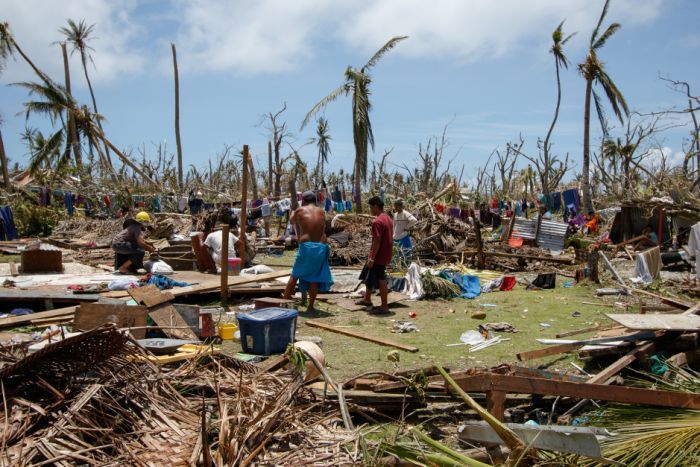
In the past, the waves had come like a thief and took three village houses on the beach. Luckily no human lives but only pigs, dogs and some chickens went with the houses in the waves. The villagers became smarter and built away from the shoreline. On bad days like this one, we all left the village. The waves were left to what to do what they wanted.
“Yupla kisim ol samting na igo antap long rot”, the loud voice interrupted.
Get your things and move up the road. It was the village councillor. The village bell rang three times signalling emergency. Three times also meant someone died. I was confused.
“Hariap!” a loud voice called. I did not see my uncle Sam but he was barking instructions too at my family to hurry. He told them not to bring rubbish. He also told his wife, his sisters, cousins and brothers to make sure they brought their underpants as he did not want anyone making pictures he did not want to see in the bush. This remark made everyone scream in laughter. It eased their tension only slightly.
I knew mother was with Grandpa. I stood up and looked out through the broken fly wire again. Then I saw Tinang, my grandma and ran down to her near the main road.
I waited near Tinang. My head reached her shoulders. I could smell lime and betel nut. I felt my way into her colourful nylon bilum to see if she had any betel nut. I was nervous and wanted to chew. In Tinang’s bilum, my hand touched empty nut skins, a towel, her Koala skin purse and other small things and not betel nut.
Tinang said, “it would be hard to move grandpa.”
“Why?”
“Because he is stubborn,” she said in Bukawac.
Grandpa can walk. I could not see how grandpa would walk all the way – but to where? The nearest mountain was miles away.
“Where are we going?” I asked Tinang.
“We are just going to go into the bush,” she finally told me. It finally made sense to me. In the bush, if we had to, we could climb up trees.
Soon, sea water ran in from the front of grandpa’s small house. It was made of bush material. There was froth and I knew more sea would come.
Then, I heard a truck coming. It was my grandma’s brother Mambu’s truck, Maac Kalac. A flat-top Mitsibishi with passenger seats. Its name, Maac Kalac in Yabem means the “proud bird”.
“Ampom!” I heard mother calling me and I ran to her. She came over to grab our things. She pulled my hand and took me to the truck and told me to get up. Someone lifted me and sat me on top of some clothes.
Below the truck engine, and all the chattering, I heard the village boys splashing and laughing in the distance and I knew they were having fun. I thought how silly they were to not see danger coming. Mother continued to madly pack food, matches and torch into our bag. Uncle Sam was giving final directions to all our family members to get on Awac Mambu’s truck.
This was a Public Motor Vehicle (PMV) licensed to transport the villagers into town for 10 cents. Tonight it was a free ride. Packed from top to bottom, it was loaded with bags, food, pots, pans, coconut. I could not believe it. Some people brought everything. There were dogs and chickens. Someone brought a duck! A duck could swim and fly. Why did they bring a duck?
“Tamang?” I turned my attention back to mother for my grandpa.
“He will come,” mother lied. Perhaps she was hoping he would come, I thought.
We loaded in less than an hour and the water started to sweep across the road to the tyres. Awac Mambu wanted to drive off and someone said grandpa was not on the truck. I sat up and looked back to the deserted house. I started crying and wanted to get off. Everyone started arguing. My mother ran back with the kerosine lantern. She disappeared behind our big house. Ten minutes later, mother ran back without the lantern and without grandpa. She whispered to me that we had to leave now and Uncle Sam would come back to get grandpa. We drove off. I thought about grandpa’s dream. I put my head on the bag of clothes next to the food and animals and closed my eyes.



 Tribalmystic Stories