All posts by tribalmysticstories, lazylittlefrog.com

Author, Artist, Arts Curator, Climate Activist, Anti - Violence against Women, and Entrepreneur

Second Part – Nathan’s story (fiction)


Warning: This may offend. Descriptions and events in the part two of Nathan’s story are not from my imagination but my son’s. As a sequel and at readers’ request, I asked Nathan’s permission to publish this story. He told me I could if I don’t edit it. The story is yet to be titled.

Part One: https://tribalmystic.me/2014/11/16/the-gift-from-god/

——————————–

Part Two:

They drove through the crowded city. Eventually Jack and Prince Toban arrived at the arena, a colossal bio-dome located in the middle of the Sahara. They were quickly blindfolded and separated. Later, Jack found himself in small, cylindrical cell with an open ceiling. The exit was only just out of reach, but the tree lines were visible nearby, as was a huge LCD screen in place of the sky – in case it wasn’t already obvious I’m doing a Hunger Games thing with this, so just picture THAT and pretend I described it really well instead, and that it was an original idea that I thought up.

A man’s face appeared on the screen/sky. He had piercing blue eyes, which would be quite dazzling if they weren’t detracted from by the octopus shape the man’s facial hair and been shaved and sculpted into, (which is supposedly how everyone is going to look in the future, but whatever). The commentator who literally could not be taken seriously began to explain the gravity of the situation. The last man standing would earn food and prosperity for their district. That mean would go free. After an extremely long countdown (in case everyone forgot, it went for 50 seconds in the movie, which was slightly excessive) the cells were dropped and all hell broke loose as the various gladiators raced to the centre of the arena to arm themselves.

Jack glanced away from where he was going for a brief second, and when he looked back he was being stared down by a sexy older woman who lived near him.  She was more eager to survive than she was to mingle. She slowly raised a bat above her head and…very weakly brought it down, feebly attempting to club her sunset haired opponent. I forgot to specify, she was at least 80, it was honestly quite upsetting to witness. Thankfully (I guess), the assault didn’t last for long. Out of nowhere, she was cleaved in half by a man hated by personal trainers everywhere, who understood the secret to building muscle FAST. Time slowed as the elderly woman’s torso slid free from her lower half; I know that’s kind of horrifying , but she was super old, it wasn’t much of a loss. Have some perspective people.

As the juiced up superhuman before him roared in response to his muscular eyes being splashed with geriatric viscera, our charming protagonist made the (probably very wise) decision to piss off into the woods and wait for the majority of fighting to blow over. Jack climbed a tree and waited, bravely sitting around doing nothing in particular as he counted the cannons firing off, marking the deaths of his fellow competitors. The count had been reduced to Jack and two others when he finally dozed off from exhaustion. He awoke to a shaking coming from the base of the tree; it was the steady chopping of a man attempting to cut down Jack’s hiding pla- I mean…strategic watch post. Taking a closer look at his assailant, Jack recognised him as a three-legged penis enlargement specialist, evident by the-…you know what? I’m not going to describe his dick bulge. These things tend to get away from me but that’s where I’m going to draw the line. Jack had almost no time to act, and even fewer options, or so he thought. That was, until, his eyes focused not on the man inconveniently dressed in track suit pants, but rather on the beach ball of a wasp nest attached to the tree several branches lower. The fire-bearded protagonist grasped one of the spears he had fashioned, and hurled it at the hive.  Something completely unexpected but necessary for me to try sum this up happened.

The spear ricocheted and was flung into the bushes, which gave an angry snarl in response. See, there were several genetically modified creatures in the stadium to keep the contestants on their toes, and due to a lapse of good fortune they had stumbled upon the most fearsome one. Quietly at first, but slowly building until the terrible cacophony of the creature’s guttural roar and insidious hissing in a cruel quartet followed a creature that could only be described as a thing that should-not-be out into the clearing. Standing before them was a colossal two-headed grizzly bear. It’s body was covered in mange and scar tissue, everywhere that is, until it’s shoulders, which slowly cleared into scales along the lengths of it’s arms and inevitably ending with venomous snake heads. Now THAT’S a fucking monster; remember what it was in the movies? Big-ish dogs. My two-headed bear thing took all of 30 seconds to think up. In short, Suzanne Collins is a hack. Anyway, the creature swung at Jack’s would-be opponent. He dodged, but the hissing snake arm smashed clean through the trunk of tree our champion was perched on. Jack boldly leaped, and elegantly crashed through close to every branch of a neighbouring tree, cleverly allowing his hardy legs and ribcage to absorb the brunt of the force. After lifting himself back up, he shot into the thick of the woods with his fellow prey, hoping the vegetation would slow the creature down. Unfortunately it maintained its pursuit with ease, tearing down trees as though they were tissue paper, gnashing all 4 sets of its teeth voraciously the entire while. The pair of contestants burst from the tree line, back into the central arena they began in, and sped their way back to the cornucopia shaped armoury.

They darted into cover, and for the sake of plot convenience, found Toban holed up inside. Their nightmarish pursuer’s many faces clashed up against their shelter’s opening. The trio took this brief moment to make some light small talk, before unanimously deciding to team up in order to survive the snake-bear-bear-snake hybrid. Clouds rolled in and drizzle began to spit as they launched their assault on the monster. Closely chasing an arrow fired into one of the beast’s eyes, the three killed it. Not right away of course, there was a huge, dramatic fight. The thing about that is, describing fight scenes in text is hard to do, and tends to be very, VERY tedious. How many ways can you think of to say “X” hit “Y” with “Z” (or the controversial flip of “X” tried, but missed “Z”)? What’s that? Not many? Yeah, exactly. I’d probably end up being forced to repeat words or phrases, then just get disappointed in myself. I refuse to do that, and will instead promise that a fight between a twin-headed grizzly with snake arms, a Nigerian prince, a guy with a massive penis and Jack Buffington was pretty neat. After administering the killing blow, Toban turned around to face Jack, smiling, until all expression was removed from his face. He coughed, his lungs full of blood, and collapsed to the ground. Standing above Toben’s body trying to retrieve his axe was the final competitor.

Jack flew into a rage, and then the two fought for a while. We have just hit the previous issue again, and it’s a bummer because the mood of this fight would have been way cooler. The really angry protagonist fighting the bad guy in the rain on top of a building is always a really cool scene. So yeah, Jack punched the huge-dick-guy, the huge-dick-guy punched Jack. There were occasional kicks too, but mostly punching. Very dramatic. Eventually, Jack’s opponent slipped and fell onto his back. Our leading man capitalised on this vulnerability by planting his weight on top of him and bearing down on the man. It was sort of uncomfortable at first due to the bulge, but the severity of the beat-down only increased. Soon, the last opponent lay broken. He spat out a broken tooth, and grinned. “Go on, kill me” he growled, “Finish this!! Kill me like I killed your friend!!!” to which, a startled Jack said “What? Toban wasn’t my friend, he pulled me into this gladiator bullshit and nearly got me killed. The guy was a jerk”. He paused, dumbfounded at how absorbed in this contest everyone seemed to be “And I’m not going to kill you, I am completely sure, that legally would count as murder”. So our Hero and his temporary, bitter rival just kind of casually hung out until officials of the games realised they didn’t plan on doing anything. The keeper of the secrets of penis enlargement (who I clearly never thought to name) admitted defeat, and so Jack was named the victor. Well, due to a technicality in Jack’s team assignment, food and prosperity was awarded to Toben’s homeland of continental Africa. Our hero didn’t go home empty-handed however. As thanks for his show of mercy, Jack’s rival took him to his homeland to teach him their age-old secrets. And so ends the story of how, by a single act of kindness, Jack Buffington ended nearly all poverty in a country, and was crowned.
 

The Gift From God


DSCN2634
Nathan Harris


Happy Birthday to my older son Nathan. We called him Nathan, as the biblical meaning, the gift from God. Today, Nathan turned 19.  Our family celebrates Nathan for many things and one of them is reading and writing. Nathan loves story-telling.

Recently, Nathan started an adventure story on Facebook for all his friends’ birthdays. In this story, he weaves his friends (as characters) into the stories, based on the theme he chooses to fit that friend’s personality.

When his brother and I took him to lunch today to celebrate, Nathan mentioned in disappointment that none of his friends even wrote a paragraph about his birthday on Facebook. I laughed. I told him, it did not matter, and he must understand, his friends are not writers like he is.  Writing may not be their thing, and his friends love him anyway.

I wanted to highlight a few things about Nathan.

  • He was born with a strawberry patch on his stomach which his father and I fought over because we thought one or the other accidentally hurt Nathan’s skin. (I thought he did it. He thought I did it). The mark appeared suddenly then disappeared as he grew older.
  • Nathan had a split tonsillitis and the paediatrician said Nathan would have difficulty speaking – that never happened.
  • Before he turned three, he wanted to go to school so badly I took Nathan to a friend’s school. On that first day, Nathan ran out of the car into the school without saying goodbye or a cuddle. I found myself crying in the car while watching my son run to his first class.
  • Nathan fell off our verandah (about three metres high) at five-years-old, and nearly cracked his skull. When he came to, on the way to the hospital, my then three-year-old apologised to me for falling. He survived the fall; got all clear and doctors thought it was amazing.
  • When he was seven, Nathan gave a speech about The Importance Of Family in front of 500 people in a United Nation’s gathering; not knowing, a few months later his father and I would separate.
  • At the same age, he corrected text books and his teachers said, it would be too hard to teach him as he got older.
  • We migrated from PNG to Australia in July 2004. Nathan exceeded all expectations, and represented the school in Mathematics and other problems-solving tournaments. He continued to excel in learning.
  • He is currently studying Bio-Med in University of Queensland.

A piece of writing from Nathan’s Facebook posts on his friend Jack’s birthday. (Fiction)

Jack fell out of bed, with all the grace of a bear emerging from hibernation. From memory, he’d set his alarm to 7, even though it was clearly closer to midday. Glancing around, he found his phone had its back cover removed and the battery thrown across the room. Smirking at his own genius aversion to early starts, he gathered the various contents and reassembled his mobile as he approached the kitchen. As Jack fearlessly prepared bacon for his morning sustenance, he realised too late how unwise it was to cook bacon before putting on more than underwear. He recoiled after being struck by a cruel splatter burn, and his phone came dislodged from his waistband. Upon retrieving it, he noticed he’d received a rather mysterious email.

The sender was a mysterious prince called Toban, from a foreign land.  A royal in his homeland of Nigeria, Toban’s way of life was in grave danger. The prince requested urgent help, and pleaded to any whom it may concern to transfer the prince some money. These funds were to assist Toban to help Jack travel to his kingdom to combat ‘the thing’ that threatened his livelihood. Jack looked puzzled; he understood a great deal about being cautious, especially with respects to strangers on the internet. he heard about scammers. However, although the email was cryptic, and explained literally nothing, Jack thought, Toban seemed to be in genuine need. Jack righteously decided that $2000 was a small amount to pay to help a kindly stranger.

Naturally, literally everyone Jack mentioned this to were 100% convinced our hero had been repeatedly dropped as a child, but he remained strong. Days became weeks, and weeks became months. Even in the face of friends questioning how many vaccinations he had at the same time, or inquiring about his childhood consumption of lead paint chips (colloquially referred to as “Wall Candy”), Jack braved them all. These people did not know Toban like he did, the brief, one-sided, 53 word exchange had brought them together. Despite this, Jack’s hope was dwindling. He was close to broken before he finally received a positive sign, in the form of a one way ticket to Nigeria from Prince Toban. He boarded the flight.

“Mr Buffington, over here Mr Buffington!!” a stout black man called across the airport when Jack cleared customs.

Ignoring completely how this man knew what he looked like, because I checked and that would need about 150 more words, Jack and Prince Toban made their way home as Toban explained his current dilemma. Firstly, he vehemently refuted the label of “internet scammer”.

“Every dubious website and questionable email that passes the average person by is completely real”, Toban said.

Annually, he told Jack,  the powers that be gathered two members of every faction of publicly labelled ‘Internet Scammer’ and forces them to fight to the death in a fierce battle royale, in order to keep them docile and to entertain the public.

Jack realised, Toban was the strongest of all the Nigerian princes, but his people had become weak and feeble. Due to shifting ideals, no one was sending them the money they needed to survive.

To Be Continued..(If I could get Nathan’s permission)


Send An Appeal To Free An Imprisoned Writer


Thank you Notes From The Aliens for sharing this powerful story with us to commemorate PEN and The Day of Imprisoned Writers, November 15.

Alexander M Zoltai's avatarNotes from An Alien

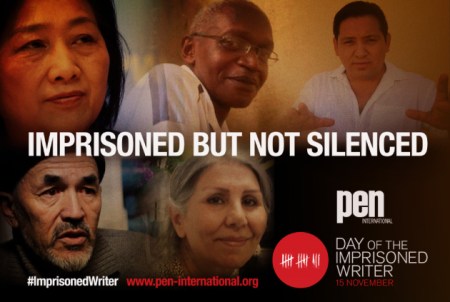
Today is The Day of The Imprisoned Writer

Day of The Imprisoned Writer Image from PEN International

“Each year PEN Centres and members worldwide commemorate the Day of the Imprisoned Writer to raise awareness of the unjust imprisonment and other forms of attack against writers around the globe, to remember those who have been killed, and stand in solidarity with imprisoned and threatened colleagues. – See more here.”

“In order to demonstrate how freedom of expression is being curtailed, each year PEN’s Writers in Prison Committee highlight five cases of writers currently in prison or being prosecuted from around the world that are emblematic of the type of threats and attacks faced by writers and journalists.

“This year PEN is highlighting the cases of five writers from Cameroon, China, Iran, Kyrgyzstan, and Paraguayandcalls for their immediate and unconditional release and for the charges against them to be dropped, along with…

View original post 312 more words

The Story Behind The Picture


My Life With Cameras

I love most art forms. To show and tell a story, I have often wondered if film and photography are the art form that truly capture the essence of a story. As a story-teller, I often ‘cheat’ by throwing in an image to complete the imagery ‘in’ my story. I see many bloggers use images this way, and it is great. As you are reading my stories, I want you to see and visualise the events, emotions, and actions with me. We are in the story together. Now, imagine if we did not have pictures; how could we, story-tellers, tell a story? I know how hard it is to describe a scene, simply. How many words and sentences do we need to describe every picture, and every scene we wish to create in our readers’ minds?

Between 1980-2000, in my news print days, I carried a Nikon FE2 with me in PNG. I must admit, I was in-love with this camera.  It took two decades of pictures with me. These pictures hit front newspaper pages and glossed magazines. I entered and won competitions. I could not have been a true journalist without it. Being a photojournalist, assisted by FE2, we took stories to another level.

Sadly, I do not use this camera anymore. Apart from losing the mirrors inside the FE2’s body to some hungry mould, I paid over $AUD600 for repair, and never got the mould completely removed. The mould began feeding and grew again. I still have the FE2 with me because we have too many memories together. I cannot use it, and I cannot bare the thought of losing it.

These days, everything has moved to digital. Over the years, trying to save money for a new ‘real’ camera has not been successful. Family, mortgage and many other urgencies always top the priority list. Without a good camera, I often wonder how many great shots I have missed in so many years. I stare for hours at photographs and  pin them on Pinterest and the net. I wonder how I could have taken these pictures differently; using light, better angle or simply, showing the object better. Fellow blogger/photographers, you know I am checking your pictures out, and I am looking at your pictures in awe and with some jealousy.  This is envy that is not evil but respectful.  A somewhat sad feeling about how much I have missed in my photography. I have long resigned to the fact that –that’s life!

Going Digital

Tami Is Research photos 061
In-coming tide on Tami Island, Lae, Morobe Province, PNG. Picture JLeahy. 2008

I still take pictures with the phone, and small digital cameras. A few years ago, I had a digital pocket sized Nikon I bought from a Cash Converters store. It accompanied me conveniently for its size. The FE2, and its lenses was sometimes hard to lug about.  After doing some solid photographic work, the little camera’s bottom broke. There is a pin inside the battery cage which broke and the camera batteries would protrude out and lose power.  So, I taped the bottom and kept using the camera.  When a moment presented itself, the photographer would need to press harder on the tape to keep the batteries in and take the shot. Only I used it expertly. It was hard work instructing others to handle the little camera in her special needs. If less pressure was applied, the camera did not work. Sounds like a joke right? The camera worked most times and I was proud of it.

The Right Equipment

Anyway, the point I am making is that, when and if you have a great equipment for your work or even artwork – everything flows beautifully. Just imagine when you don’t and the moment presents itself. In 2008, I was on Tami Island, Papua New Guinea doing my field research into how climate change affected intangible cultures.

I travelled with my mother and my broken-bottom pocket Nikon. The bottom was taped and, we went to a place at least a few hours in up the coast, in a boat, so there was no such thing as batteries nor camera shops.

I took several photos with the bad-bottom camera, and one picture has become a favourite. I had to mention this picture because, it is not only I that thinks it a wonderful picture, but strangers have complimented the photo, hundreds of times. I posted this picture on About Me, on my Page and each day, I can get numerous compliments and comments about this picture.

The Story of This Picture

Tami Is Research photos 056-2
Morning light on Awaho flowers, Tami Island, Lae, PNG. Picture, JLeahy. 2008

In the days my mother and I stayed on Wanem Island, we would wake in the morning to crisp breezes, beautiful skies and chatters of seagulls and other birds flying by, searching for food. The village was a separated by trees and coconuts. The only sound was the soft waves,  gently slapping the sandy beach. At least three metres in, from the water’s edge, the beach was lined with various soft and hardwood natives, and one we call the Awaho. This tree has many uses. Its timber is used for building, the leaves for cooking food in, and the bark for making clothing, as well as ropes. At the end of its life, the Awaho wood is a very good firewood.

Each morning, before we woke, the Awaho trees would start dropping their flowers on the hardened, cleaned sand, left by the receding low-tide. The flowers would be placed randomly but precisely, so it did not clutter. These droppings ravished the beach with these delicate burnt orange flowers with deep carmine centres. From each of the rich red-wine centre protruded a pale feathery, sticky pale stem with a red tip. Seeing the flowers on that beach for the first time, I thought someone had laid the flowers out. By the end of the day, before the flowers have completely wilted, the tide would come in, and sweep the flowers away before the shadows melted into darkness. If you swam at night, you would see the flower floating amongst the flotsam. In the morning, the white beach would be cleaned and ready. Once again,  the Awaho’s bouquets would arrive, and scattered across the white sandy beach. The cycle began all over, a picture and a moment of Mother Nature’s artwork. I would have never captured this images without the broken-bottom pocket Nikon.


‘Nudis’ of Papua New Guinea


http://vimeo.com/108538174 I like to think of nudibranchs as one of Mother Nature’s most exquisite work of art, a living installation, and a touring exhibition if you like. For those who have seen Dustin Adamson’s work I posted here weeks ago, here is another. It is in such beauty and unique attribute in Papua New Guinea’s rich culture, heritage, and the natural environment that makes me proud to be a Papua New Guinean. The nudibranchs are generally small, a bit like a traditional slug. But these slugs are much more interesting than the ones you find in the garden as Adamson shows in another beautiful short film. The different shapes, colors, and sizes make each species of nudibranchs unique and mesmerizing. Dustin said that hopefully the up close and personal pictures can give us an appreciation for the true beauty of the ‘nudis’. All Underwater Video Copyright © Dustin Adamson/Oceanshutter.com. All Rights Reserved

G20 Brisbane, Australia


5891472-16x9-2150x1210
“I’m calling for the Indonesian president to look into the genocide in West Papua and stop only looking at the economic profits – and address the impact mining companies are having.” West Papuan independence advocate Ronny Kareni “I think the most important thing is education and then health care, and then infrastructure. If we can deliver the education program and health program, I’m sure the political tension will drop.” Indonesian president Joko Widodo speaking about the province of West Papua.

World leaders have been arriving in Brisbane, our city, today. Others have already arrived, ahead of the G20 meeting. We have a public holiday today. My son made me some melon and Vodka cocktails, just to ease the heat of the day and tension. Ok, that’s an excuse, but I have not had vodka cocktails since my Uni days. It was such a refreshing drink, I had to have one more.

Some of the hottest conditions on record are expected in parts of Queensland over the next few days with many Brisbane residents heading to the beach to take advantage of today’s G20 public holiday.

Heavy traffic has been reported along the M1, the main highway from Brisbane to the Gold Coast, as people flock to the beach for the long weekend – an exodus that began on Thursday afternoon.

5888846-3x2-940x627
Three women went head to toe in green body paint to send a message to world leaders at the G20 on behalf of PETA. ABC News: Patrick Williams

World leaders arriving in Brisbane for the G20 leaders’ summit will have to contend with very hot weather conditions, with the city predicted to hit 32 degrees Celsius today, 35 on Saturday and 39 degrees on Sunday.

Brisbane’s Lord Mayor Graham Quirk said all of the city’s hotels in our city were fully booked, and those as far west as Toowoomba.

Meanwhile Gold Coast Tourism spokesman Ben Pole said occupancy rates were high across the city, as thousands of Brisbane residents flock to the region.

Two days earlier, helicopters and planes crowded our airspace, in deafening security exercises to protect our visitors. Brisbane is a great city and I hope that everything will go well with the G20 meeting.

I have yet find any Climate Action protesting groups, but I will keep looking.

Here are other G20 pictures from ABC.

http://www.abc.net.au/news/2014-11-14/g20-leaders-summit/5890634

Saving Harry


An Eel Escape


From memoir series JLeahy. Part 2

Click link below for Part 1.

https://tribalmystic.me/2014/11/12/an-eel-escape/

We had split the number of holes we saw on the creek beds as early as 8am this morning. Grandma took the right and I took the left. Each hole we dug into would have at least one eel. I was very excited. Sometimes I would find the eel and try to grab it before it knew what was happening. But they all got away. I knew Mother was waiting with our nets for them, so I was not too worried. Most times, the eels could sense the vibrations and make their way out very quietly. The eels were 20-30 centimetres long and had yellow and white bellies. Their backs were pale grey, dark green, mouldy grey and sometimes greenish black.

After at least two hours, Tinang, my grandma, called out to Mother in Bukawac.
“Have you seen any eels?”
“No! Nothing came down”, mother called back. That did not sound right and I peeked through the leaves at my grandmother.
“Keep digging Kalem”, Tinang said and pointed to the next hole.
We both worked our way upstream. We needed to at least catch a dozen baby eels so my two uncles would throw their lines for the ocean fish.

If we had gone to the river, the eels wold have been too big and hard to catch. The creeks were the best place for baby eels. Three hours later, I had exhausted every hole.
“Ok grandma, I am at my last one”.
“Good girl, finish and wash, we will sit down and have a betel nut”, Tinang promised me.
I tried to reach into the last hole and the eel quickly went out the other way. I saw it with my own eyes.
“It’s coming, I yelled out to Mother”.
“Ok, I am waiting”, Mother said.
I sat into the creek and threw the cool fresh water on myself, removing all the mud, rubbish and wiped the insect bites. There were red and swollen. I could not take all the dried leaves and rubbish out of my hair, so I left it there. I cleaned up, and walked out to the side of the bank.  Mother and Tinang were seated under a shade. No words were spoken.
“Where are the eels?” I asked. I was excited to see how many we had caught. Mother was very quiet. She had no expression.
Tinang looked at Mother and then me.
“Would you like a betel nut?” Tinang finally said.
Mother did not respond.
“Yes please”, I said. I wanted to chew and warm up, the water had cooled my body temperature.
I turned and looked at my mother. I searched her eyes and she looked ashamed.
“What happened?” I asked Mother.
Grandma was silent. I could see that “I knew it” look in grandma’s eyes and it was like, she could almost laugh.
“I am sorry. I lifted the nets and let all the eels get away”, Mother said.
“Why?”
“Because I could not bear the thought of touching them”.
It was too hard to get angry. I popped the skin of my beetle nut and sat down with grandma and gave her a hug. I knew how she felt. We sat awkwardly together. Then, I reached for the lime pot and the mustard to add to the betel nut. I had already mashed the betel-nut with my teeth. I began to chew. Grandma reluctantly reached over to mother.

“Here!”,  she said, offering her daughter a beetle-nut and mustard. Mother relaxed and accepted the peace-offering.

https://www.youtube.com/watch?v=RvyC1xo3v1A

In the South Pacific Islands eel farming is quite common. In Papua New Guinea, eels are farmed and also treated like pets. Here in New Ireland Province Cathy’ Larabina’s eels are some of the biggest pet eels. They have become well-known in the PNG tourism industry.


An Eel Escape


From memoir series JLeahy. Part 1

Suki workshop3 066
We learn early to fish and catch food for our families. In Papua New Guinea, as in many indigenous cultures, children are taken with their mothers to learn about nature and where to find food. Picture taken my JLeahy on Suki River, PNG. 2008

I stuck my right fore-finger into the freshly dug sandy, mud holes. A crab must have tried to invade this hole and got chased out. It left tracks in the mud. I imagined how it happened, and smiled. There were other holes, all about bottle-top size. The sandy mud was soft and pale brown. We needed food so my uncles had to fish tonight. My job was to catch bait; baby eels.

“Kalem! Ampom!”, Tinang called. Tinang was my grandma. She used both my names meaning, a welcoming joy, and light-skinned.
“I’m here!”, I responded softly, trying to not disturb the eels nor other life forms.
“Go there!”, she directed me, pointing to the other side.
I nodded and stepped to the other side of the creek and my eyes canvassed the freshly dug holes. I was in my blue shorts and T-shirt. At seven I was tall so mosquitoes loved my long bare legs. Even when they had filled their tight blood bellies, I could not smack them for fear I would disturb the catch. The mosquitos were also too ‘drunk’ with the blood, so I rubbed them off.

There were crab holes and eel holes but there was a difference. The eel holes did not have a messy gathering at their entrances. From the size of the hole, you could tell how big the eel was. These were small. The eels had two exit points. I started digging into the top opening and then feeling my way to the ending at the second hole. Where I had interfered, dirty water trailed down the footprints to the clean running creek water.  I looked back to see where grandma was. I stepped carefully to avoid the small openings. Then, I picked one and I inserted my fingers into the hole and followed with my hands. I trusted my instincts and repeated the process until we had enough eels.

As early as you could, most children in the village were taught how to catch an eel. I was around seven and very good at catching eels. Catching eels was always exciting and scary at the same time. Physically, the eels scared me, but they were beautiful when I watched them gliding through the water.  There was a certain peace and calmness about them. We were not allowed to catch very large eels. I have watched many get away. The large eels were considered landowners, art of us and our ancestors.

The trick to catch the eel was all in the hands. You reach the eel in the hole by touch, and caress the eel until it relaxes, and you can catch it. Sometimes you can catch the eels with bare hands, but they were slippery and difficult. My aunts were better at hand-catching the eels. The way we were catching today was by scarring the small eels back into the creek and they swam down into a hand-held net.
My uncles and grandma’s brothers would use the eels on large hooks for the open and deep-sea fish.

About six metres downstream, my mother was waiting with the open nets ready to catch the eels. I could not see her, but I could hear her smacking mosquitoes and flies and trying not to curse.
There was bush and wild banana trees between us. Vines from cane and pandanus crisscrossed above me, letting rays of sunlight spill onto the sandy bank. Not far from me, I could see the eels easing their way out and following the creek downstream. We only had to catch a few. Tinang was a few metres behind me, digging on the opposite side. If she started a song, we would sing together quietly.

Sometimes we just hummed in low tones while we fished but we were in a little creek and catching eels so we could not sing. It was very quiet except for the silent scratching noises on the sandy bank. I did not even hear one bird sing.

“Tinang!” I called in a whisper.

She looked at me.

“Did you see?” I asked, excited about the eels that swam down.

She just nodded and kept digging.

Earlier, I had asked Tinang to hold the net. We always fished together. I held the net and she brought the fish into the net. Today, Mother came along. I don’t know why because Mother hated eels. Just like snakes and anything that looked or shaped like snakes, she would run if she saw any. Mother even hated lizards and lizards had legs.

I didn’t eat eels but I didn’t mind them. My uncles said, the eel had a special smell that attracted fish-just like blood drawing sharks under water. An eel was the best bait.

“No, let your mother hold the net Tinang had told me earlier. You are better at catching the eels”. Tinang said.

“You go with Tinang” Mother said, smiling at me. I gave her my net and followed grandma up the creek. I knew mother was up to something. She wore her evil eyes in her funny smile.

The nets were cut out of small knitted nylon fishing nets. They were shaped and sewn along the sides. The top part was held in a hoop by a cane/rattan stick. To catch an eel, we got all our three nets and plugged their mouths halfway into the muddy base of the creek. Half of the mouth of the net would be open to catch anything that floated downstream. The three nets joined and combined at base, blocked off the width of the creek. The creek was about three metres wide.

Mother had bent forward and held onto the three nets. Where she was positioned, Mother could see everything that came downstream – fish, eels, yabbies, nuts from the trees and any other floating rubbish.

TO BE CONTINUED..tomorrow.

Mother Risks Her Life To Protect Environment and Heritage


604-1
Aleta Baun, an award-winning environmentalist who led non-violent protests against marble mining companies in West Timor for more than a decade, pictured at a summit on women and climate in Bali, Indonesia, Aug. 5, 2014 TRF/Thin Lei Win.

Author: Thin Lei Win

BALI, Indonesia (Thomson Reuters Foundation) – Under a full moon one night in 2006, 30 machete-wielding men surrounded Aleta Baun in the middle of a forest as she headed home to breastfeed her youngest daughter.

 “Each of the men slapped me, pulled my hair and kicked me. They banged my head against a tree. I now get headaches often,” she told Thomson Reuters Foundation. “It was very, very painful but I just prayed. I still feel thankful they just hit me and did not kill me”, Baun, now 54, told Reuters.

Baun was leading protests against mining operations in her West Timor community. Baun was protesting against the miners for destroying the land sacred to her people, the Molo Indigenous people. Baun’s attackers told her blatantly that night; they had been hired to kill her. 

Baun’s husband was at home tending to their children when she was attacked. Baun had called her husband before she was attacked.

“He(husband)said, ‘We will come and help you,’ and I asked, ‘How many of you are there?’. When he said ‘Five,’ I told him, ‘That’s useless. Don’t come. Stay at home so if something happens to me there’s someone to look after the kids”.

Baun’s attackers took the only $20 on her.  After discussing they would gang-rape or kill her, they hacked her legs with machetes, and left her to die.

Baun survived the attack but the threats continued, placing the lives of her husband and children in grave danger.  She was finally forced to leave home for a year.

Read more about Baun and other heroic women here:

http://www.trust.org/item/20140818092642-qdpr9/?source=spotlight