I have been a fan of my next Australian story for many years. Gurrumul Yunupingu has a magical voice and one that always reduces me to tears. He has a beautiful story as told by the ABC Stories. Please click on the link at the end of the post to watch a documentary about this amazing Australian’s life.
Briefly, Geoffrey Gurrumul Yunupingu has eluded the media since becoming a household name. The enigmatic blind Aboriginal musician first came to attention when he released his eponymous first album in 2008 to international acclaim.
Sung in the Yolnu dialect of Arnhem land, Gurrumul’s music transcends cultural boundaries and touches listeners in the UK and Europe as much as it does in Australia.
Yet despite the accolades and awards, Gurrumul has resolutely refused to do media interviews or provide any clues to journalists about his background or motivations; to both the chagrin and respect of the people responsible for his success.
For the first time, in 2010, Australian Story presented an intimate profile featuring behind the scenes footage of Gurrumul shot by filmmaker Naina Sen, combined with interviews from his family and unofficial spokesperson Michael Hohnen. Watch the film on the link below.
The Australia Day will be next Monday, January 26, and I would like share a few Australians that have extraordinary stories and make me and the country proud. There many Australians I am proud of. It would even be impossible to fit them all into my blog in the 1000 posts I had promised in September. However, given the limited time between now and the actual day, I will share only a few stories. I would like to start with someone my sons and I admire for his musical talent, his love for his culture and nature. It is a little like me, except, my musical talent appears when there is no audience and I have had a few wines.
On a serious note, please ask Abung (Google) to help find Xavier Rudd and listen to many of his beautiful songs. I am sure many of you will know him. He is a one-man band and plays most of the instruments himself. His life as a nature activist makes me particularly proud and this is his story from The Nature Conservancy
Xavier Rudd
Hometown: Bells Beach, Australia
Day Gig: Environmental Activist, Surfer
Night Gig: Internationally Acclaimed Singer Songwriter and Didgeredoo Master
Environmental Concern: Oceans
Singer-songwriter, musician, activist and surfer Xavier Rudd is considered to be an iconic voice in Australian music. Using a range of instruments, including guitars, yidakis (also known as didgeridoos), stomp box and percussion, Rudd has become known for marrying uplifting music with thought-provoking lyrics.
Since his first studio album, To Let, debuted in 2002, Rudd has earned a reputation as a strong mult-instrumentalist who writes, sings and plays from the heart. Solace, his second album, was recorded in Vancouver with friend and producer Todd Simko. It debuted in 2004 in the top 20 of the ARIA charts and three of its songs were voted into triple j’s annual Hottest 100. It was followed with the ARIA-nominated albums, Food In The Belly and White Moth. In 2008, the gritty, dark and dynamic Dark Shades Of Blue redefined Rudd as a lapsteel player and lyricist. His sixth album, Koonyum Sun, was recorded as “Xavier Rudd And Izintaba,” and featured a collaboration with bassist Tio Moloantoa and percussionist Andile Nqubezelo.
In 2012, Rudd released Spirit Bird. His seventh studio-recorded album, Spirit Bird debuted at #2 on the ARIA album chart, and has earned critical acclaim as well as a 2012 Australian Independent Record Labels Association Awards nomination for Best Independent Blues And Roots Album.
As a review in the Seattle Post Intelligencer notes: “over the course of his career [Rudd] has evolved from being the accompaniment for surfers and late night beach parties (not only were some of his songs featured in the movie Surfer Dude, he wrote parts of the movie’s score) with an environmental conscience to singing about having a spiritual bond with the planet and the compassion required to create it… he gives us his vision of the potential for a better world.”
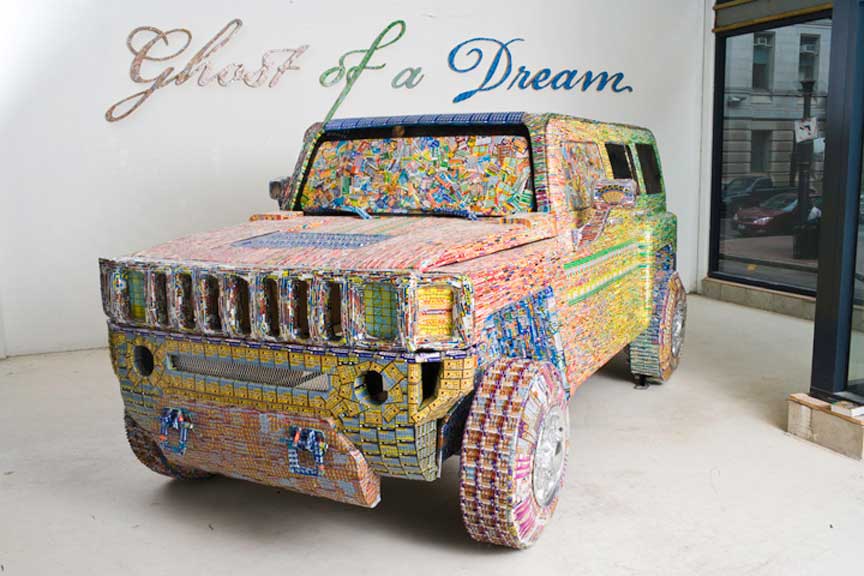
Dream ride 5,6,7 2010 discarded chinese and us lottery tickets, wood and plexiglass 44″ x 78″ x 190″
Ghost of a Dream
A sculpture and installation dream car
If only I had kept all my lottery tickets that did not win, I could have made myself a car or a piece of art. Please don’t laugh, I’m serious. Look at these babies. They made it into the Cool Stuff on my blog. For those of you that are new to the blog, every now and then, I post something I think is really cool. It can be a piece of furniture or art. These exquisite sculpture and installations were created by Adam Eckstrom and Lauren Was. For more of their work, click on the link at the end of the post.
Rear view of Dream CarDream Car 2008 $39,000 worth of discarded lottery tickets, cardboard, cast plastic, wood, steel, and mirror
I love World Music and have always found the South African music very lifting. Recently, I discovered the music of Peki Emelia Nothembi Mkhwebane from South Africa. She is an award-winning Ndebele musician. Her singing, dancing and dressing embraced a multifaceted picture of the culture of the Ndebele in South Africa. The origins of the Ndebele tribe are not known, although they are generally recognised as forming part of the Nguni tribes of Southern Africa. Nothembi has travelled the world with her beautiful music. It is the right moment for me to share a beautiful thing (her music) with you because I have to return to work tomorrow.
Profile of Peki Emelia “Nothembi” Mkhwebane
Peki Emelia “Nothembi” Mkhwebane was born in Carolina in Mpumalanga on 1 January 1953. Orphaned at the age of five, she was raised by her grandparents who could not afford her formal education. Most of her early life was spent looking after her grandfather’s cattle and sheep – their limited means of livelihood at that time. It was no mean task for a girl.
Mkhwebane’s family loved music and nurtured her first love for Ndebele songs. Her grandmother taught her to play a reed flute, while her sister exposed her to isikumero. Her uncle taught her to play a home-made guitar. In this hub of Ndebele music and culture, Mkhwebane learned a lot about the richness of her culture and later started a musical group called “Izelamani zako Nomazilyana”, which performed at cultural gatherings and weddings.
With time, she bought a keyboard and guitar to compose songs, which she recorded. Despite her burgeoning achievements, she still struggled to find a recording company, particularly as one of the major snags was her illiteracy, which proved to be a hindrance in securing proceeds from the recording breakthroughs.
Never one to despair, and propelled by her passion and talent, Mkhwebane subsequently defeated most of these obstacles to become a world-renowned, prolific singer and performer of Ndebele music. She has travelled extensively abroad, performing in countries such as the United States of America (USA), Austria, Germany, Portugal, Australia and France. In 1988, she performed in New York and London and received an award for the Best Ndebele Song.
“The One Percent“, a documentary showing the top one percent of wealth owners in United States made by Jamie Johnson. As Jamie explained, the film aimed to question the equality of wealth sharing and the social class which continues to widen the gap between the rich and the poor. Jamie is the heir of the Johnson & Johnson pharmacy chain.
Thank you Almah Taria for sharing this film with me.
While suffering in the heat in Brisbane, Australia, the past 48 hours, I have been re-thinking the whole debate about climate change and how little is being done by our leaders. It seems to me that many of us are just happy in our little pockets of the world, as long as we feel comfortable and climate change issues do not affect us. Scientists are telling us in more studies that things are getting serious. We are seeing more physical destructions such as violent storms, long periods of drought, very high temperatures, all happening right before our eyes. Reuters reported climate migration numbers are increasing at an alarming rate across Asia and India. In the Pacific Islands, people from small, low-lying islands low-lying countries are also migrating. So, in the big picture, we know MORE about our own destructions to this planet than we have ever before. The media even reminds us what we are doing, daily. Why are we not reacting?
2014 was the hottest year ever recorded. These figures finally challenged the climate skeptics. Is that alone, not scary enough? Does it not mean anything to us? Do we care and as humans, does it matter that we only have ONE planet to live on? I wanted to pick up this topic again and share this Guardian article about how we have accelerated the rate of our destruction to our planet. Please read and share the link below.
Humans are ‘eating away at our own life support systems’ at a rate unseen in the past 10,000 years, two new research papers say.
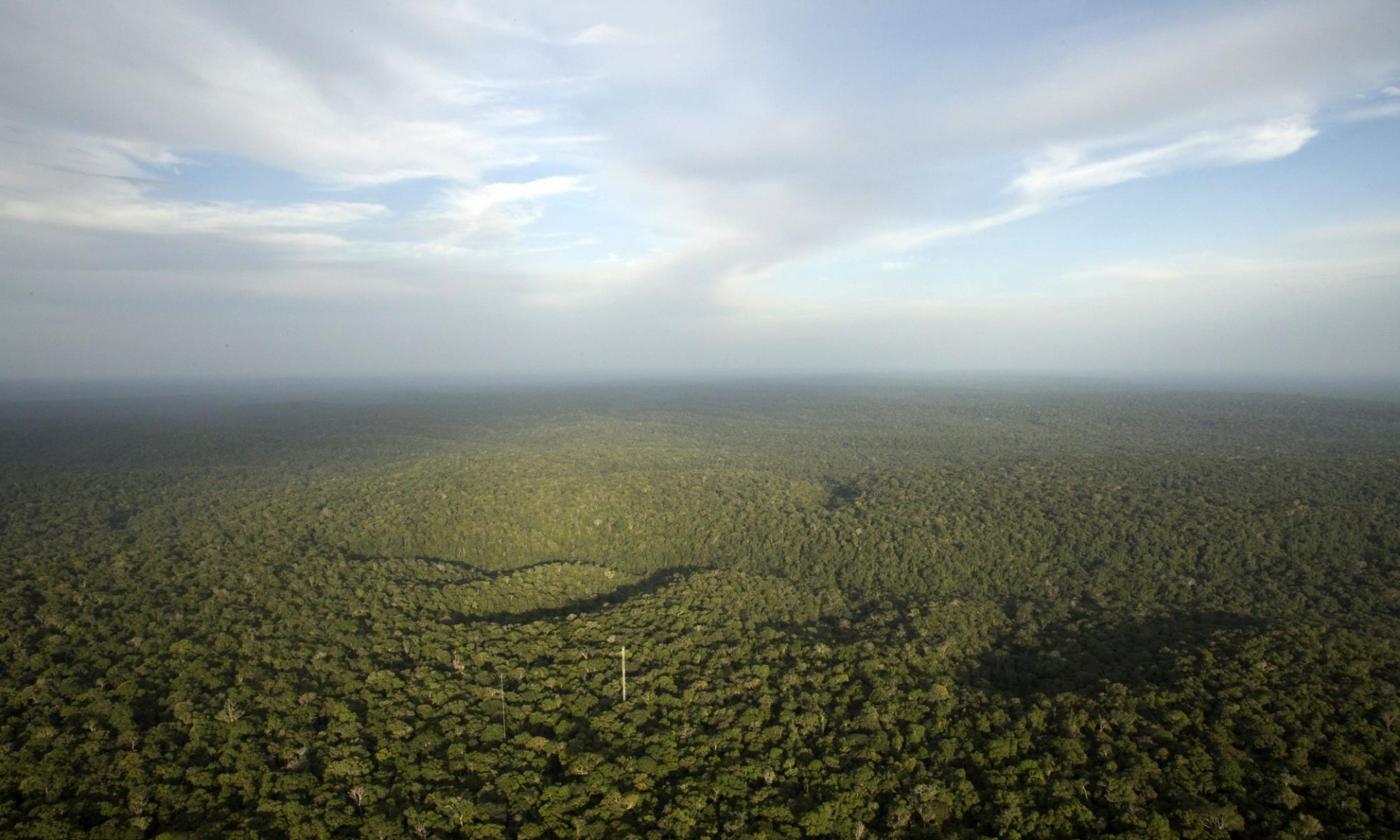
The view from the Amazon Tall Tower Observatory in the middle of the Amazon forest. Researchers say that of the nine processes needed to sustain life on Earth, four have exceeded “safe” levels. Photograph: Reuters
Humans are “eating away at our own life support systems” at a rate unseen in the past 10,000 years by degrading land and freshwater systems, emitting greenhouse gases and releasing vast amounts of agricultural chemicals into the environment, new research has found.
Two major new studies by an international team of researchers have pinpointed the key factors that ensure a livable planet for humans, with stark results.
Of nine worldwide processes that underpin life on Earth, four have exceeded “safe” levels – human-driven climate change, loss of biosphere integrity, land system change and the high level of phosphorus and nitrogen flowing into the oceans due to fertiliser use.
View of aluminium-polluted water, which flows into the Yuanjiang River, in Taoyuan county, Changde city, central China’s Hunan province, 19 November 2014. Photograph: Imaginechina/Corbis
Researchers spent five years identifying these core components of a planet suitable for human life, using the long-term average state of each measure to provide a baseline for the analysis.
They found that the changes of the last 60 years are unprecedented in the previous 10,000 years, a period in which the world has had a relatively stable climate and human civilisation has advanced significantly.
Carbon dioxide levels, at 395.5 parts per million, are at historic highs, while loss of biosphere integrity is resulting in species becoming extinct at a rate more than 100 times faster than the previous norm.
I would love to share this video from my friend L.T.Garvin’s blog. It is a short film, called Beautiful People. It is actually a feel-good commercial that lifts and fills us with endless possibilities of what we can do as humans.
I had to re-post this video link. Earlier, when I had re-blogged this story from L.T.Garvin the original link posted may have been faulty. The link did not re-direct to the video as it should have. I apologise for any convenience caused.
I have been painting “Josephine”, the woman from my head in watercolours on paper.
With several layers of pigment on heavy paper, she has taken some time to surface. In almost three weeks, and working with three other artwork at the same time, I took no notice of how she was looking. I knew “Josephine” was due to finish soon.
My sons had been away south. My younger son returned today and wanted to see what I had been up to. I showed him the gardens, told him about the chickens, the paper thief, and how my blog was going. He could see I had been painting. As usual, he went through my paintings, telling me which ones he liked. When he saw “Josephine”, he asked me if I was painting “Bubu”. Bubu is a shortened Motuan (Papua New Guinea) word for grandmother/father. Chris was referring to my mother, Freda.
I laughed. Chris was right. This woman in the painting is what my mother looked like in her younger days. Apart from her hair, most of Freda’s looks have not changed much over the years, so much so, my 16-year-old recognised her. I had not realised Josephine’s resemblance to my mother before.
How did I paint my mother without knowing? (Maybe, I miss her).
This morning, the rain stopped about 9am. I had welcomed the last two weeks of wet weather in Brisbane. My gardens have had a good drink and everything looked green with patches of bright tropical colours all around our property. I walked to one of my gardens, closer to our street and watched our chickens dirt-scratching near the roadside. They had ventured too far out and I was concerned for their safety. Besides, when the big black rooster is leading the pack of four hens, they were capable of doing anything. They could reach the public bus stop metres away and if the rooster decided to have its way, they could all catch the bus to the city. The rooster was very bossy, cocky and unruly. Apart from crowing several times continuously in a minute to annoy, it had a way of nodding its head from side to side and flapping its wings when scolded.
Today, the five were only two metres off the street, leaving their nesting place 100 metres away. The lined gum and acacia trees had shed so many leaves. Given the recent wet weather, the ground before me was covered in a thick layer of brown and black wet, slippery soil. I stayed at a dry spot, away from the road.
A small white Mitsubishi i-MiEV pulled up slowly and parked across the road from our mailbox. It was about 30 metres away from me and about ten metres from the chickens. I could see the car clearly. I was thinking it was a learner driver or a neighbour stopping to make a mobile phone call. As I watched, the car door opened and a large woman, about 150kg struggled to get out. She made it to her feet, straightened her short dark-brown hair and put on her glasses. She was dressed in a dark blue pair of denim and a lacy white blouse; two sizes too small. She wore flat slippers with no jewellery. Her tight clothing did not restrict her walk or her air of confidence. I almost thought, I had a visitor, this woman was coming up to my house.
Then, the chilling truth dawned on me. I recognised her and that car. I remembered her face. She had often sat in the car and sent a child to run across the road to take the paper. I had watched from the distance. I always wondered what they were taking, and then, our newspapers went missing. She must be the newspaper thief!
It has been almost eights months of the paper going missing and I have never been close enough to speak to her. Our gate is quite far from the house. I had suspected, the thief did their deed during my daytime work hours. The paper was gone before I got home in the evenings.
Westside News delivers the Wednesday weekly newspaper on Tuesday mornings. If I were lucky, the paper would still be there when I checked the mailbox area. Most times however, the weekly paper would be gone.
The woman looked around casually, and then crossed the road towards me, unaware I was watching her. She came up to my mailbox and with some difficulty she bent down and picked up the paper that was delivered this morning. When she got back up, her eyes caught me and she stopped, still holding the paper in her right hand. She gave me a wry smile. I stared at her. She reminded me of my black rooster with that look of arrogance and superiority. She looked hard at me, almost as if to say: “Well now that you have caught me, what are you going to do about it?”
In return, I gave her my disgust look with: “Thief, don’t ever let me catch you stealing my paper again, you have no idea what I am capable of”. She turned away. I was not surprised by her behaviour. I thought to myself, she is a pro, she is good at it, but, how many papers has she stolen each week and what did she do with them? In silence and after that ‘exchange’ between us, the woman strutted across the road and got into her little white Mitsubishi, and drove off with my paper.
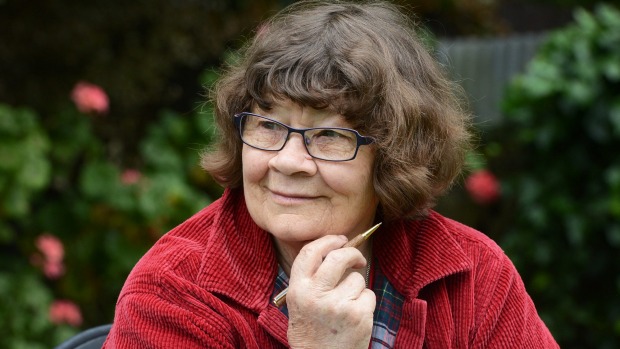
Picture by Loren Dougan/Fairfax NZ. Joy Cowley talks about the 30-day silent retreat she just completed in Wellington.
What do you do to get your creative juices flowing?
I spend time in solitude in my garden. There is something exciting about the rhythm of plants living, rooting, shedding and flowering. I also paint to get my inspiration to write. I was commenting on MilliThom’s blog today and thought, how many times have I spent trying to create stories and even artwork, when my heart was not in it. Sometimes, shutting down and walking away or diverting my mind to something else helps me come back to story-telling and the story gets even better. I have set a goal to blog each day. On top of that, I am writing my memoir and a collection of short stories. I also write magazine articles which I have not done in a while. Daily chores and the day job takes a lot of that time and numbs the brain. My mind has to travel and seek new things to write about all the time so I read too. When my brain slows down and I become forgetful, I go to the garden and start again.
There is a meditation place in Brisbane my cousin and I had once discussed going to for a week of silence and meditation. I cannot imagine how one month of silence would be like, although, I have spent a lot of days on my own when my sons have been away. I do speak with the animals so it is not complete silence. Being in complete silence for one month would be quite an achievement, especially when you are around people, eating and sitting with them and even looking at them. I think people who choose to live alone or live away from others, being in silence for a long time would seem quite normal.
Here is a story about a writer who finds her own way to “sharpen” her brain through silence in an old tradition.
When the word was silence by Nikki MacDonald
In a suburban Wellington dining room 10 people sit silently. Condiments pass across the table at the raising of an eyebrow or flick of a finger. One diner sees a neighbouring table’s empty water jug and rises quietly to fill it.
A mix of religious and non-religious, the group had never met until a month ago. Most of them had never visited this place. Now, 30 days later, they share a close connection but can scarcely remember the sound of each other’s voices.
When their voice boxes are finally awoken after a month of disuse, one man declares “silence has become my friend”. Another calls it the most radical experience of her life.
After a hugely busy year, writer Dame Joy Cowley was feeling “about as sharp as a wet cornflake”. So she switched on her email out-of-office – and disappeared for a month. But her email bounce-back message wasn’t the Rarotonga beach break brag.
“Terry and I will be on a silent retreat from Nov 2 to Dec 7. We will not have internet contact at this time. Joy,” was the message.
For a month Cowley and her husband lived at Island Bay’s Home of Compassion, which functions as an urban monastery. The mission was rest, renewal and reflection, in the oldest tradition of the Catholic Church. The twist was that it all had to be achieved in complete silence, save for a 15-minute daily chat with a spiritual director.
For Cowley, spirituality and creativity are inextricable.
“I wouldn’t know the difference between meditation and writing.”
She already wakes at 4am every day to savour half an hour of quiet before the emails begin and the phone starts ringing. But even for her, spending an entire month in silence was hard work.
“You really have to look at yourself very closely. There are always bits of ourselves that we would like to discard and you have to accept those.”
Cowley and Terry were two of a group of 10 who came from around the country to the retreat. Some were religious, others were not. They had three days of orientation to get to know each other and the home’s glorious garden setting, before stilling their vocal chords and beginning 30 days of exercises in reflection. To read more, click on the link below.




 Tribalmystic Stories