Tag Archives: Melanesian culture

How the Cassowary Became a Flightless Bird – A PNG Legend


cassowary6
Public Domain image

While described as one of the most dangerous birds in the world, cassowaries are beautiful large flightless birds. I have posted a story about threats to cassowaries in Northern Queensland due to their habitat destruction. Read Here. I had mentioned the value of cassowaries in Papua New Guinea (PNG) in that post and I wanted to show what this bird means to our  people. This legend comes from Garaina, in Morobe Province. I also come from Morobe. The legend was contributed to a national high school collection of legends told Stephen Suij.

How the Cassowary became a Flightless BirdA Legend from the Morobe Province, Papua New Guinea.

Long ago, the cassowary was a big bird with a long neck, large legs and big wings which enabled it to fly like all other birds of the forest.

At that time, the cassowary and the hornbill were best friends, and spent most of their time flying around together, feeding on the delicious fruits at the top of the trees.

They were very close friends, but as time passed, the hornbill became increasingly jealous of the cassowary, who with his long neck could stretch and reach the best of the fruit pickings. The poor hornbill had to be content with leftovers.

While the hornbill hid his jealousy, he began to plan a trick to punish the cassowary.

4581085444_98b5019d3b_b
A Hornbill Picture by Waterdragon62 – Flickr Photo-sharing

One day the hornbill broke two dried sticks off a tree branch, placed them beneath each wing, under its feathers, and then flew off meet the cassowary.

“I have an idea”, the hornbill said to the cassowary.

“After we have fed on the fruit and are fully satisfied, let us do some stylish tricks in the air to see who is more brave and skilled.”

“Sure”, the cassowary said – liking the idea.

“But”, added the hornbill, “each of us must break his wings to see how far he can fly with broken wings.”

The cassowary had no objection to this ‘idea’, so when they had eaten enough fruit, they were ready for the game. The hornbill volunteered to go first.

Pretending to break his two wings, he snapped the two dry sticks beneath his wings and then flew away. He performed some stylish tricks in the air and then flew to a nearby tree to perch. The hornbill then called the cassowary to try to outwit his tricks.

The cassowary, ignoring the pain he had to suffer, broke his wings, one by one. Then he stretched the wings to fly away but he only crashed to the ground. He could not lift his weight with broken wings.

The hornbill broke into laughter at the top of his voice he said, “you have always had the most and the best of the fruit, but now you can stay on the ground and feed on my waste while I enjoy the best of the forest.”

From that day until today, the cassowary has been a bird of the ground, with wings that could not fly.

The Cassowary – Papua New Guinea

c5280704c985694b7bfe838e4e07820f
Public Domain image

Flightless Feathered Family
The cassowaries are ratites, very large flightless birds in the genus Casuarius native to the tropical forests of Papua New Guinea, nearby islands and northeastern Australia. There are three extant species recognized today.

The most common of these, the Southern Cassowary, is the third tallest and second heaviest living bird, smaller only than the ostrich and emu.

Cassowaries (from the Malay name kesuari)[3] are part of the ratite group, which also includes the Emu, rheas, ostriches, and kiwis, and the extinct moas and elephant birds. The other two species are the Northern Cassowary, Casuarius unappendiculatus and Dwarf Cassowary, Casuarius bennetti. They are also found in Papua New Guinea.

rhoku_papua_new_guinea_brent_stirton_112782_350287
A PNG warrior wearing a cassowary feather headdress. Picture by Brent Stirton

Cassowaries are very important to the native people of New Guinea both economically and ritually. Cassowaries have been traded for pigs and even as bride price for a wife and compensation payment especially in the highlands provinces .

Some tribes hunt them for their meat which is considered a delicacy. They use the feathers to decorate headdresses, and the feather quills for earrings. The sharp claws are often placed at the tips of arrows, while the strong leg bones are used as daggers.

For many native people, cassowaries are full of legends and mystical powers. Some tribes believe that cassowaries are reincarnations of female ancestors, while others believe that the cassowary is the primal mother. These tribes do not hunt or deal in trade with cassowaries.

A HD Movie on Cassowaries narrated by David Attenborough on Natural World BBC.

Living in the Trees – The Korowai People


A life of contentment in the rainforest. The Korowai People of West Papua in Melanesia.

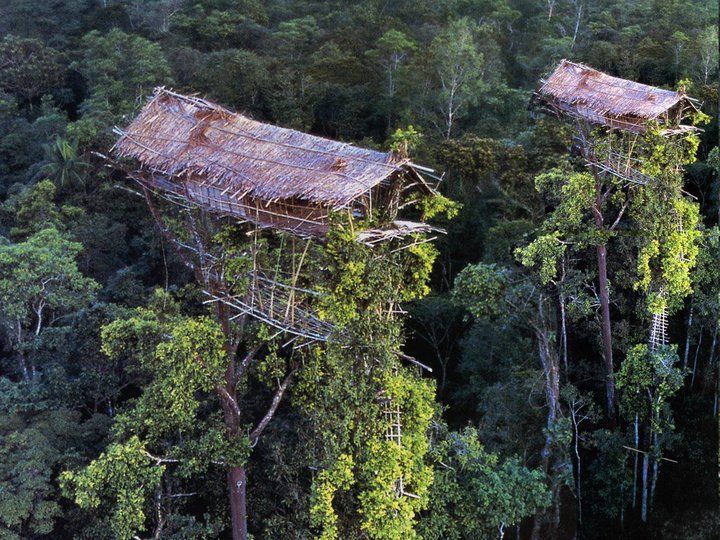
Irian Jaya's Kombai and Korowai people live in houses built in the treetops.
Irian Jaya’s Kombai and Korowai people live in houses built in the treetops.

Living in the trees is natural for the Korowai and Kombai people in  the southern eastern Papua. These tribal Melanesians are one of the last people on the planet who survive purely on their natural environment. The Korowai’s are also referred to as the Kolufo and have become known to the world through pictures and documentaries as one of the most amazing architects of tree houses.

The tree house builders survive in the basin of the Brazzan River in large areas of deep rainforest and swampy lowland. They are hunter-gatherers and horticulturists who practice shift-cultivation and have a very rich and an extraordinary oral tradition. They live together in small communities.

44f8056a45b290241653afa3fa02c1ef
Image: BBC Documentary

The higher they built a house, the more prestigious it is. The reason behind this amazing architecture which often reaches up to 100 feet or more off the ground is to avoid floods, insects and diseases. It was also a way to spot tribal enemies as the Korowai themselves had practiced cannibalism in the past.

Sowayen climbing down a “yambim” or ironwood tree after knocking loose a nest of black ants that he uses for fish bait. The Korowai are superb climbers, and get up thick trees like this by gripping vines with their hands and splayed toes. It took him about a minute to get up this tree, and it took Neeld Messler, a rope expert, over an hour to rig this tree with ropes so the photographer could climb it safely. In the lower left corner Sayah is watching. One of their fishing methods is to put a piece of an ant nest in the water and wait for the fish to come and eat the drowning ants. The fisherman hides behind foliage on the river bank, and shoots the fish with a four-pointed arrow. This picture was taken as part of an expedition for GEO Magazine and National Geographic Magazine to document the way of life of the Korowai tribe. Most of the Korowai in these photos had never had prior contact with anyone outside of their language group, and have no material goods from the outside world. They live in tree houses built above the forest floor to protect themselves from outsiders. The Korowai believe that contact with outsiders will bring an end to their culture. Cannibalism has been part of their traditional system of criminal justice to avenge the death of their clansmen, but the practice is dying out and is outlawed by the Indonesian government. The Korowai believe that most natural deaths are caused by sorcery, and must be avenged by the death (and consumption) of the person responsible.
Sowayen climbing down a “yambim” or ironwood tree after knocking loose a nest of black ants that he uses for fish bait. The Korowai are superb climbers, and get up thick trees like this by gripping vines with their hands and splayed toes. This picture was taken as part of an expedition for GEO Magazine and National Geographic Magazine to document the way of life of the Korowai tribe.

The Korowai people build their houses high above the forest floor, and deep in the swampy lowland jungles of Papua.

In the BBC documentary below, you can watch from start to finish, how a Korowai tree house is built.

The Call of Garamut


The garamut is a slit gong made out of wood. The instrument is widely used in Melanesian cultures. Garamuts are used for traditional dancing and performances. It is also used to call and gather. Communities used the garamut to call meetings, call school children to classrooms and congregations to churches.

182_0723
Picture by Pioneer Bible Translators. Calling his congregation to church; one of the most common uses of garamuts.

In Papua New Guinea the instrument, depends on its size and how shallow the slit is, gives a distinctive sound. It can also be played very rhythmically and the sounds makes you want to dance.

CUR.52.126a-c_print_front_bw
A garamut in Brooklyn Museum.

In the first video clip, I am delighted to show my own people dancing the siak, a slow motion dance in Salamaua, Morobe Province. A single and sometimes two garamuts would lead the siak accompanying kundu drums. Pay attention to the sound of the garamut – the largest wooden instrument in background.

The second video below is from Manus Province. For their performances, Manus dancing requires a collection of garamuts of various sizes and played together. The biggest drum (deepest) leads the rhythm and song.

The Spirit of Tema


h2_1979.206.1519
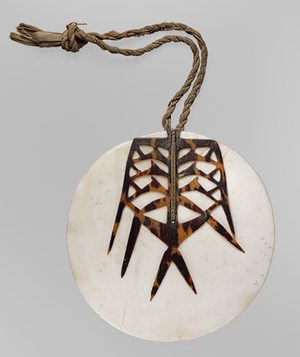
Breastplate (Tema, Tambe, or Tepatu), late 19th–early 20th century Santa Cruz Islands, Solomon Islands Tridacna shell, turtle shell, trade cloth, fiber; Diam. 7 3/8 in. (18.7 cm) The Michael C. Rockefeller Memorial Collection, Bequest of Nelson A. Rockefeller, 1979 (1979.206.1519)

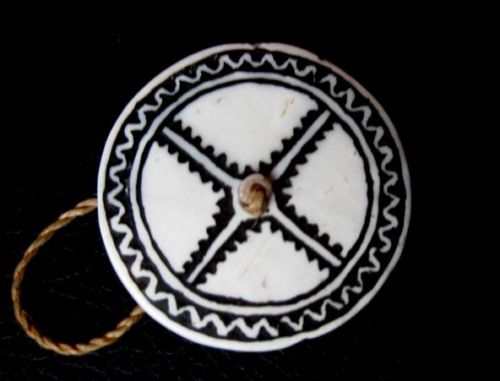
The tema or kapkap are flat, round breast plates or disks made and worn as men’s chest or forehead ornament in the Solomon Islands. Tema is one of my favourite ornaments from the Melanesian region.

Tema from Malaita
Tema from Malaita. Public domain image.

I particularly like the tema because of its spiritual meaning,  its stunning appearance and temas take a long time to make, by hand. A A tema in the Melanesian culture is regarded as a spiritual object. They are worn as a protective shield during tribal warfare and for general well-being. The white part of the tema represents the moon. It is made from the giant clam shell. In the Santa Crus Islands, the traditional symbol of the frigate bird, shark or dolphin is intricately carved out of the turtle shell and embedded or attached to the clam shell base. The brown necklace is made from bark and bush ropes.

eaeb5cceef254b0a77ee580d3069e4a1
http://www.victoriaginn.com/solomon-islands Photographer Victoria Ginn. Malaita man dressed with his tema.


The Musical Water Maidens


2013-06-05-06b_water_music_2011
Huntington Post Photo

It is not often that you find musicians using nature to aid in their musical performances. In the Melanesian culture, a rare tradition passed down from generation to generation of women still lives on.  Lakes, rivers or the sea water is used as a percussion in this tradition, to provide the music with singing. In recent years, this beautiful tradition has been shared with the world through international tours and festival performances. The performers of the Vanuatu Women’s Water Music group (two pictured) hail from the remote northern tropical islands of Vanuatu. They travel the world performing the Na Mag and Ne Lang dances as a prelude to the mystical water music, dressed in their traditional costumes of Gaua and Mere Lava made from flowers and leaves, coconuts and pandanus. Their performance is truly mesmerizing as they reimagine the old with contemporary expressions of Matto – bringing together traditional beats and rhythms with ukulele-led melodies and soaring vocal harmonies.

“And in an age when most bands are dominated by just a handful of instruments — drums, bass and guitar — I encounter a new way of making music every year at the RWMF. In 2011, women from a village in Vanuatu turned the lake of the cultural village into their instrument, cupping their hands under the water to make booming percussion sounds”, wrote Michael Switow when reviewing the women’s performance at the Rainforest World Music Festival.

To listen to one of their songs, click here

http://youtu.be/vUUVEvffzSI

Wantok Musik Foundation

Intriguing Wonders of Melanesian People


http://youtu.be/l9IG5fqGsx8

There is a term I heard when I was growing up. It was “yellow-top”. It was also called “blondie top”. I have heard people from mine and other provinces used this term in Papua New Guinea to refer to East New Britain and New Irelanders. It was not meant to be derogatory in any way; people from these places had natural blonde hair. This ‘look’ is found in many other Melanesian populations across the Pacific. I guess this blonde look on black skin has intrigued other races but to us (Melanesians), it is quite normal.

I accidentally found this video on YouTube and I wanted to share it. I found some of the narration quite amusing, especially in the pronunciation and arguments about the races/genes that could have contributed to the hair colour. The study was interesting.

………………………………………

In the next video, as it is Christmas Eve, I wanted to share some gospel music from the Melanesia. As majority of our people have followed Christianity, these songs are for worshipping. The Melanesian Choirs (Solomon Islands) sung these songs in the movie, The Thin Red Line.

This choir and the songs remind me of Christmas and my childhood memories. I miss those days when I spent Christmas with my mother, grandmother and aunts, and we would sing. It is this time that I remember all these amazing women, some gone and some afar, that love to sing their hearts out. I hope you enjoy the choir.

I wish you all a wonderful Christmas!


The Sorcerers’ Watch


The Sorcerers’ Watch

JLeahy memoir series – opening chapter/short story

We buried him this afternoon. He had died a week ago. There were a few hours left before the sorcerers would come for his remains. That’s what his father said. We needed to get to his grave before dusk and guard the grave until dawn. His father, mother and I left for Karogo’s graveyard after the last of the gathered family members left.

My aching joints gave me small comfort as I forced them to help me walk quickly up the main road, away from Saroa Village. We were near Rigo, Central Province, Papua New Guinea and in this region, witchcraft and sorcery were rife. We walked inland, headed for the small hill where Karogo and some of his deceased family members had been buried. Other villagers buried their dead in their backyard, gardens and other special places; something I was not used to. In my village, we had one cemetery for everyone.

The heavy rain and dense humidity kept the soil on the road, wet and slippery. The red clay had been washed frequently down the hills by the torrential rains leaving earthy red lines meandering through rough patches of grey and black gravel. I placed my feet carefully away from the soft red mud and in between the milky puddles. I wore thongs and these flipped a backsplash of sand and muddy water onto the dress. My clothes and looks were the last things on my mind.

For a few minutes, I stepped off the main road and I walked along the greyish clay roadside track. The muddy track was imprinted with hundreds of footprints from local traffic. I passed a few thongs left stuck in the mud and this made me want to smile. A pair of thongs was a priceless footwear. Obviously the toe parts of these pairs came apart so the thongs had been abandoned. Karogo’s father was ahead and his mother was walking behind me. I knew the couple had planned to be in this position, to protect me.

I walked as quickly as I could because it was getting dark very quickly. The moon was still rising but night creatures were already on the scene, I could hear them.

Today had flown by quickly like each day in the past week. The funeral only ‘formalized’ the death certificate. Karogo was long gone and this absence was so stark in this strange village. This place was an hour’s flight and several hours on the road, south from my home town. Apart from his immediate family, I did not know anyone. That did not bother me. I wasn’t afraid to spend the night in the graveyard. I knew I was a stranger and as his father told me, “you are a target, so you must follow everything I say”.

“Ok” I said. My own family had taught me how to handle any kind of situation with sorcery. It was always best to follow local rules as grandma would say. I had really wanted to go to the graveyard. That may have sounded crazy, as it sounded to me, but I needed to know what the sorcery-watch was about and I wanted to see Karogo again. Fear was not my issue. I could face the sorcerers or anyone from the dead.

It was not fear, as I had said, it was my anger. Karogo’s death made me very angry. This anger was so strong, that I felt cold and hardened inside. I started to feel older and stronger than my 17 years. I had insisted to his parents to take me to the grave tonight.

The torch slipped out of my tired hands and dropped into the mud almost tripping me.

“Shit!” I cursed and picked it up quickly. I quickened my pace to reach Solomon, Karogo’s father. As I caught up, my mind went back to the funeral again. My eyes salted and I wiped them quickly.

This morning about 9am, while the pastor was preaching, trying to cover his eulogy and bring closure to Karogo’s 18 years of living, I had felt every vein in my heart burst into tatters. Our past three years together were a mixture of child-play and maturing into adulthood together. Then, there were the mysteries in his life that I now could never ask anyone about, ever.  He was beautiful inside and out, but he had secrets.

In the front pew, among strangers today, I felt I had been thrown off a plane into a strange place where no one understood my language or me. People were just staring at me, even in church, while the pastor was preaching. To find comfort amongst the staring pitiful eyes, I had looked down at the bright red roses on my black polyester dress. The hem had come apart but the dress kept together. My “Gypsy dress”, Karogo had called it. We were together when I bought this Gypsy dress at the second-hand store in Lae. I was on two weeks mid-year holiday from Year 12. The dress cost me 50 cents. It was strange to feel at ease for a moment while looking at the red roses on the Gypsy dress. I wanted to see Karogo alive in my memories about the dress but only briefly I saw him before my eyes moved and focused on the coffin. The roses in the wreath on his coffin were alive. Karogo wasn’t. He laid there, just like he could have been on the day-bed at his father’s house. His eyes were shut, but he wasn’t sleeping in the opened, beautiful, rosewood coffin.

My dress was the only item that connected us briefly and at that moment in the village church. I sat amongst hundreds of strangers. Mourners, children and adults, dressed in white,  kept sneaking glances at me, probably feeling sorry for the young widowed girlfriend. I had cried inside and begged for my heart to stop right then. Yet, above the haunting Perovetta hymn at the funeral service, I could hear my heart still beating while I tried to understand why death could come to a life so young and promising.

“Joyce!’ someone had called me in the church. I remember, I did not even turn. Perhaps it was someone else with the same name. I didn’t know. I was in a daze. My thoughts were too far-gone. I had wanted to know why my chest kept moving, expanding, and contracting. I was breathing air and life, which I did not want, into me. I had wanted to stop breathing.

“Joyce!” Solomon called.

I turned my head quickly to him. I paused. He was a large, tall man with a large Afro. He combed it out neatly and sweat combined with water from his wet hair was coming down his face. He pointed a few metres ahead of me. The physical and emotional pain returned to my body once more as I stepped in the slippery, pale mud towards him.

“Come this way”, Solomon directed and I walked closer to him.

“Are you ok?” he asked, searching my face when I stopped and looked at him. We were both sweating from the walk. His wife caught up and wiped her flushed, sweaty face. She also looked at me concerned.

“Yes”, I tried to smile.

“Let’s go”, Solomon said.

We turned away from the main road and reached a small, slow flowing creek, about ankle-deep. The stones in the creek were all covered in green and black algae. We crossed the creek as the day’s shadows dissolved, forcing us to use artificial light. Solomon lit the Chinese kerosene lantern and gave me the large torch. His wife held the smaller torch. We climbed. In a few minutes, we will be at Karogo’s graveyard.

(Draft only)

Where is your grass-skirt?


8d524500ea988a90d94234c395a8ba42
A young woman in a brand new grass-skirt from the Trobriand Islands.

The story about grass-skirts

A question I’m often asked, and I know I am being teased by friends and people from other cultures is; “where is your grass-skirt?” Many people expect you to have one and wear one because you are from the islands. May be they are just joking or wishing they could see you in a grass-skirt. Who knows? The other question I often get asked is, “where are your coconut shells?” We will leave the second question for later. May be they have watched too many Tahitian dancers.

As for the grass-skirt, let me tell you, I do have one. In-fact, I have had more than one over the years. I have one grass-skirt with me here in Australia. It was not easy getting it through quarantine, but it got through. The sad part is that I have not had a chance to wear the grass-skirt in ten years. It is now too short and small for me. That says a lot doesn’t it? I need to start thinking about making a new one.

images-5
Smaller skirts for ankles.

The heritage of PNG women

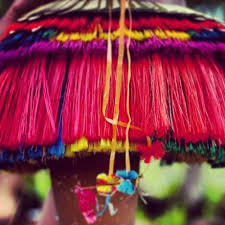
Grass-skirts are the pride of women in Papua New Guinea and other Pacific islands. In the Melanesian region, grass-skirts are made from  and dyed, with natural fibres and pigments. More women are using Chinese made dyes for the brighter colours, but often, traditional performances, songs, and dancing call only for plain grass-skirts.

$_20
Sago palm fibres on a Central Province grass-skirt waistband.

Grass-skirts are made from young fibres of sago palms, bark, sisal, pandanus, banana fibres, and many other natural fibres. The time it takes to source, collect, and prepare the raw materials; splicing, drying and dying takes a lot longer than actually making the skirt. The collection of the material process could be weeks or months and the skirt can be made in a week or less.

images-2
Using imported dyes in a Trobriand Island grass-skirt.

Using natural fibres

In my tribe, women use young palm leaves for grass-skirts. The shoot is cut early morning and boiled or spliced and dried immediately to stop iodising/browning of the cream colour. This process captures the supreme creamy white colour. If you ever see the weaving of the Micronesian women, the same kind of process is used to keep young coconut fibre almost white. A tree bark is kept under water for weeks before it becomes soft enough to pulp and split into threads for twisting. The threads would then be used to sew the palm leaves into place at the waist band. When the palm leaf is dried, we decide where the colours would be on the grass-skirt design and dye the colours. For black we use charcoal and dark grey, the fibres are buried in the water for a few weeks. Red comes from a tree seed and finally turmeric is used for yellow and orangey shades.

Rhonda prepares her grass-skirt for festival

I found this interesting film on YouTube (see link below) which gives an insight into a young woman’s preparation for the Hiri Moale Festival. Rhonda Tiana, a Motu-Koitabuan gives you an opportunity to see her prepare her grass-skirt, and use it in the Festival. This grass-skirt is from Central Province.