Unique Plant and Wildlife Loss – World-wide Concern


6-wierd-plant-data
“We have probably lost species”, Associate Professor Osia Gideon, head of the University of Papua New Guinea’s biological sciences division.

Unique plant, wildlife and forest species have been lost and more are being threatened as loggers continue to log pristine forest of Papua New Guinea. And, in a new report, scientists have found that the devastation is also affecting climate in South East Asia. The PNG forest contributes moisture into the air in this region.

Russian physicists Anasatasia Makarieva and Victor Gorshkov suggests the role of windblown moisture from PNG’s mainland forests in cooling and creating rainfall in South East Asia and beyond may have been be underestimated.

“PNG’s forests contribute to the maintenance of this current favourable climatic regime,” they said.

“Their devastation could trigger adverse changes in local, regional and possibly global climates.”

4-tree-diversity-data
By halting the allocation of Kamula Doso, PNG can save 155 million tonnes of CO2 emissions and immediately fulfil its (Paris) commitments – State of the Forests of Papua New Guinea 2014 report conclusion

ABC’s Jemima Garrett wrote an area of Papua New Guinea’s internationally significant rainforests in excess of the size of Australia’s entire Wet Tropics Heritage Area in north Queensland has been cleared or logged in the 10 years to 2014.

There is an international concern that PNG government continues to allow loggers not only to re-log in a short time, but giving the loggers to further destruct pristine remaining intact forest that is very crucial to the world eco-system, for example the Kamula Doso-Strickland region contains one of the largest remaining intact rainforest ecosystems in the world. It is an ecological wonder.

8-possum-data

The University of Papua New Guinea’s Remote Sensing Centre report shows pristine rainforest and unique species are being lost, and they are calling on PNG not to go ahead with major new logging concessions.

It took scientists two and a half years to piece together evidence from satellite images to produce their report, State of the Forests of Papua New Guinea 2014.

The report found 11,457 square kilometres of pristine forest had been cleared or logged between 2002 and 2014. Australia’s Wet Tropics Heritage Area, which stretches more than 600 kilometres from Cooktown to Townsville, is less than 9,000 square kilometres.

Jane Bryan, lead author of the latest State of the Forests of Papua New Guinea report said it is a concern that not enough time has been allowed by the government for the forest to regenerate.

“The forest needs time to regenerate and if you harvest again in too short a time period you can permanently damage the species composition and ecology of the system”, Jane Bryan.

3-silt-data

Deforestation accounted for 3,752 square kilometres of PNG’s forest loss while degradation of previously unlogged forest accounted for 7,705 square kilometres.

The island provinces of Manus, New Ireland, East and West New Britain saw the greatest proportion of change, followed by West Sepik and Gulf provinces.

“The biggest driver of that change was the expansion of industrial logging into previously unlogged areas,” said Jane Bryan, lead author of the report.

In older logging concessions repeat harvesting as soon as 15 years into the 35-year cutting moratorium is widespread, the report said.

Associate Professor Gideon says the PNG Government’s lack of action is disturbing.

“PNG is a signatory to a number of international conventions about biodiversity conservation but in terms of efforts on the ground it has been extremely disappointing,” he said.

Read more of Jemima Garett’s report here on ABC Pacific Beat.

Happy International Women’s Day


Let’s stop violence against women and girls world-wide.

Every small step counts.

DSC_0760
Watercolour on paper. JK.Leahy©

The Wild Orchid and the Tasmania Oak – A Love Story


The Wild Orchid and the Tasmania Oak – A love story

Den laevifolium 2 B
Image courtesy of the Perfume Project

JK.Leahy©

The Tasmanian Oak, is a robust, proud and resilient tree.
Years of wisdom engrained; it stood tall amongst trees of heights and sizes. Fibres of complexity, the oak tree held gave it presence.
Guarding at a gateway, the oak remained alert at all times.
When it stormed, travellers sought refuge under its wide, branched embrace where other travellers often stop. But they all braved the gateway – seeking better life. Many stories were told and left behind, under the oak.
While the tree was secretive, and always remained in silence, the Tasmanian Oak absorbed and collected these stories, one at a time for many years and became a tree of knowledge. The stories were; wisdom of great learned, adventures and lives torn, and tried and forgotten escapades. Some of these stories were of sad and glum kismet. Then one day, it stormed far away. The rains brought an unusual traveller, an exotic wild orchid. Delicate in nature, soft in physique and with light form, the orchid floated by the gateway in the rough tide. Brief glimpses and words were exchanged between the Tasmanian Oak and the orchid.
After the orchid’s journey far beyond the seas, tides changed and
once more, the gateway passage became a meeting place for the tree and the orchid. This time, the orchid floated too close and was caught by the root of the oak tree.
Days went by and the orchid clung on for safety, and unable to free itself, it grew roots. The oak remained tall, aloof and on watch and unaware of the life growing at its ‘feet’.
The orchid grew beyond the gateway canopy and above the shadows. It loved its new place and wanted to say thank you to the oak tree. Where the sun rays played and the birds greeted each other warmly the orchid grew into the Oak’s hollow. This place was warm and dry. As days turned to weeks, the orchid felt warm and safe and finally where the oak tree felt the softest, the orchid budded and flowered. In gratitude, the orchid continued to offer the the tree with its beautiful offerings of bloom, one season after another.

At first the Tasmanian Oak was intrigued and enthralled by the beauty of the orchid’s flowers. It felt proud that it could provide a safe haven for the orchid. More days slipped into weeks and months.
The Tasmanian Oak once more became fully engaged with the travellers and their stories. With all effort, the orchid rooted in the tough stringy bark and climbed higher and held on with all its might. It tried to grow new shoots after the flowering but the bark became harder to get close and grow into. The oak tree could not see the orchid anymore as its branches also grew and eventually covered the sunlight and stopped rain water from falling through.
One day, the winds blew and became very strong. It grew into a big storm. It shook both the orchid and the tree. With its delicate nature and roots not planted well enough into the Oak’s bark, it was too hard for the orchid to hang on. The orchid tried to grab onto the bark, branches and even the roots of the Oak tree, when it fell, but the winds were too strong. Once the winds ripped and threw the orchid back into the rough tides, torrents quickly tumbled and washed the orchid away from the tree.  And once more, the orchid was swept out into the open seas leaving the Tasmanian Oak, at the gateway.

Image website: the perfume project.

The Dome Camper – Photography


DSC_0924-1

I like spiders and I have posted images of Queensland’s tent spiders here before in Gangster in the Garden and Weaving Art into Web.

I know some of my readers love them too (and some of my readers don’t like spiders at all). Here is a large pregnant Dome Tent spider from my garden.

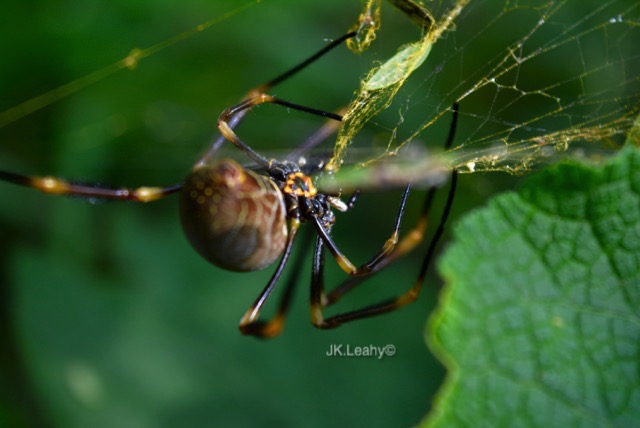
The Dome Tent spider, (Cyrtophora moluccensis) is the largest spanning the width of a man’s hand. The long body is strongly variable in colour with a broad black to rusty-red stripe for most of the back and bright yellow and white spots along the edges.

DSC_0917

DSC_0920

Tent spiders have modified the circular web into a dome, spiked tent or broad scoop.The Dome Tent spider builds a large dome-shaped web from 30-60cm across with a long tangle of web above the dome and a small tangle below. Funny enough this insect’s ‘home design’ or feature has been copied and commercialised by adventure companies. They build and sell various camping tents that are structured the way the spider builds its web.

DSC_0923

The female hunts from the top of the dome where she lays her eggs in a long bean-like and attempts to fend off the large flesh flies (Sarcophagidae) that parasitise them. From about Rockhampton northward, these spiders form massive colonies as big as houses. See more at Queensland Museum. I saw one colony yesterday where I counted seven spiders all combined their architecture to form a web structure approximately two metres wide by three meters tall. I did not have my phone nor my camera with me to capture the image, unfortunately.

DSC_0921-1

DSC_0917

Here is another kind that was weaving its ‘tent’ across my front door.

DSC_0959

Brain Pickings on Writing


mariapopova_elizabethlippman
Maria Popova. Photograph by Elizabeth Lippman for The New York Times

Writing this post about Brain Pickings gave me an opportunity to reflect on my own writing and this blog. Apart from this post, I have two more to go before I reach 500 posts on Tribalmystic blog. Over a year ago I set out to write 1000 stories. I have told close to half of that in stories and pictures. In the beginning, I questioned my own crazy motive to do such thing. It was a goal I thought was unachievable as soon as I wrote that damn post. Then, the more I wrote, I realised that I could actually reach this goal. Some of what I write is just simply information-sharing. Not too much thought has been put into those writings and I’m grateful for the sources of the information. Others, I spent a little time on it between chores, work,  family and my other interests. That is because I believe in those posts and I feel they are important in enriching my life and if they enrich others’ lives too, that’s even better. As for short stories, I enjoy it so much, it is like a game. If I had to write a fiction short story – the game is on. I guess it is a kind of icing on my cake – short, sharp and sweet in my writing world. Mondays Finish the Story by Barbara Beacham took that edge off me, but with her gone, I have to re-direct this passion into the next part of this blog.

I also enjoy visiting, reading and learning from your blogs. Learning about you, your culture, your life, pain, happiness and what we all call life experiences. Sometimes I go back through followers list to re-visit and see the transitions and transformations, just like opening a book in the library shelf and stepping into a new moment, completely leaving the present behind. Life is but a journey of transformations. I enjoy you sharing your transformations with me.

I could name many, but one of the blogs, I visit, Brain Pickings is for my pleasure of reading, my admiration for its writings and the digest’s archives are a wealth of knowledge. I started this post by trying to think of the best way to show Maria Popova’s piece on The Agony of the Artist, to Susan Sontag’s comments about writing and many more. The post went from Popova’s writings to my 500 posts …and in the end, I thought, the best way was to connect you to Brain Pickings itself other than to only discuss a few posts.

susansontag_lovewords1
Susan Sontag – From Brain Pickings

Brain Pickings is one of my favourite online digests because I keep finding things I want to read which takes me into another article and that makes me want to find out about something else again and again. It is like a travelling foodie who never stops discovering a divine dish on a foodie tour. I guess it comes down to what each of us like and this content appeals to me. Blogger and creator of Brain Pickings, Maria Popova was interviewed about how she came up with her blog and why she chooses the subjects she does. This is probably something I would like to do in the future which is to interview some of my blogger friends. It is not an original idea, but it is wonderful to find out about people you talk to and share information regularly with. And Chris the Story-Reading Ape – I owe you.

I believe the real challenge in writing is knowing your reader. But, how do we get to know the reader? That is what I hope to know one day. I think Popova has covered this – knowing what is right for her readers and maintaining that interest with her content.

There are so many articles Popova has written that I wanted to share on Tribalmystic blog several times, but you can visit and read them yourself. This is a link to what she calls, seven important lessons Popova has learnt in seven years about reading, writing and living.

Here is briefly what Popova said about her writing and her blog:

“Brain Pickings is my one-woman labor of love — a subjective lens on what matters in the world and why. Mostly, it’s a record of my own becoming as a person — intellectually, creatively, spiritually — and an inquiry into how to live and what it means to lead a good life.”

You can listen to her interview on her About Page.

Founded in 2006 as a weekly email that went out to seven friends and eventually brought online, the site was included in the Library of Congress permanent web archive in 2012.

Click here and enjoy Brain Pickings