Category Archives: short stories

Mind Games – Short Story


2015-05-04-bw-beacham

Picture by Barbara W. Beacham

 Mondays Finish the Story by Barbara W. Beacham

This is a unique flash fiction challenge where Barbara provides a new photo each week, and the first sentence of a story. The challenge is to finish the story using 100-150 words, not including the sentence provided. The challenge runs from Monday to Sunday! 

Mind Games  ©JLeahy

“After losing her head, she realised that the rest of her body was falling apart”, Joe would mimic a psychiatrist.

I sat by the window. The sun warmed my scalp and shadows danced on my hands. In hiding, I watched police take Joe away last night. He would have calmed down, but only he and I knew that; not our new neighbours.

We could have lasted in this abandoned house. If only Joe stayed quiet. My thoughts hurt my head.

“Ava! Ava! Where is your doll?”

Over the low white fence were a lilac doll pantsuit and two doll hands.

I had watched Ava at work yesterday. The toddler first ripped the doll’s head and legs, which she threw towards me. Ava caught me watching her. She laid the doll arms and pantsuit down, and dropping the body, she ran to the house. My eyes salted, thinking how scary I must have looked to her. I must leave before the Johnson Mental Health party arrives.

(150 words excluding the opening quote)

Famished Eels – A Short Story Winner by Mary Rokonadravu


In partnership with Commonwealth Writers, Granta is publishing the 2015 winning stories for Africa and the Pacific: ‘Light’ by Lesley Nneka Arimah (Nigeria) and ‘Famished Eels’ by Mary Rokonadravu (Fiji). To listen to podcasts by all the regional winners and read the regional winning stories for Asia, Canada & Europe and the Caribbean, please visit the Commonwealth Writers website.

Podcast from the story-teller

I have read and wish to share the Pacific winner’s short-story. It is one of the most beautifully told short-story I have read. I would recommend you read the whole story from the link I have provided at the end of this passage.

Famished Eels

cropped-flying-eel-long

After one hundred years, this is what I have: a daguerreotype of her in bridal finery; a few stories told and retold in plantations, kitchens, hospitals, airport lounges. Scattered recollections argued over expensive telephone conversations across centuries and continents by half-asleep men and women in pyjamas. Arguments over mango pickle recipes on email and private messages on Facebook. A copper cooking pot at the Fiji Museum. Immigration passes at the National Archives of Fiji. It is 2011.

Fiji, with Guyana, Suriname and Trinidad and Tobago, had just registered the ‘Records of the Indian Indentured Labourers’ into the UNESCO Memory of the World Register, when my father, the keeper and teller of stories, suffered a stroke. Fate rendered his tongue silent. He cannot read or write – he first set foot in a classroom at fifteen, and was told by a nun he was too old. He ignores my journalist and doctor siblings to select me, the marine biologist, to finish his task. I am off the coast of Lifou in New Caledonia counting sea urchins when the call is relayed.

He hates me for not becoming a journalist, I say to myself.

I will be on the Thursday flight, I tell my older sister.

She meets me at the airport and drives me down to Suva. It is past midnight. We pass eleven trucks overloaded with mahogany logs between Nadi and Sigatoka. A DHL courier truck. A quiet ambulance. She smokes at the wheel, flicking ash into the cold highway wind. We pass a dim lamp-lit wooden shack before Navua. Someone is frying fish. We both know it is fresh cod. We remain silent as we are flung into the kitchen of our childhood at Brown Street in Toorak. We stop to sip sweet black tea from enamel pialas in Navua.

Come on tell me, she blurts. Who you seeing now? Is it a dark-skinned Kanak? Is that what’s keeping you in Lifou? Do you speak French now?

Screw you, I say from the back seat.

He wants you to do this because you won’t lie to him, she says. The rest of us may. Just to make him happy. Just give him what he wants to hear. But you won’t. You will find out and you will tell him.

Screw you, I say again, more to myself than her.

All his life, my father has sought one thing only – to know the woman in the photograph. To know the name of her city or town in India. To know that at some juncture in history, there was a piece of earth he could call his own. All he had had was a lifetime of being told he was boci. Baku. Taga vesu. Uncircumcised.

A hundred years was not enough. Another five hundred would not be either. In a land where its first peoples arrived a couple of thousand years before the first white man, the descendants of indenture would forever remain weeds on a forsaken landscape. A blight.

He had stubbornly remained in Fiji through three military coups and one civilian takeover. Everyone had left. He remained the one who rented out flats until his brothers’ houses were sold. He supervised brush-cutting boys on hot Saturday mornings. He was the one to call the plumber to change faucets in grimy, unscrubbed shower recesses. He was the one who kept receipts for oil-based butternut paint, bolts and drill bits; photocopied them faithfully at the municipal library and mailed them to Australia, Canada or New Zealand. Each envelope had a paper-clipped note: OK. It was the only word he learned to write. I received Christmas cards from him saying the same thing: OK. The handwriting on the envelope changed depending on who the postmaster was at the time.

His younger brothers send out family newsletters on email. There is only one photograph of my father they use, a blurred profile of him holding a beer. They use the same caption – ‘Still refuses to use email.’ I wish to click Reply All and say ‘fuck you’ but there is a distant niece in Saskatchewan on the list – she writes me regularly for shark postcards and she knows the scientific names of eleven types of nudibranch. She recorded herself reciting it like bad poetry and put it on YouTube. I am the only one who knows this. She insists I use real handwriting, real stamps. She hates pancakes, frogs, flatlands. Her handwriting yearns for water. Salt water. Sea. In her milk tooth grin I see the next storyteller – the one to replace the man who has gone silent. She is ten and wants three pet octopi.

I was born to be a bridge. All I see are connections. I bridge between time, people and places. I study migratory species. Tuna fish stocks. Whales. Sea urchins in between. Cephalopods. I was nine when I picked up my first cuttlefish bones on a tidal flat in Pacific Harbour. For years I thought it was a whistle. I wrote out the names of the world’s oceans, seas, currents and fish in longhand, unaware the lead scrawlings were placing miles between my father and me. He watched me from across the kitchen table. My mother had died bringing me into the world. He washed okra with patient fingers. Boiled rice. Warned me he was going to slice red onions.

Make sure you buy land, he whispers. When you grow up, buy a small piece of land. Build a house just for you. Promise me.

Promise. But my eyes were already on the Kuroshio Current. I was already reading the voyage of Captain James Cook and the transit of the planet Venus. Hearing the howl of winds at Tierra del Fuego. No one told me that as recently as one hundred years before, ships had cut through the rough straits with people carrying the makings of my teeth in their genes. They almost never happened. Almost.

Keep writing, he says in our old kitchen. As long as someone remembers, we live.

My sister drops me off at the Colonial War Memorial Hospital.

I won’t come in now, she says. I still smell of cigarettes.

My father is asleep when I reach out to hold his hand.

Famished Eels Continues here

Feeling the Music – short story


Monday Finish the Story. Hosted by Barbara W. Beacham

2015-04-27-bw-beacham
Picture by Barbara W. Beacham

Feeling the Music © JLeahy

“Are you laughing at me?” Enoch asked me. His voice quivered and softened at the end of his question. Self pity.

“No! I love the orchids. They are beautiful.”

I looked at him, the sincerity in his large brown eyes made me want to laugh again, but I stopped myself. Without the harshness of the piercings in his nose and above his brows, and his terrible haircut, you could call him handsome.

“How did you afford this?”

“Oh, I had some money; my casual job.”

I looked at this 18-year-old boy and wondered what his parents would think, especially his mother – if she knew he was chasing his middle-aged music teacher. I held the orchids closer and observed the silky tenderness in its intricate layers of petals. I knew these flowers so well.

Each morning, I admired them as I passed the flowers at the front of the principal’s office.

(150 words)

Creative Writing – “My Last Walk”


My last post on my personal journey through domestic violence brought a lot of pain, anguish and fear. With the graphics being provided in the New York Times film by Carey Wagner, my mind took a long trip to many forgotten places where the monster lived.

I have taken some time to work through things I kept to myself for a long time but in response to the article, many kind words have been spoken by friends, family and even caring strangers both here, personal emails, phones and my Facebook Page. It is a long hard walk to the end of violence against women but we have to continue to talk about it and fight the monster.

I have two very important people in my life; my sons Nathan(18) and Chris(15). As a mother I always worry that whatever actions I take that the boys would be watching me and there would be consequences. I always worry I may hurt them emotionally. This is one of the things we need to teach our boys and young children in PNG if we are serious about starting at ground level.

For my own case, all these years, I did not speak much about my life with the monster. I felt very strongly about many things and my priority was always to protect sons. I knew they would soon learn about me and the culture they are part of. Because they were born into a combination of cultures and parents the responsibility comes back to their father and I to teach them about what is expected of them and how they should treat others.

My past did involve my sons but only just. I recall a confronting incident in 1999 that involved my children and my past. I had fled from the monster in 1988. I changed my life, settled several years later in a very happy relationship and had my sons.

Our family went to a friend’s place one day. My sons were barely 3 and six-months-old. We were invited to the friend’s place for Sunday brunch. When we arrived, the boys my partner and I, in front of my friend’s house was the man who had beat me for four years. He was invited! It was absurd. However, when you look at the big picture, which took me a long time to see was that – everything was ok. Even friends accepted that what this man did was ok.

I was shocked but having my baby (Chris) in my arms, I pretended to ignore the beast and proceeded forward. What I did not expect was he came forward, passing me, to pick up a ball my three-year-old had dropped. Stunned, I watched him hand the ball back to my son. Then the man did something that made me want to kill him. He gently touched my son’s head. I nearly fainted.

We left the party and returned home because my partner and the father of my sons could see that clearly, I became very ill. We never spoke about this incident but I knew that I could never let that person come near my children.

Like all families, life continues and we grow as people and as a family, we take on life’s challenges together. I believe as a parent, I must always do my best and show what is in my heart.  Show love. This love that I teach and show is the greatest conqueror of all hardships and it teaches my sons to love others and treat them as they would want to be treated. That was what my late grandmother, Geyam Kauc always said. I tell my sons to always treat people with love and respect. And when they are older, especially in relationships, treat women with the same love and respect and the women will appreciate and reciprocate.

Thank you to all those people that commented on the “PNG Women: When can we be safe in our own country” post and I hope that what I wrote made a small contribution to help in creating more awareness and also give hope to victims of violence.

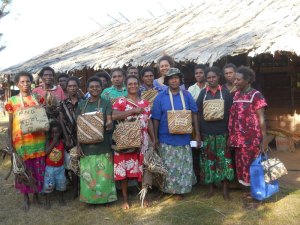
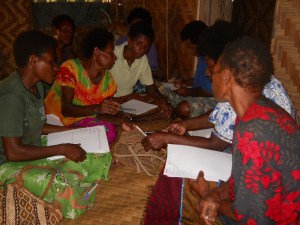
As promised, I am sharing a story I wrote based on a true story of another woman who was a victim at the hands of the monster. This story hopefully one day will be published in a book of short stories. I thank my teacher Isabel D’ Avila Winter for editing and formatting this story. If you have any comments about the story, please let me know. Pictured below is a picture of women I worked with in Eniyawa Village, Suki, PNG where I was told this story. I met several very talented women weavers, leaders and also victims of domestic violence relationships. It was in the evenings after our weaving workshop that we would sit and discuss some of our own personal triumphs and how we got away from the “the monster”.
DSCN3392DSCN3401

My Last Walk

By Joycelin Leahy

I could feel his eyes burning into my back as I struggled uphill and over the grass stubs. The air was tight around me. It is almost four in the morning and chilly.

“Walk faster!”

This time I felt Bomoga’s heavy breathing, close and menacing. I longed for the day’s first warmth, for the softness of my three-month-old baby Boni and for the giggles of his older siblings. I felt extremely fatigued and wished I could stop walking. A sudden breeze brushed over the tall grass making a shoos sound. I shivered.

This was how Bomoga and I walked to the garden, except I walked behind him with a child on my shoulder, one in the bilum on my back, whilst pulling my eldest by the hand. Their father walked proudly in front with his spear, his small bag strung across his chest. This time I was in front, wearing my favourite red meri blouse. In haste, I had worn it inside-out. It hung loosely on me.

As I reached the top of Kasu Hill, I struggled for air.

“Hurry Up!”

I could feel myself sweat vigorously as my heart pumped wildly.

Kasu was the only hill in Domogu Village in the wallaby plains of Western Province in Papua New Guinea. The rest of the area was flat grassland hunters burnt often to entrap wild game.

As commanded, I marched a further three kilometers along the ridge and then descended gradually. I stopped feeling the mud and my sore right foot. Near Kasu Hill, NGO environmentalists were studying the tailings allegedly from Ok Tedi Mining. Along the river bank, hundreds of fish and plants had died. Usually there would be people here, but it’s too early – there is no-one.

I felt my milk starting to drip down my blouse. I hadn’t worn a bra, so my breasts were full and uncomfortable. My heart beat faster as I steered my thoughts from my baby. The sun rose and faint shadows began to form while warm air caressed my face. I was sure now: we had crossed the open country and left Domogu Village. Bomoga’s ancestors, nomads like mine, had decided to settle in this land because of its fertility.

We’re up high and it is clearer. My eyes scanned over the mountains where mining giant Ok Tedi explored. To the south, there was an airstrip; Airlines PNG flew in weekly. From the top, the village looked like an exquisite jewel, a deep jade opal, festooned with glassy lakes of various sizes.

“Move!” his voice cut through the silence.

I stumbled forward.

Soon, we entered a dark forest, the only obscure part of the land. Strangely, the birds were silent. I had never been here, but I knew sorcerers came here often for bush medicine. I looked for the outside light through the tree openings. I saw only the lingering fog, separating me further from my children.

“Keep walking,” he hissed behind me.

From the moment he’d woken me this morning, I had not looked once in Bomoga’s eyes. It was still dark and I had felt his sweaty hands touch my arm. His physical stench was almost invasive. I thought he wanted sex but he shook me roughly and ordered me up and out of the house. His shadow had loomed over me as I carefully took Boni off my breast and put my meri blouse on quickly. My baby stirred and nestled into his flannelette blanket, eyes still shut. Thank God, I thought, he didn’t wake up and cry for more milk. I hung on to the last touch of his tender little fingers. Eka and Maria were asleep. I heard Bomoga pick up something and then close the door behind us. The mood between us was chilling. He was quiet and cagey, unlike his usual loud and showy ways.

If we were not having sex, which was rough and unpleasant, we had arguments which would end with a sudden punch in my eye or stomach, sometimes causing me to blackout. I knew if I answered back or cried out, the beating would be worse.

He repeatedly told me no-one would help me because I was his wife. Not even his mother, sisters, or other villagers. I always felt like his prey, moving under his watchful eyes while I went about my daily chores.

My thoughts reached out to my children, then my mother. Our years of marriage had worked this way: while Bomoga ruled, I kept my mouth shut. My bride price had been paid and when my family left after the wedding ceremony, I knew I would never see my mother again. I ran after her. We cried and hugged for a long and last time.

The sobbing began from inside now, my eyes warmed and salted with tears.

I remembered a slight improvement in Bomoga at the birth of our first son. I’d made him a proud Melanesian man by having a first male child. Eka was my child of hope. I held this hope close to my chest along with the bible. Children can change a marriage, the village pastor had said. Sadly, Bomoga’s cousin came back from the city one day with SP beer and some other alcohol. The two had many days of stories.  I saw a change aroused in Bomoga, followed by his old ways. When I had two more children and threatened that I would leave, I saw something new in his eyes. He started beating me.

Today his manners are different again. He is like a time-bomb, ready to go off at anytime. As I walked on, I remembered how no-one had seen us leave the house. Not even Tau, the old Papuan. I wish he had already opened his trade store. He was a kind man. If he or someone else saw us leave then, one day, they could tell my children. I did not leave willingly. It was not my choice to leave them behind.

As we descended through the gloomy thick undergrowth into a flatter area, I glanced across a small opening. I could finally see sunlight touching the mid canopy. It was a pretty sprinkle of luminosity touching various leaves and the moss. I caught a glimpse of a beautiful Bird Wing butterfly on a fern, just waking up. I felt a flash of hope.

We left the dense of the forest and approached a Y junction. I could hear rapids.

“Turn down towards the River,” Bomoga commanded.

I turned towards the sound of the rapids. My mind focused on the returning pain in my foot. In each step, I felt the sharpness of the rocks greeting me as I descended over each one. The rapids became louder. Before me was the belly of a fast flowing river and it was full from the rain last night. Is he going to drown me? Perhaps this was my last walk, I wondered.

I imagined villagers rushing to screaming children. My body laid there as the women rushed to the children. My laplap had been swept away and only my treasured meri blouse, still inside out, was clinging to my slim frame. I was dragged ashore with a paddle shafted under the hem of my blouse. Here, I was left on the pale silky banks of Suki River while everyone gathered to look. Then a woman ran up and started yelling and then, in a cry of recognition, she bellowed my name: “Sulita!, Sulita! It’s Suli!.” Everyone would turn and ask; “Who is Sulita?” They had not recognised me half dressed and impaled by a black palm spear. By then my corpse had been soaked pale and bloodless by the hours in the river.

“Stop!” he yelled over the rapids.

I stumbled and halted, snapping into reality.

On the river’s edge lies soft silky mud. The ground is pale and covered with smooth boulders of all kinds. In places there were no stones and the ground looked easy to dig. I kept my face down and turned away. My staggering feet were covered in mud and grass. I needed to relieve myself. Under my extreme state of duress, blood rushed to my head, causing a war of pins and needles.

“Turn around and face me. Look at me.”

Slowly, I raised my head, looking up into the point of his most prized black palm spear. In the background everything there was to see and hear faded.

Bomoga had speared the biggest pig, the fastest wallaby and driven the largest cull of deer. Many feared him because of his mastery with the weapon itself. My eyes shifted from the spear and held my husband’s eyes. Even after ten long years we stared at each other as if we were strangers. I finally felt at peace.

Bomoga’s eyes were wild, bulging and red. His nose flared and his eyebrows twitched in the anticipation of violence. He raised and pointed with the spear.

“Where would you like to be buried?” he asked.

Creative Writing


Thank you all for your comments and encouragement for my very first post yesterday. As promised here is one of my short stories. I belong to a Creative Writing workshop group at Kenmore School in the Western Suburbs of Brisbane City, QLD Australia. We meet once a week during school term to workshop our stories under the master story-teller and author Isabel D’ Avila Winter.  Here is a story I wrote under the category short-story fiction. It was based on events of a real situation but characters and scenes have been changed. I hope that it would be published later in my short story book. Please click on the highlighted link below to download or read the story.

The Price of a Small Change – JK.Leahy short story

“Any small change?”

Dit held out his right palm as he expectantly traced the bus queue at Kelvin Grove, Brisbane. It was Thursday, almost seven. For Late Night Shopping in the suburbs, not too many people were around. The wind was cold.

Visitors to the Royal Brisbane Hospital were leaving; visiting hours ended at 8pm.

“Excuse me, any small change?”, he asked the fifth person, a pale-faced peroxide blonde woman, in her fifties. Standing nearly as tall as him in a black three inch high heel and, wrapped warmly in a red coat, her heavily made-up face took a long stare at Dit’s ripped blue poly-cotton long-sleeve shirt. Clearly, Dit’s appearance did not fit. She scoffed and looked away.

Dit pressed forward without a flinch or loss of courage.

His left shirt pocket had ripped to its base and flew about like a kite in the wind. He was barefooted. His dirty blonde strands flapped in the same direction the wind took his pocket.

“Small change?” he asked the next three people. No-one gave him a thing. No-one said anything.

I could hear him coming towards my sister and I as the crust on his trouser hem swept the floor as he walked. I started to feel around for coins in my pockets, my bag and my purse, my eyes on him. Being a pensioner, I had only spent my last $20 for that week on a bus ticket and dropped the change somewhere in my bag. I had not planned for this situation. I could identify with this man’s desperation and I wanted to help.

In a few seconds, I could see his dirty brown denims sweep into view and two very dirty feet peeked at me. His toe nails, soiled, uncut and ugly. My eyes followed the awkwardly hung trouser legs up his thin frame to his face.

“Any lose coins”, he asked, standing tall and looking down at me with steel blue eyes.  Nothing could be piercing and clearer than those eyes, set in a ruffle of stringy long hair. The bus terminal overhanging casted a shadow over his face but I could see less than half a dozen teeth and a wide smile outlined by a scanty moustache.

I held up our lose change, both my sister’s and mine and he grabbed it, touching my hand. I pulled away.

“Hi, I’m Dit” he said as he pocketed our coins.

I smiled at him. He stood there, smiled back and then asked: “Don’t I know you?”

My sister stared at him, alarmed.

“No, I don’t think so”, I said.

“Oh… I KNOW YOU’, he insisted. “You helped me before”.

I was embarrassed that I could not remember. I hoped he did not think I pretended to not know him.

“Ah, maybe I did help you in the city or the Valley”, I said.

He flashed a big toothy grin and coughed. “Oh well, I better get going”.

“Alright, you take care now” I said and watched him disappear into the dimly lit street.

At that moment, Bus 333 arrived and everyone piled into it. My sister and I took the seats at the back door.  We had the view of the front but we could get off quickly to catch Bus 444 to Moggill at the city stop.

As the bus drew out,  a man in a long black coat ran and jumped on just before the bus door slammed shut. He carried something.

Stopping briefly to check the main road traffic, the driver eased Bus 333 onto the road and headed for Brisbane City.

Every passenger was sitting with their heads pointing down engrossed on their smart phones, tablets and other electronic devices. A woman in the seat near us read the paper. At the front of the bus, my eye caught that last passenger. He leaned against the metal post near the driver and there was something about his stance and his face was familiar but he was covered and his coat had a hood.

As I watched, the passenger approached the driver; we were only five minutes away from Adelaide Street Central Bus Terminal. The man leaned over and the bus driver suddenly stepped on his brakes two stops before the city and a few metres short of the next stop.

All the passengers’ eyes came up briefly and then they returned to their phones and what they were doing before. I felt something strange was about to happen.

I kept looking at the passenger. Then he stood stand up again. I saw him drop a piece of cloth revealing a gun, which he pointed at the driver. The driver slammed the brakes and everybody swayed forward and some even screamed. We had stopped in a quiet dark street.

Some passengers started crying and many tried to get up, but the stranger cocked the gun and said in a firm voice as he walked towards us: “Everyone, please stay where you are, do not move and do not try to scream, I have a loaded gun”. His voice was familiar.

The man stopped in front of my sister and me; I was shocked.

It was the same toothless smile I had only seen earlier this evening. “You two can leave”, he said, nodding his head towards the door.

Trembling and holding on to each other, we stepped down and just as we got out, he leaned over and said: “You take care now”.

The door slammed shut and Bus 333 drove away.